
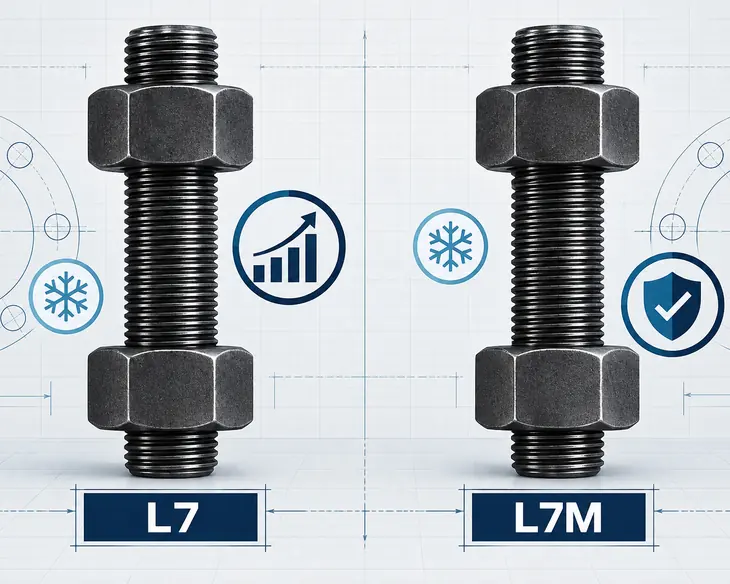
ASTM A320 L7 vs L7M Stud Bolts: What Buyers Must Check
Schnelle Antwort: ASTM A320 Grade L7 and L7M are both low-temperature alloy-steel bolting grades, aber sie sind nicht austauschbar. L7 is the higher-strength route, während L7M is a modified, lower-strength grade with tighter hardness control and grade-specific verification. Buyers must state the exact grade, adopted standard edition, stud dimensions, required impact-test temperature, mating nut grade, coating and project environmental requirements.
A purchase request that says only “A320 low-temperature bolts” leaves several acceptance points unresolved. The grade suffix changes the required property route, and the bolting assembly must be reviewed together with the flange joint, Betriebstemperatur, environmental limits and project specification.
ASTM A320 L7 vs L7M: Schneller Vergleich
| Käuferscheck | Grade L7 | Klasse L7M |
|---|---|---|
| Procurement position | Higher-strength low-temperature bolting route | Modified, lower-strength route with restricted hardness |
| Härtekontrolle | Verify the applicable grade requirements and test records | Tighter grade-specific hardness range and verification requirements |
| Schlagprüfung | Low-temperature impact requirements apply as defined by the adopted edition and order | Also a low-temperature grade, but do not assume the same test-temperature route as L7 |
| Typical marking check | Confirm permanent L7 grade marking and manufacturer identification | Confirm permanent L7M grade marking and manufacturer identification |
| Mating nuts | Specify the compatible ASTM A194 nut grade and required impact qualification | ASTM A194 Grade 7M is the common matching route when the project specifies it |
| Automatic sour-service approval? | NEIN. Grade selection alone does not establish compliance with ANSI/NACE MR0175/ISO 15156 or a project sour-service specification. | |
The purchased ASTM edition and project specification govern the actual acceptance values and test frequency. A web comparison is useful for RFQ preparation, but it cannot replace the licensed standard or the engineer’s material selection.
Was ASTM A320/A320M Abdeckungen
ASTM A320/A320M covers alloy-steel and stainless-steel bolting materials and bolting components for pressure vessels, Ventile, flanges and fittings in low-temperature service. The specification addresses chemical composition, tensile properties, Härte, impact performance and related testing. The latest public ASTM page identifies ASTM A320/A320M-26 as the active edition at the time of this article.
Do not confuse two different “M” references: the “M” in the combined designation A320/A320M identifies the SI-unit version of the standard. The “M” in Grade L7M identifies a modified material grade. Ordering “A320M L7” does not mean the same thing as ordering Grade L7M.
Why the L7M Hardness Route Matters
L7M is not simply L7 with an extra letter stamped on the end. The grade uses a different heat-treatment and mechanical-property route to keep hardness within a restricted range. This is one reason L7M is considered in projects where both low-temperature toughness and environmental-cracking controls are important.
That does not make every L7M stud suitable for every H2S-containing environment. ANSI/NACE MR0175/ISO 15156 uses environmental limits, material condition and other acceptance controls. The RFQ must state the applicable sour-service document, Ausgabe, Servicebedingungen, hardness evidence and any additional qualification or testing. A supplier should not turn the grade name into a blanket “NACE compliant” claim.
Impact-Test Temperature Is an Order Requirement
Both grades belong to a low-temperature bolting specification, but buyers should not assume that L7 and L7M have identical default impact-test conditions. Die minimale Metalltemperatur des Entwurfs, product diameter, Projektspezifikation, adopted ASTM edition and any supplementary requirements must be reviewed together.
The purchase order should state the required impact-test temperature when it is controlled by the project. The MTC should then identify the relevant test temperature and reported impact results with traceability to the supplied heat or lot. “A320” on a quotation without the grade and impact basis is not a complete low-temperature acceptance statement.
Which Nuts Go with L7 and L7M Stud Bolts?
The bolting assembly must be specified as a system. For L7, the project may call for an ASTM A194 alloy-steel nut with the required low-temperature impact qualification. For L7M, ASTM A194 Grade 7M is the common matching grade when specified. Nuss-Stil, proof-load requirements, Härte, impact qualification, thread fit and finish must follow the adopted standards and project documents.
Do not mix L7M studs with a different nut grade merely because the threads fit. The selected nut may change the hardness-control strategy and the approved assembly. The quotation should list the stud and both nuts separately so the technical comparison is visible.
What to Check on the MTC and Inspection Records
- Specification and edition: ASTM A320/A320M plus the contractually required year or revision.
- Exact grade: L7 or L7M, not only “low-temperature alloy steel.”
- Heat and lot traceability: the certificate, stud marking and packing identification must connect.
- Wärmebehandlung: verify the reported condition against the ordered grade and production route.
- Mechanische Ergebnisse: zugfest, Ertrag, elongation and hardness data as required by the governing edition.
- Härteprüfung: for L7M, confirm that the report and inspection plan address the grade-specific control rather than showing only a single representative value.
- Charpy impact results: test temperature, specimen basis, reported energy and traceability must match the order.
- Mating components: nut specification and grade, washers when required, coating and lubricant.
- Additional project controls: sour-service qualification, Inspektion durch Dritte, dimensional reports or supplementary requirements only when invoked by the order.
RFQ Checklist for L7 or L7M Stud Bolts
| RFQ-Feld | Informationen zur Angabe |
|---|---|
| Standard and grade | ASTM A320/A320M Ausgabe; Grade L7 or L7M |
| Stud dimensions | Durchmesser, thread series and class, Gesamtlänge, end details and quantity |
| Low-temperature basis | Design minimum temperature and required Charpy test temperature |
| Assembly | Mutternspezifikation, grade and style; washers if used |
| Environment | H2S/sour-service specification and operating limits when applicable |
| Beenden | Schmucklos, coated or plated condition; coating thickness, thread allowance and lubricant |
| Unterlagen | MTC-Typ, hardness and impact records, Maßprüfung, coating report and third-party witness points |
Review the product routes for ASTM A320 L7 low-temperature stud bolts Und ASTM A320 L7M low-temperature stud bolts. These pages provide RFQ starting points; Verfügbarkeit, testing and documentation remain order-specific.
Häufig gestellte Fragen
Is L7M stronger than L7?
NEIN. L7 is the higher-strength route. L7M trades some strength for a modified heat-treatment and restricted-hardness condition. Use the grade required by the approved design and material specification.
Does the M in L7M mean metric?
NEIN. The grade suffix M identifies the modified L7M grade. This is separate from the “M” in A320M, which refers to the SI-unit version of the standard.
Is every L7M stud bolt NACE compliant?
NEIN. The grade is often considered where controlled hardness is important, but compliance depends on the applicable ANSI/NACE MR0175/ISO 15156 Anforderungen, environmental limits, material condition and purchase-order controls.
Can L7M replace L7?
Nicht automatisch. The grades have different strength, hardness and test routes. A substitution requires engineering and purchasing approval, plus confirmation of the mating nuts, joint design and project documentation.
What should be marked on an A320 stud?
Verify the manufacturer identification and the permanent grade symbol, including L7 or L7M as applicable. Marking is only one check; it must trace to the MTC, heat or lot and ordered dimensions.
Request an L7 or L7M Bolting Review
Send the grade, ASTM edition, stud diameter and length, Faden, Nusssorte, Menge, minimale Auslegungstemperatur, Schlagtesttemperatur, coating and sour-service requirements. SASAFLANGE can review the item list and identify missing RFQ fields before quotation.
Primäre Referenzen
- ASTM A320/A320M-26 — official scope and active-edition page for low-temperature bolting.
- ASTM A194/A194M-26 — official scope and active-edition page for matching high-pressure/high-temperature nut grades.
- ANSI/NACE MR0175-2021/ISO 15156-2020 — official sour-environment material-selection standard page.
- Portland Bolt technical FAQ — secondary comparison cross-check; the purchased ASTM edition controls acceptance.
Verwandte Beiträge
ASTM B564 UNS N06625 Flansche: Grad 1 vs. Note 2
Erfahren Sie, wie ASTM B564 bewertet wird 1 und Note 2 anwenden…
C-2000 vs. C22-Flansche: Materialauswahl und RFQ-Prüfungen
Vergleichen Sie die Materialidentitäten der Flansche C-2000 und C22, Servicebedingungen, Schmieden…
ASTM A182 F51 vs. F60 Flansche: S31803 vs. S32205 erklärt
Vergleichen Sie die Duplexflansche ASTM A182 F51 und F60, einschließlich S31803/S32205…
UNS S32750 vs. S32760 Flansche: ASTM A182 F53 oder F55?
Vergleichen Sie die Super-Duplex-Flansche S32750 und S32760, einschließlich ASTM A182…