
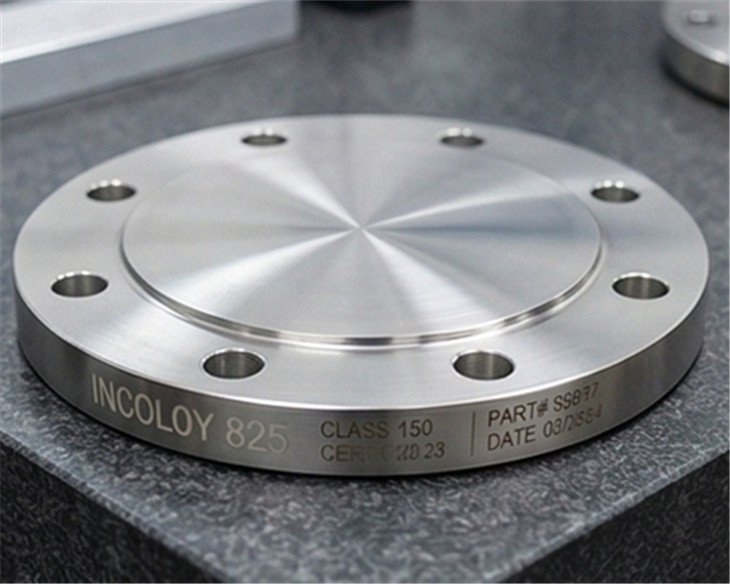
F22-Vorschweißflansche für Raffinerierohre
Direkte Antwort
ASTM A182 F22 weld neck flanges are commonly specified in 2.25Cr-1Mo refinery piping systems that require elevated-temperature strength and controlled fabrication. A reliable order must match the flange bore and weld end to the pipe, identify the ASME class and facing, and define heat treatment, welding, PWHT, Härte, PMI, NDE and certificate requirements.
Wichtige Erkenntnisse
- F22 is selected as part of a chrome-moly piping system, not as an isolated component.
- Weld neck geometry supports a full-penetration butt weld and smoother load transfer.
- Refinery service often adds controls beyond the base material specification.
Why refineries specify F22 weld neck flanges
F22 belongs to the 2.25Cr-1Mo alloy family and is widely associated with elevated-temperature process systems. Refinery material classes may use it in hydroprocessing, hot hydrocarbon, hydrogen-containing or high-temperature utility circuits after the responsible materials engineer evaluates the specific damage mechanisms.
The weld neck configuration connects through a butt-welded hub. This produces a gradual geometric transition compared with more abrupt attachment details and makes the joint suitable for radiographic or ultrasonic examination when required. It does not eliminate the need to assess external piping loads, thermal expansion and cyclic duty.
Match the flange to pipe and line class
ASTM A335 P22 pipe is commonly paired with ASTM A182 F22 components in compatible systems, but the approved line class controls. Confirm pipe outside diameter, nominal or minimum wall basis, Zeitplan, corrosion allowance and any taper required between the flange bore and pipe wall.
| Interface | What to verify | Risk if omitted |
|---|---|---|
| Pipe to flange | Bore, weld end, wall transition and WPS | Misalignment or unqualified weld geometry |
| Flange to mating flange | NPS, Klasse, gegenüber, finish and bolting | Incompatible or unreliable joint |
| Material system | F22 condition, filler metal and PWHT | Unsuitable properties or excessive hardness |
| Service requirements | Hydrogen, sour service, CUI and owner specification | Unaddressed damage mechanism |
Schweißen, PWHT and hardness controls
Preheat, interpass temperature, consumable control and PWHT must follow a qualified procedure and the governing code. The flange’s original heat treatment and the field weld thermal cycle both matter. Project hardness limits may be more restrictive than the base material specification, particularly where environmental cracking or hydrogen-related concerns exist.
Hardness readings should have defined locations, method, surface preparation and acceptance criteria. PMI confirms alloy family but cannot demonstrate correct heat treatment. When service is critical, the quality plan may combine PMI, Härte, surface NDE and volumetric examination.
Refinery buyer checklist
- ASTM A182 F22 grade, class or condition, and edition
- ASME B16.5 NPS, Klasse, weld neck type and facing
- Pipe grade, schedule and approved weld-end transition
- Design and service information required by the material requisition
- Heat-treatment records and project hardness limits
- PMI extent, MT/PT, UT/RT and acceptance criteria
- EN 10204 3.1 certificate and heat-number traceability
- Markierung, face protection and export packing
F22 improves elevated-temperature performance compared with plain carbon steel, but it is not a universal corrosion-resistant material. Process corrosion and corrosion under insulation need separate controls.
Häufig gestellte Fragen
Which pipe is commonly matched with an F22 flange?
ASTM A335 P22 pipe is commonly associated with ASTM A182 F22 components, subject to the approved project line class.
Is F22 automatically suitable for sour service?
NEIN. The environment, materieller Zustand, Härte, welding and applicable sour-service requirements must be reviewed.
Why use a weld neck flange in critical refinery piping?
Its butt-welded hub provides a gradual transition and supports inspectable full-penetration welding when the design and line class require it.
Primäre Standards, auf die verwiesen wird
- ASTM A182/A182M – Geschmiedete oder gewalzte Rohrleitungskomponenten aus Legierung und Edelstahl
- ASTM A335/A335M-26 – Seamless Ferritic Alloy-Steel Pipe for High-Temperature Service
- ASME B16.5-2025 – Rohrflansche und Flanschverbindungen, NPS 1/2 Durch NPS 24
Die Standards wurden anhand der Herausgeberseiten überprüft 3 August 2026. Kaufen und wenden Sie immer die vom Projekt angegebene Edition an.
Fordern Sie ein Angebot für einen Flansch aus legiertem Stahl an
Senden Sie die Materialqualität, Standard, NPS, Druckklasse, Flanschtyp, gegenüber, Rohrplan, Mengen- und Prüfanforderungen. Unser Team wird die technische Beschreibung vor dem Angebot prüfen.
Verwandte Beiträge
ASTM A182 F51 vs. F60 Flansche: S31803 vs. S32205 erklärt
Vergleichen Sie die Duplexflansche ASTM A182 F51 und F60, including S31803/S32205…
UNS S32750 vs. S32760 Flansche: ASTM A182 F53 oder F55?
Vergleichen Sie die Super-Duplex-Flansche S32750 und S32760, einschließlich ASTM A182…

Kann ein PN16-Flansch mit einer ASME-Klasse kombiniert werden? 150 Ventil?
Kann einen PN16-Flansch mit einer ASME-Klasse 150 verschrauben…
Kann EN 1092-1 Typ B1/B2-Verbindung mit ASME-Raised-Flanschen?
Kann EN 1092-1 Typ B1 oder B2 passen zu einem…