
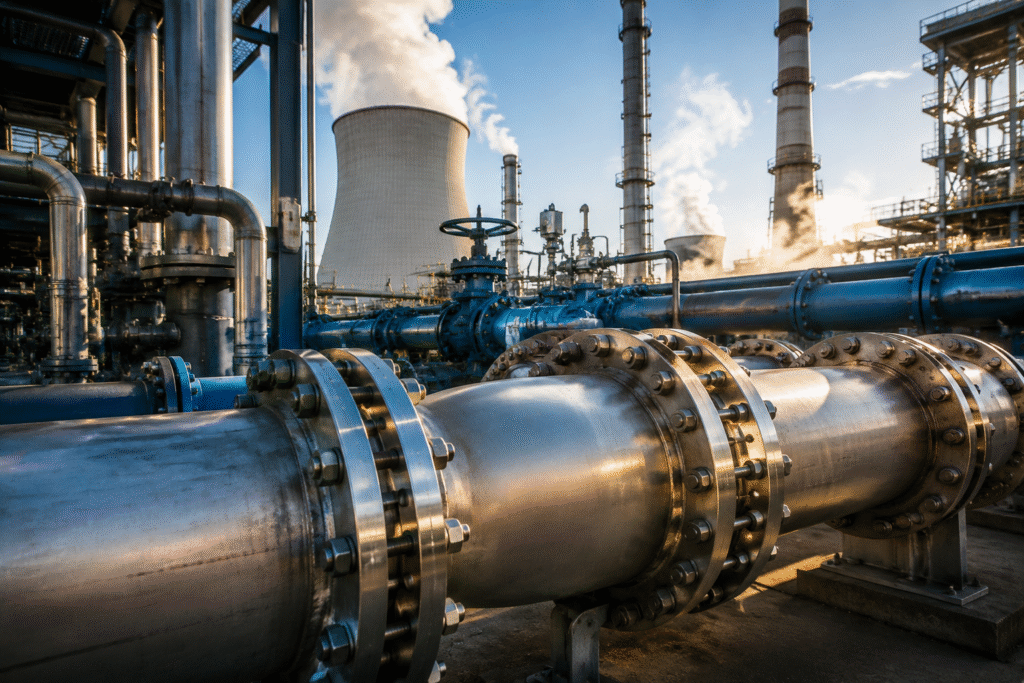
Flanschführung für Edelstahlrohre: Marktdaten, ASME B16.5/B16.47-Typen, Versteckte Vorteile und Auswahltipps
Die Nachfrage nach Edelstahlrohrflanschen steigt weiter, da Industriebetreiber eine längere Lebensdauer fordern, strengere Leckagekontrolle, und bessere Korrosionsleistung. Laut Grand View Research (2024), Der globale Markt für Industrieflansche wurde mit bewertet $5.8 Milliarden in 2023 und wird voraussichtlich erreicht werden $7.2 Milliarden von 2030, which shows why engineers increasingly focus on material grade, Standardkonformität, und Lieferantenfähigkeit.
Für Beschaffungsteams, the real challenge is not simply how to buy a flange. It is how to choose the right stainless steel pipe flange for pressure class, Medienchemie, Temperaturbereich, and code compliance without increasing total installed cost.
Industrial demand for stainless steel pipe flange products is accelerating
Industrial flanges remain a foundational component in piping systems for oil and gas, Petrochemie, Stromerzeugung, Marine, and water treatment plants. Laut Statista (2024), auf die Öl- und Gasindustrie entfallen ca 35% des weltweiten Flanschverbrauchs, which confirms how critical flange reliability is in high-consequence service.
Regional manufacturing trends also matter for sourcing strategy. Laut IBISWorld (2024), Der asiatisch-pazifische Raum macht mehr als aus 45% der weltweiten Flanschproduktion, wobei China der größte Hersteller ist, therefore global buyers increasingly evaluate Chinese producers on certification, Rückverfolgbarkeit, and machining precision.
That shift has created stronger competition among manufacturers, but it has also raised the bar for quality. Buyers now expect heat traceability, PMI-Unterstützung, EN 10204 3.1 Zertifizierung, and dimensional verification against ASME B16.5, ASME B16.47, DIN, JIS, GOST, und EN 1092 Anforderungen.
Infolge, stainless steel pipe flange procurement has become more technical and more strategic. Material choice affects not only corrosion resistance but also welding behavior, galling tendency, chloride performance, and lifecycle maintenance cost.
In vielen Projekten, stainless steel flanges replace carbon steel because unplanned shutdowns cost far more than the initial price difference. Laut Market Research Future (2024), corrosion-related asset damage still accounts for billions of dollars in industrial maintenance spending annually across global process industries.
That is why grades such as 304, 316, 316L, 904L, 2205, Und 2507 continue to gain attention in severe service. Darüber hinaus, duplex and super duplex grades often offer a useful balance of strength and pitting resistance in offshore, Entsalzung, und chloridreiche Systeme.
Für Käufer, die Lieferanten vergleichen, manufacturing depth is a major differentiator. SASA FLANGE serves global industrial customers with stainless steel flanges, Flansche aus Legierung, Flansche aus Kohlenstoffstahl, und Rohrverbindungsstücke, unterstützt von ISO 9001:2015 und PED 2014/68/EU-Zertifizierungen.
With capabilities covering materials such as 304, 316, 316L, 904L, 2205, 2507, A105, A182, Inconel, Monel, Hastelloy, und Titan, SASA FLANGE supports both commodity demand and engineered projects. Zusätzlich, Sondergrößen von 1/2 Zoll zu 60 inch help buyers consolidate sourcing across multiple line classes.
Aus kommerzieller Sicht, the hidden advantages of a reliable flange partner are consistency, Dokumentation, and on-time delivery. Those factors reduce inspection delays, Überarbeitung der Website, and mismatch risk between pipe, Beschläge, Dichtungen, and bolting.
Laut Mordor-Geheimdienst (2024), infrastructure investment and energy transition projects are increasing demand for high-integrity piping components in LNG, hydrogen-ready systems, and advanced water treatment. daher, stainless steel pipe flange selection is now tied directly to long-term plant reliability and project execution speed.
Arten von Rohrflanschen aus Edelstahl, Materialien, and hidden advantages in technical service
Ein Edelstahlrohrflansch ist keine einzelne Produktkategorie. Es umfasst Schweißhals, reinschlüpfen, blind, Muffenschweißen, mit Gewinde, Überlappungsgelenk, und lange Schweißhalsausführungen, each intended for a different combination of pressure, fatigue load, Installationsmethode, und Inspektionszugang.
Entsprechend ASME B16.5, Abmessungen, Bohren, Druck-Temperatur-Werte, gegenüber, and tolerances must align with the applicable class and material group. Für größere Durchmesser, ASME B16.47 governs many NPS 26 durch NPS 60 Flanschabmessungen, which is essential for large-bore transmission and process systems (ASME, 2023).
Als John Reynolds, corrosion and materials engineering specialist, Staaten: “The cheapest flange is rarely the lowest-cost flange over the life of a plant. Correct alloy selection and proper standard compliance prevent leakage, corrosion under insulation, and repeated shutdowns.”
That statement explains why engineers compare more than price. They also evaluate corrosion allowance, Schweißbarkeit, toughness at service temperature, Chloridexposition, sulfur content, and compatibility with mating components.
Among all stainless grades, 304 Und 316 remain the most widely specified. Jedoch, 316 and 316L generally outperform 304 in chloride-bearing media because molybdenum improves pitting and crevice corrosion resistance, especially in coastal and chemical environments.
For severe media, 904L, 2205, Und 2507 offer stronger resistance profiles. Duplex grades also provide higher strength, which can support wall thickness optimization in some engineered systems when design code permits.
Als Dr. Anita Rao, materials scientist in process metallurgy, Staaten: “When chloride concentration, Temperatur, and crevice geometry interact, flange failures accelerate quickly. Material selection must consider the whole system, not the flange in isolation.”
In der Praxis, buyers should compare stainless steel pipe flange options by service condition rather than by alloy popularity alone. The following material overview is a useful starting point.
- 304 / 304L: Gute allgemeine Korrosionsbeständigkeit, strong availability, and cost-effective for water, Essen, und milder chemischer Service.
- 316 / 316L: Better chloride resistance than 304, daher häufig im Meer, Petrochemie, and chemical process lines.
- 904L: Strong resistance in aggressive acids and high-corrosion service, although cost is higher.
- 2205 Duplex: Higher strength and good chloride resistance for offshore, Entsalzung, and process service.
- 2507 Super-Duplex: Enhanced pitting resistance and high strength for demanding seawater and chemical systems.
- Inconel, Monel, Hastelloy, Titan: Used where stainless grades cannot provide adequate corrosion or temperature performance.
Flange type selection is equally important because geometry affects stress distribution and leak resistance. Zum Beispiel, weld neck flanges perform well in cyclic service because the tapered hub reduces stress concentration at the weld transition.
Aufsteckflansche, im Gegensatz dazu, often simplify alignment and fabrication cost in low to moderate pressure applications. Blind flanges isolate future tie-ins and maintenance points, while threaded flanges support installations where hot work is restricted.
- Vorschweißflansch: Bevorzugt für hohen Druck, Temperaturwechsel, und kritischer Service.
- Aufsteckflansch: Practical for easier fabrication and lower-pressure utility systems.
- Blindflansch: Wird zum Beenden verwendet, isolieren, or future-proof piping runs.
- Muffenschweißflansch: Geeignet für kleinere Bohrungen, Hochdruckleitungen.
- Gewindeflansch: Used where welding should be minimized.
- Überlappungsflansch: Useful for systems requiring frequent dismantling and alignment flexibility.
Entsprechend ASTM A182, forged or rolled alloy and stainless steel flanges must meet defined chemical and mechanical requirements for piping components in pressure systems (ASTM, 2023). Zusätzlich, ASTM material compliance must align with end-use code expectations and purchaser specifications.
Surface finish and facing also affect sealing reliability. Erhöhtes Gesicht, flaches Gesicht, and ring type joint designs must match gasket type, Schraubenlast, and flange class, otherwise leakage risk rises despite correct nominal size.
Entsprechend NACE MR0175 / ISO 15156, sulfide stress cracking resistance becomes critical in sour service, especially where hardness limits and metallurgical control are mandatory (NACE, 2023). daher, not every stainless steel pipe flange is suitable for H2S-containing systems without specific review.
Buyers also need manufacturing confidence. SASA FLANGE supports forged and machined flange production with advanced CNC machining, Inspektionskontrolle, and broad material coverage for oil and gas, Petrochemie, Leistung, Marine, und Wasseraufbereitungsprojekte.
Offering elbows, T-Shirts, Reduzierstücke, and caps alongside flanges creates another hidden advantage. It allows procurement teams to standardize material documents, reduce vendor count, and simplify project coordination.
Gemäß ISO-Qualitätsmanagementprinzipien, supplier consistency directly influences defect prevention, Rückverfolgbarkeit, and corrective action control (ISO, 2015). That is one reason experienced buyers prioritize certified process discipline over low headline pricing.
ASME, ASTM, DIN, EN and PED compliance for stainless steel pipe flange sourcing
Code compliance is where many sourcing decisions succeed or fail. Ein Edelstahlrohrflansch muss den Maßen genügen, pressure-temperature, Material, and documentation requirements simultaneously, not as separate checklist items.
ASME B16.5 covers pipe flanges and flanged fittings for NPS 1/2 durch NPS 24 in most common pressure classes. ASME B16.47 applies to many large diameter flanges, which makes it essential for transmission, Terminal, and large process line applications.
ASTM standards define the material basis behind the product. For forged stainless steel flanges, ASTM A182 is frequently specified, while associated plate and piping materials may fall under different ASTM product standards depending on system design.
Europäische Projekte erfordern oft EN 1092 dimensional compatibility and PED 2014/68/EU conformity. daher, exporters serving EU projects must manage both manufacturing control and technical documentation with discipline.
The comparison below helps engineers and buyers align standards quickly.
- ASME B16.5: Abmessungen, Bohren, facings, Klassen, and tolerances for common flange sizes.
- ASME B16.47: Large diameter flange dimensions and drilling patterns.
- ASME B16.9: Butt weld fittings such as elbows, T-Shirts, Reduzierstücke, und Mützen.
- ASTM A182: Geschmiedete oder gewalzte Rohrflansche aus Legierung und Edelstahl sowie geschmiedete Fittings.
- EN 1092: European flange dimensions and pressure designation requirements.
- PED 2014/68/EU: Regulierungsrahmen für Druckgeräte, die auf dem EU-Markt in Verkehr gebracht werden.
- NACE MR0175 / ISO 15156: Material requirements for sour oil and gas service.
Dimensionally compliant flanges still require proper inspection. Manufacturers should verify OD, AUSWEIS, Dicke, Nabenabmessungen, Lochkreis, Bohren, Verkleidungsende, Markierung, Hitzezahl, and pressure class before release.
Documentation is equally critical in international projects. Procurement packages often request MTC to EN 10204 3.1, PMI-Ergebnisse, hydro or pneumatic test records where applicable, dimensionale Berichte, and visual inspection reports.
Gemäß DNV-Richtlinien für Offshore-Komponenten, traceability and material verification are central to reducing integrity risk in critical systems (DNV, 2023). In offshore and subsea-adjacent supply chains, that requirement is often stricter than the minimum commercial expectation.
Manufacturers with quality system discipline create measurable value here. Mit ISO 9001:2015, PED 2014/68/EU, und AD 2000 Anmeldeinformationen, SASA FLANGE aligns its production and inspection workflow with the documentation needs of international EPCs, Hersteller, und Endverbraucher.
Zusätzlich, certification should not be treated as a brochure item. It should connect directly to heat traceability, revision control, Inspektionshaltepunkte, and test record retention.
Gemäß dem PED-Rahmen der Europäischen Kommission, pressure equipment conformity requires controlled design, Herstellung, and assessment routes appropriate to product category and risk profile (PED, 2014). daher, buyers should confirm documentation requirements early, especially for CE-related deliveries.
Another common compliance issue is standard mixing. Zum Beispiel, combining ASME B16.5 mating parts with EN 1092 flanges without full dimensional review can create bolt-hole misalignment or sealing incompatibility.
That is why experienced suppliers ask for full project data. Zumindest, buyers should specify size, Bewertung, gegenüber, Material, Standard, Menge, Testanforderungen, and certificate type in every inquiry.
So wählen Sie Edelstahlrohrflanschtypen für Öl aus, Gas, chemisch, power and marine uses
The best way to choose a stainless steel pipe flange is to start with service conditions, keine Katalogfreundlichkeit. Medium, Chloridgehalt, Druckklasse, Betriebstemperatur, zyklische Belastung, and inspection access all shape the correct selection.
Für Öl- und Gassysteme, flange leakage can lead to safety, Umwelt, and production losses. daher, Halsflansche einschweißen ASTM A182 F316L, Duplex 2205, or other approved alloys are common in critical lines, especially where vibration and thermal cycling are present.
Im petrochemischen Bereich, corrosion behavior often drives alloy choice more than pressure class does. 316L may suit moderate chloride exposure, während 904L, Duplex, or nickel alloys may be necessary for stronger acids, mixed chemistries, or elevated temperature process units.
Power generation projects frequently prioritize pressure-temperature performance and dimensional consistency. In diesen Systemen, buyers often coordinate flanges with butt weld fittings manufactured to ASME B16.9 and piping materials aligned to the project line class.
Marine and shipbuilding applications require close attention to salt exposure and crevice conditions. Folglich, 316L, 2205, Und 2507 are widely reviewed for seawater, Ballast, and deck piping depending on exact chloride concentration and maintenance strategy.
Water treatment and desalination systems add another layer of selection complexity. Laut Mordor-Geheimdienst (2024), water infrastructure investment continues to expand globally, which supports stronger demand for duplex and corrosion-resistant stainless flanges in high-chloride process lines.
Buyers can simplify evaluation by using a structured checklist.
- Bestätigen Sie die Nennrohrgröße, Zeitplan, und Flanschstandard.
- Match pressure class to design pressure and temperature.
- Select facing type based on gasket and mating flange design.
- Review media chemistry, Chloridgehalt, and sour service risk.
- Check welding method, fabrication sequence, and NDE needs.
- Define certificate requirements such as EN 10204 3.1 und PMI.
- Ask for lead time, machining tolerance control, and export packing method.
Zum Beispiel, A 4 inch stainless steel pipe flange in a general water line may use a slip on or weld neck design in 304L. Jedoch, the same 4 inch line in offshore chloride service could require 316L, 2205, oder 2507 abhängig von der Temperatur, crevice risk, and owner specification.
Als Michael Trent, leitender Rohrleitungsingenieur, Staaten: “Most flange problems begin at the specification stage. When buyers define media, Temperatur, Code, and test requirements clearly, suppliers can deliver the right component the first time.”
That is especially relevant for custom orders. SASA FLANGE supports custom manufacturing across stainless steel flanges, Flansche aus Kohlenstoffstahl, Flansche aus Legierung, und Rohrverbindungsstücke, therefore project teams can source non-standard dimensions, spezielle Materialien, and mixed product packages from one supplier.
Serving customers in more than 50 Länder in den Bereichen Öl und Gas, Petrochemie, Leistung, und Meeressektoren, SASA FLANGE integrates material options such as 304, 316, 904L, 2205, 2507, Inconel, Monel, Hastelloy, and Titanium with factory-direct supply. That breadth is useful when projects involve multiple corrosion zones and mixed line classes.
Zusätzlich, commercial buyers should evaluate total procurement value. A slightly higher unit price may still reduce overall cost if it improves delivery reliability, lowers NCR risk, and shortens vendor coordination cycles.
Zukunftsaussichten für die Beschaffung von Edelstahlrohrflanschen und strategische Kaufempfehlungen
The industrial flange market is expected to remain on a growth path through the decade. Laut Grand View Research (2024), the market is projected to rise from $5.8 Milliarden in 2023 Zu $7.2 Milliarden von 2030, supported by infrastructure, Modernisierungen in der Prozessindustrie, und Energieinvestitionen.
Demand growth will not be uniform across all grades. Rostfrei, Duplex, and higher-alloy flange categories are likely to benefit from stricter corrosion control, longer asset life expectations, and tougher reliability standards in chemical, Marine, and water applications.
Digital procurement will also influence supplier selection. Buyers increasingly expect rapid drawing review, MTC turnaround, Materialrückverfolgbarkeit, and responsive technical support before issuing purchase orders.
Gleichzeitig, compliance pressure will increase. Global EPCs and end users are asking for more documented evidence on source material, Testen, und Zertifizierung, particularly for regulated or export-driven projects.
daher, strategic recommendations for buyers are straightforward but important.
- Standardize your inquiry format to include size, Klasse, gegenüber, Material, und Dokumentationsbedarf.
- Qualify suppliers on certification, Bearbeitungsfähigkeit, und Inspektionsdisziplin, nicht nur der Stückpreis.
- Use 316L, Duplex, or higher alloys where lifecycle corrosion cost justifies the upgrade.
- Überprüfen ASME B16.5, ASME B16.47, ASTM A182, EN 1092, and PED alignment before order release.
- Bundle flanges and fittings where possible to simplify traceability and logistics.
Letztlich, the hidden advantages of the right stainless steel pipe flange strategy are lower downtime, fewer field mismatches, and stronger project predictability. For buyers who need technical support on standard or custom flanges, discussing specifications early with an experienced manufacturer such as SASA FLANGE can shorten procurement cycles and improve final fit-for-service outcomes.
Häufig gestellte Fragen
Welche verschiedenen Arten von Edelstahlflanschen gibt es??
●Zu den Haupttypen von Edelstahlflanschen gehören Vorschweißflansche, reinschlüpfen, blind, Muffenschweißen, mit Gewinde, Überlappungsgelenk, und lange Schweißhalsausführungen, mit ASME B16.5 covering many common dimensional requirements.
●Laut Statista (2024), Öl und Gas machen etwa aus 35% des weltweiten Flanschverbrauchs, so weld neck and blind flanges are especially common in critical piping where sealing integrity matters.
●Vorschweißflansche werden für Hochdruck- und zyklischen Betrieb bevorzugt, while slip on flanges are often chosen for easier fabrication in utility lines and moderate-duty systems.
●Blindflansche isolieren Leitungsenden, threaded flanges help where welding is restricted, and lap joint flanges support systems that need easier dismantling and alignment.
●For projects requiring material options from 304 and 316L to 2205 Und 2507, Zusammenarbeit mit etablierten Herstellern wie SASA FLANGE trägt zur Sicherstellung der Maßhaltigkeit bei, Rückverfolgbarkeit, und Standardkonformität.
Was ist besser? 304 oder 420 Edelstahl?
●Für die meisten Anwendungen mit Edelstahlrohrflanschen, 304 is generally more suitable than 420 because it offers better corrosion resistance and broader acceptance in industrial piping systems.
●ASTM and ASME-based piping applications usually favor austenitic grades such as 304 Und 316 rather than martensitic 420, which is harder but less corrosion resistant in many wet and chemical environments.
●Grad 420 can provide higher hardness and wear resistance, but it is not the standard first choice for process flanges exposed to corrosive media, Chloride, or welded fabrication demands.
●Laut Grand View Research (2024), the industrial flange market is expected to grow to $7.2 Milliarden von 2030, therefore buyers should prioritize lifecycle suitability over initial alloy confusion.
●When service involves water, Chemikalien, or general plant piping, 304 or 316L is usually the safer recommendation, und Lieferanten mögen SASA FLANGE can help confirm the best grade for your exact medium and temperature.
Welche drei Arten von Flanschen gibt es??
●Die drei am häufigsten genannten Flanschtypen sind Vorschweißflansche, reinschlüpfen, and blind flanges because they cover a large share of industrial piping connection needs.
●Weld neck flanges handle higher stress and thermal cycling well, slip on flanges offer easier fabrication for less severe service, and blind flanges close off pipe ends for isolation or future expansion.
●Entsprechend ASME B16.5 (2023), each type must conform to dimensional, gegenüber, and drilling requirements that support correct assembly and sealing performance.
●These three types appear frequently in oil and gas, Wasseraufbereitung, Leistung, und petrochemische Anlagen, although socket weld, mit Gewinde, and lap joint flanges are also important in specific applications.
●If your project needs help choosing among pressure class, gegenüber, and material grade combinations, Hersteller wie z.B SASA FLANGE can review the technical details before ordering.
Was ist der ASME-Code für Edelstahlflansche??
●Die wichtigsten ASME-Standards für Edelstahlflansche sind ASME B16.5 for common sizes and ASME B16.47 for many large diameter flanges, während ASTM A182 often defines the forged stainless material specification.
●ASME B16.5 deckt typischerweise den NPS ab 1/2 durch NPS 24 and includes dimensions, Druck-Temperatur-Werte, facings, Toleranzen, und Kennzeichnungsanforderungen für Flansche und Flanschverbindungen.
●ASME B16.47 applies to many larger sizes from NPS 26 zum NPS 60, which is important for terminals, transmission systems, and large process piping projects.
●Laut IBISWorld (2024), Der asiatisch-pazifische Raum produziert über 45% der Flansche der Welt, so verifying ASME conformity and test documentation from suppliers is essential in global sourcing.
●Buyers should also check whether EN 1092, PED 2014/68/EU, oder NACE MR0175 requirements apply, and experienced suppliers like SASA FLANGE can help align those code requirements with the order.
Was beeinflusst den Preis für Edelstahlrohrflansche??
●Der Preis für Edelstahlrohrflansche hängt hauptsächlich von der Materialqualität ab, Flanschtyp, Größe, Druckklasse, Bearbeitungskomplexität, Testumfang, und Zertifizierungsanforderungen wie z EN 10204 3.1.
●Zum Beispiel, a 316L weld neck flange generally costs more than a 304 Aufsteckflansch, während duplex 2205, 2507, or nickel alloy options can increase pricing further because of raw material and machining demands.
●Laut Grand View Research (2024), the global industrial flange market was worth $5.8 Milliarden in 2023, which reflects continued demand pressure on specialty alloys and certified supply chains.
●Additional costs can come from PMI, Inspektion durch Dritte, special packing, PED-Dokumentation, or urgent lead times, so quotations should always be compared on a like-for-like technical basis.
●The best recommendation is to send complete specifications including standard, Größe, Klasse, gegenüber, Material, und Menge, and then request a detailed quote from a qualified supplier such as SASA FLANGE.
Wie wähle ich einen Aufsteckflansch aus Edelstahl oder einen Rohrgewindeflansch aus??
●You should choose a stainless steel slip on flange when fabrication simplicity and moderate service conditions are priorities, while a threaded pipe flange is more suitable when welding should be minimized.
●Slip on flanges are commonly used in utility, Wasser, and lower-pressure systems because they are easier to align and weld, but weld neck flanges usually outperform them in severe cyclic service.
●Threaded flanges work best in smaller bore systems and maintenance-sensitive locations, although thread compatibility, Druckstufe, and leak path considerations must be reviewed carefully.
●Entsprechend ASME B16.5 (2023), both flange types must meet dimensional and rating requirements, and proper facing selection remains essential for gasket sealing performance.
●For projects involving stainless steel flanges and fittings across multiple service conditions, Beratung eines Herstellers wie SASA FLANGE helps confirm whether slip on, mit Gewinde, or another flange design is the better engineering choice.
Verwandte Beiträge
Flanschoberflächenfinish: Konzentrische vs. spiralförmige Verzahnungen erklärt
Konzentrische und spiralförmige Verzahnungen sind beide bearbeitete Flanschflächenoberflächen…
Duplex 2205 vs. 316L-Flansche: Welches Material sollten Sie wählen??
Schnelle Antwort: Duplex 2205 Flansche sind normalerweise der stärkere Kandidat…

Definition des Öffnungsflansches, Details und Übersicht über ASME B16.36-Flansche: Marktdaten, Auswahlhilfe und Compliance-Einblicke
Der globale Markt für Industrieflansche wurde mit bewertet $5.8 Milliarde…

Marktführer für schwarze Entsorgungsflansche: Materialien, 3.5″ Kompatibilität, und B2B-Beschaffungsdaten für Küchenspülenflansche
Die Nachfrage nach schwarzen Entsorgungsflanschen steigt bei Käufern von Küchenarmaturen…