
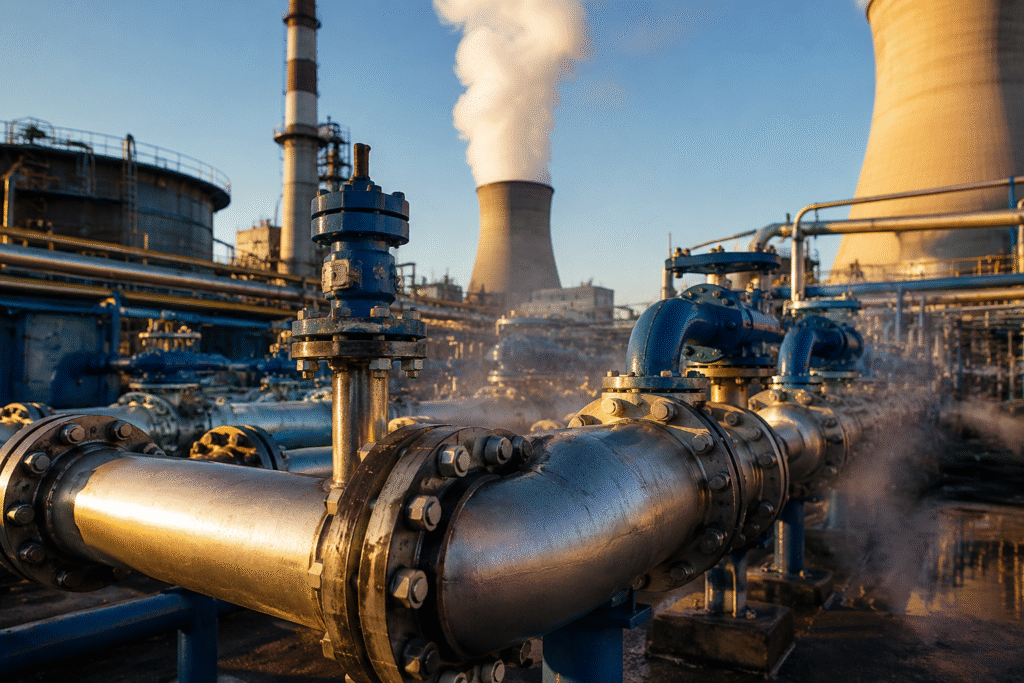
Marktführer für Edelstahlrohrflansche: ASME B16.5, B16.47 Typen, Verwendungsmöglichkeiten, und wie man Flansche in einer 5,8-Milliarden-Dollar-Branche auswählt
Die Nachfrage nach Edelstahlrohrflanschen steigt weiter, da industrielle Rohrleitungssysteme immer korrosionsanfälliger werden, sicherheitsorientiert, und Compliance-orientiert. Laut Grand View Research (2024), Der globale Markt für Industrieflansche wurde mit bewertet $5.8 Milliarden in 2023 und wird voraussichtlich erreicht werden $7.2 Milliarden von 2030, which makes stainless steel pipe flange selection a strategic procurement decision rather than a routine purchase.
Für EPC-Auftragnehmer, Anlagenbauer, und industrielle Einkäufer, the challenge is not only finding a Flange supplier. It is knowing which Stainless Steel grades, Druckklassen, Verkleidungstypen, and ASME dimensions best fit each application.
Global Demand for Stainless Steel Pipe Flange in Industrial Projects
Industrial flanges remain essential across oil and gas, Petrochemie, Stromerzeugung, Wasseraufbereitung, und Meeressysteme. Laut Statista (2024), auf die Öl- und Gasindustrie entfallen ca 35% des weltweiten Flanschverbrauchs, which confirms how critical reliable sealing and pressure integrity remain in upstream and downstream assets.
Regional manufacturing concentration also shapes sourcing decisions. Laut IBISWorld (2024), Der asiatisch-pazifische Raum macht mehr als aus 45% der weltweiten Flanschproduktion, wobei China der größte Hersteller ist, giving buyers broader access to competitive lead times and custom machining capacity.
These numbers matter because flange procurement affects installation efficiency, Wartungsintervalle, und Gesamtlebenszykluskosten. A low-cost component that fails under chloride exposure or thermal cycling can multiply outage and replacement costs.
Infolge, engineers increasingly specify stainless steel pipe flange products for corrosion control, Schweißbarkeit, und Dimensionskonsistenz. This is especially true in systems carrying seawater, Chemikalien, Dampf, or aggressive process media.
Laut Mordor-Geheimdienst (2024), industrial process infrastructure investment continues to expand in Asia and the Middle East, especially for refining, Entsalzung, und Energieprojekte. daher, the market increasingly favors manufacturers that can provide both standard ASME dimensions and project-specific machining.
In praktischer Hinsicht, buyers now compare more than unit price. They also review EN 10204 3.1 Dokumentation, PMI-Unterstützung, Rückverfolgbarkeit der Wärme, und Einhaltung von ASME, ASTM, DIN, JIS, und EN-Normen.
Hier wird die Leistungsfähigkeit der Lieferanten wirtschaftlich relevant. Mit ISO 9001:2015 und PED 2014/68/EU-Zertifizierungen, SASA FLANGE supports international industrial projects that require controlled manufacturing, dokumentierte Qualitätssysteme, and export-ready inspection packages.
Herstellung von Flanschen in 304, 316, 316L, 904L, 2205, 2507, A105, A182, Inconel, Monel, Hastelloy, und Titan, SASA FLANGE aligns with the material diversity modern process plants demand. Darüber hinaus, das Unternehmen bedient 50+ Länder in ganz Öl & Gas, Petrochemie, Leistung, Schiffbau, and Water Treatment industries.
Laut Market Research Future (2024), demand for corrosion-resistant alloy piping components is growing faster than general carbon steel components in chemically aggressive processing environments. Folglich, stainless and duplex flange procurement has shifted from a niche requirement to a mainstream engineering decision.
Auch so, not every Stainless grade fits every service. Buyers must match alloy chemistry, Flanschtyp, Druckklasse, and operating conditions to the design code and the actual process risk.
Flanschtypen für Edelstahlrohre, Materialien, und Einblicke in die Expertenauswahl
The first step in choosing stainless steel pipe flange products is understanding the main Flanges? categories used in industrial piping. Although many buyers ask for a generic stainless steel Flange, engineers usually specify by connection design, gegenüber, Bewertung, und Metallurgie.
Common ASME flange Types include weld neck, reinschlüpfen, blind, Muffenschweißen, mit Gewinde, und Überlappungsgelenk. Each design solves a different piping problem related to pressure, Ermüdungsbelastung, Wartungszugang, or installation speed.
Als David Reynolds, Leitender Rohrleitungsingenieur, Staaten: “The best flange choice is rarely the cheapest forging on paper. It is the one that preserves gasket stress, matches the piping code, and survives the real operating environment.”
Weld neck flanges remain the preferred option for severe service because they provide smoother stress transition from flange hub to Pipe. Im Gegensatz, slip on flanges can reduce fabrication cost in moderate service where alignment convenience matters more than high cyclic resistance.
- Vorschweißflansch: Am besten für hohen Druck geeignet, Temperaturwechsel, Vibration, und kritische Prozesslinien.
- Aufsteckflansch: Common for low to moderate pressure systems and easier field fit-up.
- Blindflansch: Wird zum Schließen von Zeilenenden verwendet, Geräte isolieren, oder zukünftige Erweiterungen zulassen.
- Gewindeflansch: Suitable for small-bore systems where welding is restricted.
- Muffenschweißflansch: Often selected for high-pressure small-diameter piping.
- Überlappungsflansch: Useful where frequent dismantling and stub-end rotation are needed.
Ebenso wichtig ist die Materialauswahl. ASTM A182 F304 and F304L work well in general industrial service, while F316 and F316L improve pitting resistance due to molybdenum content.
For chloride-rich, sauer, oder Offshore-Bedingungen, Duplex-Sorten wie z 2205 Und 2507 often provide superior strength and corrosion resistance. NACE guidance also influences these selections in sulfide-bearing systems (NACE, 2023).
According to ASM International corrosion data and common industry practice, 316/316L generally outperforms 304/304L in marine and chemical exposure because of improved resistance to localized attack. daher, many EPC specifications default to 316L for seawater-adjacent and washdown-intensive plants.
High-temperature service requires another layer of evaluation. Noten wie 321, 347, 310S, and stabilized high-carbon variants are often chosen for elevated temperature oxidation resistance or improved resistance to sensitization.
Als Dr. Meera Khanna, Materialwissenschaftler, Staaten: “Engineers should separate corrosion problems from temperature problems. A grade that performs well at ambient chloride exposure may not be the best solution at sustained high temperature.”
Dimensional standards also drive selection. ASME B16.5 umfasst Rohrflansche und Flanschverbindungen aus NPS 1/2 durch 24, während ASME B16.47 deckt Stahlflansche mit großem Durchmesser aus NPS ab 26 durch 60 (ASME, 2023).
That distinction matters during project estimation because a 4 inch stainless steel pipe flange belongs to a very different supply profile than a 36 Zoll ASME B16.47 Series A flange. Vorlaufzeit, Schmiederoute, Bearbeitungskomplexität, and freight planning all change with size.
According to industry procurement benchmarks compiled by IBISWorld (2024), large-diameter custom flanges can carry lead times 30% Zu 60% longer than commodity sizes. daher, early technical alignment between engineering and purchasing reduces schedule risk.
Buyers should also compare facing types because sealing performance depends on gasket compatibility and bolting control. Erhöhtes Gesicht, flaches Gesicht, Ringverbindung, and tongue-and-groove designs each serve specific pressure and service conditions.
- Erhöhtes Gesicht: Most common for ASME process piping with spiral wound or soft gaskets.
- Flaches Gesicht: Often selected for cast iron equipment or low-compression requirements.
- RTJ: Preferred for high pressure and high temperature service in oil and gas systems.
- Nut und Feder: Provides enhanced alignment and controlled gasket seating.
Unterstützt durch fortschrittliche CNC-Bearbeitung und umfassende Qualitätsprüfungen, SASA FLANGE bietet maßgeschneiderte Größen von an 1/2 Zoll zu 60 inch in multiple facing configurations. Zusätzlich, Das Unternehmen unterstützt Ellenbogen, T-Shirts, Reduzierstücke, und Kappen für die Beschaffung kompletter Rohrleitungspakete.
According to ISO-aligned quality practice across leading manufacturers, documentation quality often influences final award as much as price. daher, Mühlenprüfzertifikate, Maßkontrollberichte, PMI-Aufzeichnungen, and hydro or NDE support can improve supplier qualification outcomes.
For buyers comparing flange manufacturers or a flange vendor for global projects, the winning supplier usually combines metallurgical depth, Standardkonformität, and stable export execution. That combination is far more valuable than short-term savings on a single order line.
ASME B16.5, B16.47, ASTM, DIN, und EN-Konformität für Edelstahlflansche
Industrial buyers often ask whether a stainless steel pipe flange is “standard.” In reality, compliance depends on several layers, inklusive Abmessungen, Materialspezifikation, Druck-Temperatur-Werte, Inspektionsunterlagen, and end-use regulation.
ASME B16.5 is the most referenced standard for forged flanges from NPS 1/2 Zu 24. ASME B16.47 regelt Stahlflansche mit großem Durchmesser, and it is divided into Series A and Series B with different bolt circle and flange mass characteristics (ASME, 2023).
Material compliance usually points to ASTM specifications. For forged stainless steel flanges, ASTM A182 remains the primary reference, while associated plate or sheet material may refer to ASTM A240 depending on the component design and fabrication route (ASTM, 2023).
European projects frequently require EN 1092-1 Maßhaltigkeit, PED conformity, and traceable inspection records. Infolge, exporters serving multinational EPCs must handle both ASME and EN-based documentation pathways.
- ASME B16.5: Rohrflansche und Flanschverbindungen, NPS 1/2 Zu 24.
- ASME B16.47: Stahlflansche mit großem Durchmesser, NPS 26 Zu 60.
- ASME B16.9: Werkseitig hergestellte, geschmiedete Stumpfschweißbeschläge.
- ASTM A182: Geschmiedete oder gewalzte Rohrflansche aus Legierung und Edelstahl sowie geschmiedete Fittings.
- EN 1092-1: European flanges standard for PN-rated systems.
- DIN und JIS: Common regional dimensional standards for industrial installations.
Pressure class selection must also align with operating temperature. ASME pressure-temperature ratings change with material group, which means Class 150, 300, 600, oder 900 selection cannot be separated from alloy grade and service temperature.
According to ASME design methodology, allowable pressure decreases as metal temperature rises, especially in sustained elevated-temperature service. daher, engineers must verify the exact rating table before finalizing any Flange schedule.
Im sauren Dienst, chloride-rich systems, or offshore environments, NACE and owner specifications often add another compliance layer. This becomes especially important for duplex, Super-Duplex, and nickel alloy flange packages.
According to DNV and NORSOK project practice, Materialrückverfolgbarkeit, Korrosionsprüfung, and documentation discipline are critical for offshore procurement. Folglich, approved vendor status often depends on quality assurance maturity as much as machining capability.
SASA FLANGE supports this requirement profile with ISO 9001:2015, PED 2014/68/EU, and AD 2000-aligned manufacturing controls. Darüber hinaus, buyers can review company capabilities through sein Herstellungshintergrund before RFQ release.
For stainless steel flanges and fittings supplied into regulated projects, EN 10204 3.1 certificates are no longer optional in many tenders. They are part of the commercial and technical acceptance package.
As Michael Tan, Berater für Beschaffungsqualität, Staaten: “A compliant flange is more than a machined ring. It is a documented pressure-retaining component with traceability from heat number to final inspection.”
The practical takeaway is simple. Engineers should specify the exact standard set, while procurement teams should confirm that the supplier can manufacture, überprüfen, dokumentieren, and export to those requirements without deviation.
So wählen Sie Flansche für Öl aus, Gas, Chemisch, Leistung, and Marine Applications
When engineers ask how to Choose the right flange, the answer starts with service conditions rather than product availability. Medienchemie, Druckklasse, Temperatur, Liniengröße, Korrosionsmechanismus, and maintenance strategy should all drive the decision.
In Öl- und Gassystemen, weld neck and RTJ flange configurations often dominate because they handle pressure cycling and critical sealing duties well. Laut Statista (2024), this sector accounts for about 35% des weltweiten Flanschverbrauchs, so its specification habits heavily influence the broader market.
Für petrochemische und chemische Anlagen, corrosion resistance usually outweighs initial purchase cost. daher, 316L, 904L, Duplex 2205, or nickel alloys may become the best value once lifecycle risk is considered.
Power generation projects often combine steam service, erhöhte Temperaturen, and long design life requirements. In diesen Systemen, material stability, Flanschbewertung, and strict dimensional accuracy become decisive.
Marine and shipbuilding applications present a different challenge because chloride exposure can accelerate pitting and crevice corrosion. Folglich, 316L, Duplex, and super duplex grades gain importance for seawater lines and deck equipment systems.
- Für Öl und Gas: Prioritize weld neck, RTJ, ASTM A182 Noten, NACE-Überprüfung, and ASME pressure class verification.
- Für den Chemieservice: Review media concentration, Chloridgehalt, Temperatur, and cleaning chemistry before choosing 316L, 904L, or higher alloys.
- Für Kraftwerke: Check sustained temperature, Bolzenbelastung, and pressure-temperature ratings in ASME tables.
- For marine use: Focus on pitting resistance, PREN-driven alloy choices, and long-term chloride exposure.
- Zur Wasseraufbereitung: Balance corrosion performance, sanitation requirements, and budget across 304L, 316L, und Duplex-Optionen.
Selection also depends on project execution needs. Some buyers need standard stock for shutdown maintenance, while others require project lots with custom drilling, gegenüber, Markierung, und Fremdprüfung.
Wir bieten maßgeschneiderte Größen von an 1/2 Zoll zu 60 Zoll mit wettbewerbsfähigen Direktpreisen ab Werk, SASA FLANGE supports both routine replenishment and engineered project supply. The company also manufactures elbows, T-Shirts, Reduzierstücke, and caps to simplify multi-item sourcing.
Buyers should request the following before award:
- Material grade and ASTM specification confirmation.
- ASME B16.5 oder ASME B16.47 dimensional confirmation.
- Druckklasse, Verblendungstyp, und langweilige Details.
- Heat number traceability and EN 10204 3.1 Zertifizierung.
- PMI, Härte, Ferrit, or corrosion-related test requirements.
- Verpackung, Markierung, and export documentation requirements.
According to procurement analysts at Mordor Intelligence (2024), buyers that consolidate specification review early can reduce sourcing delays by double-digit percentages on engineered piping packages. Infolge, better RFQ discipline often produces both lower cost and faster delivery.
Im Gegensatz, vague RFQs create expensive revision cycles. A request that simply says “Edelstahlflansch” leaves too many variables undefined for a serious technical quotation.
The best industrial purchasing teams avoid this problem by sending a complete flange data sheet with standard, Grad, Größe, Klasse, gegenüber, Menge, and inspection needs. That approach produces cleaner bids and faster technical approval.
Future Outlook for Stainless Steel Pipe Flange Procurement and Strategic Sourcing
The market outlook remains favorable for high-quality flange suppliers with strong technical and export capabilities. Laut Grand View Research (2024), Es wird erwartet, dass der Markt für Industrieflansche weiter wachsen wird $5.8 Milliarden in 2023 Zu $7.2 Milliarden von 2030, driven by infrastructure upgrades, energy investment, and process industry expansion.
Gleichzeitig, buyer expectations are becoming stricter. They now expect digital documentation, kürzere Vorlaufzeiten, Flexibilität der Legierung, and verifiable compliance with ASME, ASTM, PED, and customer-specific standards.
Laut IBISWorld (2024), China remains the largest manufacturing base in a region that produces more than 45% von globalen Flanschen. daher, strategic sourcing increasingly depends on selecting manufacturers that can combine cost efficiency with quality assurance and international communication discipline.
Drei strategische Empfehlungen stechen für B2B-Käufer hervor. Erste, standardize your approved flange specifications by service category rather than by project team preference.
Zweite, qualify suppliers on documentation capability, not only machining output. Dritte, align engineering and procurement before RFQ release so that material and standard mismatches do not delay award.
For companies buying stainless steel pipe flange products across multiple plants or international projects, supplier partnerships create measurable value. They improve consistency, reduce rework, and support long-term maintenance planning.
That is why many industrial buyers prefer manufacturers that can supply stainless, Kohlenstoffstahl, Legierung, and special material flanges under one quality system. Mit breiter Materialabdeckung, CNC-Bearbeitung, und international anerkannte Zertifizierungen, SASA FLANGE remains a practical sourcing option for projects that demand both technical precision and dependable execution.
Häufig gestellte Fragen
Was sind die Flanschgrößen von Edelstahlrohren??
●Stainless steel pipe flange sizes typically follow ASME B16.5 von NPS 1/2 durch 24 Und ASME B16.47 von NPS 26 durch 60.
●Laut ASME (2023), dimensional control includes outside diameter, Lochkreis, Flanschdicke, and bore size, so buyers should match each flange to the exact pipe schedule and pressure class.
●In der praktischen Beschaffung, A 2 Zoll-Klasse 150 slip on flange and a 2 Zoll-Klasse 600 weld neck flange differ significantly in dimensions, Gewicht, and gasket seating profile even though the nominal pipe size is the same.
●Stainless steel pipe flange sizes also vary by standard family, because EN 1092-1, DIN, and JIS dimensions do not directly interchange with ASME bolt patterns in many cases.
●Laut IBISWorld (2024), Der asiatisch-pazifische Raum produziert über 45% der Flansche der Welt, which gives buyers broad access to both standard and custom size production but also increases the need for strict drawing review.
●Engineers should verify not only NPS and class, but also raised face height, Verkleidungsende, and schedule bore compatibility before purchase.
●For project packages requiring mixed ASME and EN dimensional systems, Zusammenarbeit mit etablierten Herstellern wie SASA FLANGE helps reduce mismatch risk through controlled machining and documented inspection.
What is the typical 4 inch stainless steel pipe flange specification?
●A 4 inch stainless steel pipe flange is most commonly specified under ASME B16.5, with material grades such as ASTM A182 F304, F304L, F316, or F316L depending on service conditions.
●Typical purchase details include flange type, Druckklasse, gegenüber, and pipe schedule bore, weil a 4 inch weld neck Class 300 flange is not interchangeable with a 4 inch slip on Class 150 Flansch.
●Gemäß ASTM (2023), forged stainless flanges should meet chemical and mechanical requirements appropriate to the designated grade, which is especially important for corrosion-critical or regulated systems.
●In chemical plants and marine applications, buyers often upgrade from 304L to 316L because the added molybdenum improves resistance to pitting and crevice corrosion.
●Laut Statista (2024), oil and gas consumes about 35% von globalen Flanschen, Also 4 inch sizes are especially common in process lines, Kufen, Mannigfaltigkeiten, and utility systems across that sector.
●Procurement teams should also confirm gasket compatibility, Schraubenmaterial, and inspection requirements before finalizing the order.
●For critical installations, Anfrage EN 10204 3.1 certification and dimensional reports from a qualified supplier such as SASA FLANGE.
Was beeinflusst den Preis für Edelstahlrohrflansche??
●Der Preis für Edelstahlrohrflansche hängt hauptsächlich von der Materialqualität ab, Größe, Druckklasse, Flanschtyp, Bearbeitungskomplexität, und Dokumentationspflichten.
●Higher alloy grades such as 904L, 2205, 2507, Inconel, or Hastelloy cost more than 304L or 316L because raw material prices, Schmiedeschwierigkeit, and inspection demands are substantially higher.
●Laut Grand View Research (2024), der Markt für Industrieflansche erreicht $5.8 Milliarden in 2023, and pricing pressure has increased as buyers seek corrosion-resistant materials for longer service life.
●Large diameter ASME B16.47 flanges also cost more than standard ASME B16.5 sizes because they require more material, schwerere Bearbeitung, and often longer production lead times.
●Inspektion durch Dritte, PMI, NTE, PED-Konformität, and export packing can further increase total delivered cost even when the unit flange price appears competitive.
●Buyers should compare total project value rather than only unit price, because a cheaper flange with poor traceability or incorrect dimensions can create expensive site delays and rework.
●Für eine genaue Budgetierung, send a full RFQ with standard, Grad, Größe, Klasse, gegenüber, Menge, and certification needs to a manufacturer like SASA FLANGE.
Was sind die wichtigsten Flanschtypen aus Edelstahl??
●Die wichtigsten Edelstahlflanschtypen sind Vorschweißflansche, reinschlüpfen, blind, Muffenschweißen, mit Gewinde, und Überlappungsgelenk, and each design suits a different piping duty.
●Weld neck flanges are generally preferred for high pressure, Temperaturwechsel, and severe service because the tapered hub reduces stress concentration at the pipe connection.
●Slip on flanges simplify alignment and fabrication in moderate service, while blind flanges close line ends or isolate equipment for testing and maintenance.
●Entsprechend ASME B16.5 (2023), dimensional control and rating classification are essential because flange type alone does not determine pressure capability.
●Threaded flanges can help where welding is restricted, and socket weld flanges are often chosen for smaller high-pressure lines where bore integrity is important.
●As many engineers note, selecting flange type should reflect piping code requirements, Ermüdungsbelastung, future maintenance access, and actual operating risk rather than installer preference.
●For mixed projects that include stainless steel flanges and fittings, buyers benefit from working with experienced suppliers that can quote complete packages with coordinated standards and inspection records.
How do stainless steel flanges and fittings work together in a piping package?
●Stainless steel flanges and fittings work together by connecting, umleiten, reduzierend, or terminating flow paths while maintaining pressure integrity across the piping system.
●Flanges provide the detachable bolted connection points, while fittings such as elbows, T-Shirts, Reduzierstücke, and caps shape the route and function of the line.
●Entsprechend ASME B16.9 (2023), wrought buttwelding fittings must meet dimensional requirements that align with the piping design, which is why package consistency matters during fabrication and installation.
●Using mismatched grades or standards can create galvanic issues, fit-up problems, or documentation gaps that delay project approval and commissioning.
●Laut Market Research Future (2024), demand for corrosion-resistant alloy piping components is rising across water treatment, chemische Verarbeitung, und Meeressektoren, increasing the value of integrated sourcing.
●Procurement teams often reduce complexity by buying flanges and fittings from one qualified manufacturer so that heat traceability, Materialzertifikate, and inspection formats remain consistent across the package.
●For projects requiring complete stainless steel flanges and fittings supply, coordinated sourcing through companies like SASA FLANGE can improve quality control and reduce commercial fragmentation.
Wann sollte ich einen Edelstahl-Rohrflansch mit Gewinde verwenden??
●A stainless steel threaded pipe flange is typically used in small-bore piping where welding is impractical, eingeschränkt, oder aus Wartungs- oder Sicherheitsgründen unerwünscht.
●These flanges are common in utility service, Anwendungen mit niedrigem bis mittlerem Druck, and systems where field assembly speed matters more than high-cycle fatigue resistance.
●Threaded flanges must still comply with the applicable dimensional and pressure class standard, and buyers should verify thread form, pipe schedule compatibility, and service limitations before purchase.
●According to ASME guidance and common industry practice, threaded flanges are not usually the first choice for severe vibration, very high temperature, or repeated thermal cycling service because threaded joints can loosen or concentrate stress.
●Material grade remains important, so 304L may suit general clean service while 316L is often preferred for marine, Abwaschen, or mildly aggressive chemical exposure.
●Laut Grand View Research (2024), Der Markt für Industrieflansche wird voraussichtlich an Bedeutung gewinnen $7.2 Milliarden von 2030, reflecting ongoing demand for specialized flange solutions across maintenance and new-build projects.
●For threaded flange applications requiring precise machining and traceable materials, buyers should consult experienced manufacturers that understand both the dimensional standard and the actual service duty.
Verwandte Beiträge
Flanschoberflächenfinish: Konzentrische vs. spiralförmige Verzahnungen erklärt
Konzentrische und spiralförmige Verzahnungen sind beide bearbeitete Flanschflächenoberflächen…
Duplex 2205 vs. 316L-Flansche: Welches Material sollten Sie wählen??
Schnelle Antwort: Duplex 2205 Flansche sind normalerweise der stärkere Kandidat…

Definition des Öffnungsflansches, Details und Übersicht über ASME B16.36-Flansche: Marktdaten, Auswahlhilfe und Compliance-Einblicke
Der globale Markt für Industrieflansche wurde mit bewertet $5.8 Milliarde…

Marktführer für schwarze Entsorgungsflansche: Materialien, 3.5″ Kompatibilität, und B2B-Beschaffungsdaten für Küchenspülenflansche
Die Nachfrage nach schwarzen Entsorgungsflanschen steigt bei Käufern von Küchenarmaturen…