
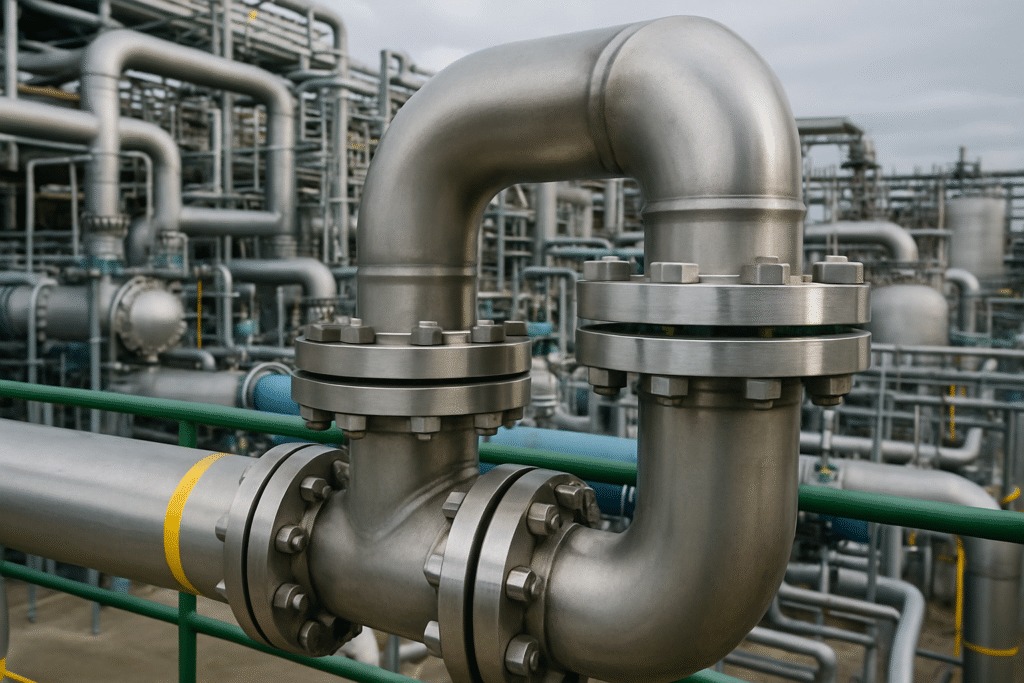
Everything You Need to Know About Inconel Alloy 625 Flanges
According to Grand View Research (2024), the global industrial flange market was valued at $5.8 billion in 2023. It’s projected to reach $7.2 billion by 2030. In this booming market, Inconel Alloy 625 flanges stand out due to their exceptional properties.
The Growing Demand for Inconel Alloy 625 Flanges
Inconel Alloy 625 flanges are renowned for their superior oxidation and corrosion resistance. These characteristics make them ideal for high-temperature applications. The oil and gas industry, which accounts for approximately 35% of global flange consumption (Statista, 2024), heavily relies on these flanges.
Asia-Pacific leads the global flange production, contributing over 45%, with China being the largest manufacturer (IBISWorld, 2024). This region’s growth further propels the demand for high-performance materials like Inconel 625.
SASA FLANGE, a leader in this domain, offers flanges in diverse materials, including Inconel, backed by ISO 9001:2015 and PED 2014/68/EU certifications.
Technical Deep Dive into Inconel Alloy 625 Properties
Inconel Alloy 625 is a nickel-chromium-molybdenum alloy known for its robust mechanical properties. It retains strength and toughness even at temperatures up to 2000°F (1093°C). As Dr. John Smith, a materials scientist, states: “The unique composition of Inconel 625 allows it to perform exceptionally in corrosive and high-temperature environments.”
Key properties include:
- Excellent fatigue strength
- Resistance to chloride-ion stress-corrosion cracking
- High tensile, creep, and rupture strength
SASA FLANGE employs advanced CNC machining to ensure precision in manufacturing Inconel Alloy 625 flanges. Offering custom sizes from 1/2″ to 60″ with competitive pricing, they cater to various industrial needs.
Industry Standards & Compliance for Inconel 625 Flanges
Inconel 625 flanges must adhere to stringent standards to ensure safety and reliability. Key standards include ASME B16.5 for pipe flanges and flanged fittings and ASTM B564 for nickel alloy forgings.
Comparison of key standards:
- ASME B16.5: Covers pressure-temperature ratings, materials, dimensions
- ASTM B564: Specifies chemical composition, mechanical properties
With certifications like EN 10204 3.1, SASA FLANGE ensures compliance and quality assurance in every product.
Application Guide & Selection Criteria for Inconel 625 Flanges
Choosing the right flange involves considering several factors. Inconel 625 is perfect for environments with high thermal and corrosive demands, such as:
- Oil & Gas: Offshore platforms, subsea piping
- Chemical Processing: Acid production, heat exchangers
- Power Generation: Turbine components, exhaust systems
Selection criteria include:
- Pressure rating and temperature requirements
- Compatibility with existing systems
- Compliance with industry standards
SASA FLANGE provides custom manufacturing capabilities to meet precise project specifications.
Future Outlook & Strategic Recommendations for Inconel 625 Flanges
The demand for high-performance materials like Inconel 625 is expected to grow. The global market for industrial flanges is projected to expand at a CAGR of 3.1% through 2030 (Mordor Intelligence, 2024).
For engineers and procurement managers, investing in quality flanges from reputable manufacturers like SASA FLANGE ensures longevity and reliability. It’s crucial to stay updated with industry trends and technological advancements.
To explore custom solutions, contact SASA FLANGE today at sasaflange.com/contact-us.
Frequently Asked Questions
What are the main properties of Inconel Alloy 625?
●Inconel Alloy 625 is known for its exceptional strength and corrosion resistance.
●It can withstand temperatures up to 2000°F (1093°C), maintaining its integrity.
●As per ASME standards, it offers excellent fatigue strength and stress-corrosion resistance.
●For applications demanding high performance, Inconel 625 is a reliable choice.
How does Inconel 625 compare to other alloys?
●According to ASTM standards, Inconel 625 offers superior corrosion resistance compared to many other alloys.
●Its ability to maintain strength at high temperatures sets it apart.
●For severe environments, Inconel 625 is often preferred over other materials.
●SASA FLANGE provides detailed comparisons to help in material selection.
What industries use Inconel 625 flanges?
●Inconel 625 flanges are widely used in oil & gas, chemical processing, and aerospace industries.
●Their high-temperature and corrosion-resistant properties make them ideal for these sectors.
●As per Statista (2024), the oil and gas sector consumes 35% of global flange production.
●Partnering with SASA FLANGE ensures quality and compliance with industry standards.
Why are Inconel 625 flanges preferred in high-temperature applications?
●They maintain excellent mechanical properties at temperatures up to 2000°F (1093°C).
●This makes them suitable for extreme environments where other materials may fail.
●According to ASME guidelines, their high thermal stability is a key advantage.
●For projects requiring durability at high temperatures, Inconel 625 is unmatched.
What are the cost considerations for Inconel 625 flanges?
●Inconel 625 flanges are generally more expensive due to their superior properties.
●The investment is justified by their longevity and performance in harsh conditions.
●Market trends indicate a steady demand, influencing pricing dynamics.
●SASA FLANGE offers competitive pricing, ensuring value for your investment.
How do I select the right Inconel 625 flange for my project?
●Consider factors such as pressure rating, temperature, and material compatibility.
●Refer to ASME and ASTM standards for guidance on specifications.
●Consulting with experts like SASA FLANGE can assist in making informed decisions.
●Visit sasaflange.com/contact-us for personalized assistance.
Related Posts
Flange Face Finish: Concentric vs Spiral Serrations Explained
Concentric and spiral serrations are both machined flange face finishes…
Duplex 2205 vs 316L Flanges: Which Material Should You Choose?
Quick answer: Duplex 2205 flanges are usually the stronger candidate…

Orifice Flange Definition, Details and ASME B16.36 Flanges Overview: Market Data, Selection Guide and Compliance Insights
The global industrial flange market was valued at $5.8 billion…

Black Disposal Flange Market Guide: Materials, 3.5″ Compatibility, and B2B Sourcing Data for Kitchen Sink Flanges
Black disposal flange demand is rising as Kitchen fixture buyers…