
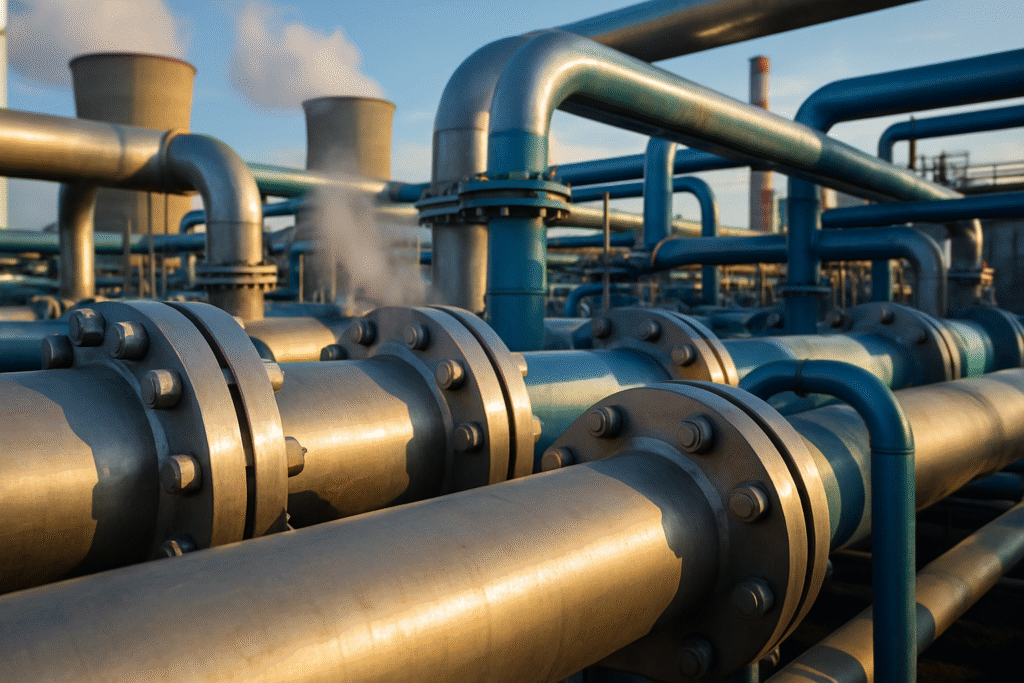
Marktführer für Edelstahlrohrflansche: 7 Datenpunkte auf Typen, Verwendungsmöglichkeiten, ASME B16.5 & B16.47 Auswahl
Laut Grand View Research (2024), Der globale Markt für Industrieflansche wurde mit bewertet $5.8 Milliarden in 2023 und wird voraussichtlich erreicht werden $7.2 Milliarden von 2030. That growth makes the stainless steel pipe flange a priority component for engineers and procurement teams that need corrosion resistance, Code-Compliance, und lange Lebensdauer.
Darüber hinaus, buyers are no longer comparing only price. They now assess material traceability, ASME dimensional compliance, pressure class accuracy, und Dokumentation wie z EN 10204 3.1 certificates before placing orders.
Industrielle Nachfragetrends prägen die Beschaffung von Edelstahlrohrflanschen
The flange market remains tightly linked to energy, Wasser, und Prozessindustrien. Laut Statista (2024), auf die Öl- und Gasindustrie entfallen ca 35% des weltweiten Flanschverbrauchs, which explains why pressure integrity and corrosion performance dominate purchase decisions.
Parallel dazu, Asia-Pacific has become the center of supply. Laut IBISWorld (2024), Der asiatisch-pazifische Raum macht mehr als aus 45% der weltweiten Flanschproduktion, wobei China der größte Hersteller ist.
That production concentration benefits international buyers seeking competitive lead times and broader material availability. Jedoch, it also increases the need to qualify suppliers on machining tolerance, PMI-Tests, Wärmebehandlungskontrolle, and documentation accuracy.
For stainless applications, the cost of failure is often far higher than the initial component price. A leaking flange joint in a refinery, desalination unit, or offshore skid can trigger unplanned shutdowns, Dichtungsaustausch, labor costs, und Sicherheitsexposition.
Infolge, procurement teams increasingly prefer suppliers with stable quality systems. Mit ISO 9001:2015 und PED 2014/68/EU-Zertifizierungen, SASA FLANGE supports industrial buyers who require compliant stainless steel flanges and fittings for export projects.
Market demand also reflects a broader shift toward higher-alloy materials. Laut Mordor-Geheimdienst (2024), corrosion-resistant alloys and duplex grades are gaining share in seawater, chloridreich, and sour-service applications because lifecycle costs often outperform low-grade alternatives.
That trend is especially relevant when comparing 304, 316L, 2205, Und 2507. Obwohl 304 remains widely used, many EPC contractors now standardize molybdenum-bearing or duplex grades in aggressive environments to reduce maintenance frequency.
Standards continue to shape this buying behavior. ASME B16.5 governs dimensions and tolerances for pipe flanges and flanged fittings in NPS 1/2 durch 24, während ASME B16.47 deckt Stahlflansche mit großem Durchmesser aus NPS ab 26 durch 60 (ASME, 2023).
daher, a buyer sourcing a 4 inch stainless steel pipe flange and a 36 inch ring flange is often working under different dimensional frameworks. Selecting the correct standard at the RFQ stage prevents rework, mismatch, and costly project delays.
Material specifications matter just as much as dimensions. ASTM A182 Im Allgemeinen werden geschmiedete oder gewalzte Rohrflansche aus Legierung und Edelstahl abgedeckt, geschmiedete Beschläge, und Ventile für den Hochtemperaturbetrieb, während ASTM A240 addresses plate, Blatt, und Streifen für Druckbehälter und allgemeine Anwendungen (ASTM, 2023).
In praktischer Beschaffungssprache, that means the word Flange on a quotation is not enough. Buyers should specify grade, Klasse, gegenüber, Standard, Testumfang, Menge, and required certificates at the start.
Unterstützt durch fortschrittliche CNC-Bearbeitung und umfassende Qualitätsprüfungen, SASA FLANGE stellt Flansche her 304, 316, 316L, 904L, 2205, 2507, A182, Inconel, Monel, Hastelloy, und Titan. Zusätzlich, Das Unternehmen beliefert Öl & Gas, Petrochemie, Stromerzeugung, Schiffbau, Wasseraufbereitung, and Construction markets in 50+ Länder.
Flanschtypen für Edelstahlrohre, Versteckte Vorteile, und Materialauswahllogik
Choosing among stainless steel flange types requires more than matching pipe size. Engineers must balance pressure class, Temperatur, Medienchemie, zyklische Belastung, Schweißverfahren, Inspektionsumfang, und Gesamtinstallationskosten.
Als John Reynolds, corrosion specialist and former API chairman, Staaten: “Materials selection should always be based on the real operating environment, not simply on nominal alloy category.” That principle is especially important when a stainless steel pipe flange will face chlorides, Spaltkorrosion, Temperaturwechsel, or intermittent chemical cleaning.
Laut Market Research Future (2024), industrial stainless component demand is rising steadily in water treatment and chemical processing because corrosion failures can increase maintenance costs by more than 20% over asset life. daher, the Hidden Advantages of properly selected stainless flanges include lower leakage risk, cleaner service conditions, und längere Austauschintervalle.
Not all Stainless grades perform the same way. Während 304 and 304L suit general service, 316 and 316L provide better pitting resistance because of molybdenum additions, und Duplex-Sorten wie 2205 deliver higher strength with improved chloride performance.
Als Dr. David Browne, Werkstoffingenieur, Staaten: “A flange joint is only as reliable as the interaction between metallurgy, Verschraubung, Dichtung, and operating conditions.” Mit anderen Worten, even premium Flanges? can underperform if the grade is right but the face finish, Schraubenlast, or gasket compatibility is wrong.
The most common stainless steel flange Types and Uses include the following:
- Vorschweißflansch für Hochdruck, hohe Temperatur, und zyklischer Dienst.
- Slip on flange for lower pressure systems where cost and easy alignment matter.
- Blindflansch zur Leitungsisolierung, Testen, und zukünftige Systemerweiterungen.
- Muffenschweißflansch für kleine Bohrungen, Hochdruckleitungen.
- Threaded flange for non-welded connections in specific maintenance-sensitive systems.
- Überlappungsflansch für Systeme, die häufig demontiert werden müssen.
Each design offers specific advantages. Zum Beispiel, weld neck flanges provide better stress distribution through the tapered hub, while blind flanges simplify hydrotesting and future tie-ins.
Ebenso wichtig ist die Auswahl der Druckklasse. ASME B16.5 stainless steel pipe flange products are generally supplied in Class 150, 300, 600, 900, 1500, Und 2500, and each class must align with design pressure, Temperatur, and material group rules under ASME calculations.
Large diameter applications call for ASME B16.47. Buyers handling terminal piping, offshore seawater headers, or cooling water systems often Choose B16.47 Series A or Series B based on bolt circle, Gewicht, and compatibility with existing plant standards.
Below is a practical material comparison for common stainless flange grades:
- 304/304L: Cost-effective and widely available for mild corrosive service.
- 316/316L: Better chloride resistance for chemical, Marine, and process systems.
- 904L: Superior resistance in strong corrosive environments including certain acids.
- 2205 Duplex: High strength and strong resistance to stress corrosion cracking.
- 2507 Super-Duplex: Preferred for aggressive offshore and desalination duties.
Gemäß den NACE-Richtlinien für Korrosionsanwendungen, Chloridkonzentration, Temperatur, oxygen content, and crevice geometry can sharply influence stainless performance (NACE, 2023). daher, material selection should always consider the full operating envelope rather than only nominal media description.
Für Beschaffungsteams, the key data set should include:
- Materialqualität und ASTM-Spezifikation.
- Größenbereich, wie zum Beispiel 1/2 Zoll zu 60 Zoll.
- Druckstufe oder Klasse.
- Verblendungstyp, einschließlich RF, FF, RTJ.
- Wall schedule and mating pipe data.
- Testing requirements, einschließlich PMI, Hydrotest, Härte, and NDE if needed.
- Dokumentation, einschließlich MTC und EN 10204 3.1.
Wir bieten maßgeschneiderte Größen von an 1/2 Zoll zu 60 Zoll mit wettbewerbsfähigen Direktpreisen ab Werk, SASA FLANGE supports standard and custom orders for weld neck, reinschlüpfen, blind, mit Gewinde, Überlappungsgelenk, und Muffenschweißkonstruktionen. Darüber hinaus, the company can supply matching elbows, T-Shirts, Reduzierstücke, und Obergrenzen zur Reduzierung der Beschaffungskomplexität.
Many buyers also compare Stainless and carbon steel on total cost. Although stainless can carry a higher upfront price, it often reduces painting, corrosion monitoring, Austauschhäufigkeit, and contamination risk in long-life process systems.
According to ISO-aligned lifecycle costing studies summarized by industry analysts, corrosion management can represent 3% Zu 5% des BIP in industrialisierten Volkswirtschaften. Infolge, the right stainless steel pipe flange often delivers value beyond purchase price alone.
ASME B16.5, B16.47, ASTM, DIN, und EN-Konformität für Edelstahlflansche
Compliance is not a marketing feature. It is a project requirement that directly affects fit-up, Druckintegrität, site acceptance, and export approval.
Für globale Projekte, buyers often work across multiple code systems. ASME and ASTM dominate many oil, Gas, and petrochemical specifications, while DIN and EN standards remain common in Europe, Marine, and equipment exports.
The most relevant standards for stainless steel pipe flange sourcing include:
- ASME B16.5 for flanges and flanged fittings NPS 1/2 Zu 24.
- ASME B16.47 for large diameter steel flanges NPS 26 Zu 60.
- ASME B16.9 für Stumpfschweißfittings.
- ASTM A182 für geschmiedete oder gewalzte Flansche aus Legierung und Edelstahl.
- ASTM A240 for stainless plate and sheet material references.
- EN 1092 for European flange dimensions and ratings.
- DIN flange standards for regional industrial systems.
- PED 2014/68/EU für die Konformität von Druckgeräten in der EU.
There are also critical differences between ASME and EN systems. Pressure ratings, Flanschdicke, Details gegenüberstellen, and bolt patterns can differ, so a stainless steel flange 2 inch under EN 1092 may not interchange with an ASME equivalent.
That is why RFQs should never use only the phrase stainless steel flange for sale. A complete specification should define standard, Nenngröße, Bewertung, Material, gegenüber, Menge, und Inspektionsanforderungen.
When export documentation is required, buyers should verify both manufacturing and quality systems. Mit ISO 9001:2015, PED 2014/68/EU, und AD 2000 Anmeldeinformationen, SASA FLANGE provides a stronger compliance basis for regulated projects.
Quality documentation typically includes mill test certificates, heat numbers, Maßkontrollberichte, Und, wo angegeben, PMI or third-party witness records. For higher-risk service, many end users also request hardness testing, Ferritprüfungen, and NDE confirmation.
The following comparison helps clarify common compliance paths:
- Oil and gas upstream: ASME, ASTM, API references, and sometimes NACE MR0175 für sauren Service.
- Petrochemical process lines: ASME B16.5 mit ASTM A182 F304/F316 materials is common.
- European equipment export: EN 1092 and PED documentation may be mandatory.
- Marine und Offshore: DNV or owner specifications may supplement ASME and ASTM requirements.
Gemäß dem PED-Rahmen der Europäischen Kommission, pressure-retaining components entering the EU market must meet conformity assessment obligations under PED 2014/68/EU. daher, supplier documentation quality can be as important as manufacturing quality itself.
Buyers should also review surface finish and facing. Erhöhtes Gesicht, flaches Gesicht, and ring type joint configurations each suit different gasket systems and pressure conditions, and mismatched faces remain a common source of leakage during installation.
For authoritative standard references, engineers should always review the issuing bodies directly, einschließlich ASME. That step helps confirm the latest edition year, dimensional tables, and rating notes before purchase release.
Im Gegensatz zu generischen Händlern, manufacturers with machining and inspection depth can control tolerances more consistently. That advantage becomes important for B16.47 large diameter flanges where bolt alignment and flatness can affect field assembly time.
Zusätzlich, Integrierte Beschaffung reduziert das Risiko von Fehlanpassungen. Buyers ordering flanges and fittings from the same qualified source can simplify material traceability, paperwork review, and shipping coordination across project packages.
So wählen Sie den richtigen Edelstahlrohrflansch für Öl aus, Gas, Chemisch, Leistung, und Meeresprojekte
Die Auswahl beginnt mit den Servicebedingungen, keine Katalogfotos. Procurement teams should first define media, Betriebstemperatur, Auslegungsdruck, Liniengröße, Korrosionsrisiken, and required standard.
Bei Öl und Gas, the major concern is often pressure integrity combined with corrosive media. Laut Statista (2024), Dieser Sektor repräsentiert ca 35% des weltweiten Flanschverbrauchs, so proven compliance and traceability are essential for contractor approval.
For upstream and refinery systems, engineers often Choose weld neck designs in 316L, Duplex 2205, oder Super-Duplex 2507 wo Chloride, H2S, or cyclic stresses are present. If sour service applies, NACE MR0175 compatibility should be checked against the exact process conditions.
In der chemischen Verarbeitung, corrosion data usually governs material choice. 316L works well for many moderate chemical duties, während 904L, Hastelloy, or titanium may be necessary for stronger acids or mixed corrosive streams.
Power generation projects present a different logic. Temperaturwechsel, Vibration, and steam service can make forged flange quality, Bolzenlastkontrolle, and gasket compatibility more important than nominal alloy cost.
Marine and shipbuilding applications often face salt spray, Meerwasserexposition, and space limitations. daher, 316L, 2205, Und 2507 are common candidates, especially where long maintenance intervals justify higher initial material cost.
Water treatment and desalination projects have become a major growth area. According to industry analyses summarized by Mordor Intelligence (2024), corrosion-resistant alloy demand is increasing in desalination because chloride-rich environments quickly expose material weaknesses.
Use the following checklist to Choose the correct Flange:
- Bestätigen Sie den geltenden Standard: ASME B16.5, B16.47, DIN, oder EN 1092.
- Confirm material grade: 304, 316L, 904L, 2205, 2507, oder Nickellegierung.
- Match pressure class and design temperature.
- Select flange type: Hals schweißen, reinschlüpfen, blind, mit Gewinde, Überlappungsgelenk, oder Muffenschweißen.
- Verkleidung definieren: RF, FF, oder RTJ.
- Request testing: PMI, Maßprüfung, Härte, Wasserkraft, or third-party witness as needed.
- Dokumentation angeben: MTC, Rückverfolgbarkeit der Wärme, Und EN 10204 3.1.
Zum Beispiel, A 4 inch stainless steel pipe flange in a clean water skid may use ASME B16.5 Klasse 150 slip on 304L. Jedoch, the same size in an offshore chemical injection line may require ASME B16.5 Klasse 600 Hals schweißen 2205 with PMI and full traceability.
Lead time also influences specification strategy. Standard 304 Und 316 sizes are usually easier to source quickly, während 904L, 2507, Inconel, and custom B16.47 sizes may require longer production planning and stricter raw material control.
That is where supplier capability matters. Unterstützt durch fortschrittliche CNC-Bearbeitung, breite Klassenabdeckung, und umfassende Qualitätsprüfung, SASA FLANGE supports custom manufacturing for stainless steel flanges, Ellenbogen, T-Shirts, Reduzierstücke, and caps across multiple international standards.
Engineers should also consider mating components. A premium flange cannot solve problems caused by incorrect gasket material, poor bolt lubrication, falsch ausgerichtete Rohrleitungen, or inconsistent torque sequence during installation.
Infolge, strong suppliers add value by helping customers align technical data before production. That support reduces NCR risk, Verzögerungen vor Ort, and the hidden costs often ignored in simple unit-price comparisons.
Future Outlook for Stainless Steel Pipe Flange Supply Chains and Strategic Buying Decisions
Die Marktaussichten bleiben positiv. Laut Grand View Research (2024), Es wird erwartet, dass der Markt für Industrieflansche weiter wachsen wird $5.8 Milliarden in 2023 Zu $7.2 Milliarden von 2030, supported by energy investment, Wasserinfrastruktur, und Modernisierung von Prozessanlagen.
Darüber hinaus, regional supply patterns are unlikely to change quickly. Da der asiatisch-pazifische Raum bereits über liegt 45% der weltweiten Flanschproduktion (IBISWorld, 2024), procurement teams will continue to rely on qualified Chinese manufacturers for volume, Kosteneffizienz, and broad alloy availability.
Jedoch, buyers are becoming more selective. They increasingly ask for shorter lead times, third-party inspection readiness, PED-Dokumentation, and full traceability rather than accepting generic commodity supply.
Digital procurement is also reshaping the process. Engineers now search terms such as stainless steel pipe flange sizes, Flanschtypen aus Edelstahl, Stainless Steel Threaded Pipe Flange, and Api weld neck flange before issuing formal RFQs.
daher, the most effective sourcing strategy combines technical clarity with supplier qualification. Buyers should standardize their RFQ templates, define testing scope early, and compare offers on lifecycle value rather than unit price alone.
Recommended actions for B2B buyers include:
- Prequalify suppliers against ISO 9001:2015, PED, and project-specific standards.
- Use complete technical descriptions rather than short product names.
- Separate critical-service items from general-service items for better cost control.
- Request documentation samples before placing first orders.
- Consolidate flanges and fittings with one capable manufacturer where possible.
For projects requiring stainless steel pipe flange supply in 304, 316L, 904L, 2205, 2507, und andere Premiumqualitäten, working with an experienced manufacturer can reduce sourcing risk and improve consistency. Buyers comparing compliance, Anpassung, and factory-direct pricing can review capabilities at SASA FLANGE Produkte und Unternehmenshintergrund bei SASA FLANGE über uns.
Letztlich, the most Intriguing advantage in today’s market is not simply material choice. It is the ability to align engineering standards, Fertigungsqualität, and delivery reliability from the first inquiry onward.
Häufig gestellte Fragen
Was ist besser? 304 oder 420 Edelstahl?
●304 stainless steel is generally better for stainless steel pipe flange applications because it offers stronger corrosion resistance and broader use in process piping.
●ASTM and industry practice favor 304 Und 316 series grades for flanges, während 420 is a martensitic grade more often used where hardness matters.
●For industrial piping projects requiring ASME B16.5 oder B16.47-Konformität, Zusammenarbeit mit etablierten Herstellern wie SASA FLANGE helps ensure the chosen grade matches the service environment.
Was ist der ASME-Code für Edelstahlflansche??
●Der primäre ASME-Abmessungscode für Edelstahlflansche ist ASME B16.5 für NPS 1/2 durch 24 Und ASME B16.47 für NPS 26 durch 60.
●Material specification is commonly covered by ASTM A182 for forged stainless steel flanges rather than by ASME dimensional standards alone.
●Buyers should specify both the ASME standard and the ASTM grade on every RFQ to avoid dimensional or material mismatch.
Welche Temperatur wird 304 Edelstahl standhalten?
●304 stainless steel can handle elevated temperatures, but exact limits depend on continuous or intermittent service, Druck, und Korrosionsbedingungen.
●In many industrial references, 304 performs well in general high-temperature service, although stabilized or higher-temperature grades may be preferred above about 800°F.
●Engineers should verify temperature limits against the project code, Medienchemie, and flange class before final material approval.
What are the stainless steel flange types?
●Die wichtigsten Edelstahlflanschtypen sind Vorschweißflansche, reinschlüpfen, blind, Muffenschweißen, mit Gewinde, und Überlappungsgelenk.
●Jeder Typ erfüllt eine andere Aufgabe, with weld neck preferred for severe service and slip on often selected for lower-pressure applications.
●For mixed projects involving standard and custom sizes, sourcing from a manufacturer with broad machining capability improves fit-up consistency.
Was beeinflusst den Preis für Edelstahlrohrflansche??
●Stainless steel pipe flange price depends mainly on grade, Größe, Druckklasse, gegenüber, Prüfanforderungen, und Auftragsvolumen.
●Laut Grand View Research (2024), sustained market growth and alloy demand continue to influence raw material and supply-chain pricing.
●Um Angebote genau zu vergleichen, buyers should align standards, Zertifizierungsumfang, and documentation requirements before reviewing unit cost.
Wie wähle ich zwischen ASME B16.5 and B16.47 flanges?
●ASME B16.5 usually applies to smaller sizes from NPS 1/2 Zu 24, während ASME B16.47 covers larger sizes from NPS 26 Zu 60.
●B16.47 is often used for large bore pipelines, marine headers, and terminal systems where bolt patterns and dimensions differ from B16.5.
●Vor der Bestellung, confirm the plant standard, Größenbereich, and mating flange details so the selected flange will assemble correctly in the field.
Verwandte Beiträge
Flanschoberflächenfinish: Konzentrische vs. spiralförmige Verzahnungen erklärt
Konzentrische und spiralförmige Verzahnungen sind beide bearbeitete Flanschflächenoberflächen…
Duplex 2205 vs. 316L-Flansche: Welches Material sollten Sie wählen??
Schnelle Antwort: Duplex 2205 Flansche sind normalerweise der stärkere Kandidat…

Definition des Öffnungsflansches, Details und Übersicht über ASME B16.36-Flansche: Marktdaten, Auswahlhilfe und Compliance-Einblicke
Der globale Markt für Industrieflansche wurde mit bewertet $5.8 Milliarde…

Marktführer für schwarze Entsorgungsflansche: Materialien, 3.5″ Kompatibilität, und B2B-Beschaffungsdaten für Küchenspülenflansche
Die Nachfrage nach schwarzen Entsorgungsflanschen steigt bei Käufern von Küchenarmaturen…