
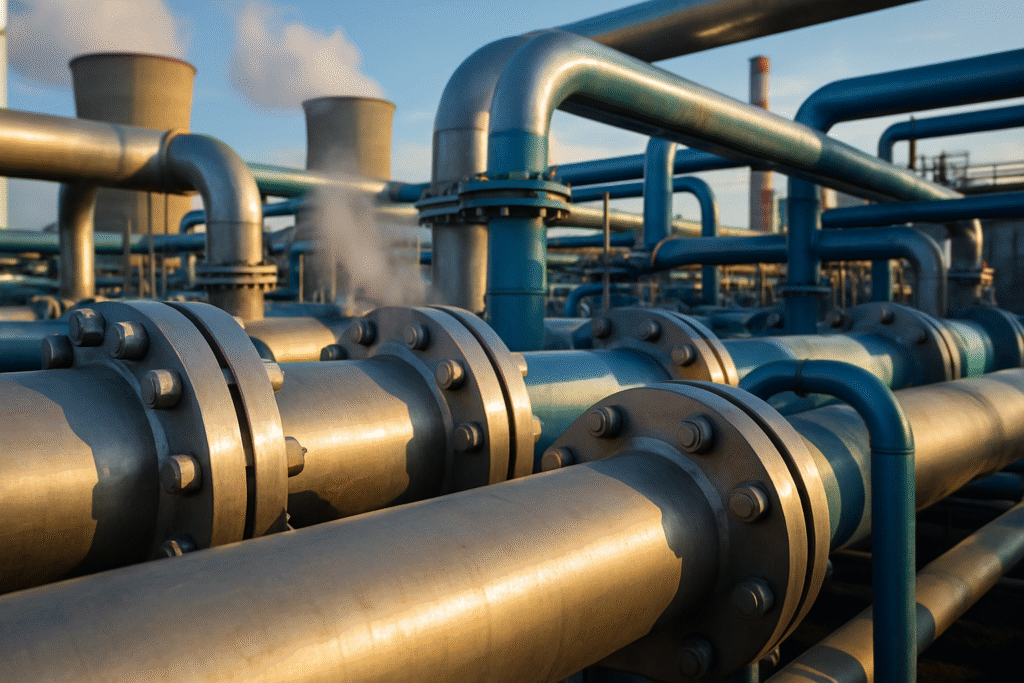
Guia de mercado de flange de tubo de aço inoxidável: 7 Pontos de dados sobre tipos, Usos, ASME B16.5 & B16.47 Seleção
De acordo com a pesquisa Grand View (2024), o mercado global de flanges industriais foi avaliado em $5.8 bilhão em 2023 e está projetado para atingir $7.2 bilhão por 2030. That growth makes the stainless steel pipe flange a priority component for engineers and procurement teams that need corrosion resistance, conformidade do código, e longa vida útil.
Além disso, buyers are no longer comparing only price. They now assess material traceability, ASME dimensional compliance, pressure class accuracy, e documentação como EN 10204 3.1 certificates before placing orders.
Tendências de demanda industrial que moldam a aquisição de flanges de tubos de aço inoxidável
The flange market remains tightly linked to energy, água, e indústrias de processo. De acordo com Statista (2024), a indústria de petróleo e gás é responsável por aproximadamente 35% do consumo global de flanges, which explains why pressure integrity and corrosion performance dominate purchase decisions.
Em paralelo, Asia-Pacific has become the center of supply. De acordo com IBISWorld (2024), Ásia-Pacífico é responsável por mais de 45% da produção global de flanges, sendo a China o maior fabricante.
That production concentration benefits international buyers seeking competitive lead times and broader material availability. No entanto, it also increases the need to qualify suppliers on machining tolerance, Teste PMI, controle de tratamento térmico, and documentation accuracy.
For stainless applications, the cost of failure is often far higher than the initial component price. A leaking flange joint in a refinery, desalination unit, or offshore skid can trigger unplanned shutdowns, substituição da junta, labor costs, e exposição de segurança.
Como resultado, procurement teams increasingly prefer suppliers with stable quality systems. Com ISO 9001:2015 e certificações PED 2014/68/EU, SASA FLANGE supports industrial buyers who require compliant stainless steel flanges and fittings for export projects.
Market demand also reflects a broader shift toward higher-alloy materials. De acordo com a Inteligência Mordor (2024), corrosion-resistant alloys and duplex grades are gaining share in seawater, chloride-rich, and sour-service applications because lifecycle costs often outperform low-grade alternatives.
That trend is especially relevant when comparing 304, 316eu, 2205, e 2507. Embora 304 remains widely used, many EPC contractors now standardize molybdenum-bearing or duplex grades in aggressive environments to reduce maintenance frequency.
Standards continue to shape this buying behavior. ASME B16.5 governs dimensions and tolerances for pipe flanges and flanged fittings in NPS 1/2 através 24, enquanto ASME B16.47 cobre flanges de aço de grande diâmetro da NPS 26 através 60 (ASME, 2023).
Portanto, a buyer sourcing a 4 inch stainless steel pipe flange and a 36 inch ring flange is often working under different dimensional frameworks. Selecting the correct standard at the RFQ stage prevents rework, mismatch, and costly project delays.
Material specifications matter just as much as dimensions. ASTM A182 geralmente cobre ligas forjadas ou laminadas e flanges de tubos de aço inoxidável, acessórios forjados, e válvulas para serviço em alta temperatura, enquanto ASTM A240 placa de endereços, folha, e tira para vasos de pressão e aplicações gerais (ASTM, 2023).
Em termos práticos de fornecimento, that means the word Flange on a quotation is not enough. Buyers should specify grade, aula, enfrentando, padrão, escopo de teste, quantidade, and required certificates at the start.
Apoiado por usinagem CNC avançada e testes de qualidade abrangentes, SASA FLANGE fabrica flanges em 304, 316, 316eu, 904eu, 2205, 2507, A182, Inconel, Monel, Hastelloy, e titânio. Adicionalmente, a empresa atende Petróleo & Gás, Petroquímica, Geração de energia, Construção naval, Tratamento de Água, and Construction markets in 50+ países.
Tipos de flange de tubo de aço inoxidável, Vantagens ocultas, and Material Selection Logic
Choosing among stainless steel flange types requires more than matching pipe size. Engineers must balance pressure class, temperatura, química da mídia, carregamento cíclico, procedimento de soldagem, escopo de inspeção, e custo total instalado.
Como John Reynolds, corrosion specialist and former API chairman, estados: “Materials selection should always be based on the real operating environment, not simply on nominal alloy category.” That principle is especially important when a stainless steel pipe flange will face chlorides, corrosão em fendas, ciclagem térmica, or intermittent chemical cleaning.
De acordo com a Pesquisa de Mercado Futuro (2024), industrial stainless component demand is rising steadily in water treatment and chemical processing because corrosion failures can increase maintenance costs by more than 20% over asset life. Portanto, the Hidden Advantages of properly selected stainless flanges include lower leakage risk, cleaner service conditions, and longer replacement intervals.
Not all Stainless grades perform the same way. Enquanto 304 and 304L suit general service, 316 and 316L provide better pitting resistance because of molybdenum additions, e qualidades duplex, como 2205 deliver higher strength with improved chloride performance.
Como Dr.. David Browne, engenheiro de materiais, estados: “A flange joint is only as reliable as the interaction between metallurgy, aparafusamento, junta, and operating conditions.” Em outras palavras, even premium Flanges? can underperform if the grade is right but the face finish, carga do parafuso, or gasket compatibility is wrong.
The most common stainless steel flange Types and Uses include the following:
- Flange de pescoço soldado para alta pressão, alta temperatura, e serviço cíclico.
- Slip on flange for lower pressure systems where cost and easy alignment matter.
- Flange cego para isolamento de linha, testando, e futura expansão do sistema.
- Flange de solda de soquete para furo pequeno, tubulação de alta pressão.
- Threaded flange for non-welded connections in specific maintenance-sensitive systems.
- Flange de junta sobreposta para sistemas que requerem desmontagem frequente.
Each design offers specific advantages. Por exemplo, weld neck flanges provide better stress distribution through the tapered hub, while blind flanges simplify hydrotesting and future tie-ins.
A seleção da classe de pressão é igualmente importante. ASME B16.5 stainless steel pipe flange products are generally supplied in Class 150, 300, 600, 900, 1500, e 2500, and each class must align with design pressure, temperatura, and material group rules under ASME calculations.
Large diameter applications call for ASME B16.47. Buyers handling terminal piping, offshore seawater headers, or cooling water systems often Choose B16.47 Series A or Series B based on bolt circle, peso, and compatibility with existing plant standards.
Below is a practical material comparison for common stainless flange grades:
- 304/304eu: Cost-effective and widely available for mild corrosive service.
- 316/316eu: Better chloride resistance for chemical, marinho, and process systems.
- 904eu: Superior resistance in strong corrosive environments including certain acids.
- 2205 duplex: High strength and strong resistance to stress corrosion cracking.
- 2507 superduplex: Preferred for aggressive offshore and desalination duties.
De acordo com as orientações da NACE para serviços corrosivos, concentração de cloreto, temperatura, oxygen content, and crevice geometry can sharply influence stainless performance (NACE, 2023). Portanto, material selection should always consider the full operating envelope rather than only nominal media description.
Para equipes de compras, the key data set should include:
- Material grade and ASTM specification.
- Faixa de tamanho, como 1/2 polegada para 60 polegada.
- Classificação ou classe de pressão.
- Tipo de revestimento, incluindo RF, FF, RTJ.
- Wall schedule and mating pipe data.
- Requisitos de teste, incluindo PMI, hidroteste, dureza, and NDE if needed.
- Documentação, incluindo MTC e EN 10204 3.1.
Oferecendo tamanhos personalizados de 1/2 polegada para 60 polegada com preços competitivos direto da fábrica, SASA FLANGE supports standard and custom orders for weld neck, escorregar, cego, rosqueado, junta sobreposta, e projetos de solda de soquete. Além disso, the company can supply matching elbows, camisetas, redutores, and caps to reduce sourcing complexity.
Many buyers also compare Stainless and carbon steel on total cost. Although stainless can carry a higher upfront price, it often reduces painting, corrosion monitoring, replacement frequency, and contamination risk in long-life process systems.
According to ISO-aligned lifecycle costing studies summarized by industry analysts, corrosion management can represent 3% para 5% of GDP in industrialized economies. Como resultado, the right stainless steel pipe flange often delivers value beyond purchase price alone.
ASME B16.5, B16.47, ASTM, DIN, e conformidade EN para flanges de aço inoxidável
Compliance is not a marketing feature. It is a project requirement that directly affects fit-up, integridade de pressão, site acceptance, and export approval.
For global projects, buyers often work across multiple code systems. ASME and ASTM dominate many oil, gás, and petrochemical specifications, while DIN and EN standards remain common in Europe, marinho, and equipment exports.
The most relevant standards for stainless steel pipe flange sourcing include:
- ASME B16.5 for flanges and flanged fittings NPS 1/2 para 24.
- ASME B16.47 for large diameter steel flanges NPS 26 para 60.
- ASME B16.9 para conexões de solda de topo.
- ASTM A182 para ligas forjadas ou laminadas e flanges de aço inoxidável.
- ASTM A240 for stainless plate and sheet material references.
- EN 1092 for European flange dimensions and ratings.
- DIN flange standards for regional industrial systems.
- PED 2014/68/EU for pressure equipment compliance in the EU.
There are also critical differences between ASME and EN systems. Classificações de pressão, espessura da flange, detalhes voltados, and bolt patterns can differ, so a stainless steel flange 2 inch under EN 1092 may not interchange with an ASME equivalent.
That is why RFQs should never use only the phrase stainless steel flange for sale. A complete specification should define standard, tamanho nominal, avaliação, material, enfrentando, quantidade, e requisitos de inspeção.
When export documentation is required, buyers should verify both manufacturing and quality systems. Com ISO 9001:2015, PED 2014/68/EU, e ANÚNCIO 2000 credenciais, SASA FLANGE provides a stronger compliance basis for regulated projects.
Quality documentation typically includes mill test certificates, números de calor, relatórios de inspeção dimensional, e, onde especificado, PMI or third-party witness records. For higher-risk service, many end users also request hardness testing, verificações de ferrite, and NDE confirmation.
The following comparison helps clarify common compliance paths:
- Oil and gas upstream: ASME, ASTM, API references, and sometimes NACE MR0175 para serviço azedo.
- Petrochemical process lines: ASME B16.5 com ASTM A182 F304/F316 materials is common.
- European equipment export: EN 1092 and PED documentation may be mandatory.
- Marítimo e offshore: DNV or owner specifications may supplement ASME and ASTM requirements.
De acordo com a estrutura PED da Comissão Europeia, pressure-retaining components entering the EU market must meet conformity assessment obligations under PED 2014/68/EU. Portanto, supplier documentation quality can be as important as manufacturing quality itself.
Buyers should also review surface finish and facing. Rosto levantado, cara plana, and ring type joint configurations each suit different gasket systems and pressure conditions, and mismatched faces remain a common source of leakage during installation.
For authoritative standard references, engineers should always review the issuing bodies directly, incluindo ASME. That step helps confirm the latest edition year, dimensional tables, and rating notes before purchase release.
Em contraste com os comerciantes genéricos, manufacturers with machining and inspection depth can control tolerances more consistently. That advantage becomes important for B16.47 large diameter flanges where bolt alignment and flatness can affect field assembly time.
Adicionalmente, o fornecimento integrado reduz o risco de incompatibilidade. Buyers ordering flanges and fittings from the same qualified source can simplify material traceability, paperwork review, and shipping coordination across project packages.
Como escolher o flange de tubo de aço inoxidável certo para óleo, Gás, Químico, Poder, e Projetos Marítimos
A seleção começa com as condições de serviço, não fotos de catálogo. Procurement teams should first define media, temperatura operacional, pressão de projeto, tamanho da linha, riscos de corrosão, e padrão exigido.
Em petróleo e gás, the major concern is often pressure integrity combined with corrosive media. De acordo com Statista (2024), este setor representa cerca de 35% do consumo global de flanges, so proven compliance and traceability are essential for contractor approval.
For upstream and refinery systems, engineers often Choose weld neck designs in 316L, duplex 2205, ou super duplex 2507 where chlorides, H2S, or cyclic stresses are present. If sour service applies, NACE MR0175 compatibility should be checked against the exact process conditions.
No processamento químico, corrosion data usually governs material choice. 316L works well for many moderate chemical duties, enquanto 904L, Hastelloy, or titanium may be necessary for stronger acids or mixed corrosive streams.
Power generation projects present a different logic. Ciclismo térmico, vibração, and steam service can make forged flange quality, bolt load control, and gasket compatibility more important than nominal alloy cost.
Marine and shipbuilding applications often face salt spray, exposição à água do mar, and space limitations. Portanto, 316eu, 2205, e 2507 are common candidates, especially where long maintenance intervals justify higher initial material cost.
Water treatment and desalination projects have become a major growth area. According to industry analyses summarized by Mordor Intelligence (2024), corrosion-resistant alloy demand is increasing in desalination because chloride-rich environments quickly expose material weaknesses.
Use the following checklist to Choose the correct Flange:
- Confirme o padrão governante: ASME B16.5, B16.47, DIN, ou PT 1092.
- Confirme a qualidade do material: 304, 316eu, 904eu, 2205, 2507, or nickel alloy.
- Match pressure class and design temperature.
- Select flange type: pescoço de solda, escorregar, cego, rosqueado, junta sobreposta, ou solda de soquete.
- Definir revestimento: RF, FF, ou RTJ.
- Request testing: PMI, inspeção dimensional, dureza, hydro, or third-party witness as needed.
- Specify documentation: CTM, rastreabilidade térmica, e EN 10204 3.1.
Por exemplo, um 4 inch stainless steel pipe flange in a clean water skid may use ASME B16.5 Aula 150 slip on 304L. No entanto, the same size in an offshore chemical injection line may require ASME B16.5 Aula 600 pescoço de solda 2205 with PMI and full traceability.
Lead time also influences specification strategy. Padrão 304 e 316 sizes are usually easier to source quickly, enquanto 904L, 2507, Inconel, and custom B16.47 sizes may require longer production planning and stricter raw material control.
É aí que a capacidade do fornecedor é importante. Apoiado por usinagem CNC avançada, ampla cobertura de grau, e testes de qualidade abrangentes, SASA FLANGE supports custom manufacturing for stainless steel flanges, cotovelos, camisetas, redutores, and caps across multiple international standards.
Engineers should also consider mating components. A premium flange cannot solve problems caused by incorrect gasket material, poor bolt lubrication, tubulação desalinhada, or inconsistent torque sequence during installation.
Como resultado, strong suppliers add value by helping customers align technical data before production. That support reduces NCR risk, atrasos no site, and the hidden costs often ignored in simple unit-price comparisons.
Perspectivas futuras para cadeias de fornecimento de flanges de tubos de aço inoxidável e decisões estratégicas de compra
A perspectiva do mercado permanece positiva. De acordo com a pesquisa Grand View (2024), espera-se que o mercado de flange industrial cresça de $5.8 bilhão em 2023 para $7.2 bilhão por 2030, apoiado pelo investimento em energia, infraestrutura hídrica, and process plant modernization.
Além disso, regional supply patterns are unlikely to change quickly. Dado que a Ásia-Pacífico já representa mais de 45% da produção global de flanges (IBISWorld, 2024), procurement teams will continue to rely on qualified Chinese manufacturers for volume, eficiência de custos, and broad alloy availability.
No entanto, os compradores estão se tornando mais seletivos. They increasingly ask for shorter lead times, third-party inspection readiness, Documentação PED, and full traceability rather than accepting generic commodity supply.
Digital procurement is also reshaping the process. Engineers now search terms such as stainless steel pipe flange sizes, tipos de flange de aço inoxidável, Stainless Steel Threaded Pipe Flange, and Api weld neck flange before issuing formal RFQs.
Portanto, the most effective sourcing strategy combines technical clarity with supplier qualification. Buyers should standardize their RFQ templates, define testing scope early, and compare offers on lifecycle value rather than unit price alone.
Recommended actions for B2B buyers include:
- Prequalify suppliers against ISO 9001:2015, DEP, e padrões específicos do projeto.
- Use complete technical descriptions rather than short product names.
- Separate critical-service items from general-service items for better cost control.
- Request documentation samples before placing first orders.
- Consolidate flanges and fittings with one capable manufacturer where possible.
For projects requiring stainless steel pipe flange supply in 304, 316eu, 904eu, 2205, 2507, e outras notas premium, working with an experienced manufacturer can reduce sourcing risk and improve consistency. Buyers comparing compliance, personalização, and factory-direct pricing can review capabilities at SASA FLANGE produtos e histórico da empresa em SASA FLANGE sobre nós.
Em última análise, the most Intriguing advantage in today’s market is not simply material choice. It is the ability to align engineering standards, qualidade de fabricação, and delivery reliability from the first inquiry onward.
Perguntas frequentes
O que é melhor 304 ou 420 aço inoxidável?
●304 stainless steel is generally better for stainless steel pipe flange applications because it offers stronger corrosion resistance and broader use in process piping.
●ASTM and industry practice favor 304 e 316 series grades for flanges, enquanto 420 is a martensitic grade more often used where hardness matters.
●For industrial piping projects requiring ASME B16.5 ou conformidade com B16.47, trabalhando com fabricantes estabelecidos como SASA FLANGE helps ensure the chosen grade matches the service environment.
Qual é o código ASME para flanges de aço inoxidável?
●The primary ASME dimensional code for stainless steel flanges is ASME B16.5 para NPS 1/2 através 24 e ASME B16.47 para NPS 26 através 60.
●Material specification is commonly covered by ASTM A182 for forged stainless steel flanges rather than by ASME dimensional standards alone.
●Buyers should specify both the ASME standard and the ASTM grade on every RFQ to avoid dimensional or material mismatch.
Qual será a temperatura 304 suportar aço inoxidável?
●304 stainless steel can handle elevated temperatures, but exact limits depend on continuous or intermittent service, pressão, e condições de corrosão.
●Em muitas referências industriais, 304 performs well in general high-temperature service, although stabilized or higher-temperature grades may be preferred above about 800°F.
●Engineers should verify temperature limits against the project code, química da mídia, and flange class before final material approval.
What are the stainless steel flange types?
●Os principais tipos de flange de aço inoxidável são pescoço de solda, escorregar, cego, solda de soquete, rosqueado, e junta sobreposta.
●Cada tipo cumpre uma função diferente, with weld neck preferred for severe service and slip on often selected for lower-pressure applications.
●For mixed projects involving standard and custom sizes, sourcing from a manufacturer with broad machining capability improves fit-up consistency.
O que afeta o preço do flange do tubo de aço inoxidável?
●Stainless steel pipe flange price depends mainly on grade, tamanho, classe de pressão, enfrentando, requisitos de teste, e volume de pedidos.
●De acordo com a pesquisa Grand View (2024), sustained market growth and alloy demand continue to influence raw material and supply-chain pricing.
●Para comparar cotações com precisão, buyers should align standards, escopo de certificação, and documentation requirements before reviewing unit cost.
Como faço para escolher entre ASME B16.5 and B16.47 flanges?
●ASME B16.5 usually applies to smaller sizes from NPS 1/2 para 24, enquanto ASME B16.47 covers larger sizes from NPS 26 para 60.
●B16.47 is often used for large bore pipelines, marine headers, and terminal systems where bolt patterns and dimensions differ from B16.5.
●Antes de fazer o pedido, confirm the plant standard, faixa de tamanho, and mating flange details so the selected flange will assemble correctly in the field.
Posts Relacionados
Acabamento da face do flange: Serrilhas concêntricas vs espirais explicadas
As serrilhas concêntricas e espirais são acabamentos de face de flange usinados…
Dúplex 2205 vs Flanges 316L: Qual material você deve escolher?
Resposta rápida: Dúplex 2205 flanges são geralmente o candidato mais forte…

Definição de flange de orifício, Detalhes e visão geral dos flanges ASME B16.36: Dados de mercado, Guia de seleção e insights de conformidade
O mercado global de flanges industriais foi avaliado em $5.8 bilhão…

Guia de mercado de flange de descarte preto: Materiais, 3.5″ Compatibilidade, e dados de fornecimento B2B para flanges de pia de cozinha
A demanda por flanges descartáveis pretos está aumentando à medida que os compradores de utensílios de cozinha…