
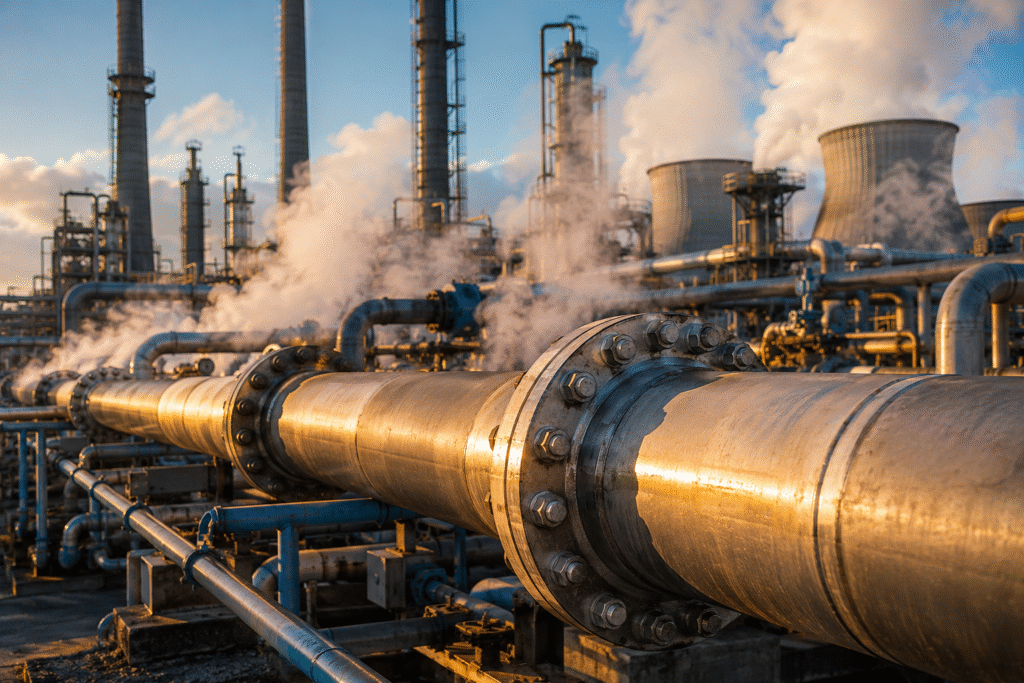
Markt für Edelstahlrohrflansche: 7 Versteckte Vorteile, Typen, Verwendungsmöglichkeiten und ASME B16.5/B16.47 Auswahlhilfe
Laut Grand View Research (2024), Der globale Markt für Industrieflansche wurde mit bewertet $5.8 Milliarden in 2023 und wird voraussichtlich erreicht werden $7.2 Milliarden von 2030. That growth highlights why the Rohrflansch aus Edelstahl remains a critical component for engineers, EPC-Auftragnehmer, and procurement teams seeking durability, Korrosionsbeständigkeit, und lange Lebensdauer.
Für industrielle Käufer, the most Intriguing factor is not only the visible strength of Stainless Steel Flanges, but also the Hidden Advantages in lifecycle cost, inspection reliability, and application Versatility. daher, selecting the right flange by material, Druckklasse, gegenüber, und Standard wie ASME B16.5 oder ASME B16.47 wirkt sich direkt auf die Sicherheit aus, Betriebszeit, und Gesamtinstallationskosten.
Nachfrage nach Edelstahlrohrflanschen, Market Growth, and Procurement Trends
Laut IBISWorld (2024), Der asiatisch-pazifische Raum macht mehr als aus 45% der weltweiten Flanschproduktion, wobei China der größte Hersteller ist. Infolge, global buyers increasingly source stainless steel pipe flange products from qualified Chinese factories that can combine scale, CNC precision, und Exportdokumentation.
Laut Statista (2024), auf die Öl- und Gasindustrie entfallen ca 35% des weltweiten Flanschverbrauchs. Darüber hinaus, petrochemische Anlagen, power generation projects, Entsalzungssysteme, and shipbuilding programs continue to expand demand for corrosion-resistant piping components.
The procurement landscape has also changed. Buyers now expect mill test certificates, EN 10204 3.1 Dokumentation, PMI, hydrostatische oder pneumatische Prüfunterstützung, and traceability by heat number before releasing large-value orders.
Laut Mordor-Geheimdienst (2024), industrial infrastructure spending in energy and water sectors continues to support above-average demand for alloy and stainless piping components. Außerdem, duplex and super duplex grades are gaining traction where chloride corrosion and sour service conditions shorten the life of conventional carbon steel systems.
In diesem Umfeld, a supplier must offer more than catalog inventory. It must provide precise dimensional control, Einhaltung der ASME- und ASTM-Standards, and material availability across 304, 316, 316L, 904L, 2205, 2507, und Nickellegierungen.
SASA FLANGE operates in this quality-focused segment with ISO 9001:2015, PED 2014/68/EU, und AD 2000 Anmeldeinformationen. Unterstützt durch fortschrittliche CNC-Bearbeitung und umfassende Qualitätsprüfungen, Das Unternehmen stellt Edelstahlflansche her, Flansche aus Kohlenstoffstahl, Flansche aus Legierung, and pipe fittings for customers in Oil & Gas, Petrochemie, Leistung, Marine, Wasseraufbereitung, und Bauwesen.
Für Einkaufsmanager, market expansion creates both opportunity and risk. On one hand, more sourcing options can improve pricing. Jedoch, inconsistent machining tolerances, non-compliant raw material, and weak documentation can create downstream failures that cost far more than the initial purchase savings.
As David Nguyen, Leitender Rohrleitungsingenieur, Staaten: “A flange is a small percentage of project CAPEX, but it has an outsized effect on mechanical integrity and shutdown risk.” That observation reflects why serious buyers prioritize standards compliance and material suitability over headline price alone.
Another important trend involves customization. Laut Market Research Future (2024), specialized industrial components for aggressive service environments are growing faster than commodity piping accessories, driven by stricter operating conditions and longer asset life expectations.
daher, manufacturers that can supply custom sizes from 1/2" bis 60", Spezialbohrung, non-standard facings, and exotic materials hold a clear advantage in the B2B market. This is especially relevant when projects require mixed standards, rapid turnaround, or replacement parts for older installations.
Technical Advantages of Stainless Steel Pipe Flange Products: Materialien, Typen, und Leistung
The Hidden Advantages of a stainless steel pipe flange begin with metallurgical stability. Compared with ordinary steel in corrosive service, stainless grades form a passive chromium oxide layer that improves resistance to oxidation, moisture attack, and many chemical media.
According to ASTM material frameworks and common industrial practice, austenitische Sorten wie z 304 Und 316 dominate general process piping because they balance weldability, Formbarkeit, und Korrosionsverhalten. Im Gegensatz, Duplex-Sorten wie z 2205 Und 2507 provide higher strength and better chloride stress corrosion cracking resistance in more severe environments.
Als Dr. Elena Morris, Materialwissenschaftler, Staaten: “The best flange material is not the most expensive alloy, but the alloy that matches chloride level, Temperatur, Druckklasse, und Herstellungsverfahren.” daher, the right selection depends on process chemistry and not on brand familiarity alone.
From a technical perspective, several Types of stainless flanges serve different assembly requirements. Weld neck flanges distribute stress efficiently. Slip-on flanges offer easier alignment and economical installation. Blind flanges terminate a line or nozzle and support inspection and maintenance access.
Other common Types include socket weld, mit Gewinde, Überlappungsgelenk, and ring-type joint configurations. Each option influences fabrication speed, weld profile, Ermüdungsleistung, and sealing behavior under thermal cycling.
- 304/304L: Gute allgemeine Korrosionsbeständigkeit, strong weldability, and cost-effective performance for water, Essen, und leichter chemischer Service.
- 316/316L: Added molybdenum improves resistance in chlorides, Meeresatmosphären, and many chemical applications.
- 904L: Higher nickel and molybdenum content supports strong resistance in aggressive acidic service.
- 2205 Duplex: Higher yield strength and improved SCC resistance for offshore, Meerwasser, and process systems.
- 2507 Super-Duplex: Premium choice for high-chloride and high-pressure environments.
According to NACE guidance used widely in sour service engineering, material compatibility must be checked against H2S exposure, Härtegrenzen, und Betriebstemperatur. Zusätzlich, buyers should evaluate flange class, Dichtungskompatibilität, Schraubenlast, and corrosion allowance together rather than as isolated variables.
Performance also depends on manufacturing quality. A forged stainless steel pipe flange usually provides better grain flow and mechanical integrity than poorly controlled alternatives, especially in pressure-retaining systems.
Entsprechend ASME B16.5, Flanschabmessungen, Bohren, Druck-Temperatur-Werte, Toleranzen, and markings must conform to specified requirements for NPS 1/2 durch 24. ASME B16.47 extends dimensional coverage for larger diameters, im Allgemeinen NPS 26 durch 60, which is critical for large process lines and terminal infrastructure.
These standards matter because interchangeability reduces site delays. When a flange does not align with bolt holes, raised face dimensions, or thickness tolerances, installation crews lose hours and projects absorb avoidable cost.
The Uses of stainless flanges extend across sectors because Stainless components support both clean and corrosive service. Zum Beispiel, 316L flanges are common in pharmaceutical water systems, während 2205 Und 2507 are widely specified in offshore skid packages and desalination trains.
Laut a 2024 industry estimate from Statista, process industries are increasing spending on corrosion-resistant equipment as maintenance budgets shift from reactive repairs to reliability planning. Infolge, engineers are more often instructed to justify lifecycle value rather than first-cost savings.
SASA FLANGE supports this need by manufacturing flanges in 304, 316, 904L, 2205, 2507 und andere Premiumqualitäten, alongside A105, A182, Inconel, Monel, Hastelloy, und Titan. Das Unternehmen liefert auch Ellenbogen, T-Shirts, Reduzierstücke, and caps to help buyers consolidate sourcing and simplify project documentation.
When teams Choose a supplier, they should check machining capability, PMI procedures, positive traceability, und ob EN 10204 3.1 documents are available. They should also confirm whether the factory can produce raised face, flaches Gesicht, RTJ, and custom drilling patterns in accordance with project specifications.
As Mark Feldman, Industriemarktanalyst, Staaten: “In global sourcing, documentation discipline is becoming as important as metallurgy.” That is particularly true for export projects requiring PED dossiers, Inspektion durch Dritte, and strict ITP compliance.
- Gängige Druckklassen: 150, 300, 600, 900, 1500, 2500.
- Gemeinsame Verkleidungen: RF, FF, RTJ.
- Relevant standards: ASME B16.5, ASME B16.47, ASME B16.9, ASTM A182, EN 1092, DIN, JIS, GOST.
- Inspektionsmöglichkeiten: PMI, Maßprüfung, Härtetest, Unterstützung bei Hydrotests, surface finish checks, Materialüberprüfung.
Letztlich, durability is not a marketing word in piping systems. It is a measurable result of correct alloy choice, proper flange design, compliant dimensions, and disciplined manufacturing control.
ASME, ASTM, DIN, and EN Compliance Requirements for Stainless Steel Flanges
Compliance determines whether a stainless steel pipe flange can be installed confidently in regulated or high-risk service. daher, engineers usually begin with the governing dimensional standard, then move to material standard, Druckklasse, Testanforderungen, und Dokumentationspaket.
For most international projects, ASME B16.5 Und ASME B16.47 define dimensional requirements for flanges. ASTM A182 commonly defines forged or rolled alloy and stainless steel pipe flanges, während ASME B16.9 applies to butt weld fittings used alongside the flange assembly.
In europäischen Projekten wird häufig EN angegeben 1092 dimensions and PED 2014/68/EU compliance. Zusätzlich, DIN and JIS standards remain important in legacy plants, marine projects, and regional procurement packages.
Laut der ASME code framework, correct dimensional conformity ensures interchangeability and reliable bolting alignment. Darüber hinaus, standards reduce ambiguity across global supply chains and support safer maintenance planning.
- ASME B16.5: Rohrflansche und Flanschverbindungen für NPS 1/2 Zu 24.
- ASME B16.47: Stahlflansche mit großem Durchmesser für NPS 26 Zu 60.
- ASTM A182: Geschmiedete oder gewalzte Flanschmaterialien aus Legierung und Edelstahl.
- EN 1092-1: European flange dimensions and PN pressure classes.
- NACE MR0175: Materialleitfaden für saure Betriebsumgebungen.
Buyers should also understand that standards do not automatically guarantee suitability for all media. Zum Beispiel, a compliant ASTM A182 F304 flange may still be the wrong choice in high-chloride service where 316L, 2205, oder 2507 would perform better.
Documentation quality is equally important. Mill test certificates should identify heat number, Chemie, mechanische Eigenschaften, und Standardkonformität, während EN 10204 3.1 paperwork helps project teams verify traceability during inspection and handover.
According to ISO-aligned quality management principles, traceability and process consistency reduce non-conformance risk during production and final release. daher, Hersteller mit ISO 9001:2015 systems typically offer stronger procedural control for incoming material, Bearbeitung, und Endkontrolle.
SASA FLANGE integrates ISO 9001:2015, PED 2014/68/EU, und AD 2000 credentials into its manufacturing and export workflow. That matters for buyers who need reliable document packs, factory-direct communication, and support for third-party inspection before shipment.
The most common compliance mistakes are avoidable. They include ordering the wrong pressure class, mixing ASME and DIN drilling, overlooking gasket seating finish, or ignoring corrosion requirements in marine and sour service applications.
Procurement teams should confirm the following before issuing a PO:
- Maßstandard und Ausgabe.
- Material grade and supplementary requirements.
- Facing type and surface finish.
- Druckklasse oder PN-Bewertung.
- Inspection and documentation scope.
- Verpackung, Markierung, and traceability requirements.
When these details are defined early, lead times and technical clarifications drop sharply. Im Gegensatz, incomplete purchase descriptions often cause delays, NCRs, and expensive field modifications.
So wählen Sie Edelstahl-Rohrflanschlösungen für Öl aus, Gas, Chemisch, Leistung, und Marinedienst
To Choose correctly, engineers should first evaluate the process medium. Chloride, Schwefelverbindungen, Säuren, Temperaturschwankungen, and cleaning chemicals all influence the best Stainless material and flange design.
Bei Öl und Gas, flange reliability is tied to pressure containment and corrosion control. Because this sector consumes about 35% von globalen Flanschen (Staatsmann, 2024), it remains the benchmark for robust materials, vollständige Rückverfolgbarkeit, and strict inspection acceptance.
For upstream and offshore systems, duplex and super duplex grades often outperform standard austenitic materials in chloride-rich environments. Darüber hinaus, RTJ facings and higher pressure classes may be required for severe pressure and temperature service.
In der chemischen Verarbeitung, buyers often prioritize 316L, 904L, or nickel alloys depending on acidity and oxidation potential. daher, the right choice involves corrosion data review, Dichtungskompatibilität, and validation of cleaning and CIP cycles.
Power generation systems present a different challenge. Thermische Ermüdung, Dampfservice, and planned outages make dimensional consistency and weld preparation especially important for maintenance efficiency.
Marine and shipbuilding applications place continuous stress on components through salt exposure, Vibration, und Feuchtigkeit. Infolge, 316/316L and duplex grades are commonly preferred over lower-alloy alternatives in deck piping, Ballastsysteme, and seawater treatment lines.
- Für Öl & Gas: Druckklasse prüfen, sour service needs, und Chloridbeständigkeit.
- For Petrochemical: Match alloy to media chemistry and cleaning cycles.
- For Power: Focus on thermal stability, Schweißqualität, and outage efficiency.
- For Marine: Prioritize seawater resistance, vibration tolerance, und langfristige Haltbarkeit.
Flange Types also affect installation cost. A slip-on flange may reduce fabrication complexity in lower-pressure utility systems, while a weld neck flange usually provides better fatigue resistance for critical process lines.
Three of the most specified Types are weld neck, Slip-on, und blind. Jedoch, threaded flanges remain useful where welding is restricted, and socket weld flanges are often selected for small-bore high-pressure systems.
Price evaluation should include more than unit cost. Der Preis für Edelstahlrohrflansche hängt von der Materialqualität ab, Klasse, gegenüber, Größe, Menge, Inspektionsumfang, and current alloy market conditions.
Zum Beispiel, A 4 Zoll Edelstahlrohrflansch in 304 may be significantly less expensive than the same size in 316L or 2205. Jedoch, if premature corrosion forces replacement, the initial savings disappear quickly through downtime, Arbeit, und Sicherheitsexposition.
This is where supplier capability matters. SASA FLANGE bietet kundenspezifische Fertigungsmöglichkeiten, wettbewerbsfähige Preise direkt ab Werk, and export support for projects requiring standard and non-standard flanges from 1/2" bis 60".
Portion 50+ Länder in ganz Öl & Gas, Petrochemie, Leistung, und Marineindustrie, the company can support both production orders and replacement demand. Zusätzlich, buyers can source matching elbows, T-Shirts, Reduzierstücke, and caps to simplify logistics and technical alignment.
To improve selection accuracy, use this practical checklist:
- Define process media, Temperatur, und Druck.
- Confirm standard such as ASME B16.5, ASME B16.47, oder EN 1092.
- Select material grade based on corrosion and strength requirements.
- Choose flange type and facing based on service and assembly method.
- Geben Sie Tests an, MTCs, and traceability requirements.
- Review supplier machining capability and lead time performance.
When these factors are aligned, buyers reduce technical risk and improve asset life. daher, the best procurement outcome comes from combining engineering rigor with supplier qualification.
Zukunftsaussichten für Edelstahlflansche und strategische Kaufempfehlungen
The flange market outlook remains positive as energy, Wasser, und industrielle Modernisierungsprojekte werden weltweit fortgesetzt. Laut Grand View Research (2024), Es wird erwartet, dass der Markt weiter wächst $5.8 Milliarden in 2023 Zu $7.2 Milliarden von 2030, reinforcing sustained demand for stainless and specialty alloy products.
Gleichzeitig, buyers face tighter technical scrutiny. Einhaltung gesetzlicher Vorschriften, Materialrückverfolgbarkeit, and lifecycle cost accountability are becoming standard requirements rather than premium options.
Laut IBISWorld (2024), Asia-Pacific will remain the largest manufacturing base for flange production. daher, strategic sourcing from qualified Chinese manufacturers can improve cost control if quality systems, Einhaltung von Standards, and export communication are verified early.
Blick nach vorn, several trends will shape purchasing decisions:
- Higher demand for duplex and super duplex in chloride-rich service.
- More specification of PED-compliant documentation for export projects.
- Greater use of supplier audits and third-party inspection.
- Increased preference for bundled sourcing of flanges and fittings.
Für Einkaufsmanager, the most effective strategy is to standardize approved grades, Inspektionspläne, and document requirements before tendering. Darüber hinaus, supplier scorecards should measure NCR rate, on-time delivery, and technical response speed, nicht nur der Preis.
Für Ingenieure, the recommendation is equally clear. Choose a stainless steel pipe flange based on service conditions, Code-Anforderungen, and long-term durability rather than generic catalog descriptions.
Companies that align technical specifications with a qualified manufacturing partner will reduce shutdowns, nacharbeiten, und Austauschhäufigkeit. For projects requiring ASME, EN, or custom stainless flange solutions, discussing detailed requirements with SASA FLANGE can help accelerate sourcing decisions with stronger quality assurance.
Häufig gestellte Fragen
Wofür werden Edelstahlflansche verwendet??
●Zur Verbindung von Rohren werden Edelstahlflansche verwendet, Ventile, Pumps, und Druckbehälter in Systemen, die Korrosionsbeständigkeit erfordern, Stärke, and reliable maintenance access.
●Laut Statista (2024), Öl und Gas machen ca. aus 35% des weltweiten Flanschverbrauchs, which shows how essential flanged joints are in critical process industries.
●They are widely specified in chemical plants, Meeressysteme, Wasseraufbereitungsanlagen, Lebensmittelverarbeitungslinien, and power stations because Stainless materials combine durability with strong sealing performance.
●Zu den häufigen Verwendungszwecken gehört die Linienmontage, nozzle connection, Geräteisolierung, and blind-end closure for inspection or future expansion.
●For projects requiring traceable materials and standards such as ASME B16.5 oder EN 1092, Zusammenarbeit mit etablierten Herstellern wie SASA FLANGE helps ensure compliant dimensions and reliable documentation.
Stellen sie Rohrverbindungsstücke aus Edelstahl her??
●Ja, Hersteller produzieren üblicherweise Rohrverbindungsstücke aus Edelstahl, wie z. B. Winkelstücke, T-Shirts, Reduzierstücke, and caps to match stainless steel flange systems.
●Laut Market Research Future (2024), demand for corrosion-resistant piping components continues to rise as industrial buyers prioritize lifecycle value and lower maintenance frequency.
●These fittings are usually supplied to ASME B16.9 oder verwandten Standards und sind in Güteklassen wie z 304, 316, 316L, 904L, 2205, Und 2507 für unterschiedliche Servicebedingungen.
●Matching fittings and flanges from one supplier can simplify material traceability, Inspektion, and dimensional coordination during fabrication.
●For integrated flange and fitting packages, buyers often prefer manufacturers like SASA FLANGE that can support multiple grades, Sondergrößen, und Exportdokumentation.
Welche verschiedenen Arten von Edelstahlflanschen gibt es??
●Different types of stainless steel flanges include weld neck, Slip-on, blind, Muffenschweißen, mit Gewinde, Überlappungsgelenk, and ring-type joint designs.
●ASME B16.5 defines key dimensional requirements for many common flange Types from NPS 1/2 durch 24, während ASME B16.47 covers larger sizes used in major industrial lines.
●Vorschweißflansche werden für Hochdruck- und Hochtemperaturanwendungen bevorzugt, slip-on flanges are often chosen for easier installation, and blind flanges are used to close a line end or nozzle.
●The best option depends on pressure class, Schweißverfahren, Wartungsbedarf, and the specific media in the system.
●When engineers need help comparing Types, facings, und Materialqualitäten, experienced suppliers can provide practical selection support before procurement is finalized.
Welche drei Arten von Flanschen gibt es??
●Die drei häufigsten Flanschtypen sind Vorschweißflansche, Slip-on, und Blindflansche.
●These designs are widely used because they cover most industrial joining needs, from permanent high-integrity connections to economical utility service and line isolation.
●Weld neck flanges offer better stress distribution, slip-on flanges are easier to align and weld, and blind flanges seal the end of a piping system for testing or maintenance.
●According to ASME dimensional standards, each type must meet specific requirements for thickness, Lochkreis, gegenüber, and tolerances to ensure interchangeability.
●For code-sensitive projects, buyers should confirm the exact standard, Druckklasse, und Materialqualität vor der Bestellung.
Wie wähle ich zwischen 304 Und 316 Materialien für Rohrflansche aus Edelstahl?
●304 stainless steel pipe flange products are usually selected for general service, während 316 or 316L is preferred when chloride exposure or stronger corrosion resistance is required.
●Der Zusatz von Molybdän in 316 improves resistance in marine atmospheres, Chemieservice, and many aggressive cleaning environments compared with 304.
●According to common ASTM and industry practice, both grades offer excellent weldability, but lifecycle performance differs significantly depending on media and temperature.
●If the system operates in seawater, Küste, or high-chloride conditions, 316L often delivers better long-term durability despite a higher initial price.
●Engineers should review media chemistry, Temperatur, Druck, and fabrication requirements before choosing either grade for critical service.
Was beeinflusst den Preis und die Lieferzeit von Edelstahlrohrflanschen??
●Stainless steel pipe flange price and delivery time depend mainly on material grade, Größe, Druckklasse, gegenüber, Menge, Inspektionsumfang, and current alloy costs.
●A 4 Zoll Edelstahlrohrflansch in ASTM A182 F304 is generally more affordable than the same flange in F316L, 2205, oder 2507, especially when PMI and third-party inspection are added.
●Laut Grand View Research (2024), market growth and industrial demand continue to support strong global consumption, which can influence raw material pricing and capacity planning.
●Lead time also depends on whether the product is standard ASME B16.5 stock or a custom B16.47, DIN, or EN configuration with special drilling and documentation.
●Um Verzögerungen zu reduzieren, buyers should issue clear technical specifications and confirm testing, Zertifikate, and packing requirements before production begins.
Verwandte Beiträge
Flanschoberflächenfinish: Konzentrische vs. spiralförmige Verzahnungen erklärt
Konzentrische und spiralförmige Verzahnungen sind beide bearbeitete Flanschflächenoberflächen…
Duplex 2205 vs. 316L-Flansche: Welches Material sollten Sie wählen??
Schnelle Antwort: Duplex 2205 Flansche sind normalerweise der stärkere Kandidat…

Definition des Öffnungsflansches, Details und Übersicht über ASME B16.36-Flansche: Marktdaten, Auswahlhilfe und Compliance-Einblicke
Der globale Markt für Industrieflansche wurde mit bewertet $5.8 Milliarde…

Marktführer für schwarze Entsorgungsflansche: Materialien, 3.5″ Kompatibilität, und B2B-Beschaffungsdaten für Küchenspülenflansche
Die Nachfrage nach schwarzen Entsorgungsflanschen steigt bei Käufern von Küchenarmaturen…