
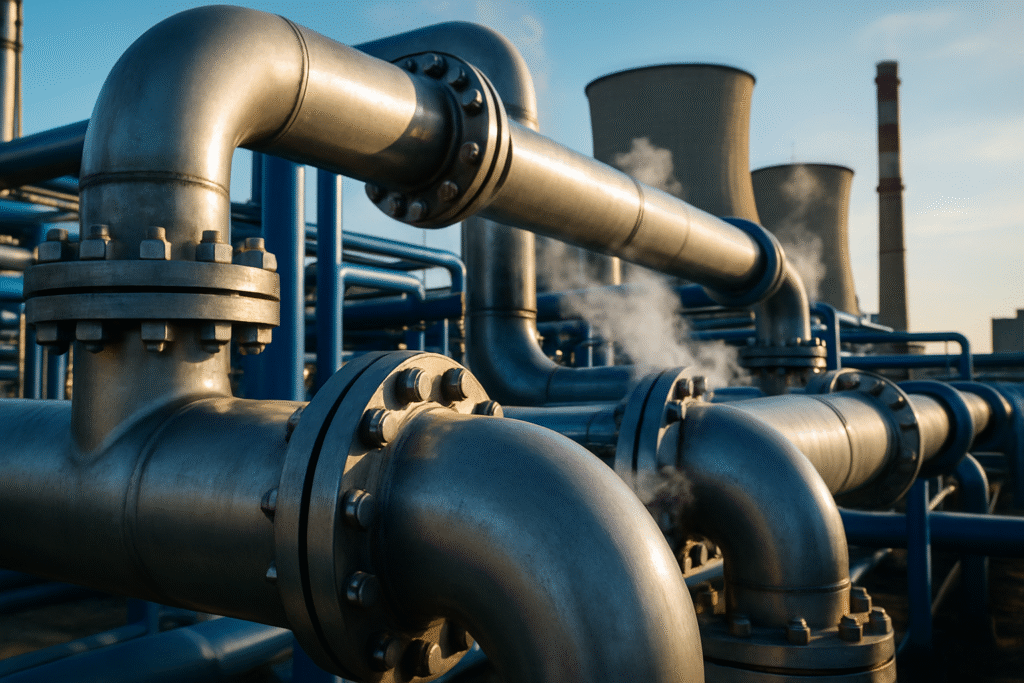
Rohrflansch aus Edelstahl: Vollständiger Leitfaden zu Typen, Verwendungsmöglichkeiten, Versteckte Vorteile und ASME B16.5/B16.47-Auswahl
Der Markt für Edelstahlrohrflansche wächst mit der weltweiten Nachfrage nach korrosionsbeständigen Rohrleitungskomponenten im gesamten Energiebereich, chemisch, und Meeressektoren. Laut Grand View Research (2024), Der globale Markt für Industrieflansche wurde mit bewertet $5.8 Milliarden in 2023 und wird voraussichtlich erreicht werden $7.2 Milliarden von 2030, which makes technical selection more important for buyers.
Für Beschaffungsteams und Rohrleitungsingenieure, the challenge is not simply to buy Stainless Steel flanges. The real task is to Choose the right material, Druckklasse, gegenüber, and standard for Different operating conditions while controlling lifecycle cost.
Industrial Market Trends Driving Stainless Steel Pipe Flange Demand
Demand for stainless steel pipe flange products continues to rise because operators want longer service life, geringerer Wartungsaufwand, and stronger compliance in aggressive environments. Laut IBISWorld (2024), Der asiatisch-pazifische Raum macht mehr als aus 45% der weltweiten Flanschproduktion, wobei China der größte Hersteller ist.
That regional concentration matters for international sourcing strategies. Es wirkt sich auf die Durchlaufzeiten aus, Rohstoffpreise, quality planning, and supplier qualification for EPC contractors and OEM buyers.
End-use concentration is equally significant. Laut Statista (2024), auf die Öl- und Gasindustrie entfallen ca 35% des weltweiten Flanschverbrauchs, which explains why ASME pressure-temperature performance and material traceability remain top purchasing criteria.
Darüber hinaus, stainless grades are gaining share in water treatment, Marine, and chemical processing because corrosion failures cost far more than the initial component premium. Laut Mordor-Geheimdienst (2024), corrosion-related maintenance can represent a high single-digit share of plant operating cost in process industries, especially in chloride-bearing systems.
Infolge, buyers increasingly prefer Complete supply partners that can provide flanges and fittings under one quality system. Hier ist SASA FLANGE fällt auf, mit ISO 9001:2015 und PED 2014/68/EU-Zertifizierungen, fortschrittliche CNC-Bearbeitung, and manufacturing capability across 304, 316, 316L, 904L, 2205, 2507, A182, Inconel, Monel, Hastelloy, und Titansorten.
Laut Market Research Future (2024), Wachstum bei der Entsalzung, Offshore-Plattformen, and high-purity industrial processing is supporting above-average demand for stainless and duplex flange assemblies. daher, buyers should review not only purchase price but also corrosion allowance, Schweißverträglichkeit, and documentation requirements such as EN 10204 3.1 Zertifikate.
Many competitor pages focus only on material names. Jedoch, experienced buyers need dimensions, Druckklassen, standard references, testing details, and practical Uses by sector.
Zusätzlich, international projects increasingly require harmonized compliance across ASME, DIN, und EN-Spezifikationen. Aus diesem Grund, suppliers serving export markets must demonstrate reliable dimensional control, PMI-Unterstützung, and inspection discipline from raw material receipt to final marking.
SASA FLANGE dient 50+ Länder in ganz Öl & Gas, Petrochemie, Leistung, Wasseraufbereitung, Konstruktion, und Marineindustrie. Außerdem, Das Unternehmen bietet maßgeschneiderte Größen an 1/2 Zoll zu 60 inch with factory-direct pricing, which supports both MRO replenishment and project procurement programs.
Flanschtypen für Edelstahlrohre, Materialien, und Einblicke in die technische Auswahl
A stainless steel pipe flange may look simple, yet flange performance depends on several combined factors. Materialchemie, Druckklasse, Verblendungstyp, Bohrungsausrichtung, Dichtungskompatibilität, and bolt load all influence leakage risk and total service life.
Als Dr. John Sedriks, corrosion specialist and metallurgical author, Staaten: “Stainless steels perform best when alloy selection matches the environment, especially chloride level, Temperatur, und Herstellungsverfahren.” That principle is central when deciding between 304, 316, 321, 347, 904L, or duplex Stainless grades.
Gemäß ASTM- und ASME-Materialpraxis, Geschmiedete Edelstahlflansche werden üblicherweise darunter geliefert ASTM A182 for pressure-containing applications, while dimensions typically follow ASME B16.5 oder ASME B16.47 depending on size range and configuration (ASME, 2023). daher, engineering teams should not evaluate material grade in isolation.
Gemäß NACE-Korrosionsrichtlinie, chloride-rich service, sour media, and elevated temperature can sharply reduce the safe operating window of standard austenitic grades if specification is incomplete (NACE, 2023). Im Gegensatz, duplex and high-alloy stainless options often deliver lower lifecycle cost despite a higher initial unit price.
As piping engineer Gareth O’Brien, Senior Mechanical Consultant, Staaten: “The Hidden Advantages in flange selection usually come from preventing one shutdown, not saving a few dollars on the purchase order.” That is especially true in offshore platforms, refinery turnaround work, und hochreine Prozesslinien.
Common stainless steel pipe flange Types include the following:
- Vorschweißflansch für Hochdruck, hohe Temperatur, und zyklischer Dienst.
- Slip-on flange for moderate pressure systems with easier alignment during installation.
- Socket weld flange for small-bore high-pressure piping.
- Threaded flange for low-pressure or non-weldable field conditions.
- Blindflansch zur Leitungsisolierung, Hydrotest, und zukünftige Erweiterungspunkte.
- Überlappungsflansch für Systeme, die häufig demontiert werden müssen.
Material selection should match the actual fluid and service envelope. The Different grades below are often specified for industrial piping projects:
- 304/304L: Allgemeine Korrosionsbeständigkeit, good formability, and wide availability.
- 316/316L: Added molybdenum improves pitting resistance in chlorides and marine environments.
- 321 Und 347: Stabilized grades for elevated temperature service and reduced sensitization risk.
- 904L: Strong resistance in aggressive acids and severe chloride exposure.
- 2205 Duplex: Higher strength and improved chloride stress corrosion cracking resistance.
- 2507 Super-Duplex: Preferred for offshore, Meerwasser, and severe corrosion duty.
From a specification standpoint, 304 Und 316 remain the most frequently requested materials for commercial and industrial service. Jedoch, they should not be treated as interchangeable when chloride concentration, Temperatur, or required PREN value becomes critical.
According to industry pricing benchmarks tracked by procurement analysts, 316/316L flanges often carry a material premium of roughly 15% Zu 30% over 304/304L depending on nickel and molybdenum market movement (IBISWorld, 2024). Trotzdem, that premium can be justified quickly in coastal or chemical environments.
Pressure class also affects performance and project cost. ASME B16.5 deckt den NPS ab 1/2 durch 24 with pressure classes from 150 Zu 2500, während ASME B16.47 generally covers larger diameter flanges from NPS 26 durch 60 in Series A and Series B configurations (ASME, 2023).
For engineers comparing ASME B16.5 und B16.47, the most practical Difference is size range and bolt pattern. Series A usually has thicker, heavier flanges with fewer larger bolts, while Series B is often optimized for lower weight and legacy compatibility.
Facing choice is another key decision. Raised Face is common for steel piping systems, Ring Type Joint is preferred for high-pressure critical service, and Flat Face is often used when mating to cast iron or flat-faced equipment nozzles.
Buyers also need to verify welding and inspection requirements early. Zum Beispiel, projects may require ferrite control, PMI, Härteprüfung, Hydrotest-Unterstützung, or surface finish confirmation for gasket seating performance.
Unterstützt durch fortschrittliche CNC-Bearbeitung und umfassende Qualitätsprüfungen, SASA FLANGE supplies stainless steel flanges and matching elbows, T-Shirts, Reduzierstücke, und Kappen, um die Paketbeschaffung zu vereinfachen. Zusätzlich, the company supports ANSI B16.5, ANSI B16.47, ASME B16.9, DIN, JIS, GOST, und EN 1092 dimensions for export-focused buyers.
When a project requires custom drilling, nicht standardmäßige Dicke, or alloy upgrades, supplier flexibility matters as much as catalog range. daher, buyers should confirm raw material traceability, machining tolerance capability, and final documentation before issuing the purchase order.
ASME, ASTM, DIN, und EN-Normen für die Konformität von Edelstahlrohrflanschen
Standards compliance is the foundation of safe flange procurement. Without correct dimensional, Material, and test references, even a well-machined flange can create installation mismatch or pressure integrity problems.
The most frequently cited dimensional standard in global industrial piping is ASME B16,5 für NPS 1/2 Zu 24. Für größere Durchmesser, ASME B16.47 definiert Dimensionen, Toleranzen, facings, Bohren, and pressure classes for large-size flanges.
ASTM-Spezifikationen definieren Materialchemie und mechanische Eigenschaften. Für geschmiedete Edelstahlflansche, ASTM A182 ist üblich, während ASTM A240 often applies to plate products used in some fabricated components.
European and international projects may call for DIN or EN 1092 flange dimensions instead of ASME patterns. daher, engineering teams must verify drilling, Druckbezeichnung, and face compatibility before mixing systems.
Zu den wichtigsten Standards und Compliance-Referenzen gehören::
- ASME B16.5: Rohrflansche und Flanschverbindungen, NPS 1/2 Zu 24.
- ASME B16.47: Stahlflansche mit großem Durchmesser, NPS 26 Zu 60.
- ASME B16.9: Fabrikgefertigte Formstücke zum Stumpfschweißen.
- ASTM A182: Geschmiedete oder gewalzte Rohrflansche aus Legierung und Edelstahl sowie geschmiedete Fittings.
- EN 1092: Flanges and their joints for European applications.
- NACE MR0175/ISO 15156: Materials for H2S-containing environments in oil and gas production.
- PED 2014/68/EU: Pressure Equipment Directive for EU market compliance.
Comparison points buyers should confirm before placing orders:
- Nominal size and schedule bore match.
- Druckklasse oder PN-Bewertung.
- Verblendungstyp wie RF, FF, RTJ, or tongue and groove.
- Bolt hole quantity, Durchmesser, and pitch circle.
- Material grade and heat treatment status.
- Certificate package including EN 10204 3.1.
Gemäß ISO-Qualitätsmanagementrichtlinien, documented control of traceability, Kalibrierung, and inspection records directly improves repeatability in pressure equipment manufacturing (ISO, 2023). That is why procurement teams increasingly prefer suppliers with formal quality systems and export compliance experience.
For projects entering the EU, PED documentation can be as important as the flange itself. Ähnlich, sour service or offshore packages may require NACE, DNV, or client-specific inspection plans for material approval.
SASA FLANGE integrates ISO 9001:2015, PED 2014/68/EU, und AD 2000 credentials into production and inspection workflows. Darüber hinaus, the company can support MTCs, Maßprüfung, PMI coordination, and project documentation for EPC and distributor customers through direct technical inquiry.
Procurement managers should also review the country of use and end-client specification before finalizing standards. A flange that meets ASTM chemistry but misses the required drilling pattern, pressure series, or inspection note can still fail project acceptance.
As materials engineer Robert Baboian, corrosion authority, Staaten: “Correct material selection and specification detail prevent most premature corrosion problems before the plant ever starts up.” In flange sourcing, that means standards, Papierkram, and machining discipline must align from the start.
How to Choose the Right Stainless Steel Pipe Flange for Different Industrial Uses
Die Auswahl des richtigen Edelstahlrohrflansches beginnt mit den Betriebsbedingungen, keine Katalogpräferenz. Ingenieure sollten die Flüssigkeitschemie bewerten, Auslegungsdruck, Auslegungstemperatur, Korrosionszuschlag, Wartungszugang, and expected shutdown cost.
Im Öl- und Gasservice, flange selection often centers on pressure class, saure Servicekompatibilität, and reliability under thermal cycling. Laut Statista (2024), Öl und Gas stellen ungefähr dar 35% des weltweiten Flanschverbrauchs, so flange failure prevention has clear commercial impact.
For petrochemical plants, 316L, 321, 347, 904L, or duplex grades may be selected depending on acid exposure, Chloridgehalt, and process temperature. Außerdem, weld neck flanges are often preferred for critical lines because they improve stress distribution at the hub-to-pipe transition.
Bei der Stromerzeugung, steam conditions and thermal fatigue can drive the need for stabilized or high-temperature alloys. daher, buyers must check not only material grade but also gasket system, Schraubenmaterial, and mating flange surface condition.
Marine and shipbuilding applications demand strong resistance to seawater splash, salt atmosphere, and intermittent wet-dry cycling. In diesen Umgebungen, 316L is often a practical baseline, während 2205 oder 2507 may be justified for severe chloride service or long design life.
Water treatment and desalination projects often evaluate life-cycle economics very closely. Laut Market Research Future (2024), desalination infrastructure investment is expanding steadily, which supports stronger demand for duplex stainless flanges and fittings in coastal markets.
Auswahlkriterien sollten Folgendes umfassen::
- Prozessmedium, einschließlich Chloride, Säuren, Sulfide, und Feststoffgehalt.
- Operating and upset temperature range.
- Pressure class and code design margin.
- Rohrgröße, Zeitplan, und Flanschtyp.
- Required standards such as ASME, EN, DIN, oder JIS.
- Inspection and documents including MTC, PMI, Härte, and NDE.
- Vorlaufzeit, Verpackung, and export marking requirements.
Practical guidance for common applications:
- Refinery high-pressure line: geschmiedet ASTM A182 F316L-Vorschweißflansch, ASME B16.5 Klasse 600 or above, RF or RTJ depending on service severity.
- Chemical dosing skid: slip-on or weld neck in 316L or 904L depending on chemical concentration and maintenance philosophy.
- Offshore seawater line: 2205 oder 2507 flange with strict PMI and traceability.
- Food and beverage process line: 304L or 316L with surface finish considerations and hygienic design compatibility.
- Large water transmission system: ASME B16.47 oder EN 1092 large-diameter flange with coating, Passivierung, and transport protection plan.
Many buyers also ask about price by size, especially for a 4 inch stainless steel pipe flange or a stainless steel threaded pipe flange. Unit price varies by grade, Druckklasse, gegenüber, Bearbeitungskomplexität, und erforderliche Dokumentation, so technical equivalence must be confirmed before comparison.
The Hidden Advantages of working with a capable manufacturer include consolidated sourcing, shorter clarification cycles, and better fit-up accuracy in the field. Those benefits reduce installation delays, gasket waste, and rework costs.
Für individuelle Projekte, SASA FLANGE can produce flanges, Ellenbogen, T-Shirts, Reduzierstücke, and caps in coordinated materials and dimensions. That makes it easier for buyers to standardize metallurgy and paperwork across one package instead of splitting procurement among multiple suppliers.
Zusätzlich, custom manufacturing support helps when a project needs non-standard bores, drilled blinds, spezielle Verkleidungen, or alloy upgrades. Buyers can Kontakt SASA FLANGE for technical review on dimensions, Materialien, and delivery planning before finalizing RFQs.
Zukunftsaussichten für die Beschaffung von Edelstahlrohrflanschen und strategische Empfehlungen
The outlook for stainless steel pipe flange demand remains positive as industrial operators invest in safer, langlebigere Rohrleitungssysteme. Laut Grand View Research (2024), Es wird erwartet, dass der Markt weiter wächst $5.8 Milliarden in 2023 Zu $7.2 Milliarden von 2030, unterstützt durch Energie, Infrastruktur, and process industry expansion.
Darüber hinaus, sourcing behavior is changing. Buyers increasingly prioritize quality documentation, stable lead times, Legierungsverfügbarkeit, and technical support over headline unit price alone.
Laut Mordor-Geheimdienst (2024), digital procurement and supplier consolidation are accelerating across industrial projects. Infolge, flange manufacturers that can provide Complete packages, material versatility, and export documentation will gain a competitive edge.
Strategic recommendations for procurement and engineering teams include:
- Standardize approved grades for each service environment.
- Angeben ASME B16.5 or B16.47 clearly, including facing and class.
- Require ASTM material references and EN 10204 3.1 Zertifizierung.
- Confirm PMI, Härte, or NACE needs before order placement.
- Vergleichen Sie die Lebenszykluskosten, nicht nur der Kaufpreis.
- Qualify suppliers on machining, Rückverfolgbarkeit, and responsiveness.
Kurzfristig, duplex and high-alloy flanges should see stronger adoption in offshore, Entsalzung, and aggressive chemical service. Jedoch, 304L and 316L will remain core commercial grades because of their broad availability and proven fabrication performance.
Für B2B-Käufer, the best results come from aligning engineering specifications with a manufacturer that understands Different global standards and project documentation. Mit breiter Materialabdeckung, Sondergrößen, and certified quality systems, SASA FLANGE is well positioned to support both routine replenishment and complex project orders through its engineering sales team.
Häufig gestellte Fragen
Was ist besser? 304 oder 420 Edelstahl?
●304 stainless steel is generally better for a stainless steel pipe flange because it offers stronger corrosion resistance and broader process-industry acceptance than 420, which is a martensitic grade used more often for hardness and wear applications.
●According to ASTM alloy classifications and common industrial material practice, 304 is an austenitic Stainless grade with excellent fabrication and welding performance, während 420 is selected when hardness is more important than corrosion resistance.
●For piping, chemisch, Wasser, and marine-adjacent Uses, most engineers Choose 304 oder 316 rather than 420 because flange reliability depends on corrosion behavior, gasket seating stability, and weld integrity under service conditions.
What is better, 304 oder 316 Edelstahl?
●316 Edelstahl ist normalerweise besser als 304 in chloride-bearing or marine environments because its molybdenum addition improves resistance to pitting and crevice corrosion.
●According to procurement cost tracking cited by IBISWorld (2024), 316 and 316L often cost roughly 15% Zu 30% more than 304 und 304L, but that premium may be justified by longer service life.
●For general indoor industrial service, 304 can be a cost-effective choice, while projects involving seawater, Chemikalien, or aggressive cleaning agents should often Choose 316 or 316L for a stainless steel pipe flange.
How can I tell if my stainless steel is 304 oder 316?
●The most reliable way to identify whether a flange is 304 oder 316 is to review the material test certificate and confirm the chemistry against ASTM A182 or the applicable material specification.
●Portable PMI testing is also widely used because it can quickly verify alloy composition and detect the molybdenum content that distinguishes 316 aus 304 in many field situations.
●Für kritische Projekte, buyers should avoid visual identification alone and request traceability, heat numbers, and inspection records from an established manufacturer such as SASA FLANGE.
Welche Temperatur wird 304 Edelstahl standhalten?
●304 stainless steel can handle high intermittent temperatures, but exact limits depend on pressure, Laden, oxidation conditions, and whether the application risks sensitization during prolonged exposure.
●In many industrial references, 304 is used effectively below about 800°F for general service, while elevated-temperature duty may call for 304H or other alloys better suited to sustained heat exposure.
●Engineers should verify both temperature and environment together because a stainless steel pipe flange exposed to heat, Chloride, and cyclic loading may require a Different grade than one used in dry service.
What are the main stainless steel flange types used in industrial piping?
●Die wichtigsten Edelstahlflanschtypen sind Schweißhalsflansche, Slip-on, Muffenschweißen, mit Gewinde, Überlappungsgelenk, und blind, and each design serves Different installation and pressure requirements.
●ASME B16.5 deckt viele dieser Konfigurationen für NPS ab 1/2 durch 24, während ASME B16.47 applies to larger diameters that are common in water transmission and process plants.
●For critical pressure service, buyers typically Choose weld neck designs, while blind flanges are used for isolation and threaded flanges are often selected for small-bore or non-welded connections.
What standards apply to stainless steel pipe flange dimensions and materials?
●ASME B16.5 Und ASME B16.47 are the key dimensional standards for steel flanges, während ASTM A182 is one of the most common material standards for forged Stainless flanges.
●Für europäische Projekte ist möglicherweise auch EN erforderlich 1092 oder DIN-Maße, so bolt pattern, Druckbezeichnung, and face type must be checked carefully before mixing standards.
●Für den Export oder regulierte Projekte, buyers should specify the exact code, Grad, Klasse, gegenüber, and documentation package at the RFQ stage to avoid mismatch and approval delays.
Verwandte Beiträge
Flanschoberflächenfinish: Konzentrische vs. spiralförmige Verzahnungen erklärt
Konzentrische und spiralförmige Verzahnungen sind beide bearbeitete Flanschflächenoberflächen…
Duplex 2205 vs. 316L-Flansche: Welches Material sollten Sie wählen??
Schnelle Antwort: Duplex 2205 Flansche sind normalerweise der stärkere Kandidat…

Definition des Öffnungsflansches, Details und Übersicht über ASME B16.36-Flansche: Marktdaten, Auswahlhilfe und Compliance-Einblicke
Der globale Markt für Industrieflansche wurde mit bewertet $5.8 Milliarde…

Marktführer für schwarze Entsorgungsflansche: Materialien, 3.5″ Kompatibilität, und B2B-Beschaffungsdaten für Küchenspülenflansche
Die Nachfrage nach schwarzen Entsorgungsflanschen steigt bei Käufern von Küchenarmaturen…