
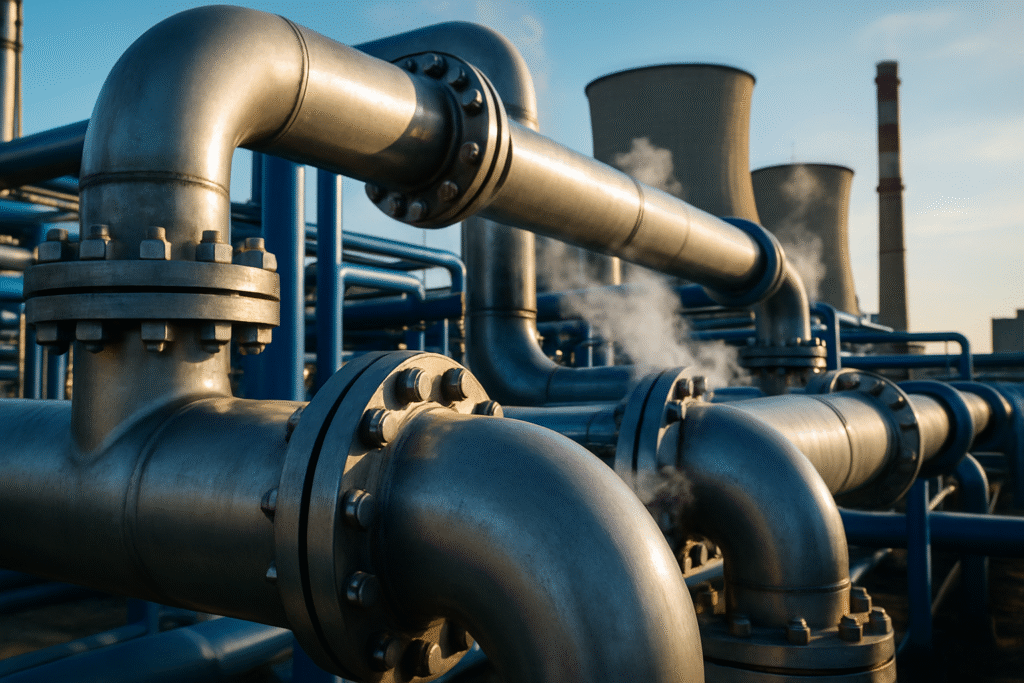
Flensa Pipa Baja Tahan Karat: Panduan Lengkap untuk Jenis, Kegunaan, Keuntungan Tersembunyi dan Seleksi ASME B16.5/B16.47
Pasar flensa pipa baja tahan karat berkembang seiring dengan permintaan global akan komponen pipa tahan korosi di seluruh energi, kimia, dan sektor kelautan. Menurut Penelitian Grand View (2024), pasar flensa industri global dihargai $5.8 miliar masuk 2023 dan diperkirakan akan tercapai $7.2 miliar oleh 2030, which makes technical selection more important for buyers.
Untuk tim pengadaan dan insinyur perpipaan, the challenge is not simply to buy Stainless Steel flanges. The real task is to Choose the right material, kelas tekanan, menghadap, and standard for Different operating conditions while controlling lifecycle cost.
Industrial Market Trends Driving Stainless Steel Pipe Flange Demand
Demand for stainless steel pipe flange products continues to rise because operators want longer service life, pemeliharaan yang lebih rendah, and stronger compliance in aggressive environments. Menurut IBISWorld (2024), Asia-Pasifik menyumbang lebih dari itu 45% produksi flensa global, dengan Tiongkok sebagai produsen terbesar.
That regional concentration matters for international sourcing strategies. Ini mempengaruhi waktu tunggu, penetapan harga bahan baku, quality planning, and supplier qualification for EPC contractors and OEM buyers.
End-use concentration is equally significant. Menurut Statista (2024), industri minyak dan gas menyumbang sekitar 35% konsumsi flensa global, which explains why ASME pressure-temperature performance and material traceability remain top purchasing criteria.
Lebih-lebih lagi, stainless grades are gaining share in water treatment, laut, and chemical processing because corrosion failures cost far more than the initial component premium. Menurut Intelijen Mordor (2024), corrosion-related maintenance can represent a high single-digit share of plant operating cost in process industries, especially in chloride-bearing systems.
Sebagai akibat, buyers increasingly prefer Complete supply partners that can provide flanges and fittings under one quality system. Di sinilah SASA FLANGE menonjol, dengan ISO 9001:2015 dan sertifikasi PED 2014/68/EU, mesin CNC canggih, and manufacturing capability across 304, 316, 316L, 904L, 2205, 2507, A182, tidak konel, Monel, Hastelloy, dan nilai Titanium.
Menurut Riset Pasar Masa Depan (2024), pertumbuhan desalinasi, platform lepas pantai, and high-purity industrial processing is supporting above-average demand for stainless and duplex flange assemblies. Karena itu, buyers should review not only purchase price but also corrosion allowance, kompatibilitas pengelasan, dan persyaratan dokumentasi seperti EN 10204 3.1 sertifikat.
Many competitor pages focus only on material names. Namun, experienced buyers need dimensions, kelas tekanan, standard references, testing details, and practical Uses by sector.
Selain itu, international projects increasingly require harmonized compliance across ASME, DIN, dan spesifikasi EN. Untuk alasan itu, suppliers serving export markets must demonstrate reliable dimensional control, dukungan PMI, and inspection discipline from raw material receipt to final marking.
SASA FLANGE melayani 50+ negara-negara di seluruh Minyak & Gas, Petrokimia, Kekuatan, Pengolahan Air, Konstruksi, dan industri Kelautan. Lebih-lebih lagi, perusahaan menawarkan ukuran khusus dari 1/2 inci ke 60 inch with factory-direct pricing, which supports both MRO replenishment and project procurement programs.
Jenis Flange Pipa Stainless Steel, Bahan, dan Wawasan Seleksi Teknis
Flensa pipa stainless steel mungkin terlihat sederhana, yet flange performance depends on several combined factors. Kimia bahan, kelas tekanan, tipe menghadap, penyelarasan lubang, kompatibilitas paking, and bolt load all influence leakage risk and total service life.
Sebagai Dr. John Sedriks, corrosion specialist and metallurgical author, negara bagian: “Stainless steels perform best when alloy selection matches the environment, especially chloride level, suhu, dan metode fabrikasi.” That principle is central when deciding between 304, 316, 321, 347, 904L, or duplex Stainless grades.
Menurut praktik materi ASTM dan ASME, forged stainless flanges are commonly supplied under ASTM A182 for pressure-containing applications, while dimensions typically follow ASME B16.5 atau ASME B16.47 depending on size range and configuration (ASME, 2023). Karena itu, engineering teams should not evaluate material grade in isolation.
Menurut panduan korosi NACE, chloride-rich service, media asam, and elevated temperature can sharply reduce the safe operating window of standard austenitic grades if specification is incomplete (NACE, 2023). Sebaliknya, duplex and high-alloy stainless options often deliver lower lifecycle cost despite a higher initial unit price.
As piping engineer Gareth O’Brien, Senior Mechanical Consultant, negara bagian: “The Hidden Advantages in flange selection usually come from preventing one shutdown, not saving a few dollars on the purchase order.” That is especially true in offshore platforms, refinery turnaround work, dan jalur proses dengan kemurnian tinggi.
Jenis flensa pipa baja tahan karat yang umum meliputi yang berikut ini:
- Flensa leher las untuk tekanan tinggi, suhu tinggi, dan layanan siklik.
- Slip-on flange for moderate pressure systems with easier alignment during installation.
- Flensa las soket untuk pipa bertekanan tinggi dengan lubang kecil.
- Threaded flange for low-pressure or non-weldable field conditions.
- Flensa buta untuk isolasi saluran, uji hidro, dan titik ekspansi di masa depan.
- Flensa sambungan pangkuan untuk sistem yang perlu sering dibongkar.
Material selection should match the actual fluid and service envelope. The Different grades below are often specified for industrial piping projects:
- 304/304L: Ketahanan korosi secara umum, sifat mampu bentuk yang baik, and wide availability.
- 316/316L: Added molybdenum improves pitting resistance in chlorides and marine environments.
- 321 Dan 347: Stabilized grades for elevated temperature service and reduced sensitization risk.
- 904L: Strong resistance in aggressive acids and severe chloride exposure.
- 2205 rangkap: Higher strength and improved chloride stress corrosion cracking resistance.
- 2507 super dupleks: Preferred for offshore, air laut, and severe corrosion duty.
From a specification standpoint, 304 Dan 316 remain the most frequently requested materials for commercial and industrial service. Namun, they should not be treated as interchangeable when chloride concentration, suhu, or required PREN value becomes critical.
According to industry pricing benchmarks tracked by procurement analysts, 316/316L flanges often carry a material premium of roughly 15% ke 30% over 304/304L depending on nickel and molybdenum market movement (Dunia IBIS, 2024). Namun demikian, that premium can be justified quickly in coastal or chemical environments.
Pressure class also affects performance and project cost. ASME B16.5 mencakup NPS 1/2 melalui 24 with pressure classes from 150 ke 2500, ketika ASME B16.47 generally covers larger diameter flanges from NPS 26 melalui 60 dalam konfigurasi Seri A dan Seri B (ASME, 2023).
For engineers comparing ASME B16.5 dan B16.47, the most practical Difference is size range and bolt pattern. Series A usually has thicker, heavier flanges with fewer larger bolts, while Series B is often optimized for lower weight and legacy compatibility.
Facing choice is another key decision. Raised Face is common for steel piping systems, Ring Type Joint is preferred for high-pressure critical service, and Flat Face is often used when mating to cast iron or flat-faced equipment nozzles.
Buyers also need to verify welding and inspection requirements early. Misalnya, projects may require ferrite control, PMI, pengujian kekerasan, dukungan uji hidro, or surface finish confirmation for gasket seating performance.
Didukung oleh permesinan CNC canggih dan pengujian kualitas yang komprehensif, SASA FLANGE supplies stainless steel flanges and matching elbows, kaos, reduksi, dan batas untuk menyederhanakan sumber paket. Selain itu, the company supports ANSI B16.5, ANSI B16.47, ASME B16.9, DIN, JIS, gost, dan EN 1092 dimensions for export-focused buyers.
When a project requires custom drilling, ketebalan non-standar, or alloy upgrades, supplier flexibility matters as much as catalog range. Karena itu, buyers should confirm raw material traceability, machining tolerance capability, and final documentation before issuing the purchase order.
ASME, ASTM, DIN, dan Standar EN untuk Kepatuhan Flange Pipa Stainless Steel
Kepatuhan terhadap standar adalah dasar dari pengadaan flensa yang aman. Without correct dimensional, bahan, and test references, even a well-machined flange can create installation mismatch or pressure integrity problems.
The most frequently cited dimensional standard in global industrial piping is ASME B16.5 untuk NPC 1/2 ke 24. Untuk diameter lebih besar, ASME B16.47 mendefinisikan dimensi, toleransi, menghadap, pengeboran, and pressure classes for large-size flanges.
ASTM specifications define material chemistry and mechanical properties. Untuk flensa tahan karat palsu, ASTM A182 adalah hal yang umum, ketika ASTM A240 often applies to plate products used in some fabricated components.
European and international projects may call for DIN or EN 1092 flange dimensions instead of ASME patterns. Karena itu, engineering teams must verify drilling, penunjukan tekanan, and face compatibility before mixing systems.
Standar utama dan referensi kepatuhan mencakup:
- ASME B16.5: Flensa pipa dan alat kelengkapan flensa, NPC 1/2 ke 24.
- ASME B16.47: Flensa baja berdiameter besar, NPC 26 ke 60.
- ASME B16.9: Perlengkapan las pantat tempa buatan pabrik.
- ASTM A182: Flensa pipa baja tahan karat dan paduan tempa atau canai serta alat kelengkapan tempa.
- EN 1092: Flanges and their joints for European applications.
- NACE MR0175/ISO 15156: Materials for H2S-containing environments in oil and gas production.
- PED 2014/68/UE: Pressure Equipment Directive for EU market compliance.
Comparison points buyers should confirm before placing orders:
- Nominal size and schedule bore match.
- Kelas tekanan atau peringkat PN.
- Tipe menghadap seperti RF, FF, RTJ, or tongue and groove.
- Bolt hole quantity, diameter, and pitch circle.
- Material grade and heat treatment status.
- Certificate package including EN 10204 3.1.
Menurut panduan manajemen mutu ISO, documented control of traceability, kalibrasi, and inspection records directly improves repeatability in pressure equipment manufacturing (ISO, 2023). That is why procurement teams increasingly prefer suppliers with formal quality systems and export compliance experience.
For projects entering the EU, PED documentation can be as important as the flange itself. Demikian pula, sour service or offshore packages may require NACE, DNV, or client-specific inspection plans for material approval.
SASA FLANGE integrates ISO 9001:2015, PED 2014/68/UE, dan IKLAN 2000 credentials into production and inspection workflows. Lebih-lebih lagi, the company can support MTCs, pemeriksaan dimensi, PMI coordination, and project documentation for EPC and distributor customers through direct technical inquiry.
Procurement managers should also review the country of use and end-client specification before finalizing standards. A flange that meets ASTM chemistry but misses the required drilling pattern, pressure series, or inspection note can still fail project acceptance.
As materials engineer Robert Baboian, corrosion authority, negara bagian: “Correct material selection and specification detail prevent most premature corrosion problems before the plant ever starts up.” In flange sourcing, that means standards, dokumen, and machining discipline must align from the start.
How to Choose the Right Stainless Steel Pipe Flange for Different Industrial Uses
Memilih flensa pipa stainless steel yang tepat dimulai dengan kondisi servis, bukan preferensi katalog. Insinyur harus mengevaluasi kimia fluida, tekanan desain, suhu desain, tunjangan korosi, akses pemeliharaan, and expected shutdown cost.
Dalam layanan minyak dan gas, flange selection often centers on pressure class, kompatibilitas layanan asam, and reliability under thermal cycling. Menurut Statista (2024), minyak dan gas mewakili sekitar 35% konsumsi flensa global, so flange failure prevention has clear commercial impact.
For petrochemical plants, 316L, 321, 347, 904L, or duplex grades may be selected depending on acid exposure, kadar klorida, dan suhu proses. Lebih-lebih lagi, weld neck flanges are often preferred for critical lines because they improve stress distribution at the hub-to-pipe transition.
Dalam pembangkit listrik, steam conditions and thermal fatigue can drive the need for stabilized or high-temperature alloys. Karena itu, buyers must check not only material grade but also gasket system, bahan baut, and mating flange surface condition.
Marine and shipbuilding applications demand strong resistance to seawater splash, salt atmosphere, and intermittent wet-dry cycling. Di lingkungan ini, 316L is often a practical baseline, ketika 2205 atau 2507 may be justified for severe chloride service or long design life.
Water treatment and desalination projects often evaluate life-cycle economics very closely. Menurut Riset Pasar Masa Depan (2024), desalination infrastructure investment is expanding steadily, which supports stronger demand for duplex stainless flanges and fittings in coastal markets.
Kriteria seleksi harus mencakup:
- Media proses, termasuk klorida, asam, sulfida, dan kandungan padatan.
- Operating and upset temperature range.
- Pressure class and code design margin.
- Ukuran pipa, jadwal, dan tipe flensa.
- Required standards such as ASME, EN, DIN, atau JIS.
- Inspection and documents including MTC, PMI, kekerasan, and NDE.
- Waktu memimpin, kemasan, and export marking requirements.
Practical guidance for common applications:
- Refinery high-pressure line: tertempa ASTM A182 Flensa leher las F316L, ASME B16.5 Kelas 600 or above, RF or RTJ depending on service severity.
- Selip dosis kimia: slip-on or weld neck in 316L or 904L depending on chemical concentration and maintenance philosophy.
- Offshore seawater line: 2205 atau 2507 flange with strict PMI and traceability.
- Food and beverage process line: 304L or 316L with surface finish considerations and hygienic design compatibility.
- Large water transmission system: ASME B16.47 atau EN 1092 large-diameter flange with coating, pasif, and transport protection plan.
Many buyers also ask about price by size, especially for a 4 inch stainless steel pipe flange or a stainless steel threaded pipe flange. Unit price varies by grade, kelas tekanan, menghadap, kompleksitas pemesinan, dan dokumentasi yang diperlukan, so technical equivalence must be confirmed before comparison.
The Hidden Advantages of working with a capable manufacturer include consolidated sourcing, shorter clarification cycles, and better fit-up accuracy in the field. Those benefits reduce installation delays, gasket waste, and rework costs.
Untuk proyek khusus, SASA FLANGE can produce flanges, siku, kaos, reduksi, and caps in coordinated materials and dimensions. That makes it easier for buyers to standardize metallurgy and paperwork across one package instead of splitting procurement among multiple suppliers.
Selain itu, custom manufacturing support helps when a project needs non-standard bores, drilled blinds, permukaan khusus, or alloy upgrades. Buyers can kontak SASA FLANGE for technical review on dimensions, bahan, and delivery planning before finalizing RFQs.
Prospek Masa Depan Pengadaan Flange Pipa Stainless Steel dan Rekomendasi Strategis
The outlook for stainless steel pipe flange demand remains positive as industrial operators invest in safer, sistem perpipaan yang lebih tahan lama. Menurut Penelitian Grand View (2024), pasar diperkirakan akan tumbuh $5.8 miliar masuk 2023 ke $7.2 miliar oleh 2030, didukung oleh energi, infrastruktur, dan perluasan industri proses.
Lebih-lebih lagi, sourcing behavior is changing. Buyers increasingly prioritize quality documentation, waktu tunggu yang stabil, ketersediaan paduan, and technical support over headline unit price alone.
Menurut Intelijen Mordor (2024), digital procurement and supplier consolidation are accelerating across industrial projects. Sebagai akibat, flange manufacturers that can provide Complete packages, material versatility, and export documentation will gain a competitive edge.
Strategic recommendations for procurement and engineering teams include:
- Standardize approved grades for each service environment.
- Menentukan ASME B16.5 or B16.47 clearly, including facing and class.
- Require ASTM material references and EN 10204 3.1 sertifikasi.
- Confirm PMI, kekerasan, or NACE needs before order placement.
- Bandingkan biaya siklus hidup, tidak hanya harga beli.
- Qualify suppliers on machining, ketertelusuran, dan daya tanggap.
Dalam waktu dekat, duplex and high-alloy flanges should see stronger adoption in offshore, desalinasi, and aggressive chemical service. Namun, 304L and 316L will remain core commercial grades because of their broad availability and proven fabrication performance.
Untuk pembeli B2B, the best results come from aligning engineering specifications with a manufacturer that understands Different global standards and project documentation. Dengan cakupan materi yang luas, ukuran khusus, and certified quality systems, SASA FLANGE is well positioned to support both routine replenishment and complex project orders through its engineering sales team.
Pertanyaan yang Sering Diajukan
Mana yang lebih baik 304 atau 420 baja tahan karat?
●304 stainless steel is generally better for a stainless steel pipe flange because it offers stronger corrosion resistance and broader process-industry acceptance than 420, which is a martensitic grade used more often for hardness and wear applications.
●According to ASTM alloy classifications and common industrial material practice, 304 is an austenitic Stainless grade with excellent fabrication and welding performance, ketika 420 is selected when hardness is more important than corrosion resistance.
●For piping, kimia, air, and marine-adjacent Uses, most engineers Choose 304 atau 316 rather than 420 because flange reliability depends on corrosion behavior, gasket seating stability, and weld integrity under service conditions.
What is better, 304 atau 316 baja tahan karat?
●316 baja tahan karat biasanya lebih baik daripada 304 in chloride-bearing or marine environments because its molybdenum addition improves resistance to pitting and crevice corrosion.
●According to procurement cost tracking cited by IBISWorld (2024), 316 and 316L often cost roughly 15% ke 30% more than 304 dan 304L, but that premium may be justified by longer service life.
●For general indoor industrial service, 304 can be a cost-effective choice, while projects involving seawater, bahan kimia, or aggressive cleaning agents should often Choose 316 or 316L for a stainless steel pipe flange.
How can I tell if my stainless steel is 304 atau 316?
●The most reliable way to identify whether a flange is 304 atau 316 is to review the material test certificate and confirm the chemistry against ASTM A182 or the applicable material specification.
●Portable PMI testing is also widely used because it can quickly verify alloy composition and detect the molybdenum content that distinguishes 316 dari 304 in many field situations.
●Untuk proyek-proyek penting, buyers should avoid visual identification alone and request traceability, angka panas, and inspection records from an established manufacturer such as SASA FLANGE.
Berapa suhu yang akan terjadi 304 tahan baja tahan karat?
●304 stainless steel can handle high intermittent temperatures, but exact limits depend on pressure, memuat, oxidation conditions, and whether the application risks sensitization during prolonged exposure.
●Dalam banyak referensi industri, 304 is used effectively below about 800°F for general service, while elevated-temperature duty may call for 304H or other alloys better suited to sustained heat exposure.
●Engineers should verify both temperature and environment together because a stainless steel pipe flange exposed to heat, klorida, and cyclic loading may require a Different grade than one used in dry service.
What are the main stainless steel flange types used in industrial piping?
●The main stainless steel flange Types are weld neck, tergelincir, las soket, berulir, sambungan pangkuan, dan buta, and each design serves Different installation and pressure requirements.
●ASME B16.5 mencakup banyak konfigurasi ini untuk NPS 1/2 melalui 24, ketika ASME B16.47 applies to larger diameters that are common in water transmission and process plants.
●For critical pressure service, buyers typically Choose weld neck designs, while blind flanges are used for isolation and threaded flanges are often selected for small-bore or non-welded connections.
What standards apply to stainless steel pipe flange dimensions and materials?
●ASME B16.5 Dan ASME B16.47 are the key dimensional standards for steel flanges, ketika ASTM A182 is one of the most common material standards for forged Stainless flanges.
●Proyek-proyek Eropa mungkin juga memerlukan EN 1092 atau dimensi DIN, so bolt pattern, penunjukan tekanan, and face type must be checked carefully before mixing standards.
●Untuk proyek ekspor atau yang diatur, buyers should specify the exact code, nilai, kelas, menghadap, and documentation package at the RFQ stage to avoid mismatch and approval delays.
Posting Terkait
Selesai Wajah Flange: Penjelasan Gerigi Konsentris vs Spiral
Gerigi konsentris dan spiral keduanya merupakan penyelesaian permukaan flensa yang dikerjakan dengan mesin…
Rangkap 2205 vs Flensa 316L: Bahan Mana Yang Harus Anda Pilih?
Jawaban cepat: Rangkap 2205 flensa biasanya merupakan kandidat yang lebih kuat…

Definisi Flensa Lubang, Detail dan Ikhtisar Flensa ASME B16.36: Data Pasar, Panduan Seleksi dan Wawasan Kepatuhan
Pasar flensa industri global dihargai $5.8 miliar…

Panduan Pasar Flensa Pembuangan Hitam: Bahan, 3.5″ Kesesuaian, dan Data Sumber B2B untuk Flensa Wastafel Dapur
Permintaan flensa pembuangan hitam meningkat sebagai pembeli perlengkapan dapur…