
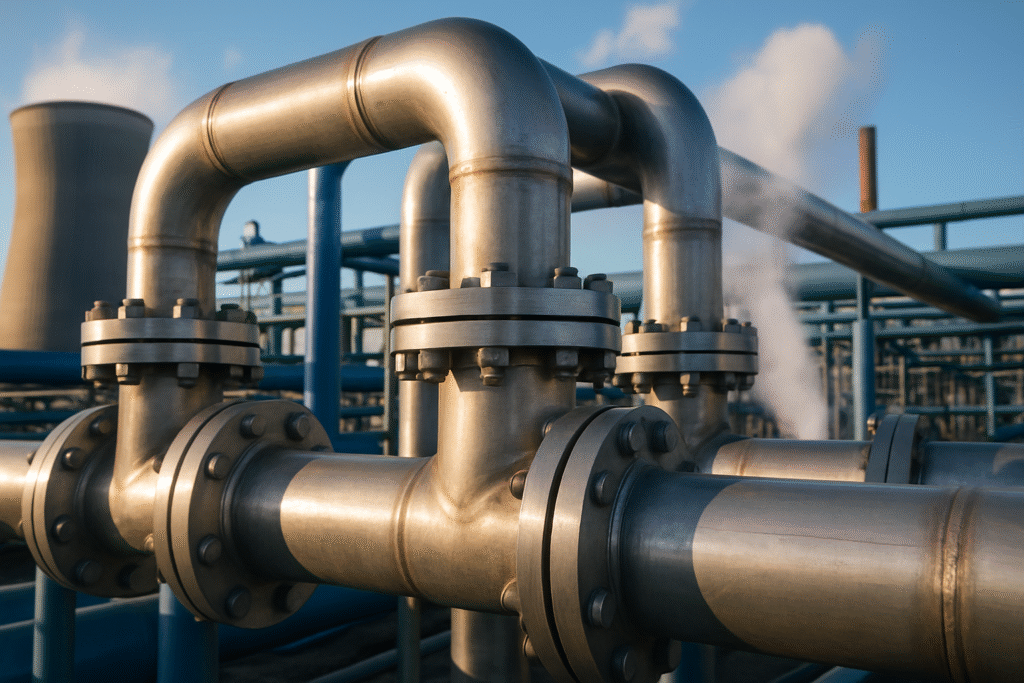
Materialauswahl für Edelstahlflansche für industrielle Rohrleitungen
Laut Grand View Research (2024), Der globale Markt für Industrieflansche wurde mit bewertet $5.8 Milliarden in 2023 und wird voraussichtlich erreicht werden $7.2 Milliarden von 2030. That growth highlights why the stainless steel pipe flange has become a strategic component for engineers, EPC-Auftragnehmer, and procurement teams seeking long service life, Korrosionsbeständigkeit, and predictable compliance in critical piping systems.
In today’s process industries, buyers are not only comparing price. They are evaluating material traceability, Druckklasse, Inspektionsumfang, und Lieferantenzuverlässigkeit. daher, understanding the Hidden Advantages, Typen, Verwendungsmöglichkeiten, and how to Choose Flanges? is essential for safe and cost-effective applications.
Industrielle Nachfragetrends prägen die Beschaffung von Edelstahlrohrflanschen
Industrial demand for stainless steel flanges continues to rise across energy, Wasser, Marine, and chemical sectors. Laut Statista (2024), auf die Öl- und Gasindustrie entfallen ca 35% des weltweiten Flanschverbrauchs, which makes flange reliability a direct factor in plant uptime and maintenance budgets.
Regional manufacturing capacity also influences sourcing decisions. Laut IBISWorld (2024), Der asiatisch-pazifische Raum macht mehr als aus 45% der weltweiten Flanschproduktion, wobei China der größte Hersteller ist. Infolge, global buyers increasingly look to qualified Chinese manufacturers with strong quality systems and export documentation.
That shift is not only about cost. It is also about lead time, Bearbeitungskapazität, and access to a wider material portfolio. Für Projekte, die Folgendes erfordern ASTM A182 F304/F316, Duplex 2205, Super-Duplex 2507, oder Nickellegierungen, supply chain depth matters as much as unit price.
Laut Mordor-Geheimdienst (2024), global investment in industrial water treatment and desalination infrastructure continues to accelerate, particularly in Asia and the Middle East. daher, demand for corrosion resistant flanges in 316L, 904L, and duplex grades is expanding beyond traditional refinery and upstream applications.
Buyers also expect more from a flange supplier than dimensional conformity. Sie wollen EN 10204 3.1 Zertifizierung, PMI, hydrostatische oder pneumatische Prüfunterstützung, Härteprüfung bei Bedarf, and complete compliance with ASME B16.5, ASME B16.47, DIN, JIS, GOST, oder EN 1092 Abmessungen.
As piping engineer Mark Reynolds, Leitender Rohrleitungsberater, Staaten: “A flange is a small percentage of project cost, but a large percentage of joint risk. Material mismatch or dimensional deviation can create delays far beyond the original purchase value.” That observation reflects the reality faced by EPC teams managing shutdown windows and construction schedules.
Within this environment, SASA FLANGE positions itself as a factory-focused manufacturer serving Oil & Gas, Petrochemie, Stromerzeugung, Schiffbau & Marine, Wasseraufbereitung, und Baumärkte. Mit ISO 9001:2015 und PED 2014/68/EU-Zertifizierungen, the company supports export projects that require disciplined quality control and international compliance.
Darüber hinaus, SASA FLANGE stellt Edelstahlflansche her, Flansche aus Kohlenstoffstahl, Flansche aus Legierung, und Rohrverbindungsstücke einschließlich Winkelstücke, T-Shirts, Reduzierstücke, und Mützen. Herstellung von Flanschen in 304, 316, 316L, 904L, 2205, 2507, A105, A182, Inconel, Monel, Hastelloy, and Titanium gives procurement teams a broader sourcing base from a single industrial partner.
Für Käufer, die Lieferanten vergleichen, factory capability should be reviewed against project complexity. Unterstützt durch fortschrittliche CNC-Bearbeitung und umfassende Qualitätsprüfungen, suppliers that can control tolerances, Verkleidungsende, and marking consistency reduce downstream installation risk. That is especially important for raised face, Ringverbindung, and custom drilling requirements.
Zusätzlich, laut Market Research Future (2024), industrial process modernization is increasing demand for higher integrity piping components in plants adopting predictive maintenance and digital asset management. In praktischer Hinsicht, that means flanges with verified metallurgy and repeatable dimensions are becoming more valuable, not less.
Flanschtypen für Edelstahlrohre, Versteckte Vorteile, and Material Selection Criteria
The most Intriguing aspect of stainless steel pipe flange selection is that the right grade and design can extend service life far beyond the apparent purchase premium. Stainless materials offer strong resistance to oxidation, media attack, und Kontamination, while also supporting hygienic or high purity systems in selected applications.
According to ASTM and ASME dimensional and material frameworks, stainless steel flanges are commonly supplied in ASTM A182 Qualitäten wie F304, F304L, F316, F316L, F321, F347, Duplex-Sorten, and high alloy variants. Each grade brings different performance against chloride exposure, Temperaturwechsel, or aggressive chemical service.
Als Dr. Helen Wu, Materialwissenschaftler in der Korrosionstechnik, Staaten: “The Hidden Advantages of stainless steel are rarely hidden to failure analysts. Correct alloy choice prevents pitting, Spaltkorrosion, and premature gasket surface damage that carbon steel systems often face in wet or chloride-rich environments.”
Für viele allgemeine industrielle Anwendungen, 304 and 304L remain the volume leaders because they balance corrosion resistance, Verfügbarkeit, und einfache Herstellung. Jedoch, 316 and 316L are often preferred where chlorides, Meeresexposition, or more aggressive process media are present. That distinction matters in coastal plants, Entsalzungssysteme, und chemische Transferleitungen.
High performance projects increasingly move toward duplex and super duplex materials. According to NACE guidance and field practice in sour and chloride service, duplex stainless steels can provide higher strength and better chloride stress corrosion cracking resistance than standard austenitic grades when correctly specified.
Common stainless steel pipe flange Types include the following:
- Vorschweißflansch für Hochdruck, hohe Temperatur, und zyklischer Dienst.
- Slip-on flange for moderate duty systems where installation speed and cost matter.
- Blindflansch zum Leitungsabschluss, zukünftige Erweiterungspunkte, und Druckbehälterstutzen.
- Socket weld flange for small-bore high pressure piping.
- Threaded flange for low pressure systems where welding is undesirable.
- Lap joint flange for systems requiring frequent dismantling or alloy-saving stub end designs.
Each design serves different Uses in the field. Weld neck flanges provide the best stress distribution because the tapered hub transitions load into the pipe wall. Im Gegensatz, slip-on flanges are easier to align and often cost less in low to medium pressure applications.
Pressure class and dimensional compatibility are equally important. Unter ASME B16.5, common classes include 150, 300, 600, 900, 1500, Und 2500. daher, a buyer must confirm not only nominal pipe size, but also facing type, Bohrplan, Bohrbild, und passender Komponentenstandard.
Typical factors used to Choose Flanges? for industrial Pipe systems include:
- Prozessmedium, einschließlich Chloride, Säuren, Ätzen, or sour gas.
- Betriebstemperatur und Auslegungsdruck.
- Required flange standard such as ASME B16.5, ASME B16.47, DIN, oder EN 1092-1.
- Rohrplan und Bohrungsübereinstimmung.
- Welding method and site installation conditions.
- Required inspection documents such as EN 10204 3.1, PMI, UT, or PT.
- Korrosionszuschlag, Isolationszustand, and external environment.
- Gesamtinstallationskosten, not only piece price.
According to ISO and PED-driven procurement practice, traceability is a major commercial requirement in Europe and many export projects. daher, mill heat number control, Markierung, and documentation should be reviewed during technical bid evaluation. A low-cost flange without full material traceability can create expensive approval delays.
Zusätzlich, stainless steel flanges often deliver lifecycle savings even when initial cost is higher than carbon steel alternatives. Reduced coating needs, geringere Wartungshäufigkeit, and longer replacement intervals can improve total cost of ownership in water treatment, Off-Shore-, and corrosive process services.
Zum Beispiel, 316L stainless steel pipe flange components are widely specified in pharmaceutical utilities, food process water, and marine support systems because low carbon content helps reduce sensitization risk after welding. Ebenfalls, Duplex 2205 is frequently selected for seawater handling, Sole, and offshore topside applications where strength and corrosion resistance both matter.
Laut Grand View Research (2024), infrastructure renewal and energy investment are supporting long-term demand for high-performance piping products. That trend favors suppliers who can provide custom drilling, non-standard bore machining, große Durchmesser, and mixed material packages from one source.
SASA FLANGE supports this requirement by offering custom sizes from 1/2" bis 60" mit wettbewerbsfähigen Direktpreisen ab Werk. Portion 50+ Länder in ganz Öl & Gas, Petrochemie, Leistung, und Marineindustrie, the company helps buyers consolidate flange and fitting procurement while maintaining specification discipline.
Wie Beschaffungsanalyst James Porter feststellt: “In industriellen Rohrleitungen, consistency beats improvisation. Buyers want a supplier that can repeat the same metallurgy, Toleranzen, and documentation across every shipment.” That is especially relevant for shutdown jobs and multi-phase EPC programs.
ASME, ASTM, DIN, and EN Compliance for Stainless Steel Pipe Flange Applications
Compliance is not a paperwork formality. It is the framework that ensures dimensional interchangeability, Druckintegrität, and material suitability. daher, every stainless steel pipe flange should be evaluated against the correct combination of material standard, Maßstandard, test requirement, und Projektspezifikation.
For dimensional control, ASME B16.5 covers flanges and flanged fittings for NPS 1/2 durch 24. ASME B16.47 erweitert die Abdeckung auf größere Durchmesser, im Allgemeinen NPS 26 durch 60, in Series A and Series B configurations. European projects often reference EN 1092-1, while some markets also request DIN legacy dimensions.
For material chemistry and mechanical properties, ASTM A182 is one of the core standards for forged or rolled alloy and stainless steel pipe flanges. Related piping components may also involve ASTM A240 plate for cut flanges or ASTM A403 for stainless steel butt weld fittings in coordinated systems.
The following compliance points are commonly reviewed in engineering approval:
- ASME B16.5 oder ASME B16.47 für Maße, Bohren, und Druckklasse.
- ASTM A182 für geschmiedete Edelstahl- und Legierungsflanschmaterialien.
- ASME B16.9 für zugehörige Stumpfschweißverbindungen.
- EN 1092-1 for European flange dimensions and PN ratings.
- PED 2014/68/EU for pressure equipment compliance in EU-regulated projects.
- NACE MR0175 oder ISO 15156 for sour service material restrictions where applicable.
- EN 10204 3.1 für Prüfbescheinigungsanforderungen.
For authoritative dimensional references, buyers should review the relevant ASME publication directly at ASME.org. That is especially important where mixed standards may create bolt hole or facing incompatibility between ASME and EN systems.
A practical comparison is useful during procurement:
- ASME Class ratings use pressure-temperature relationships such as Class 150 Und 300.
- EN systems use PN designations such as PN16, PN25, und PN40.
- ASME bores align with NPS and schedule combinations.
- EN flanges often require different dimensional checks for thickness and drilling.
In corrosive or safety-critical service, the flange standard alone is not enough. Buyers must also specify facing type, Dichtungskompatibilität, Schraubenmaterial, and any supplementary testing. Zum Beispiel, PMI and ferrite testing may be requested for duplex stainless materials, while PT may be required on machined surfaces for higher integrity service.
According to DNV and offshore procurement practice, documentation quality is a recurring source of project delay. daher, certified material test reports, Rückverfolgbarkeit der Wärme, and clear packing identification should be treated as standard requirements rather than optional extras.
SASA FLANGE supports export-oriented compliance with ISO 9001:2015, PED 2014/68/EU, und AD 2000 Anmeldeinformationen. These certifications strengthen qualification for European and internationally regulated projects where quality systems and manufacturing control are audited closely.
Darüber hinaus, SASA FLANGE can supply flanges in stainless steel, Kohlenstoffstahl, Duplex, Nickellegierung, and titanium grades with documentation packages aligned to project requirements. Unterstützt durch fortschrittliche CNC-Bearbeitung und umfassende Qualitätsprüfungen, Das Unternehmen unterstützt die Maßprüfung, Markierungskontrolle, and material verification for demanding industrial applications.
According to ISO-aligned manufacturing practice, repeatability is central to quality. A flange that meets dimensions once is not enough for serial procurement. Engineers need confidence that every heat, every face finish, and every bore will match the approved drawing and standard.
So wählen Sie Flansche für Öl aus & Gas, Chemisch, Leistung, Marine, and Water Treatment Applications
The right flange for one service can be the wrong choice for another. daher, engineers should begin with process conditions, not product familiarity. A stainless steel pipe flange used in potable water will not necessarily suit chloride-rich offshore spray, Hochtemperaturdampf, or acidic chemical duty.
In Öl & Gas applications, weld neck flanges are often preferred for high pressure, Vibration, und Temperaturwechsel. Laut Statista (2024), Der Sektor repräsentiert ca 35% der weltweiten Flanschnachfrage, so performance expectations in this market strongly influence flange design and testing practices worldwide.
Für die petrochemische und chemische Verarbeitung, media compatibility is usually the first filter. 316L may handle many corrosive services effectively, but stronger acids or mixed chloride conditions may require 904L, Duplex 2205, Hastelloy, or other high alloy solutions. daher, material review should include actual concentration, Temperatur, and cleaning cycles.
Bei der Stromerzeugung, temperature and pressure class become dominant factors. Dampfleitungen, Kondensatanlagen, and balance-of-plant piping often need robust dimensional control and verified metallurgy. In diesen Systemen, flange facing quality also affects gasket performance and leak prevention during long operating cycles.
Marine and shipbuilding environments demand resistance to salt spray, Luftfeuchtigkeit, und Spaltkorrosion. Infolge, 316L and duplex grades are widely considered for deck piping, Ballastleitungen, Meerwasserkühlung, und Offshore-Versorgungssysteme. Material choice should also consider external corrosion, not only the internal process fluid.
Water treatment and desalination projects often operate in aggressive chloride conditions. Laut Market Research Future (2024), investment in advanced water infrastructure is accelerating in coastal and water-stressed regions. Folglich, Duplex 2205 und Super-Duplex 2507 are increasingly specified where standard austenitic stainless may be insufficient.
Key selection criteria for industrial applications include:
- Nennrohrgröße, langweilig, and schedule match.
- Druckklasse oder PN-Bewertung.
- Betriebs- und Auslegungstemperatur.
- Internal media chemistry and external environment.
- Required corrosion allowance and design life.
- Flanschtyp, gegenüber, and gasket arrangement.
- Inspection scope and documentation level.
- Project standard hierarchy and end-user approvals.
Procurement teams should also examine commercial factors. These include minimum order quantity, machining lead time, export packing, and the supplier’s ability to combine flanges with elbows, T-Shirts, Reduzierstücke, und Kappen in einer Sendung. That reduces vendor coordination and often improves total landed cost.
Custom manufacturing can be decisive in turnaround and retrofit work. Nicht standardmäßiges Bohren, besondere Verkleidung, larger hub dimensions, unusual bore transitions, and matching to legacy piping systems are common field requirements. Suppliers with in-house machining are generally better positioned to manage these deviations without quality loss.
Aus diesem Grund, many B2B buyers prefer manufacturers rather than traders for technically sensitive items. SASA FLANGE offers custom manufacturing for flanges and fittings across 304, 316, 904L, 2205, 2507, A105, A182, Inconel, Monel, Hastelloy, und Titansorten. That flexibility supports standard and project-specific applications across process, Leistung, Marine, and infrastructure markets.
Zusätzlich, buyers should ask for practical data during technical clarification. Request flange drawings, Bestätigung der Druckklasse, surface finish details, Inspektionsplan, and sample MTC format before final award. This shortens approval time and reduces the risk of mismatched assumptions between engineering and procurement teams.
Future Outlook for Stainless Steel Pipe Flange Supply and Strategic Buying Recommendations
The outlook for stainless steel pipe flange demand remains positive as energy, Wasser, and industrial modernization projects continue globally. Laut Grand View Research (2024), Es wird erwartet, dass der Markt steigen wird $5.8 Milliarden in 2023 Zu $7.2 Milliarden von 2030. That projected expansion signals sustained demand for reliable manufacturers with material breadth and export discipline.
Gleichzeitig, procurement expectations are becoming stricter. Buyers increasingly require traceability, faster quotation response, and clearer compliance mapping to ASME, ASTM, DIN, EN, PED, and customer specifications. daher, suppliers that combine technical support with manufacturing control will gain share.
Several trends are shaping sourcing strategy:
- Higher use of duplex and super duplex materials in chloride service.
- Greater demand for custom machined flanges in brownfield projects.
- More bundled sourcing of flanges and pipe fittings to simplify logistics.
- Stronger emphasis on third-party inspection and digital documentation.
Für Ingenieure und Einkaufsmanager, the practical recommendation is clear. Standardize material and dimensional requirements early, align them with the end-user specification, and qualify suppliers on repeatability rather than headline price alone. Im Gegensatz, late material substitutions often create approval delays and installation risk.
Darüber hinaus, long-term supplier relationships can improve planning for framework contracts and urgent shutdown orders. A manufacturer that already understands your flange ratings, schedule combinations, marking rules, and documentation expectations can respond faster when project schedules tighten.
For companies evaluating new supply partners, it is worth engaging manufacturers that combine broad material capability with verified quality systems. Mit ISO 9001:2015 und PED 2014/68/EU-Zertifizierungen, breite Legierungsabdeckung, and export experience across demanding sectors, SASA FLANGE offers a practical route for buyers seeking dependable stainless steel pipe flange supply for critical applications.
Häufig gestellte Fragen
Was ist besser? 304 oder 420 Edelstahl?
●304 stainless steel is usually better for a stainless steel pipe flange because it offers stronger corrosion resistance than 420 in wet and industrial service.
●420 stainless steel contains higher carbon and is valued for hardness, but it is less suitable for many flange applications that face chlorides, Chemikalien, oder Außenbelichtung.
●For most piping projects requiring ASME B16.5 Und ASTM A182 Einhaltung, engineers should prioritize 304, 316, oder Duplex-Sorten, and for project-specific guidance, Zusammenarbeit mit etablierten Herstellern wie SASA FLANGE helps ensure the correct alloy is selected.
Was ist der ASME-Code für Edelstahlflansche??
●The main ASME dimensional code for stainless steel flanges is ASME B16.5 für NPS 1/2 durch 24, while larger sizes are generally covered by ASME B16.47.
●Material compliance is commonly specified through ASTM A182 für geschmiedete Edelstahlflansche, so buyers should verify both the dimensional and material standards together.
●Für industrielle Anwendungen, the best practice is to confirm ASME class, Verblendungstyp, Bohrplan, and MTC requirements before ordering from qualified suppliers such as SASA FLANGE.
Wofür werden Edelstahlflansche verwendet??
●Zur Rohrverbindung werden Edelstahlflansche verwendet, Ventile, Pumps, und Ausrüstung in Systemen, die Festigkeit erfordern, Korrosionsbeständigkeit, und einfacherer Wartungszugang.
●Laut Statista (2024), the oil and gas industry accounts for about 35% des weltweiten Flanschverbrauchs, and additional major applications include chemical processing, Marine, Wasseraufbereitung, und Stromerzeugung.
●When corrosion resistance and traceable quality matter, buyers should select the flange type, Legierungsgrad, and standard carefully, especially for critical projects requiring EN 10204 3.1 Dokumentation.
Welche drei Arten von Flanschen gibt es??
●Die drei am häufigsten genannten Flanschtypen sind Vorschweißflansche, Aufsteckflansch, und Blindflansch.
●Weld neck flanges suit high pressure and cyclic service, slip-on flanges support easier installation in moderate duty systems, and blind flanges close line ends or nozzle openings.
●Because each type serves different applications, engineers should match the flange design to pressure class, Rohrplan, and maintenance needs before final procurement.
How do I choose a stainless steel flange manufacturer?
●A reliable stainless steel flange manufacturer should demonstrate ISO 9001:2015 Zertifizierung, international export experience, Bearbeitungsfähigkeit, und vollständige Dokumentationsunterstützung.
●Laut IBISWorld (2024), Der asiatisch-pazifische Raum macht mehr als aus 45% der weltweiten Flanschproduktion, so buyers should qualify suppliers on quality systems, Inspektionsumfang, and standard compliance rather than region alone.
●Für Projekte, die individuelle Größen erfordern, Premium-Legierungen, and PED-compliant supply, Hersteller mögen SASA FLANGE provide a stronger technical and commercial foundation.
What should I know about 2205 flanges and flange diameter selection?
●2205 flanges are duplex stainless steel flanges that offer higher strength and improved chloride resistance compared with many standard austenitic grades.
●Flange diameter selection must match nominal pipe size, Zeitplan, Druckklasse, and the applicable standard such as ASME B16.5 oder EN 1092-1 to avoid installation mismatch.
●Für Meerwasser, Off-Shore-, und Wasseraufbereitungsanwendungen, buyers should confirm both the 2205 material certification and the exact flange dimensions with the manufacturer before production begins.
Verwandte Beiträge
Flanschoberflächenfinish: Konzentrische vs. spiralförmige Verzahnungen erklärt
Konzentrische und spiralförmige Verzahnungen sind beide bearbeitete Flanschflächenoberflächen…
Duplex 2205 vs. 316L-Flansche: Welches Material sollten Sie wählen??
Schnelle Antwort: Duplex 2205 Flansche sind normalerweise der stärkere Kandidat…

Definition des Öffnungsflansches, Details und Übersicht über ASME B16.36-Flansche: Marktdaten, Auswahlhilfe und Compliance-Einblicke
Der globale Markt für Industrieflansche wurde mit bewertet $5.8 Milliarde…

Marktführer für schwarze Entsorgungsflansche: Materialien, 3.5″ Kompatibilität, und B2B-Beschaffungsdaten für Küchenspülenflansche
Die Nachfrage nach schwarzen Entsorgungsflanschen steigt bei Käufern von Küchenarmaturen…