
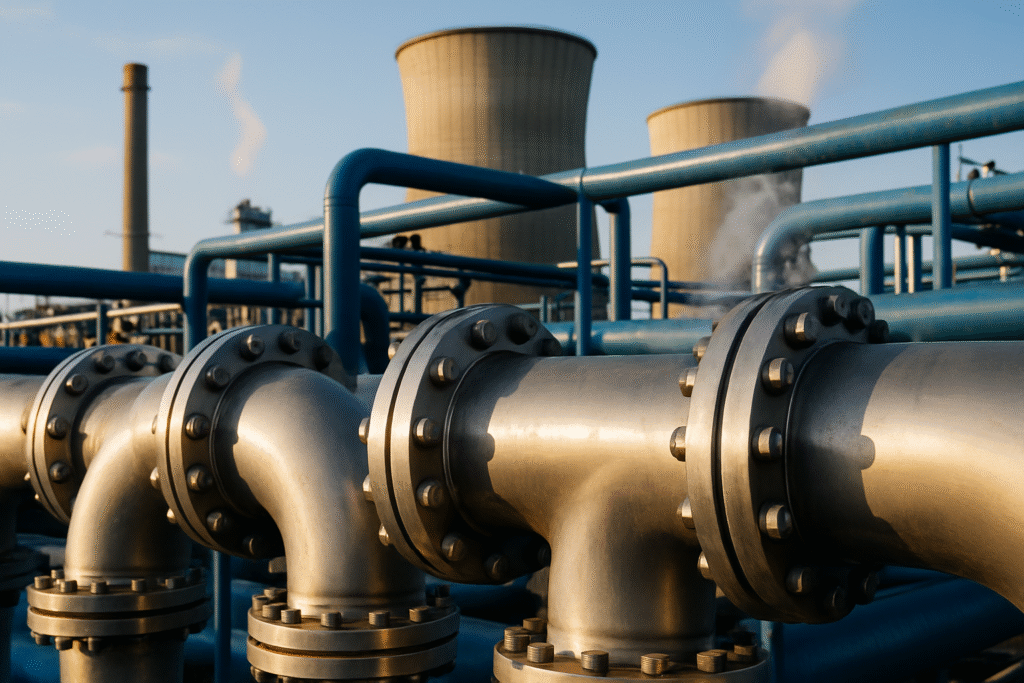
Markt für Edelstahlrohrflansche 2025: Versteckte Vorteile, Premium-Typen, Verwendungsmöglichkeiten, und Auswahldaten
Der Rohrflansch aus Edelstahl bleibt eine entscheidende Komponente moderner Prozessrohrleitungen, insbesondere da die Anforderungen an die Zuverlässigkeit im gesamten Ölsektor steigen, Gas, Wasser, und Energieprojekte. Laut Grand View Research (2024), Der globale Markt für Industrieflansche wurde mit bewertet $5.8 Milliarden in 2023 und wird voraussichtlich erreicht werden $7.2 Milliarden von 2030.
That growth reflects more than volume. It shows the hidden advantages of premium stainless solutions, including corrosion resistance, Haltbarkeit, Kontrolle der Lebenszykluskosten, and broad versatility across aggressive service conditions.
Warum der Markt für Edelstahlrohrflansche weiter wächst
Industrial buyers no longer evaluate flanges as simple connection hardware. They evaluate performance over years of pressure cycling, thermal loading, chemische Belastung, and maintenance downtime.
Laut Statista (2024), auf die Öl- und Gasindustrie entfallen ca 35% des weltweiten Flanschverbrauchs. daher, materials that reduce leakage risk and unplanned shutdowns have become strategically important.
Laut IBISWorld (2024), Der asiatisch-pazifische Raum macht mehr als aus 45% der weltweiten Flanschproduktion, wobei China der größte Hersteller ist. Infolge, Beschaffungsteams vergleichen zunehmend nicht nur den Preis, sondern auch die Rückverfolgbarkeit, Einhaltung von Standards, and factory quality systems.
This shift favors manufacturers with certified systems and broad machining capabilities. Mit ISO 9001:2015 und PED 2014/68/EU-Zertifizierungen, SASA FLANGE supports buyers who need consistent documentation, Maßhaltigkeit, and export-ready quality control.
In praktischer Hinsicht, a stainless steel pipe flange offers several commercial benefits over lower-grade alternatives. It often delivers longer service life in chloride-bearing media, lower maintenance frequency, and better compatibility with hygienic or high-purity systems.
Laut Mordor-Geheimdienst (2024), global investment in downstream petrochemical and industrial processing infrastructure continues to support steady demand for corrosion-resistant piping components. Darüber hinaus, replacement spending in mature plants is driving recurring flange purchases, vor allem in ASTM A182 F304/F304L and F316/F316L grades.
Engineers also prioritize joint integrity under changing pressure classes. ASME B16.5 Und ASME B16.47 Flanschabmessungen, mit Toleranzen konfrontiert, and pressure-temperature ratings remain central to safe piping design (ASME, 2023).
That is why specification language has become more precise. Buyers increasingly request ASTM material grades, EN 10204 3.1 Prüfbescheinigungen, PMI-Tests, and heat number traceability before approving a supplier.
In contrast with commodity sourcing, premium projects demand complete manufacturing accountability. Aus diesem Grund, many EPC contractors prefer suppliers that can produce stainless, Kohlenstoffstahl, Legierung, Duplex, Nickellegierung, and titanium flanges under one quality system.
SASA FLANGE serves this requirement by manufacturing flanges in 304, 316, 316L, 904L, 2205, 2507, A105, A182, Inconel, Monel, Hastelloy, und Titan. Zusätzlich, the company supplies pipe fittings such as elbows, T-Shirts, Reduzierstücke, and caps for integrated project purchasing.
Für Einkaufsmanager, this broader supply scope reduces coordination risk. It can also shorten purchasing cycles when projects require multiple materials, Druckklassen, and standards such as ANSI, DIN, JIS, GOST, und EN 1092.
Technischer Leitfaden für Flanschtypen für Edelstahlrohre, Verwendungsmöglichkeiten, and Premium Material Choices
The best stainless steel pipe flange specification depends on media chemistry, Temperatur, Auslegungsdruck, Korrosionszuschlag, und Herstellungsverfahren. Jedoch, 304/304L and 316/316L still dominate general industrial demand because they balance cost, Schweißbarkeit, und Korrosionsverhalten.
Gemäß ASTM und allgemeiner Branchenpraxis, 304/304L is widely selected for water, Lebensmittelqualität, und allgemeiner Chemieservice, while 316/316L adds molybdenum for improved resistance to chlorides and more aggressive corrosive environments (ASTM, 2023). daher, 316/316L often becomes the preferred choice for marine, Off-Shore-, und chemische Verarbeitungssysteme.
Als John Butterfield, a senior piping engineer, Staaten: “Flange failures rarely start with dimensions alone; they start when the material grade does not match the corrosion mechanism of the service.” That point is especially relevant in chloride service, saurer Service, and high-temperature cycling applications.
Stainless grades are not interchangeable in every duty. Buyers should match metallurgy to actual process conditions, not only to initial budget.
- 304/304L: General-purpose stainless for moderate corrosion environments and good fabrication performance.
- 316/316L: Improved pitting and crevice corrosion resistance in chloride-bearing applications.
- 904L: Better resistance in strong reducing acids and selected severe chemical environments.
- 2205 Duplex: Higher strength and better chloride stress corrosion cracking resistance than standard austenitic grades.
- 2507 Super-Duplex: Premium option for highly aggressive offshore, Meerwasser, and high-chloride service.
- Titan: Strong choice for seawater and highly corrosive media where weight and corrosion resistance matter.
Material selection also affects wall thickness transitions and welding procedures. Zum Beispiel, low-carbon L grades help reduce sensitization risk after welding, especially in fabricated systems that may later face corrosive process streams.
Laut Market Research Future (2024), demand for corrosion-resistant alloys in process industries is expected to outpace standard carbon steel categories in several high-growth applications. Darüber hinaus, duplex and super duplex flanges are gaining share where operators need higher strength-to-weight performance.
Not all flange Types serve the same piping condition. Gesichtstyp, bore geometry, and installation method directly influence sealing reliability and maintenance accessibility.
- Vorschweißflansch: Preferred for high-pressure and high-temperature service because the tapered hub reduces stress concentration.
- Aufsteckflansch: Often selected for moderate service where fabrication speed and lower installed cost matter.
- Blindflansch: Wird zum Schließen von Zeilenenden verwendet, Gefäßdüsen, oder zukünftige Erweiterungspunkte.
- Muffenschweißflansch: Suitable for smaller bore high-pressure lines.
- Gewindeflansch: Wird dort eingesetzt, wo Schweißen unpraktisch oder eingeschränkt ist.
- Überlappungsflansch: Useful for systems requiring frequent dismantling and alignment flexibility.
Entsprechend ASME B16.5 (2023), flange ratings from Class 150 zur Klasse 2500 provide standardized pressure-temperature guidance. Infolge, a correct class selection must consider not only operating pressure but also material group and service temperature.
Als Dr. Elena Morris, a materials scientist in corrosion engineering, Staaten: “The hidden advantages of stainless are most visible over time, because durability, geringerer Wartungsaufwand, and reduced contamination often outweigh higher upfront cost.” This lifecycle view is increasingly shaping industrial procurement decisions.
Dimensional compatibility matters just as much as metallurgy. Common requests include 2 Zoll, 4 Zoll-Edelstahlrohrflanschprodukte, large-diameter ASME B16.47 pieces, and custom-drilled flanges for replacement work.
Unterstützt durch fortschrittliche CNC-Bearbeitung und umfassende Qualitätsprüfungen, SASA FLANGE bietet maßgeschneiderte Größen von an 1/2 Zoll zu 60 Zoll mit wettbewerbsfähigen Direktpreisen ab Werk. Außerdem, the company supports RF, FF, RTJ, and custom facing requirements for project-specific applications.
Procurement teams should also review these specification points before ordering:
- Material grade and dual certification, wie 304/304L oder 316/316L.
- Anwendbarer Standard, einschließlich ASME B16.5, ASME B16.47, DIN, JIS, oder EN 1092-1.
- Pressure rating and service temperature.
- Verblendungstyp, wie zum Beispiel ein erhabenes Gesicht, flaches Gesicht, oder Ringverbindung.
- Testumfang, einschließlich PMI, Hydrotest-Unterstützung, Härte, und Maßprüfung.
- Documentation requirements, einschließlich EN 10204 3.1 und Wärmerückverfolgbarkeit.
- Corrosion risks, insbesondere Chloride, Säuren, sour media, oder Meeresexposition.
These details influence performance, Inspektionsabnahme, und Gesamtinstallationskosten. In vielen Projekten, the right premium flange specification prevents expensive rework later.
ASME, ASTM, DIN, and EN Compliance Requirements for Industrial Flanges
Standards compliance separates dependable industrial supply from generic metal trading. For a stainless steel pipe flange, engineers usually begin with dimensional standards, then confirm material standards, Druckklasse, und Inspektionsanforderungen.
The most common dimensional references are ASME B16.5 für NPS 1/2 durch 24 Und ASME B16.47 für größere Größen. In europäischen Projekten, EN 1092-1 is frequently specified, while DIN legacy references still appear in maintenance and retrofit work.
Ebenso wichtig sind Materialstandards. ASTM A182 governs forged or rolled alloy and stainless steel pipe flanges and forged fittings for high-temperature service, während ASTM A240 covers stainless steel plate, Blatt, und Streifen für Druckbehälter und allgemeine Anwendungen (ASTM, 2023).
For buyers comparing international projects, the following framework is useful:
- ASME B16.5: Abmessungen, Toleranzen, Druck-Temperatur-Werte, Markierungen, and testing for common flanges.
- ASME B16.47: Stahlflansche mit großem Durchmesser.
- ASME B16.9: Werkseitig hergestellte, geschmiedete Stumpfschweißbeschläge.
- ASTM A182: Geschmiedete Flanschmaterialien aus Edelstahl und Legierung.
- EN 1092-1: European flange dimensions and PN rating system.
- DIN/JESUS/GOST: Regional dimensional systems for specific installed bases.
- NACE MR0175/ISO 15156: Materialberatung für saure Betriebsumgebungen.
According to NACE and ISO guidance, material compatibility in H2S-containing systems requires careful review of hardness, Chemie, Wärmebehandlung, und Umweltbelastung (NACE, 2023). daher, stainless selection in sour service must never rely on catalog descriptions alone.
Compliance also extends beyond dimensions and chemistry. PED 2014/68/EU, Prüfzeugnisse, and traceability records are often mandatory for exported pressure equipment packages.
For many European and international buyers, documented quality systems reduce approval time. Mit ISO 9001:2015, PED 2014/68/EU, und AD 2000 Zertifizierungen, SASA FLANGE aligns with the documentation expectations common in regulated industrial supply chains.
Inspection scope should be agreed before production starts. That usually includes raw material review, forging controls, machining inspection, Markierungsüberprüfung, Maßkontrollen, and final release documentation.
A practical compliance checklist often includes:
- Correct standard edition listed on PO and drawings.
- Materialqualität, Hitzezahl, and traceability markings.
- Pressure class or PN rating verification.
- Facing finish and serration confirmation.
- EN 10204 3.1 or project-specific MTC requirements.
- Optionales PMI, Ferrit, Härte, or NDE reports.
Gemäß DNV-Richtlinien für Offshore-Systeme, documentation quality and traceability can be as important as material strength because verification supports long-term operational integrity (DNV, 2024). Infolge, buyers should treat quality documents as part of the product, not as an afterthought.
For engineers managing mixed-standard projects, early technical clarification prevents expensive mismatch issues. Bolt circle differences, face dimensions, and drilling patterns can create installation failures even when nominal Pipe size appears identical.
That is why experienced manufacturers review drawings and standards before production release. Buyers can explore broader product options through SASA FLANGE Produktfähigkeiten when applications require both flange and fitting packages under one supplier.
So wählen Sie Edelstahlrohrflansche für Öl aus, Gas, Chemisch, Leistung, und Marinedienst
Selection should start with operating data, keine Katalogfreundlichkeit. Medienkomposition, Chloride, Druckklasse, Strömungsregime, and shutdown economics all affect the right stainless steel pipe flange choice.
In Öl- und Gassystemen, Korrosionsgefahr, Druckwechsel, and sour service conditions often drive stricter specifications. Laut Statista (2024), Dieser Sektor repräsentiert ca 35% des weltweiten Flanschverbrauchs, so specification discipline remains high.
Für Upstream- und Midstream-Linien, engineers frequently prefer weld neck Flanges in ASTM A182 F316/L, Duplex 2205, oder Super-Duplex 2507 depending on chloride level and pressure conditions. Wo NACE MR0175 gilt, metallurgy review becomes even more important.
In petrochemischen und chemischen Anlagen, media compatibility often determines whether 304/304L is sufficient or whether 316L, 904L, Hastelloy, or titanium is necessary. daher, corrosion data and process temperature should be reviewed together.
Zur Stromerzeugung, thermal fatigue and pressure integrity matter more than simple atmospheric corrosion resistance. High-temperature applications may require alloy grades and carefully controlled forging quality, especially for critical steam or condensate systems.
Marine and shipbuilding projects create a different challenge. Saltwater exposure, Spritzzonen, and long maintenance intervals often push engineers toward 316L, 2205, 2507, or titanium depending on budget and design life.
Use this practical selection approach:
- Öl & Gas: Prioritize pressure class, NACE-Überprüfung, and leak-tight sealing performance.
- Chemische Verarbeitung: Match alloy to acid concentration, Chloride, und Betriebstemperatur.
- Stromerzeugung: Focus on temperature, Ermüdungsbeständigkeit, und Code-Compliance.
- Marine: Select grades with proven seawater and chloride resistance.
- Wasseraufbereitung: Balance corrosion resistance with lifecycle cost and hygienic requirements.
- Construction and Utilities: Consider standard availability, Installationsgeschwindigkeit, und Wartungszugänglichkeit.
Der Preis ist immer noch wichtig, especially in large tenders. Jedoch, stainless steel pipe flange price should be evaluated against service life, Wartungsarbeiten, production downtime, und Austauschhäufigkeit.
Als Michael Trent, an industrial procurement analyst, Staaten: “The cheapest flange on day one can become the most expensive connection in the plant if documentation, Metallurgie, or machining quality is inconsistent.” That is why serious buyers compare total cost of ownership rather than unit price alone.
According to ISO-aligned procurement practices across process industries, approved vendors increasingly need consistent QC records and repeatable dimensional control (ISO, 2023). Folglich, purchasing teams often shortlist factories with proven export experience and broad standards coverage.
SASA FLANGE unterstützt kundenspezifische Fertigung für Standard- und Nicht-Standard-Anforderungen, including stainless, Kohlenstoff, Legierung, Duplex, and nickel alloy flanges. Portion 50+ Länder in ganz Öl & Gas, Petrochemie, Leistung, und Marineindustrie, the company also supplies matching elbows, T-Shirts, Reduzierstücke, and caps for coordinated sourcing.
When evaluating a supplier, buyers should ask:
- Can the manufacturer supply from 1/2 Zoll zu 60 Zoll?
- Can it meet ASME, DIN, JIS, GOST, und EN 1092 Anforderungen?
- Can it provide EN 10204 3.1 certificates and PMI results?
- Can it machine special facings or custom drillings?
- Can it support urgent shutdown or replacement schedules?
These questions help separate a premium manufacturing partner from a simple reseller. In critical applications, that distinction directly affects project risk.
Future Outlook for Premium Stainless Flanges and Strategic Buying Recommendations
Demand for corrosion-resistant piping components is expected to stay firm as refinery upgrades, LNG-Investition, Ausbau der Wasserinfrastruktur, and marine replacement cycles continue. Laut Grand View Research (2024), the flange market is projected to grow from $5.8 Milliarden in 2023 Zu $7.2 Milliarden von 2030.
That growth will likely favor suppliers with strong quality systems, Exportdokumentation, and material range. Zusätzlich, buyers are showing greater interest in duplex, Super-Duplex, and nickel alloy options where hidden advantages justify higher upfront spend.
Procurement strategy should therefore combine technical review with supply-chain resilience. Buyers should lock down standards, Inspektionsumfang, Vorlaufzeit, and traceability before purchase order release.
These actions improve purchasing outcomes:
- Standardize approved material grades for recurring service conditions.
- Specify ASME or EN dimensional standards clearly on RFQs.
- Fordern Sie MTCs an, PMI, und Rückverfolgbarkeit für kritische Linien.
- Evaluate total lifecycle cost, nicht nur Stückpreis.
- Use suppliers with integrated machining and testing capability.
In a market where durability, Vielseitigkeit, and compliance increasingly shape buying decisions, the right stainless steel pipe flange supplier becomes part of project risk management. For teams seeking premium materials, Sondergrößen, and certified export support, verbinden mit SASA FLANGE is a practical next step in sourcing with greater confidence.
Häufig gestellte Fragen
Was ist der ASME-Code für Edelstahlflansche??
●The main ASME dimensional code for a stainless steel pipe flange is ASME B16.5 für Größen ab NPS 1/2 durch 24, während ASME B16.47 deckt Flansche mit größerem Durchmesser ab.
●ASTM A182 is commonly used with ASME dimensions because it defines forged stainless and alloy material requirements for many industrial flange applications.
●For projects requiring verified compliance, Zusammenarbeit mit etablierten Herstellern wie SASA FLANGE helps ensure correct dimensional standards, Materialrückverfolgbarkeit, Und EN 10204 3.1 certification support.
Wofür werden Edelstahlflansche verwendet??
●Zur Verbindung von Rohren werden Edelstahlflansche verwendet, Ventile, Pumps, und Ausrüstung in Systemen, die Korrosionsbeständigkeit erfordern, Druckintegrität, und einfacherer Wartungszugang.
●Laut Statista (2024), auf den Öl- und Gassektor entfallen ca 35% des weltweiten Flanschverbrauchs, which shows how essential flanges are in critical industrial service.
●They are especially useful in chemical processing, Marine, Wasseraufbereitung, and hygienic systems where durability and leak-tight sealing matter over long operating periods.
Welche drei Arten von Flanschen gibt es??
●The three most commonly referenced flange types in general industrial discussions are weld neck flanges, Aufsteckflansche, und Blindflansche.
●Weld neck flanges suit high-pressure service, slip-on flanges simplify fabrication in moderate conditions, and blind flanges close line ends or future tie-in points.
●Selection should still follow ASME B16.5 rating rules and service conditions, especially when temperature, Druck, or corrosive media could affect joint reliability.
Was ist besser? 304 oder 420 Edelstahl?
●Für die meisten Flanschanwendungen, 304 Edelstahl ist besser als 420 because it offers stronger corrosion resistance and better weldability in process piping service.
●Grad 420 is a martensitic stainless more often associated with hardness and wear resistance, während 304 remains one of the most widely specified stainless materials for industrial flanges and fittings.
●Buyers should choose 304 or 316-series forged flange grades for most piping systems unless a specific hardness-driven application requires an alternative metallurgy.
Welche Faktoren beeinflussen den Preis für Edelstahlrohrflansche??
●Der Preis für Edelstahlrohrflansche hängt hauptsächlich von der Materialqualität ab, Größe, Druckklasse, Bedingungen auf dem Rohstoffmarkt, Bearbeitungskomplexität, und Prüfanforderungen.
●Laut IBISWorld (2024), Der asiatisch-pazifische Raum macht mehr als aus 45% der weltweiten Flanschproduktion, so regional manufacturing capacity and export logistics have a direct effect on pricing competitiveness.
●Um Angebote genau zu vergleichen, buyers should evaluate certification, Inspektionsumfang, Vorlaufzeit, and lifecycle value rather than unit price alone.
How do I choose the right flange diameter and size?
●Flange diameter and size should match the pipe nominal size, Zeitplan, Druckklasse, Verblendungstyp, und anwendbare Maßnorm wie z ASME B16.5 oder EN 1092-1.
●A 4 Zoll-Rohrflansch aus Edelstahl, Zum Beispiel, can differ in outside diameter, Lochkreis, and bore details depending on class and standard, so nominal pipe size alone is not enough.
●For replacement and project-critical work, sharing drawings and operating data with a qualified manufacturer like SASA FLANGE reduces mismatch risk and speeds technical confirmation.
Verwandte Beiträge
Flanschoberflächenfinish: Konzentrische vs. spiralförmige Verzahnungen erklärt
Konzentrische und spiralförmige Verzahnungen sind beide bearbeitete Flanschflächenoberflächen…
Duplex 2205 vs. 316L-Flansche: Welches Material sollten Sie wählen??
Schnelle Antwort: Duplex 2205 Flansche sind normalerweise der stärkere Kandidat…

Definition des Öffnungsflansches, Details und Übersicht über ASME B16.36-Flansche: Marktdaten, Auswahlhilfe und Compliance-Einblicke
Der globale Markt für Industrieflansche wurde mit bewertet $5.8 Milliarde…

Marktführer für schwarze Entsorgungsflansche: Materialien, 3.5″ Kompatibilität, und B2B-Beschaffungsdaten für Küchenspülenflansche
Die Nachfrage nach schwarzen Entsorgungsflanschen steigt bei Käufern von Küchenarmaturen…