
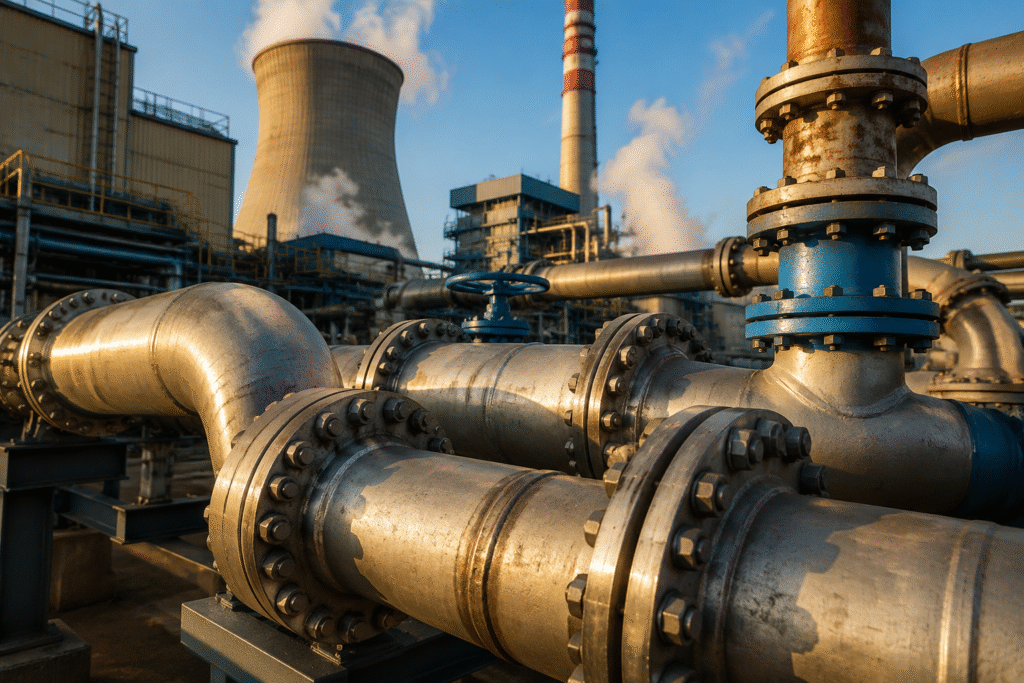
Markt für Edelstahlrohrflansche: $5.8B Wachstum, 600# Leistung, und Einblicke in die industrielle Auswahl
Der Markt für Edelstahlrohrflansche wächst mit zunehmender Zuverlässigkeit, Korrosionsbeständigkeit, und Lebenszykluskosten werden für die industrielle Beschaffung von zentraler Bedeutung. Laut Grand View Research (2024), Der globale Markt für Industrieflansche wurde mit bewertet $5.8 Milliarden in 2023 und wird voraussichtlich erreicht werden $7.2 Milliarden von 2030.
That growth reflects a simple reality. Engineers increasingly specify Stainless Steel Flanges for critical services because they combine durability, Druckintegrität, and broad standardization across ASME, ASTM, DIN, und EN-Systeme.
Globale Nachfragetrends prägen die Beschaffung von Edelstahlrohrflanschen
Industrial buyers are no longer choosing flanges on price alone. They now compare total installed cost, Korrosionszuschlag, Wartungshäufigkeit, and documentation quality before approving a Pipe Flange package.
Laut IBISWorld (2024), Der asiatisch-pazifische Raum macht mehr als aus 45% der weltweiten Flanschproduktion, wobei China der größte Hersteller ist. Infolge, sourcing teams increasingly evaluate manufacturing depth, Exportkonformität, and testing capability in Chinese supply chains.
The energy sector remains the largest consumption base. Laut Statista (2024), auf die Öl- und Gasindustrie entfallen ca 35% des weltweiten Flanschverbrauchs, which explains the continued demand for ASTM A182 F304, F316, A105, Duplex, und Nickellegierungssorten.
Parallel dazu, Wasseraufbereitung, Marine, and petrochemical projects are increasing their use of stainless solutions. Mordor-Geheimdienst (2024) notes that corrosion-resistant piping components are gaining share in facilities targeting lower maintenance shutdowns and longer service intervals.
Für Einkaufsmanager, this means the specification stage matters more than ever. A mismatch between flange facing, Druckklasse, and material chemistry can create leakage risks, costly rework, or accelerated corrosion in chloride-bearing systems.
That is where supplier capability becomes a differentiator. Mit ISO 9001:2015 und PED 2014/68/EU-Zertifizierungen, SASA FLANGE supports B2B buyers who need traceable Stainless, Stahl, Flanges for export projects and regulated industrial systems.
Beyond standard catalog items, industrial projects often require mixed packages. Dazu gehört der Schweißhals, blind, reinschlüpfen, Überlappungsgelenk, Muffenschweißen, and Threaded flanges in classes from 150 Zu 2500, including frequently specified 600# Versammlungen.
Laut Market Research Future (2024), process industries are increasing capital spending on corrosion-resistant piping systems at a mid-single-digit annual rate. daher, buyers are prioritizing suppliers that can deliver consistent dimensional accuracy and EN 10204 3.1 Inspektionsdokumentation.
Als ASME B16.5 Und ASME B16.47 dimensions remain the dominant reference for global process plants, interchangeability is non-negotiable. Jedoch, application conditions still determine whether 304, 316L, 2205, oder 2507 is the technically sound selection.
As piping engineer Michael Tran, Senior Materials Consultant, Staaten: “A flange is not a commodity when the service is aggressive. Materialauswahl, Verkleidungsgeometrie, and bolting integrity determine whether the joint survives its design life.”
This is why technical content must go beyond inventory listings. Buyers want real guidance on Versatility, Dichtungsleistung, and durability across changing temperatures, cyclic pressure, Vibration, und korrosive Medien.
How Stainless Steel Flanges Deliver Versatility, 600# Stärke, and Long-Term Durability
A stainless steel pipe flange performs two core jobs. It creates a removable connection in a piping system, and it maintains mechanical and sealing integrity under defined pressure-temperature conditions.
In praktischer Hinsicht, the correct flange reduces shutdown risk. It also simplifies maintenance, Inspektion, and replacement when compared with permanent welded spool changes in many plant layouts.
Entsprechend ASME B16.5, Flanschabmessungen, Verkleidungstypen, Bohren, and pressure classes are standardized for NPS 1/2 durch 24. Larger diameters typically fall under ASME B16.47, which is widely used in transmission, Lagerung, and heavy process systems (ASME, 2023).
Material choice then determines corrosion performance. ASTM A182 stainless grades such as F304, F304L, F316, and F316L remain common because they balance mechanical strength, Herstellbarkeit, und Verfügbarkeit (ASTM, 2024).
For chloride-rich or more severe services, buyers often upgrade to duplex or super duplex. According to NACE guidance and field practice in offshore systems, duplex alloys can provide significantly improved pitting resistance over conventional austenitic stainless in suitable conditions (NACE, 2023).
Als Dr. Elena Kovacs, Materialwissenschaftler, Staaten: “316L is a dependable industrial baseline, but chloride content, Spaltgeometrie, and temperature still drive failures when engineers under-specify the flange alloy.”
Different flange designs address different loading and assembly demands. daher, engineers should compare joint behavior, inspectability, and fabrication constraints before selecting a type.
- Vorschweißflansch: Am besten für hohen Druck geeignet, Temperaturwechsel, and critical process lines because the tapered hub improves stress distribution.
- Aufsteckflansch: Cost-effective for lower to moderate pressure services and easier alignment during fabrication.
- Muffenschweißflansch: Often used in small-bore high-pressure piping where smooth bore and compact assembly matter.
- Gewindeflansch: Useful where welding is restricted or field hot work is undesirable, especially on utility and instrument connections.
- Blindflansch: Used to terminate or isolate line ends, Gefäßdüsen, und zukünftige Erweiterungspunkte.
- Überlappungsflansch: Supports frequent dismantling and alignment flexibility when paired with a stub end.
Ebenso wichtig ist die Auswahl der Druckklasse. A 600# flange is not simply a stronger version of a 150 class component, because allowable pressure depends on temperature, Materialgruppe, and standard rating tables.
Zum Beispiel, carbon steel and stainless steel can have different pressure-temperature behavior under ASME rating methodology. daher, engineering teams should verify class ratings against design temperature rather than relying on nominal class alone.
Surface finish and facing style also affect sealing. Raised face is the most common for process service, while ring type joint designs are preferred in higher pressure and critical hydrocarbon systems.
Buyers comparing stainless options should evaluate these technical factors:
- Base alloy and carbon content, wie zum Beispiel 304 versus 304L or 316 im Vergleich zu 316L.
- Druckklasse, einschließlich 150, 300, Und 600# Anforderungen.
- Verblendungstyp, wie RF, FF, RTJ, or special machine finish.
- Wall schedule compatibility for the mating Pipe.
- Korrosionsumgebung, einschließlich Chloride, Säuren, und Temperaturschwankungen.
- Documentation needs, including MTC, PMI, Hydrotest, Und EN 10204 3.1.
According to DNV practice in marine and offshore systems, joint reliability is strongly linked to fit-up accuracy, bolting control, und Materialrückverfolgbarkeit (DNV, 2023). That is why a technically capable manufacturer adds value beyond nominal product supply.
SASA FLANGE stellt Flansche her 304, 316, 316L, 904L, 2205, 2507, A105, A182, Inconel, Monel, Hastelloy, und Titan. Unterstützt durch fortschrittliche CNC-Bearbeitung und umfassende Qualitätsprüfungen, Das Unternehmen unterstützt kundenspezifische Größen von 1/2 Zoll zu 60 Zoll für Öl & Gas, Petrochemie, Leistung, and Marine projects.
Für EPC-Auftragnehmer, package consistency matters as much as metallurgy. A supplier able to align dimensions, Verschraubungsmuster, Fasenvorbereitung, and inspection records across mixed flange and fitting orders can reduce site delays significantly.
According to ISO quality management studies summarized by industrial auditors, standardized process control reduces non-conformance risk in repetitive machining operations (ISO, 2023). Darüber hinaus, that process discipline supports better repeatability for bore concentricity, Verkleidungsende, and drilling tolerance.
As piping specialist David Romero, former refinery turnaround lead, Staaten: “Most field flange leaks begin with avoidable issues such as poor finish, mismatched faces, or incomplete traceability rather than with the pressure class itself.”
Standards, Testen, und Konformitätsanforderungen für Edelstahlflansche
Standards compliance is the foundation of safe flange procurement. Without it, dimensions may not match mating components, material properties may be uncertain, and pressure ratings may be misapplied.
The core dimensional standards are ASME B16.5 Und ASME B16.47 für Flansche, während ASME B16.9 covers many associated butt weld fittings. Material standards commonly include ASTM A182 for forged alloy and stainless flanges and ASTM A240 or A276 for related raw materials, depending on product form.
European and international projects also reference DIN and EN systems. EN 1092 is especially important in EU projects, while PED 2014/68/EU governs conformity obligations for pressure equipment placed on the European market.
Für sauren Betrieb oder korrosive Kohlenwasserstoffumgebungen, NACE MR0175 and project-specific material restrictions may apply. daher, procurement teams should confirm hardness limits, Chemie, Wärmebehandlung, and supplementary testing where required.
Zu den wichtigsten Compliance-Kontrollpunkten gehören::
- Dimensional verification to ASME B16.5, ASME B16.47, DIN, JIS, GOST, oder EN 1092.
- Material traceability to ASTM or equivalent forged grade requirements.
- Pressure-temperature rating confirmation for the selected alloy and class.
- Face finish, langweilig, and drilling inspection before release.
- Inspection records such as MTC and EN 10204 3.1 Zertifizierung.
- Optionales PMI, Härte, Ferrit, Hydrotest, and third-party witness checks.
Gemäß dem Rahmenwerk der Europäischen Kommission für PED, documentation and conformity assessment are essential for pressure-retaining components used in regulated applications (PED, 2014). Infolge, EU-bound orders need more than basic dimensional compliance.
Procurement teams should also understand the difference between standard compliance and application suitability. A flange can meet ASME dimensions yet still fail in service if the wrong stainless grade is selected for chlorides, caustic cleaning cycles, or galvanic exposure.
Below is a practical comparison often used during early specification review:
- 304/304L: Good general corrosion resistance and strong availability for water, Essen, und leichter chemischer Service.
- 316/316L: Improved resistance to chlorides and chemicals due to molybdenum addition.
- 904L: Higher alloy content for aggressive acids and more demanding corrosion conditions.
- 2205 Duplex: Higher strength and better pitting resistance than standard austenitic grades in many services.
- 2507 Super-Duplex: Preferred for severe chloride and offshore environments with strict corrosion demands.
For buyers needing certified export supply, SASA FLANGE Angebote ISO 9001:2015, PED 2014/68/EU, und AD 2000 aligned manufacturing support. That combination is especially relevant for projects that require repeatable QC, documented traceability, and international standard compatibility.
Another differentiator is test discipline. Reputable manufacturers verify positive material identification, Maßtoleranzen, Oberflächenzustand, and marking clarity before shipment, because missing or incorrect markings can delay receiving inspections on major projects.
Authoritative references should always guide final approval. Engineers can review dimensional and rating information directly from ASME and material requirements from ASTM specifications.
Anwendungsleitfaden: Selecting the Right Stainless Steel Pipe Flange for Oil, Gas, Chemisch, Leistung, und Marinedienst
Application context determines the correct flange design. A Stainless solution that performs well in a clean utility line may be the wrong choice in offshore brine service or cyclic steam conditions.
Bei Öl und Gas, weld neck and RTJ designs often dominate critical lines. Laut Statista (2024), Dieser Sektor stellt ungefähr dar 35% des weltweiten Flanschverbrauchs, so pressure containment and inspection documentation remain major buying criteria.
In petrochemischen und chemischen Anlagen, 316L, 904L, Duplex, and nickel alloys may be justified by corrosion economics. Even when initial price is higher, lower maintenance and fewer leak-related shutdowns often improve total cost of ownership.
Power generation applications introduce different priorities. Thermische Ermüdung, startup cycling, and high-energy line integrity may drive the use of weld neck geometries, controlled bolting procedures, and stricter face finish verification.
Shipbuilding and marine systems demand strong attention to chloride exposure. daher, 316L, 2205, Und 2507 are common discussion points where splash zones, Ballastsysteme, and aggressive seawater conditions increase pitting risk.
Water treatment projects often seek a balance between corrosion performance and budget. In diesen Anwendungen, 304 Und 316 stainless flanges are common, although local water chemistry still determines whether an upgrade is necessary.
Bei der Auswahl eines Edelstahlrohrflansches, Ingenieure sollten überprüfen:
- Design pressure and operating temperature.
- Flüssigkeitschemie, Chloridgehalt, and pH.
- Flanschtyp, gegenüber, und Dichtungskompatibilität.
- Required pressure class, wie zum Beispiel 150, 300, oder 600#.
- Welding restrictions or the need for Threaded connections.
- Inspection and documentation requirements for project approval.
- Vorlaufzeit, Verpackung, and shipment method for site delivery.
Practical examples make the selection logic clearer:
- Offshore firewater line: 316L or duplex blind and weld neck flanges with strict traceability and corrosion review.
- Refinery utility piping: Threaded or slip on options may be suitable for selected lower-risk services where codes allow.
- Chemical dosing skid: 316L or higher alloy flange and fitting package with verified gasket compatibility.
- Steam condensate line: Weld neck Pipe Flange designs may better handle thermal cycling and stress concentration.
Many buyers also want package consolidation. Instead of sourcing flanges, Ellenbogen, T-Shirts, Reduzierstücke, and caps from multiple vendors, they prefer one qualified manufacturer that can maintain dimensional consistency across the full bill of materials.
SASA FLANGE supports that model by supplying stainless steel flanges alongside pipe fittings such as elbows, T-Shirts, Reduzierstücke, und Mützen. This simplifies vendor qualification and can improve delivery control for EPC and OEM customers.
Custom manufacturing capability is increasingly valuable in retrofit work. Legacy systems may require non-standard drilling, spezielle Verkleidungen, gemischte Standards, or exact bore transitions that catalog listings cannot cover.
SASA FLANGE dient 50+ Länder in ganz Öl & Gas, Petrochemie, Leistung, und Marineindustrie. Wir bieten maßgeschneiderte Größen von an 1/2 Zoll zu 60 Zoll mit wettbewerbsfähigen Direktpreisen ab Werk, the company supports both standard ASME orders and project-specific engineered requirements.
For buyers evaluating durability, the best decision is usually application-specific rather than catalog-driven. daher, the right supplier should review service conditions, not just part numbers, before confirming a final recommendation.
Future Outlook for Stainless Steel Flanges and Strategic Sourcing Recommendations
Demand for Stainless Steel Flanges will remain strong as plants modernize aging assets and expand corrosion-resistant infrastructure. Laut Grand View Research (2024), the flange market is expected to rise from $5.8 Milliarden in 2023 Zu $7.2 Milliarden von 2030.
Gleichzeitig, sourcing criteria are becoming stricter. Buyers now expect material traceability, kurze Lieferzeiten, digitale Dokumentation, and reliable export packaging as standard rather than premium service.
Laut IBISWorld (2024), Der asiatisch-pazifische Raum produziert mehr als 45% der globalen Flanschleistung. daher, competitive advantage will increasingly depend on the ability to pair manufacturing scale with international compliance and stable QC systems.
Three strategic recommendations stand out for procurement teams:
- Standardize approved flange materials by service condition, not by habit.
- Audit supplier documentation capability as closely as machining capability.
- Consolidate flange and fitting purchasing where dimensional consistency matters.
Zusätzlich, engineers should review whether 304, 316L, Duplex, or higher alloys deliver the best lifecycle value instead of the lowest purchase price. In corrosive duty, the cheapest flange can become the costliest asset in the line.
Digital procurement will also influence market behavior. More buyers will compare delivery reliability, Inspektionsdaten, and technical response speed before issuing RFQs, especially for 600# systems and critical Threaded or weld neck applications.
For project teams seeking a qualified manufacturing partner, technical support should begin at the specification stage. That approach helps avoid mismatched standards, unnecessary alloy upgrades, and preventable leakage risks.
With certified production, breite Materialfähigkeit, and export-focused quality control, SASA FLANGE is positioned to support buyers who need dependable stainless steel pipe flange solutions for demanding industrial service.
Häufig gestellte Fragen
Flanschgrößen für Edelstahlrohre?
●Die Größen der Flansche von Edelstahlrohren reichen typischerweise von 1/2 Zoll zu 24 Zoll unter ASME B16.5, mit größeren Durchmessern abgedeckt durch ASME B16.47.
●Zu den gängigen Druckklassen gehören: 150, 300, Und 600#, and bore dimensions must match the pipe schedule for proper fit-up and flow continuity.
●For projects requiring mixed standards or custom diameters, Zusammenarbeit mit etablierten Herstellern wie SASA FLANGE helps ensure dimensional compliance and traceable documentation.
4 Zoll-Rohrflansch aus Edelstahl?
●A 4 inch stainless steel pipe flange is one of the most frequently specified industrial sizes because it balances flow capacity, Verfügbarkeit, and manageable installation weight.
●It is commonly supplied in weld neck, reinschlüpfen, blind, and Threaded configurations in 304, 316, und 316L, mit ASME B16.5 governing dimensions in many global projects.
●Buyers should confirm pressure class, Verblendungstyp, and pipe schedule before ordering to avoid mismatch during fabrication or site assembly.
Stainless steel pipe flange price?
●Stainless steel pipe flange price depends on alloy grade, Größe, Druckklasse, gegenüber, Inspektionsumfang, and order volume rather than on size alone.
●Laut Grand View Research (2024), continued market growth to $7.2 Milliarden von 2030 indicates sustained demand, which can affect availability and pricing for 316L, Duplex, and higher alloys.
●The best procurement approach is to compare total value including certification, Bearbeitungsgenauigkeit, and lead time instead of selecting the lowest quoted unit price.
Stainless steel pipe flange for sale?
●Stainless steel pipe flange for sale listings should be evaluated against standards such as ASME B16.5, ASTM A182, und EN 1092 rather than by inventory claims alone.
●Industrial buyers should verify MTCs, EN 10204 3.1 Zertifizierung, Druckklassenmarkierungen, and material traceability before issuing a purchase order.
●Für den Export oder regulierte Projekte, sourcing from certified manufacturers reduces the risk of non-conformance, delays, and unplanned replacement costs.
Stainless steel flanges and fittings?
●Stainless steel flanges and fittings are often purchased together to maintain material consistency, dimensional alignment, and easier quality control across the piping package.
●Laut Statista (2024), Öl und Gas machen ca. aus 35% des weltweiten Flanschverbrauchs, which is why integrated package supply is common in EPC and maintenance contracts.
●Procurement teams should favor suppliers that can provide elbows, T-Shirts, Reduzierstücke, Kappen, and matching flange types under the same inspection and documentation process.
Stainless steel flange types?
●Major stainless steel flange types include weld neck, reinschlüpfen, Muffenschweißen, blind, Überlappungsgelenk, and Threaded, and each type suits a different assembly and service condition.
●Weld neck flanges generally perform best in severe pressure and temperature duty, while Threaded and slip on designs can be practical in selected lower-risk or no-hot-work applications.
●Engineers should choose flange type based on stress distribution, Wartungsbedarf, Code-Anforderungen, and the actual operating environment rather than on familiarity alone.
Verwandte Beiträge
Flanschoberflächenfinish: Konzentrische vs. spiralförmige Verzahnungen erklärt
Konzentrische und spiralförmige Verzahnungen sind beide bearbeitete Flanschflächenoberflächen…
Duplex 2205 vs. 316L-Flansche: Welches Material sollten Sie wählen??
Schnelle Antwort: Duplex 2205 Flansche sind normalerweise der stärkere Kandidat…

Definition des Öffnungsflansches, Details und Übersicht über ASME B16.36-Flansche: Marktdaten, Auswahlhilfe und Compliance-Einblicke
Der globale Markt für Industrieflansche wurde mit bewertet $5.8 Milliarde…

Marktführer für schwarze Entsorgungsflansche: Materialien, 3.5″ Kompatibilität, und B2B-Beschaffungsdaten für Küchenspülenflansche
Die Nachfrage nach schwarzen Entsorgungsflanschen steigt bei Käufern von Küchenarmaturen…