
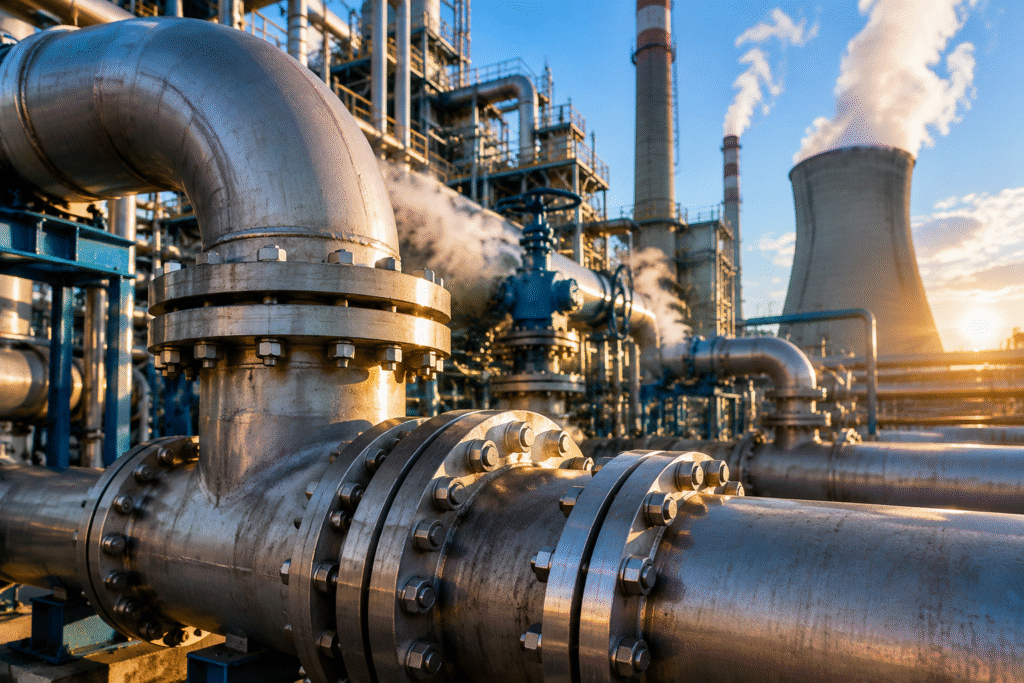
Der Markt für Edelstahlrohrflansche liegt bei 5,8 Milliarden US-Dollar: Versteckte Vorteile, Typen, Verwendungsmöglichkeiten, und wie man die gängigsten Rohrflansche auswählt
Laut Grand View Research (2024), Der globale Markt für Industrieflansche wurde mit bewertet $5.8 Milliarden in 2023 und wird voraussichtlich erreicht werden $7.2 Milliarden von 2030. That growth is one reason stainless steel pipe flange demand remains strong across oil and gas, Petrochemie, Stromerzeugung, Marine, und Wasseraufbereitungsprojekte.
Für Ingenieure und Beschaffungsteams, the most intriguing value is not just corrosion resistance. The hidden advantages of stainless steel pipe flange selection include lower lifecycle cost, stärkere Rückverfolgbarkeit, easier compliance with ASME and EN standards, and better reliability in aggressive service.
Warum der Markt für Edelstahlrohrflansche weiter wächst
Industrial buyers now expect more than a product list. They want clear guidance on flange types, Druckklassen, Materialqualitäten, Dokumentation, and lead times. That shift favors suppliers that combine manufacturing depth with technical support.
Laut IBISWorld (2024), Der asiatisch-pazifische Raum macht mehr als aus 45% der weltweiten Flanschproduktion, wobei China der größte Hersteller ist. Infolge, buyers increasingly source from qualified Chinese producers that can meet international standards and documentation requirements.
Laut Statista (2024), auf die Öl- und Gasindustrie entfallen ca 35% des weltweiten Flanschverbrauchs. Darüber hinaus, Raffinerien, LNG projects, Offshore-Plattformen, and pipeline systems continue to specify stainless and alloy materials where corrosion, Chloridexposition, or elevated temperature create risk.
That market demand also explains why stainless steel pipe flange products remain among the most common pipe connection components in industrial systems. Unlike commodity parts, flanges affect sealing integrity, Wartungsintervalle, and inspection performance across the entire piping loop.
Laut Mordor-Geheimdienst (2024), capital spending in process industries continues to support demand for pressure-retaining piping components in both greenfield and brownfield projects. daher, buyers are comparing not only flange price, but also machining accuracy, PMI-Tests, EN 10204 3.1 Zertifizierung, und Liefertreue.
Als John Carter, Leitender Rohrleitungsingenieur, Staaten: “A flange is a small percentage of project cost, but a major percentage of joint reliability.” His point reflects a common field reality, because gasket seating, bolt load distribution, and facing tolerances directly affect leak prevention.
Aus diesem Grund, stainless steel pipe flange selection should be tied to process conditions, Code-Anforderungen, and long-term maintenance strategy. 304, 316, 316L, 904L, 2205, Und 2507 each offer different performance profiles under chloride, Säure, Temperatur, and pressure exposure.
SASA FLANGE serves global buyers with stainless steel flanges, Flansche aus Kohlenstoffstahl, Flansche aus Legierung, and pipe fittings in materials such as 304, 316, 316L, 904L, 2205, 2507, A105, A182, Inconel, Monel, Hastelloy, und Titan. Mit ISO 9001:2015 und PED 2014/68/EU-Zertifizierungen, the company supports projects that require traceable quality and consistent compliance.
In contrast to purely catalog-style pages, procurement teams benefit from selection guidance built around real operating conditions. That includes flange facing type, Druckklasse, Nennrohrgröße, Korrosionszuschlag, Schweißverfahren, and the interaction between flange and mating pipe or fitting material.
Laut Market Research Future (2024), infrastructure modernization and water treatment investment are increasing demand for corrosion-resistant piping components worldwide. Folglich, stainless steel pipe flange demand is expanding beyond traditional oil and gas into desalination, pharmaceutical processing, und Versorgungssysteme in Lebensmittelqualität.
Flanschtypen für Edelstahlrohre, Materialien, and Hidden Advantages in Real Service
The most common pipe flange designs are weld neck, Slip-on, blind, mit Gewinde, Muffenschweißen, und Überlappungsgelenk. Jedoch, the correct choice depends on stress concentration, Inspektionsbedarf, fluid hazard level, Vibration, and expected maintenance cycles.
Entsprechend ASME B16.5, dimensional consistency and pressure-temperature rating control are essential for flanges from NPS 1/2 durch 24. Für größere Durchmesser, ASME B16.47 trifft typischerweise zu, especially in transmission, Lagerung, and large process piping systems (ASME, 2023).
Als Dr. Helen Morris, Materialwissenschaftler, Staaten: “The hidden advantages of stainless steel are most visible when chloride resistance, Schweißbarkeit, and lifecycle maintenance are evaluated together.” That is why 316L and duplex grades often outperform lower-cost options in seawater-adjacent or chemically aggressive service.
Material selection starts with environment. 304 works well for many general industrial applications, während 316 und 316L bieten eine verbesserte Molybdän-Korrosionsbeständigkeit. For stronger pitting and crevice corrosion resistance, 904L, 2205, Und 2507 become more compelling.
Gemäß den NACE-Richtlinien für saure und ätzende Anwendungen, material failure often begins at crevices, weld zones, or improperly matched components rather than in bulk metal alone (NACE, 2023). daher, flange selection should be coordinated with pipe schedule, Schweißverfahren, Dichtungstyp, and bolting specification.
- 304 Edelstahlflansch: Good general corrosion resistance and cost efficiency for water, Luft, und milder chemischer Service.
- 316/316L-Flansch aus Edelstahl: Better chloride and chemical resistance for offshore, pharmazeutisch, and petrochemical use.
- 904L-Flansch: Strong resistance in sulfuric and reducing acid environments.
- 2205 Duplexflansch: Higher strength than austenitic grades and strong resistance to chloride stress corrosion cracking.
- 2507 Super-Duplex-Flansch: Preferred for severe offshore, unterseeisch, und Bedingungen mit hohem Chloridgehalt.
Buyers often ask which flange types deliver the best total cost. Weld neck flanges usually cost more upfront, but they reduce stress concentration and perform well in high-pressure and cyclic service. Slip-on flanges lower fabrication cost, yet they may not suit severe fatigue or critical service as effectively.
That tradeoff matters because rework is expensive. According to ASTM and field fabrication studies cited by industry analysts, alignment errors, facing defects, and poor weld preparation are among the most common causes of flange joint leakage during commissioning (ASTM, 2023).
The most common pipe flange comparison can be summarized clearly.
- Vorschweißflansch: Am besten für hohen Druck geeignet, Temperaturwechsel, und strenger Service.
- Aufsteckflansch: Economical for low to moderate pressure systems with simpler fabrication.
- Blindflansch: Used to terminate or isolate a line, Ventilstation, or nozzle opening.
- Gewindeflansch: Useful where welding is not preferred, often on small-bore or temporary systems.
- Muffenschweißflansch: Common for small diameter, Hochdruckleitungen.
- Überlappungsflansch: Selected where frequent dismantling or alignment flexibility is needed.
Flange facing also affects performance. Raised face remains the most common for ASME process systems, while ring type joint is often specified for higher pressure classes in oil and gas. Flat face may be required for cast iron equipment or selected low-pressure installations.
Gemäß den Offshore-Richtlinien von DNV, flange integrity risks increase significantly when material selection, Dichtungskompatibilität, and bolt preload are treated separately rather than as one joint system (DNV, 2023). Infolge, experienced manufacturers emphasize dimensional control, Verkleidungsende, und vollständige Materialrückverfolgbarkeit.
SASA FLANGE manufactures flanges in ANSI B16.5, ANSI B16.47, DIN, JIS, GOST, und EN 1092 Konfigurationen. Unterstützt durch fortschrittliche CNC-Bearbeitung und umfassende Qualitätsprüfungen, Das Unternehmen bietet maßgeschneiderte Größen an 1/2 Zoll zu 60 Zoll mit wettbewerbsfähigen Direktpreisen ab Werk.
In der praktischen Beschaffung, the hidden advantages of a well-made stainless steel pipe flange include lower downtime, fewer replacement cycles, and smoother audit compliance. Those factors matter even more when a project requires MTCs, PMI, hydrotest support documentation, or PED-related records for export to Europe.
ASME, ASTM, DIN, und EN-Normen, die die Flanschkonformität definieren
Standards are not optional in industrial piping. Sie definieren Dimensionen, Druck-Temperatur-Grenzwerte, Materialien, Toleranzen, inspection practices, and marking rules. daher, every stainless steel pipe flange purchase should reference the correct standard set from the start.
Zu den am häufigsten genannten Maßnormen gehören: ASME B16.5, ASME B16.47, DIN, und EN 1092-1. Material specifications often include ASTM A182 for forged or rolled alloy and stainless flanges, while related plate products may reference ASTM A240 for stainless steel plate, Blatt, und ausziehen.
Zusätzlich, ASME B16.9 governs many butt weld fittings used with flanged piping systems. That is important because elbows, T-Shirts, Reduzierstücke, and caps must match the metallurgy and service conditions of the flange joint.
- ASME B16.5: Rohrflansche und Flanschverbindungen, NPS 1/2 Zu 24.
- ASME B16.47: Stahlflansche mit großem Durchmesser, NPS 26 Zu 60.
- ASTM A182: Geschmiedete oder gewalzte Rohrflansche aus Legierung und Edelstahl, Beschläge, Ventile, und Teile.
- ASTM A240: Chromium and chromium-nickel stainless steel plate and sheet for pressure vessels and general applications.
- EN 1092-1: European flange standard covering dimensions, Druckstufen, and facing forms.
- NACE MR0175/ISO 15156: Materialanforderungen für H2S-haltige Umgebungen bei der Öl- und Gasförderung.
Gemäß der Druckgeräterichtlinie, traceability and conformity assessment are critical for pressure-retaining components entering the EU market (PED 2014/68/EU). Folglich, procurement teams should verify certificates, heat numbers, Maßkontrollprotokolle, and marking before shipment.
Für viele EPC-Auftragnehmer, documentation is as important as metallurgy. A compliant flange package may include EN 10204 3.1 Materialzertifikate, PMI-Berichte, Maßkontrollprotokolle, Härteprüfungen, and surface finish verification. In sour service or offshore duty, additional NACE or project-specific testing may also apply.
Als Mark Ellison, Industriemarktanalyst, Staaten: “Procurement risk falls sharply when standard compliance, Rückverfolgbarkeit, and inspection records are confirmed before fabrication starts.” That is why serious buyers review not only product availability, but also the manufacturer’s quality system and export experience.
The difference between a quotation and a compliant supply package can be substantial. Zum Beispiel, a low-cost offer may exclude third-party inspection, Schlagprüfung, or PED documentation. Jedoch, those items can become mandatory depending on end user specifications and destination market.
SASA FLANGE supports buyers requiring ISO 9001:2015, PED 2014/68/EU, und AD 2000 aligned manufacturing documentation. Portion 50+ Länder in ganz Öl & Gas, Petrochemie, Leistung, und Marineindustrie, the company helps project teams match flange supply to both code compliance and schedule pressure.
For buyers comparing EN and ASME systems, dimensional interchangeability should never be assumed. Lochkreis, Dicke, Verkleidungsgeometrie, and pressure designation can differ. daher, project drawings and flange mating details must be checked before procurement approval.
Authoritative technical references are available from ASME und ASTM. Those sources remain essential for confirming dimensions, Bewertungen, and material requirements on critical piping orders.
So wählen Sie Edelstahl-Rohrflanschlösungen für Öl aus, Gas, Chemisch, Leistung, und Marinedienst
The right flange is chosen by service condition, not by habit. Engineers should begin with fluid composition, Auslegungsdruck, Betriebstemperatur, Korrosionsgefahr, und Wartungszugang. After that, they can narrow the correct material grade, gegenüber, Druckklasse, und Flanschtyp.
In Öl- und Gassystemen, the most common pipe flange choices are weld neck and blind flanges in 316L, Duplex, or alloy materials depending on process severity. Offshore and sour environments often require stronger chloride resistance, NACE-Konformität, and higher confidence in fatigue performance.
Im petrochemischen Bereich, corrosive media and thermal cycling matter more than initial price. daher, 316L, 904L, or nickel alloys may be selected where acids, Chloride, or elevated temperature create accelerated attack on standard grades.
Power generation applications often prioritize pressure class, thermal stress resistance, and weld integrity. Infolge, flange selection may focus on Class 300, 600, oder höhere Bewertungen, especially on steam, Kondensat, or high-energy process lines.
Marine and shipbuilding systems add salt exposure, Vibration, und Platzbeschränkungen. Duplex stainless flanges often provide a strong balance of corrosion resistance and strength in these environments, while 316L remains common for many utility and deck systems.
- Wählen 304 for general service with limited chloride exposure and moderate temperature.
- Wählen Sie 316/316L for better pitting resistance in marine, chemisch, und pharmazeutische Systeme.
- Wählen 2205 when strength and chloride resistance must improve without moving immediately to super duplex.
- Wählen 2507 for severe offshore, Entsalzung, and high-salinity duty.
- Choose weld neck flanges für Hochdruck, hohe Temperatur, or dynamic loading.
- Choose slip-on flanges for cost-sensitive utility lines with lower service severity.
Size and pressure rating also drive cost and availability. Common searches such as stainless steel pipe flange sizes, 4 Zoll-Rohrflansch aus Edelstahl, Edelstahlflansch 2, and stainless steel threaded pipe flange reflect practical buying needs rather than abstract product interest. daher, suppliers should provide dimensional options, Details gegenüberstellen, and lead-time transparency.
Custom manufacturing is especially important when standard stock does not fit project conditions. Large OD machining, Nicht standardmäßige Bohrungen, spezielle Verkleidungen, and mixed-standard requirements appear frequently in retrofit work, Kufenfertigung, and international EPC projects.
SASA FLANGE supports custom flange manufacturing and matching pipe fittings including elbows, T-Shirts, Reduzierstücke, und Mützen. Herstellung von Flanschen in 304, 316, 904L, 2205, 2507 und andere Premiumqualitäten, the company helps buyers reduce supplier fragmentation on complex piping packages.
When comparing offers, buyers should ask for the following data before placing an order.
- Applicable standard and edition.
- Material grade and forging route.
- Druckklasse oder PN-Bewertung.
- Facing type and surface finish.
- Heat treatment and test reports.
- EN 10204 3.1 certificates and PMI availability.
- Größenbereich, Toleranz, and marking details.
- Vorlaufzeit, Verpackungsmethode, and export destination support.
That process improves purchasing accuracy and reduces mismatch risk. Darüber hinaus, it helps engineers confirm that the selected stainless steel pipe flange will perform as expected in the actual operating environment, not only on paper.
Future Outlook for Stainless Steel Pipe Flange Procurement and Strategic Buying Decisions
The flange market will likely remain resilient because industrial maintenance, expansion projects, and energy transition infrastructure all require reliable piping connections. Laut Grand View Research (2024), Der Markt wird voraussichtlich erreichen $7.2 Milliarden von 2030, which confirms continued global demand.
Zusätzlich, corrosion-resistant materials are gaining attention as operators look to reduce downtime and total cost of ownership. According to industry estimates from Market Research Future (2024), lifecycle-driven procurement is becoming more common in water treatment, Marine, and process manufacturing.
That trend favors stainless and duplex grades where maintenance access is difficult or shutdown cost is high. It also favors manufacturers that can combine factory pricing with documentation, Bearbeitungspräzision, and international compliance support.
Für Beschaffungsteams, the best strategy is straightforward. Standardize approved grades for each service category. Flansch ausrichten, Beschlag, Dichtung, and bolting specifications early. Then qualify suppliers on quality systems, export records, and inspection capability rather than on unit price alone.
Für Ingenieure, the key recommendation is to evaluate hidden advantages together with headline cost. A lower purchase price may look attractive, yet lifecycle cost can rise quickly if flange alignment, Oberflächenbeschaffenheit, or corrosion resistance is inadequate.
As sourcing becomes more global, responsiveness and technical clarity will matter even more. Buyers who need stainless steel pipe flange support for ongoing projects, replacement demand, or custom specifications often benefit from working directly with manufacturers that understand ASME, ASTM, DIN, EN, and PED requirements from quotation stage onward.
Häufig gestellte Fragen
Wofür werden Edelstahlflansche verwendet??
●Zur Rohrverbindung werden Edelstahlflansche verwendet, Ventile, Pumps, and pressure equipment in systems that need strength, Korrosionsbeständigkeit, und einfacherer Wartungszugang.
●Laut Statista (2024), Öl und Gas machen ca. aus 35% des weltweiten Flanschverbrauchs, which shows how essential flanged joints are in critical process systems.
●Sie werden häufig in der Öl- und Gasindustrie eingesetzt, Petrochemie, Stromerzeugung, Marine, Wasseraufbereitung, Lebensmittelverarbeitung, and pharmaceutical facilities because they allow secure bolted connections and simpler line disassembly.
●Engineers usually select a stainless steel pipe flange when the service involves moisture, Chloride, Chemikalien, erhöhte Temperaturen, or strict hygiene requirements that can challenge carbon steel alternatives.
●For projects requiring corrosion-resistant flanges with traceable quality documents, Zusammenarbeit mit etablierten Herstellern wie SASA FLANGE trägt dazu bei, die Einhaltung von ASME sicherzustellen, ASTM, und EN-Normen.
Stellen sie Rohrverbindungsstücke aus Edelstahl her??
●Ja, Hersteller produzieren Rohrverbindungsstücke aus Edelstahl, wie z. B. Winkelstücke, T-Shirts, Reduzierstücke, and caps to match flanged piping systems in both standard and custom configurations.
●Entsprechend ASME B16.9, butt weld fittings must meet dimensional requirements that support proper integration with pipe and flange assemblies in pressure service.
●Zu den gängigen Noten gehören: 304, 316, 316L, 904L, 2205, Und 2507, and the correct choice depends on corrosion risk, Prozessflüssigkeit, Druck, Temperatur, und Herstellungsverfahren.
●It is best practice to match fitting material and flange material wherever possible so weld zones, Korrosionsverhalten, and inspection records remain consistent across the piping package.
●For buyers seeking stainless steel flanges and fittings from one source, manufacturers with machining and documentation capability can reduce delays, simplify inspections, and improve package control.
Welche verschiedenen Arten von Edelstahlflanschen gibt es??
●Die verschiedenen Arten von Edelstahlflanschen umfassen einen Schweißhals, Slip-on, blind, mit Gewinde, Muffenschweißen, and lap joint designs for varying pressure, Temperatur, und Wartungsbedingungen.
●Entsprechend ASME B16.5 (2023), these flange types are standardized to maintain dimensional compatibility, pressure-temperature integrity, and installation consistency across piping systems.
●Weld neck flanges are preferred for severe service, slip-on flanges are common in cost-sensitive utility lines, Blindflansche isolieren Systeme, and threaded flanges are useful when welding is not practical.
●Facing options such as raised face, flaches Gesicht, and ring type joint also influence gasket seating, Bolzenbelastung, and leak performance, so flange type should always be reviewed together with facing geometry.
●Für kritische Aufträge, buyers should request standard references, Materialzertifikate, and facing details before approving a stainless steel pipe flange purchase.
Welche drei Arten von Flanschen gibt es??
●The three types of flanges most commonly referenced in general industrial discussions are weld neck, Slip-on, and blind flanges because they cover the majority of process piping connection needs.
●According to field procurement data and standard usage patterns, these three designs appear most often in refineries, Chemieanlagen, Versorgungssysteme, and pipeline isolation points.
●Weld neck flanges provide stronger stress distribution, slip-on flanges offer lower fabrication cost, and blind flanges terminate or isolate nozzles and line ends during operation or maintenance.
●Although only three are often highlighted, mit Gewinde, Muffenschweißen, and lap joint flanges are also important in specific sizes and services, especially where welding limits or dismantling frequency influence selection.
●Engineers should confirm flange type against design pressure, Liniengröße, Code-Anforderungen, and inspection access before issuing a purchase order.
Wie wählen Käufer zwischen 304 Und 316 Materialien für Rohrflansche aus Edelstahl?
●Käufer wählen normalerweise 304 für den allgemeinen Dienst und 316 or 316L for better corrosion resistance in chloride-bearing, Marine, or chemical environments.
●Als Dr. Helen Morris, Materialwissenschaftler, Staaten: “The hidden advantages of stainless steel are most visible when chloride resistance, Schweißbarkeit, and lifecycle maintenance are evaluated together.”
●316 enthält Molybdän, which improves resistance to pitting and crevice corrosion, so it is often preferred for offshore systems, chemische Verarbeitungslinien, und pharmazeutische Anlagen.
●304 remains one of the most common pipe material choices because it balances availability, einfache Herstellung, und Kosten, but it may not perform well in aggressive salt or acidic service.
●For long-life projects with uncertain exposure conditions, many procurement teams prefer 316L because the incremental purchase cost can be outweighed by reduced maintenance and replacement risk.
Was beeinflusst den Preis für Edelstahlrohrflansche??
●Stainless steel pipe flange price is affected by alloy grade, Größe, Druckklasse, Schmiederoute, Bearbeitungskomplexität, Testumfang, und Zertifizierungsanforderungen.
●Laut Grand View Research (2024), Der globale Markt für Industrieflansche wurde mit bewertet $5.8 Milliarden in 2023, and that scale means raw material volatility and industrial demand can influence pricing across regions.
●Higher nickel and molybdenum content generally increases cost, which is why 316L, 904L, Duplex, and nickel alloy flanges are priced above standard 304 grades in comparable sizes.
●Price also rises when buyers require PED documentation, EN 10204 3.1 Zertifikate, PMI, Inspektion durch Dritte, spezielle Verkleidungen, or non-standard drilling patterns for retrofit applications.
●To compare offers accurately, procurement teams should evaluate total delivered value including compliance, Testen, Verpackung, and lead time rather than reviewing unit price alone.
Verwandte Beiträge
Flanschoberflächenfinish: Konzentrische vs. spiralförmige Verzahnungen erklärt
Konzentrische und spiralförmige Verzahnungen sind beide bearbeitete Flanschflächenoberflächen…
Duplex 2205 vs. 316L-Flansche: Welches Material sollten Sie wählen??
Schnelle Antwort: Duplex 2205 Flansche sind normalerweise der stärkere Kandidat…

Definition des Öffnungsflansches, Details und Übersicht über ASME B16.36-Flansche: Marktdaten, Auswahlhilfe und Compliance-Einblicke
Der globale Markt für Industrieflansche wurde mit bewertet $5.8 Milliarde…

Marktführer für schwarze Entsorgungsflansche: Materialien, 3.5″ Kompatibilität, und B2B-Beschaffungsdaten für Küchenspülenflansche
Die Nachfrage nach schwarzen Entsorgungsflanschen steigt bei Käufern von Küchenarmaturen…