
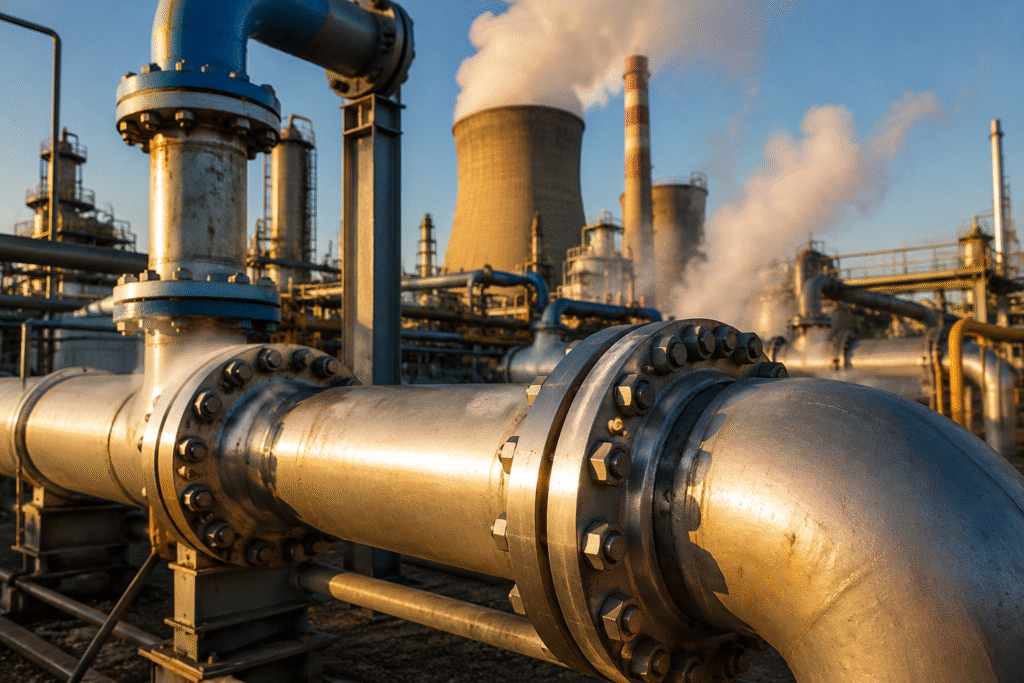
Markt für Edelstahlrohrflansche: 7 Datengestützte Einblicke in Typen, Verwendungsmöglichkeiten, Haltbarkeit, und wie man wählt
Laut Grand View Research (2024), Der globale Markt für Industrieflansche wurde mit bewertet $5.8 Milliarden in 2023 und wird voraussichtlich erreicht werden $7.2 Milliarden von 2030. Dieses Wachstum macht das Rohrflansch aus Edelstahl eine strategische Komponente für Ingenieure und Käufer, die Korrosionsbeständigkeit benötigen, Haltbarkeit, and lifecycle value in critical piping systems.
Für Beschaffungsteams, Der faszinierende Teil sind nicht nur die Materialkosten. The hidden advantages of stainless steel pipe flange selection include lower maintenance, stronger media compatibility, and better long-term performance across Oil & Gas, Petrochemie, Marine, und Wasseraufbereitungsanwendungen.
Warum der Markt für Edelstahlrohrflansche weiter wächst
Laut IBISWorld (2024), Der asiatisch-pazifische Raum macht mehr als aus 45% der weltweiten Flanschproduktion, wobei China der größte Hersteller ist. daher, buyers increasingly compare not just product price, but also factory capability, Einhaltung von Standards, und nachvollziehbare Qualitätsdokumentation.
Laut Statista (2024), auf die Öl- und Gasindustrie entfallen ca 35% des weltweiten Flanschverbrauchs. That figure matters because demanding process conditions often require stainless, Duplex, Nickellegierung, or carbon steel flange solutions with strict pressure-temperature ratings.
In der Praxis, a stainless steel pipe flange supports bolted pipe connections that simplify installation, Inspektion, und Wartung. Jedoch, performance depends on correct selection of material grade, Flanschverkleidung, Druckklasse, Wandstärke, Verschraubung, und Dichtungskompatibilität.
ASME B16.5 remains the core dimensional standard for pipe flanges and flanged fittings up to NPS 24, während ASME B16.47 deckt größere Durchmesser ab. Zusätzlich, ASTM A182 governs forged or rolled alloy and stainless steel pipe flanges for high-temperature service, which directly affects material acceptance for many industrial projects (ASME, 2023; ASTM, 2023).
The versatility of stainless steel pipe flange products explains their broad industrial use. Noten wie 304, 316, 316L, 904L, 2205, Und 2507 give engineers flexible options for chloride exposure, erhöhte Temperaturen, Druckwechsel, and sour service design requirements.
As procurement cycles become more data-driven, buyers expect mill test certificates, EN 10204 3.1 Inspektionsunterlagen, PMI, und dimensionale Berichte. Darüber hinaus, certified manufacturing systems reduce sourcing risk when project schedules are tight and compliance requirements are non-negotiable.
SASA FLANGE agiert in diesem Umfeld mit ISO 9001:2015, PED 2014/68/EU, und AD 2000 Anmeldeinformationen. Herstellung von Flanschen in 304, 316, 904L, 2205, 2507 und andere Premiumqualitäten, Das Unternehmen beliefert Öl & Gas, Petrochemie, Leistung, Marine, Wasseraufbereitung, und Baumärkte.
Laut Mordor-Geheimdienst (2024), infrastructure upgrades and energy investments continue to support demand for industrial piping components across emerging and mature markets. Infolge, stainless steel flange buyers increasingly prioritize supplier responsiveness, kundenspezifische Bearbeitung, and inspection transparency alongside cost.
That shift creates a clear opportunity for technically strong manufacturers. Unterstützt durch fortschrittliche CNC-Bearbeitung und umfassende Qualitätsprüfungen, SASA FLANGE can supply custom sizes from 1/2" bis 60" with competitive factory-direct pricing for global projects.
Flanschtypen für Edelstahlrohre, Versteckte Vorteile, und technische Auswahlfaktoren
The most effective buying decision starts with flange type and service condition, not price alone. In many systems, the hidden advantages of the right stainless steel pipe flange include longer gasket life, fewer leak paths, and reduced unplanned shutdowns.
As John Harrington, Leitender Rohrleitungsingenieur, Staaten: “A flange is rarely a commodity in severe service. The wrong facing, Legierung, or pressure class can multiply maintenance costs far beyond the initial purchase price.”
Laut Market Research Future (2024), corrosion-related maintenance still represents a major lifecycle expense in process industries, often consuming 3% Zu 5% of annual operating budgets in asset-intensive facilities. daher, selecting between 304, 316L, 2205, oder 2507 should be based on fluid chemistry, Chloridgehalt, Temperatur, and design pressure.
According to NACE guidance and common process industry practice, chloride-bearing media often accelerate pitting and crevice corrosion in lower-alloy stainless grades. Folglich, 316/316L, 904L, Duplex 2205, oder Super-Duplex 2507 may offer better durability than 304 in marine or chemical duty.
The main flange types used in industrial piping include the following.
- Vorschweißflansch für Hochdruck, zyklische Belastungen, und kritischer Service.
- Slip on flange for lower-pressure systems and cost-efficient installation.
- Muffenschweißflansch für Hochdruckrohre mit kleinem Durchmesser.
- Threaded flange for non-welded connections in limited cases.
- Überlappungsflansch für Systeme, die häufig demontiert werden müssen.
- Blindflansch zum Leitungsabschluss, Druckprüfung, oder zukünftige Erweiterung.
Each type has specific advantages in fabrication and field use. Zum Beispiel, weld neck designs improve stress distribution at the hub transition, while slip on designs reduce machining complexity and often shorten installation time.
Ebenso wichtig ist die Materialauswahl. ASTM A182 F304 and F316 are common forged stainless grades, while F316L offers lower carbon content that supports improved weldability and reduced risk of sensitization after welding.
Im Gegensatz, Duplex-Sorten wie z 2205 combine higher strength with stronger chloride stress corrosion cracking resistance. That often allows wall thickness optimization in selected applications, although welding control and procedure qualification become more critical.
Als Dr. Elena Morris, Materialwissenschaftler, Staaten: “The best flange alloy is the one that matches both the corrosion mechanism and the fabrication route. Buyers should evaluate not only media compatibility, but also weldability, Dokumentation, and availability.”
Engineers usually assess these technical parameters before they choose a flange.
- Nominal pipe size from 1/2" bis 60".
- Druckklasse wie z 150, 300, 600, 900, 1500, oder 2500.
- Verkleidungstyp einschließlich RF, FF, RTJ, Nut und Feder, or male-female.
- Schedule and wall thickness of the mating pipe.
- Betriebstemperatur und Auslegungsdruck.
- Fluid corrosivity, Feststoffgehalt, und Reinigungsregime.
- Required documentation such as EN 10204 3.1, PMI, Hydrotest, or NDT.
For buyers comparing stainless steel flange types, the most common material choice remains 304 oder 316. Jedoch, the better grade depends on exposure conditions, Weil 316 and 316L generally outperform 304 in chloride-rich media due to molybdenum addition.
According to ASTM and ASME material standards, forged flange chemistry and mechanical properties must stay within tightly defined limits. daher, supplier quality systems, Rückverfolgbarkeit der Wärme, and inspection discipline matter just as much as catalog listings.
Mit ISO 9001:2015 und PED 2014/68/EU-Zertifizierungen, SASA FLANGE supports buyers that need standard and custom flange production. The company offers stainless steel flanges, Flansche aus Kohlenstoffstahl, Flansche aus Legierung, und Rohrverbindungsstücke wie Winkelstücke, T-Shirts, Reduzierstücke, and caps for integrated sourcing.
In real project execution, availability also affects specification decisions. If a 4 Zoll-Edelstahlrohrflansch in der Klasse 300 is needed urgently, buyers may choose a stocked forged grade with full traceability rather than a special alloy with extended lead time.
Das heißt, lifecycle economics often justify a higher initial material cost. According to industry analysts at Grand View Research (2024), demand is shifting toward higher-performance materials in corrosive service as operators pursue lower maintenance and longer asset life.
ASME, ASTM, DIN, und EN-Anforderungen für die Konformität von Edelstahlrohrflanschen
Standards compliance is the backbone of flange procurement. Without dimensional conformity, Materialüberprüfung, and pressure-temperature validation, even a well-machined flange can create installation delays or integrity risks.
The most referenced standards for stainless steel pipe flange projects include ASME, ASTM, DIN, JIS, GOST, und EN-Systeme. In international supply chains, mixed standard environments are common, so buyers should confirm all dimensions before release.
- ASME B16.5 for pipe flanges and flanged fittings up to NPS 24.
- ASME B16.47 für Stahlflansche mit großem Durchmesser.
- ASME B16.9 for butt-welding fittings used with flange-connected systems.
- ASTM A182 for forged or rolled alloy and stainless flanges.
- EN 1092 für europäische Flanschabmessungen und Druckbezeichnungen.
- DIN flange standards for legacy and regional industrial systems.
Laut ASME (2023), Die Druck-Temperatur-Werte variieren je nach Materialgruppe und Flanschklasse. daher, eine Klasse 300 stainless steel pipe flange does not simply equal any PN-rated EN flange without dimensional and design verification.
Buyers should also evaluate documentation and regulatory requirements early. For projects entering Europe, PED 2014/68/EU compliance may be mandatory, while offshore or marine projects may request DNV or NORSOK-aligned documentation depending on the end use.
The following checklist helps reduce mismatch risk during sourcing.
- Confirm governing flange standard and revision level.
- Verify ASTM material grade and supplementary requirements.
- Match facing type to gasket style and bolting design.
- Review pressure class, temperature rating, und Korrosionszuschlag.
- Anfrage EN 10204 3.1 certificates and PMI where required.
- Überprüfen NACE MR0175 oder ISO 15156 relevance for sour service.
Für aggressive Medien, standards alone do not guarantee suitability. Jedoch, they provide the dimensional and material baseline needed for engineering review and quality acceptance.
Als Michael Trent, Industriemarktanalyst, Staaten: “In global procurement, compliance paperwork often decides supplier approval before price does. Traceability and standards alignment are now central buying criteria for energy and process projects.”
Buyers often compare ASME and EN flange systems as shown below.
- ASME uses pressure classes such as 150 Und 300, while EN commonly uses PN designations.
- ASME flange dimensions differ from EN 1092 dimensions in drilling and thickness details.
- Material naming may differ between ASTM and EN systems, even for similar chemistry ranges.
- Interchangeability should never be assumed without full drawing review.
For technical references, procurement and engineering teams can review standards directly through ASME. That step is especially useful for EPC projects where client specifications add supplementary testing, Markierung, or surface finish requirements.
SASA FLANGE supports ASME, ANSI, DIN, JIS, GOST, und EN 1092 manufacturing requirements. Portion 50+ Länder in ganz Öl & Gas, Petrochemie, Leistung, und Marineindustrie, the company provides inspection support and material options including 304, 316, 316L, 904L, 2205, 2507, A105, A182, Inconel, Monel, Hastelloy, und Titan.
That breadth matters when projects involve mixed metallurgy. A buyer may need stainless steel pipe flange assemblies for utility service, duplex flanges for seawater, and nickel alloys for acid handling in the same package.
So wählen Sie Edelstahl-Rohrflanschlösungen für Öl aus, Gas, Chemisch, Leistung, und Meeresprojekte
Selection begins with the application. A flange for potable water service differs significantly from one used in offshore injection lines, high-temperature steam systems, or corrosive chemical transfer.
In Öl & Gas, flange integrity directly affects leak prevention and maintenance intervals. Since this sector represents approximately 35% des weltweiten Flanschverbrauchs (Staatsmann, 2024), buyers often demand higher traceability, Druckstufen, and corrosion-resistant alloys.
For petrochemical plants, 316L and higher alloys are common where process media contain chlorides or aggressive compounds. Darüber hinaus, Dichtungskompatibilität, Flanschausführung, and bolt material must align with the process envelope to avoid premature failure.
Power generation projects often prioritize pressure class, Temperaturwechselbeständigkeit, und Dimensionskonsistenz. daher, weld neck flange designs are widely used in high-pressure steam and condensate systems where fatigue performance matters.
Marine and shipbuilding applications typically emphasize seawater resistance and compact maintenance planning. In diesen Fällen, Duplex 2205 oder Super-Duplex 2507 may outperform standard austenitic stainless in chloride-heavy environments.
Water treatment systems create a different set of priorities. Hier, buyers may focus on corrosion control, reliable availability, and cost-efficient maintenance, especially for pump stations, Entsalzungsanlagen, and chemical dosing lines.
Wenn sich Ingenieure für einen Rohrflansch aus Edelstahl entscheiden, they usually assess these factors.
- Servicemedium, einschließlich Chloride, Säuren, Alkalien, or solids.
- Betriebsdruck, Überspannungsbedingungen, and temperature range.
- Installationsmethode, Schweißerqualifikation, and field labor cost.
- Inspektionsebene, einschließlich PMI, UT, PT, oder hydrostatische Prüfung.
- Required standard system such as ASME B16.5 oder EN 1092.
- Delivery schedule, stocking needs, and custom machining lead time.
The intriguing benefit of working with a specialized manufacturer is application guidance. Instead of only supplying a catalog item, an experienced team can recommend flange face, Klasse, Legierung, and matching fittings based on service conditions and project specification.
SASA FLANGE offers custom manufacturing for standard and non-standard dimensions. Unterstützt durch fortschrittliche CNC-Bearbeitung und umfassende Qualitätsprüfungen, the company can support projects needing raised face, flaches Gesicht, RTJ, and custom drilled configurations.
Zum Beispiel, a marine buyer sourcing a 2 inch stainless steel flange for ballast or seawater service may favor duplex material over 304 due to chloride exposure. Im Gegensatz, a food-grade utility line may use 304 oder 316 depending on cleaning chemistry and hygiene protocol.
Ebenfalls, A 4 inch stainless steel pipe flange for high-temperature chemical service may require F316H, 321, or another heat-resistant grade depending on process temperature and code design. daher, flange selection should always connect material science with standards compliance and operating reality.
Buyers should also compare total package value. A supplier that can combine flanges with elbows, T-Shirts, Reduzierstücke, and caps often reduces procurement complexity, Dokumentationslücken, and shipment delays across multi-line piping projects.
For project teams that need factory-direct support, SASA FLANGE can assist with technical review, Zitat, and custom production planning. That is especially useful for contractors balancing price, delivery, and certification requirements at the same time.
Zukunftsaussichten für die Nachfrage nach Edelstahlrohrflanschen und strategische Kaufempfehlungen
The outlook remains positive as energy, Wasser, and industrial infrastructure spending continues to rise. Laut Grand View Research (2024), Es wird erwartet, dass der Markt für Industrieflansche weiter wachsen wird $5.8 Milliarden in 2023 Zu $7.2 Milliarden von 2030, which reflects sustained replacement and expansion demand.
Zusätzlich, buyers are moving toward stronger supply-chain resilience. Laut IBISWorld (2024), Der asiatisch-pazifische Raum produziert mehr als 45% der globalen Flanschleistung, so regional sourcing strategy, backup suppliers, and logistics planning now carry more weight in procurement decisions.
Auch die digitale Beschaffung verändert den Markt. Engineers increasingly expect fast drawing confirmation, Materialrückverfolgbarkeit, and immediate access to test documentation before issuing purchase orders.
Für B2B-Käufer, three recommendations stand out. Erste, standardize approved flange materials by service category. Zweite, qualify suppliers on certification, Inspektionsfähigkeit, and responsiveness. Dritte, evaluate total installed cost rather than unit price alone.
In praktischer Hinsicht, that means using 304 where corrosion conditions allow, upgrading to 316L or 904L where chemistry demands, and considering duplex grades where higher strength and chloride resistance create measurable lifecycle value. Darüber hinaus, always verify ASME or EN dimensional compatibility before procurement release.
The hidden advantages of disciplined flange sourcing are significant. Better specification control reduces rework, protects turnaround schedules, and supports safer plant operation over the long term.
For companies planning new projects or replacement purchases, working with a manufacturer that understands materials, Standards, and custom machining can shorten the path from RFQ to approved delivery. Buyers that need reliable stainless steel pipe flange supply, technische Unterstützung, and documented quality can explore solutions through SASA FLANGE as part of a broader industrial piping sourcing strategy.
Häufig gestellte Fragen
Welche verschiedenen Arten von Edelstahlflanschen gibt es??
●Die wichtigsten Edelstahlflanschtypen sind Vorschweißflansche, reinschlüpfen, Muffenschweißen, mit Gewinde, Überlappungsgelenk, und Blindflansche, Und ASME B16.5 defines the core dimensional framework for most standard industrial sizes.
●Laut Statista (2024), the oil and gas sector uses about 35% des globalen Flanschvolumens, which is why weld neck and blind flange designs are especially common in higher-pressure systems.
●Weld neck flanges offer better stress distribution, while slip on flanges simplify alignment and fabrication in lower-pressure lines.
●Threaded flanges support non-welded installation in special cases, and socket weld flanges are often chosen for small-bore high-pressure service.
●For projects requiring multiple flange types in 304, 316, 2205, or custom grades, Zusammenarbeit mit etablierten Herstellern wie SASA FLANGE helps ensure dimensional consistency and full traceability.
Was ist besser? 304 oder 420 Edelstahl?
●Für die meisten Anwendungen mit Edelstahlrohrflanschen, 304 ist im Allgemeinen besser als 420 because it offers stronger corrosion resistance and is more widely used in industrial piping systems.
●Grad 420 ist ein martensitischer Edelstahl mit höherem Härtepotenzial, but it is less suitable for many corrosive flange services than austenitic 304 oder 316 Noten.
●According to ASTM material classifications and common process industry practice, 304 remains one of the most common stainless selections for fabricated and forged piping components because of its balance of formability, Schweißbarkeit, und Kosten.
●Jedoch, if chloride exposure is significant, 316 or 316L is often a better flange choice than either 304 oder 420 due to improved pitting resistance from molybdenum addition.
●For application-specific alloy selection, buyers should confirm fluid chemistry, Temperatur, and standard requirements with a qualified supplier such as SASA FLANGE.
In welcher Branche wird am meisten Edelstahl verwendet??
●Among flange-consuming sectors, oil and gas is the largest single end-use segment, macht ungefähr aus 35% des weltweiten Flanschverbrauchs laut Statista (2024).
●That does not mean all stainless demand comes only from oil and gas, because chemical processing, Marine, Wasseraufbereitung, Lebensmittelverarbeitung, and power generation also use large volumes of stainless materials.
●Stainless steel becomes especially important where corrosion resistance, Hygiene, or elevated temperature performance directly affects uptime and safety.
●Zum Beispiel, water treatment and marine sectors often specify 316L, Duplex 2205, or higher alloys where chloride exposure can quickly shorten the life of lower-grade materials.
●Companies sourcing across several industries benefit from suppliers that can provide both stainless steel flanges and matching fittings under one quality system, einschließlich ISO 9001:2015 and PED-aligned documentation.
Welche drei Arten von Flanschen gibt es??
●Die drei Flanschtypen, auf die in grundlegenden Industriediskussionen am häufigsten Bezug genommen wird, sind Schweißhalsflansche, reinschlüpfen, and blind flanges because they cover many standard piping installation needs.
●Weld neck flanges are preferred for high-pressure or cyclic service, slip on flanges are used for simpler and often lower-pressure fabrication, and blind flanges close the end of a line or vessel nozzle.
●Entsprechend ASME B16.5, all three types are standardized by dimensions, gegenüberstehende Optionen, und Druckklassen, which helps buyers compare products across qualified manufacturers.
●In realen Projekten, engineers also frequently use socket weld, mit Gewinde, and lap joint flanges when piping size, Wartungsbedarf, or field welding limitations make those designs more practical.
●Buyers should select flange type based on process duty, Inspektionsanforderungen, and total installed cost rather than assuming one design fits every piping service.
How do I choose the right stainless steel pipe flange?
●The right stainless steel pipe flange is chosen by matching material grade, Druckklasse, gegenüber, Rohrplan, and corrosion conditions to the project design code and service medium.
●Laut Grand View Research (2024), the industrial flange market will reach $7.2 Milliarden von 2030, and that growth reflects increasing demand for application-specific solutions rather than one-size-fits-all components.
●In praktischer Hinsicht, buyers should first verify whether 304, 316L, 904L, 2205, oder 2507 is appropriate for the fluid chemistry and operating temperature.
●Nächste, they should confirm whether ASME B16.5, ASME B16.47, oder EN 1092 regelt die Dimensionen, and then check if RF, FF, or RTJ facing best fits the gasket system.
●For critical service or custom sizes from 1/2" bis 60", eine Partnerschaft mit einem Lieferanten wie z SASA FLANGE improves the chances of getting compliant documentation and reliable lead times.
Was beeinflusst den Preis für Edelstahlrohrflansche??
●Der Preis für Edelstahlrohrflansche hängt hauptsächlich von der Legierungssorte ab, Größe, Druckklasse, Bearbeitungskomplexität, Prüfanforderungen, und Auftragsvolumen.
●Zum Beispiel, a 316L weld neck flange usually costs more than a 304 slip on flange of the same size because the material value and machining profile are both higher.
●Laut IBISWorld (2024), Auf den asiatisch-pazifischen Raum entfallen mehr als 45% der weltweiten Flanschproduktion, which means regional manufacturing scale and logistics can significantly influence quoted price and lead time.
●Additional requirements such as PMI, EN 10204 3.1 Zertifizierung, NACE-Konformität, or custom drilling can increase total cost but often reduce project risk in return.
●To compare price accurately, buyers should evaluate total delivered value, einschließlich Compliance, Rückverfolgbarkeit, Verpackung, and support for matching fittings, rather than focusing on unit price alone.
Verwandte Beiträge
Flanschoberflächenfinish: Konzentrische vs. spiralförmige Verzahnungen erklärt
Konzentrische und spiralförmige Verzahnungen sind beide bearbeitete Flanschflächenoberflächen…
Duplex 2205 vs. 316L-Flansche: Welches Material sollten Sie wählen??
Schnelle Antwort: Duplex 2205 Flansche sind normalerweise der stärkere Kandidat…

Definition des Öffnungsflansches, Details und Übersicht über ASME B16.36-Flansche: Marktdaten, Auswahlhilfe und Compliance-Einblicke
Der globale Markt für Industrieflansche wurde mit bewertet $5.8 Milliarde…

Marktführer für schwarze Entsorgungsflansche: Materialien, 3.5″ Kompatibilität, und B2B-Beschaffungsdaten für Küchenspülenflansche
Die Nachfrage nach schwarzen Entsorgungsflanschen steigt bei Käufern von Küchenarmaturen…