
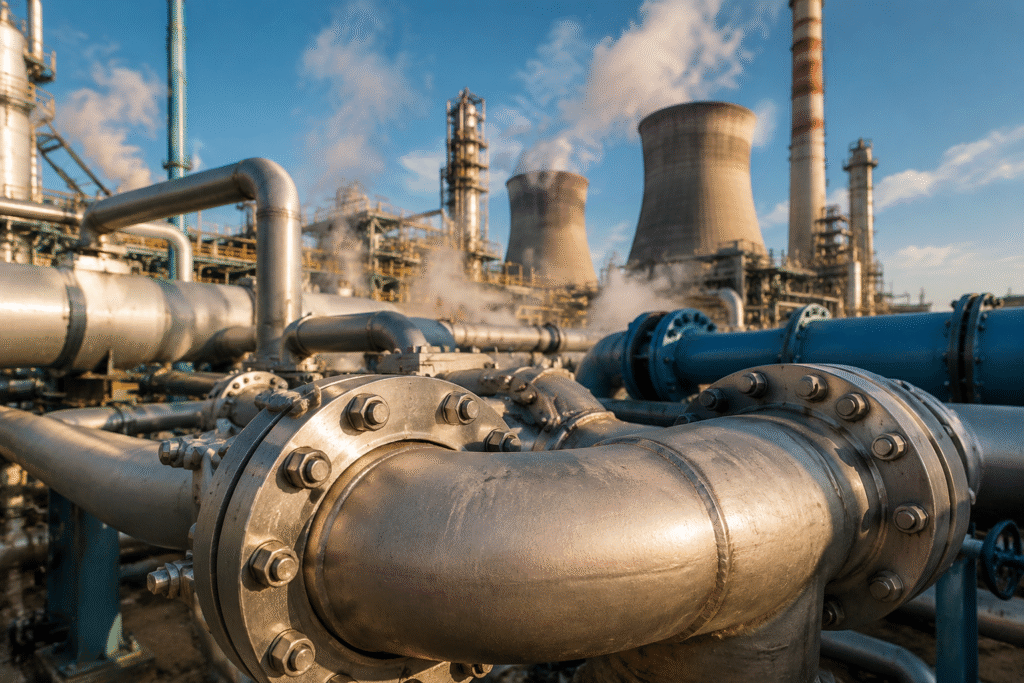
Panduan Flange Pipa Stainless Steel: Data Pasar, Keuntungan Tersembunyi, Jenis Umum dan Kegunaan Industri
Pasar flensa pipa baja tahan karat berkembang seiring dengan investasi industri global dan standar keandalan yang lebih ketat. Menurut Penelitian Grand View (2024), pasar flensa industri global dihargai $5.8 miliar masuk 2023 dan diperkirakan akan tercapai $7.2 miliar oleh 2030.
Untuk manajer pengadaan dan insinyur perpipaan, bahwa pertumbuhan mencerminkan realitas praktis. Stainless steel pipe flange selection now affects corrosion life, biaya pemeliharaan, risiko penutupan, dan kepatuhan di bidang minyak dan gas, petrokimia, laut, pengolahan air, dan aplikasi daya.
Many buyers search for intriguing stainless steel flanges because they want more than a basic product list. They want a guide that explains hidden advantages, tipe umum, nilai materi, kelas tekanan, and how to choose flanges for real operating conditions.
Menurut IBISWorld (2024), Asia-Pasifik menyumbang lebih dari itu 45% produksi flensa global, dengan Tiongkok tetap menjadi basis manufaktur terbesar. Karena itu, buyers increasingly compare certified Chinese manufacturers on metallurgy, presisi pemesinan, ketertelusuran, and inspection capability.
That is where supplier qualification becomes important. SASA FLANGE serves customers in more than 50 countries and manufactures stainless steel, baja karbon, paduan, rangkap, paduan nikel, and titanium flanges and fittings for demanding industrial projects.
Why Stainless Steel Pipe Flange Demand Keeps Rising in Industrial Projects
The strongest demand driver remains infrastructure modernization. Menurut Statista (2024), industri minyak dan gas menyumbang sekitar 35% konsumsi flensa global, which shows how heavily critical piping systems rely on dependable flange connections.
Namun, oil and gas is not the only growth sector. Pengolahan air, platform lepas pantai, pembuatan kapal, LNG, and power plants increasingly prefer stainless materials because corrosion failures create expensive downtime and safety exposure.
Stainless steel pipe flange products deliver a practical balance of strength, ketahanan terhadap korosi, kemampuan las, dan umur panjang. Sebaliknya, lower-cost materials may reduce upfront spend but often increase maintenance frequency in chloride, uap, atau layanan yang agresif secara kimia.
Menurut Riset Pasar Masa Depan (2024), industrial piping component demand is growing at more than 4% CAGR in energy and processing sectors. Sebagai akibat, buyers are asking for shorter lead times, wider size ranges, Dan EN 10204 3.1 material documentation as standard.
Material selection also changed after many end users tightened lifecycle cost targets. Menurut Intelijen Mordor (2024), pemeliharaan terkait korosi dapat mewakili 15% ke 25% anggaran pemeliharaan pabrik tahunan di industri proses, tergantung pada kondisi layanan.
That figure explains the hidden advantages of stainless steel flanges. A correctly specified 316L, 2205, or 904L flange often reduces leakage risk, extends inspection intervals, and improves total ownership economics.
For buyers comparing manufacturers, capability depth matters as much as catalog breadth. Dengan ISO 9001:2015 dan sertifikasi PED 2014/68/EU, SASA FLANGE produces flanges to ANSI B16.5, ANSI B16.47, DIN, JIS, gost, dan EN 1092 persyaratan.
Selain itu, perusahaan memasok siku, kaos, reduksi, and caps to support complete piping packages. That matters for EPC contractors who prefer fewer vendors, simpler documentation control, and consistent quality across flange and fitting assemblies.
Material range is another differentiator. Flensa manufaktur masuk 304, 316, 316L, 904L, 2205, 2507, A105, A182, tidak konel, Monel, Hastelloy, and Titanium allows engineers to align the flange grade with medium chemistry, kisaran suhu, dan kelas tekanan.
Seperti John Reynolds, insinyur material dan konsultan korosi, negara bagian: “The lowest flange price rarely equals the lowest system cost. Correct alloy selection is one of the fastest ways to reduce leakage, penggantian, and unplanned shutdowns.”
That statement reflects current procurement reality. Buyers increasingly evaluate supplier performance on metallurgy support, akurasi pemesinan, ketersediaan PMI, pengujian hidrostatik, and documentation turnaround rather than piece price alone.
Karena itu, a useful guide must do more than list products. It should explain the most common flange types, compare stainless grades, and show how to choose a stainless steel pipe flange for actual service conditions.
Technical Guide to Stainless Steel Pipe Flange Materials, Ratings and Common Types
At the technical level, stainless steel pipe flange selection starts with three variables. These are material grade, tipe flensa, and pressure-temperature rating under the applicable standard.
ASME B16.5 mencakup flensa pipa dan fitting flensa hingga NPS 24, ketika ASME B16.47 covers large diameter flanges from NPS 26 melalui NPS 60 (ASME, 2023). ASTM A182 is the common forged material specification for stainless and alloy steel flanges in high-temperature service (ASTM, 2024).
The most common stainless grades remain 304, 304L, 316, dan 316L. They are widely available, hemat biaya, and suitable for a broad range of industrial services when media chemistry and chloride content stay within acceptable limits.
304 and 304L are often chosen for general process systems, food applications, and moderate corrosion environments. Namun, 316 and 316L perform better in chlorides and marine atmospheres because molybdenum improves pitting resistance.
Higher-performance applications may require 904L, rangkap 2205, atau super dupleks 2507. These materials offer stronger resistance to chloride attack, retak korosi tegangan, atau beban mekanis yang lebih tinggi, especially in offshore and aggressive chemical service.
Menurut panduan korosi NACE, konsentrasi klorida, suhu, pH, and oxygen level must all be reviewed together when specifying stainless alloys (NACE, 2023). Karena itu, grade selection should never rely on a single chemical property alone.
Sebagai Dr. Anita Verma, a metallurgical specialist in process materials, negara bagian: “304 Dan 316 answer many industrial needs, but duplex grades often provide the better value proposition when chloride exposure and strength requirements rise together.”
That insight is especially relevant for buyers evaluating hidden advantages beyond the most common grades. Duplex flanges can reduce wall thickness in some systems because of higher strength, although welding procedures and fabrication control become more demanding.
The most common flange types each suit different installation priorities. Engineers typically compare welding method, toleransi keselarasan, frekuensi pemeliharaan, integritas tekanan, dan total biaya pemasangan.
- Flensa leher las: Lebih disukai untuk tekanan tinggi, suhu tinggi, dan layanan siklik karena hub yang meruncing meningkatkan distribusi tegangan.
- Selipkan flensa: Easier to align and economical for low to moderate pressure service, especially where fabrication simplicity matters.
- Flensa buta: Used to close a line end, test section, atau titik ekspansi di masa depan.
- Flensa las soket: Cocok untuk pipa bertekanan tinggi dengan lubang kecil, often where leak integrity is important.
- Flensa berulir: Berguna jika pengelasan dibatasi, though pressure and vibration limits must be considered carefully.
- Flensa sambungan putaran: Practical when frequent dismantling is required and stub end construction offers cost or maintenance advantages.
Kelas tekanan juga sama pentingnya. ASME B16.5 classes typically include 150, 300, 600, 900, 1500, Dan 2500, and allowable pressure falls as temperature rises according to the material group and standard tables (ASME, 2023).
That is why buyers should avoid selecting a flange by nominal pressure alone. Sebuah Kelas 300 stainless steel pipe flange in ambient service may not satisfy the same process conditions at elevated temperature.
Surface finish and facing type also influence sealing reliability. Wajah terangkat, wajah datar, and ring type joint designs each support different gasket systems and bolting strategies.
Didukung oleh permesinan CNC canggih dan pengujian kualitas yang komprehensif, SASA FLANGE menawarkan ukuran khusus dari 1/2 inci ke 60 inci. This capability helps EPC firms source standard and non-standard flanges under one purchasing workflow.
Inspection is another technical checkpoint that procurement teams should define clearly. Untuk layanan kritis, typical requirements include PMI, pemeriksaan dimensi, pengujian kekerasan, hydrostatic or pneumatic verification where relevant, Dan EN 10204 3.1 dokumentasi.
Menurut panduan manajemen mutu ISO, documented process control reduces variation and improves traceability in manufactured pressure components (ISO, 2023). Karena itu, certified quality systems remain a practical requirement rather than a marketing add-on.
For stainless steel pipe flange projects in refineries or chemical units, engineers should review the following before issuing a PO.
- Process fluid composition, termasuk klorida, senyawa belerang, asam, and solids.
- Suhu pengoperasian dan desain.
- Operating and design pressure.
- Standar flensa, menghadap, dan kelas tekanan.
- Jadwal pipa dan kecocokan bore.
- Welding procedure compatibility and post-weld requirements.
- NACE MR0175 or sour service restrictions where applicable.
- Sertifikat yang diperlukan, menandai, dan ruang lingkup pengujian.
These details separate a successful installation from an expensive field correction. Lebih-lebih lagi, they help manufacturers quote faster and reduce commercial ambiguity.
Standar, Compliance and Quality Controls for Stainless Steel Pipe Flange Procurement
Industrial buyers usually work across several standards systems at once. ASME, ASTM, DIN, EN, and API references often appear together in project specifications, especially on international EPC work.
ASME B16.5 and B16.47 govern dimensions, toleransi, pengeboran, and pressure classes for many flange applications. ASTM specifications define material chemistry and mechanical properties, sementara DI 1092 and DIN systems remain common across European projects.
For regulated pressure systems, compliance extends beyond dimensions. Dokumentasi PED 2014/68/EU, ketertelusuran panas, and inspection records may all be required before equipment can move into approved service.
Menurut kerangka PED Komisi Eropa, pressure components must demonstrate conformity through appropriate assessment procedures before placement on the EU market (PED, 2024). Karena itu, documentation quality can delay a project as easily as manufacturing lead time.
NACE MR0175 becomes relevant when H2S or sour service is involved. Dalam kasus tersebut, batas kekerasan, metallurgy restrictions, and environment-specific material controls protect against sulfide stress cracking and other failure mechanisms.
The following comparison helps buyers organize common flange compliance checkpoints.
- ASME B16.5: Dimensions and pressure-temperature ratings for NPS 1/2 ke 24.
- ASME B16.47: Large diameter flange dimensions for NPS 26 ke 60.
- ASTM A182: Forged stainless and alloy steel material requirements.
- ASME B16.9: Factory-made wrought buttwelding fittings for elbows, kaos, reduksi, dan topi.
- EN 1092: European flange design and dimensional standard.
- EN 10204 3.1: Inspection certificate confirming material compliance and test results.
- NACE MR0175: Persyaratan material untuk lingkungan yang mengandung H2S dalam produksi minyak dan gas.
Experienced procurement teams also define marking rules in advance. This typically includes heat number, kelas materi, kelas tekanan, ukuran, standar, manufacturer mark, dan ketertelusuran asal.
Dalam praktiknya, conformity is strongest when quality systems, prosedur pengujian, and production controls align. Dengan ISO 9001:2015, PED 2014/68/UE, dan IKLAN 2000 kredensial, SASA FLANGE supports projects that require formal quality assurance and export-ready documentation.
That matters for marine, di lepas pantai, and power buyers who must present organized records to owners, inspectors, or third-party agencies. It also matters when replacement parts must match existing installations exactly.
Menurut panduan DNV untuk komponen kelautan dan lepas pantai, traceability and documented material compliance are essential for maintaining asset integrity in corrosive service environments (DNV, 2023). Sebagai akibat, reputable flange suppliers build documentation control into production planning from the start.
Untuk profesional pengadaan, the best approach is to request a clear manufacturing and inspection matrix before order release. That matrix should confirm standards, raw material source, ruang lingkup permesinan, NDT if needed, certificate format, and delivery marking.
Buyers should also verify whether the supplier can package complete packages. Flensa, gasket, lari, and fittings shipped under one quality plan often reduce receiving delays and mismatch risk.
When reviewing vendors, compare more than headline compliance claims. Ask for sample MTCs, quality manual scope, previous PED shipment experience, and evidence of dimensional inspection on comparable sizes and classes.
For further specification support or quotation review, engineers can contact SASA FLANGE secara langsung. A technically competent supplier should be able to respond with standards-based recommendations rather than generic sales language.
How to Choose Flanges for Oil and Gas, Kimia, Power and Marine Applications
The right stainless steel pipe flange depends on service-specific variables, not just nominal size. Kimia media, kelas tekanan, suhu, tunjangan korosi, and maintenance strategy all influence the final selection.
Dalam minyak dan gas, weld neck flanges remain common for high-pressure and cyclic systems. Menurut Statista (2024), sektor ini mewakili tentang 35% konsumsi flensa global, so reliability and standard compliance are major purchasing priorities.
For sour or chloride-bearing service, engineers often move beyond basic austenitic grades. Rangkap 2205, super dupleks 2507, or nickel alloys may be justified when pitting resistance and strength margin become more important than initial price.
Dalam pengolahan petrokimia dan kimia, corrosion mapping is critical. Asam, klorida, pelarut, and elevated temperatures can quickly expose the limitations of lower-alloy materials.
Karena itu, buyers should compare actual fluid data to material performance, not assume all stainless grades perform similarly. 316L may suit one process line very well, while 904L or Hastelloy is necessary in another.
Power generation imposes different stresses. Siklus termal, kondisi uap, and long service intervals often favor robust forged flanges with documented heat treatment and tight dimensional consistency.
Marine and shipbuilding environments add continuous salt exposure. Sebagai akibat, 316L, nilai dupleks, and careful sealing design often outperform basic alternatives in deck, pemberat, desalinasi, dan sistem air laut.
The following checklist helps buyers choose flanges more efficiently.
- Confirm line size, jadwal, dan standar komponen kawin.
- Select the correct flange type for welding method and maintenance needs.
- Match alloy to fluid chemistry and external environment.
- Check temperature-pressure rating under the exact standard.
- Definisikan menghadap, kompatibilitas paking, dan persyaratan baut.
- Request inspection certificates and traceability level before ordering.
- Review lead time for standard versus custom dimensions.
- Confirm whether fittings are needed in the same material heat lot or package.
As Mark Delaney, senior piping engineer in offshore projects, negara bagian: “Most flange problems begin before installation. They start when buyers approve a grade, menghadap, or pressure class without fully checking the service envelope.”
This is why application guidance should sit beside product data. A comprehensive supplier helps translate standards and metallurgy into a practical purchasing decision.
SASA FLANGE supports that approach by supplying custom manufacturing, including standard and non-standard sizes, forged and machined flanges, and coordinated pipe fitting packages. Menawarkan ukuran khusus dari 1/2 inci ke 60 inches with competitive factory-direct pricing is especially useful for EPC, MRO, and distributor buyers.
Selain itu, many projects now demand shorter delivery windows. Menurut IBISWorld (2024), China remains the largest flange manufacturing center, which gives qualified exporters an advantage on scale, ketersediaan bahan, and production responsiveness.
Namun, fast supply only matters when quality remains stable. Karena itu, buyers should balance lead time against machining capability, pengendalian bahan baku, kemasan ekspor, and communication accuracy.
Untuk proyek yang membutuhkan 304, 316, 316L, 904L, 2205, 2507, tidak konel, Monel, Hastelloy, or Titanium flanges and fittings, bekerja dengan produsen mapan seperti SASA FLANGE helps reduce sourcing risk. The combination of broad metallurgy, cakupan standar, and documented QA supports better purchasing outcomes.
Prospek Masa Depan untuk Pasokan Flange Pipa Stainless Steel dan Keputusan Pembelian Strategis
The medium-term outlook remains positive for stainless steel pipe flange demand. Menurut Penelitian Grand View (2024), the industrial flange market is projected to grow from $5.8 miliar masuk 2023 ke $7.2 miliar oleh 2030, reflecting continued investment in energy, air, and industrial infrastructure.
Pada saat yang sama, the market is becoming more specification-driven. Semakin banyak pembeli yang meminta ketertelusuran penuh, paduan tahan korosi, and project-ready documentation rather than only comparing unit price.
That shift creates opportunities for technically strong suppliers. It also rewards procurement teams that standardize approved grades, inspection plans, and preferred manufacturers across regions.
Several trends will likely shape future purchases.
- Higher demand for duplex and super duplex flanges in chloride service.
- More complete package sourcing that combines flanges and fittings.
- Greater emphasis on PED, EN 10204 3.1, and digital documentation.
- Shorter sourcing cycles supported by responsive Asian manufacturing.
- Lifecycle cost evaluation replacing lowest-price-only procurement.
Untuk pembeli, the practical recommendation is simple. Build sourcing decisions around service data, kepatuhan standar, and documentation quality first, then compare lead time and price within that qualified group.
Selain itu, maintain a shortlist of suppliers with proven capability in both standard and custom work. This is especially important when shutdown schedules or export compliance leave little room for error.
If your team is reviewing intriguing stainless steel flanges, comparing common types, or planning a stainless steel pipe flange package for a new project, it is worth engaging a manufacturer early in the specification stage. Early technical review often prevents costly revisions later in procurement and fabrication.
Pertanyaan yang Sering Diajukan
Apa sajakah jenis flensa baja tahan karat?
●Jenis flensa baja tahan karat yang paling umum adalah leher las, mengenakan, buta, las soket, berulir, dan sambungan pangkuan, dengan ASME B16.5 covering many standard dimensions and classes.
●Weld neck flanges suit high pressure and cyclic duty, while slip on and threaded designs are often chosen for easier installation or lower-pressure service.
●Untuk sistem kritis, engineers should match flange type to pressure class, menghadap, desain paking, and corrosion environment before purchase.
Mana yang lebih baik 304 atau 420 baja tahan karat?
●Untuk sebagian besar aplikasi flensa, 304 stainless steel is the better choice because it offers stronger corrosion resistance and better weldability than 420 baja tahan karat.
●Nilai 420 is a martensitic stainless steel used more often for hardness and wear resistance, sedangkan ASTM A182 F304 flange material is widely accepted in process piping.
●If the service involves moisture, bahan kimia, or welded joints, pembeli biasanya harus memprioritaskan 304 atau 316 grades instead of 420.
Industri apa yang paling banyak menggunakan baja tahan karat?
●Menurut Statista (2024), minyak dan gas menyumbang sekitar 35% konsumsi flensa global, making it one of the heaviest industrial users of stainless and alloy flanges.
●Namun, petrokimia, pengolahan air, laut, pengolahan makanan, and power generation also use large volumes of stainless components because corrosion resistance improves reliability.
●When the line medium contains chlorides, senyawa belerang, atau bahan kimia agresif, buyers should review higher-performance grades such as 316L, 2205, atau 2507.
Sebutkan tiga jenis flensa?
●The three flange types most commonly referenced in basic piping discussions are weld neck, mengenakan, and blind flanges because they cover many installation scenarios.
●Weld neck flanges offer superior stress distribution, slip on flanges simplify fit-up, and blind flanges close line ends or test sections.
●For engineered purchasing, these three should still be evaluated against socket weld, berulir, and lap joint options under the applicable ASME or EN standard.
How do I choose the right stainless steel pipe flange size and pressure class?
●Flange size must match the pipe NPS and schedule, while pressure class must be selected from standards such as ASME B16.5 Kelas 150 melalui 2500 based on temperature and material group.
●Menurut ASME (2023), allowable pressure decreases as temperature rises, so a class rating cannot be judged correctly without the full service condition.
●Procurement teams should confirm mating flange standard, tipe menghadap, kompatibilitas paking, and design temperature before approving any stainless steel pipe flange order.
Apa yang mempengaruhi harga flensa pipa stainless steel?
●Harga flensa pipa baja tahan karat terutama bergantung pada tingkat paduan, ukuran, kelas tekanan, forged weight, kompleksitas pemesinan, ruang lingkup pengujian, dan persyaratan sertifikasi seperti EN 10204 3.1 atau PED.
●Menurut Penelitian Grand View (2024), pasar flensa industri tercapai $5.8 miliar masuk 2023, and stronger demand for premium alloys continues to influence material cost and lead time.
●To control project cost, buyers should standardize specifications early and request quotations from qualified manufacturers that can supply both flanges and fittings efficiently.
Posting Terkait
Selesai Wajah Flange: Penjelasan Gerigi Konsentris vs Spiral
Gerigi konsentris dan spiral keduanya merupakan penyelesaian permukaan flensa yang dikerjakan dengan mesin…
Rangkap 2205 vs Flensa 316L: Bahan Mana Yang Harus Anda Pilih?
Jawaban cepat: Rangkap 2205 flensa biasanya merupakan kandidat yang lebih kuat…

Definisi Flensa Lubang, Detail dan Ikhtisar Flensa ASME B16.36: Data Pasar, Panduan Seleksi dan Wawasan Kepatuhan
Pasar flensa industri global dihargai $5.8 miliar…

Panduan Pasar Flensa Pembuangan Hitam: Bahan, 3.5″ Kesesuaian, dan Data Sumber B2B untuk Flensa Wastafel Dapur
Permintaan flensa pembuangan hitam meningkat sebagai pembeli perlengkapan dapur…