
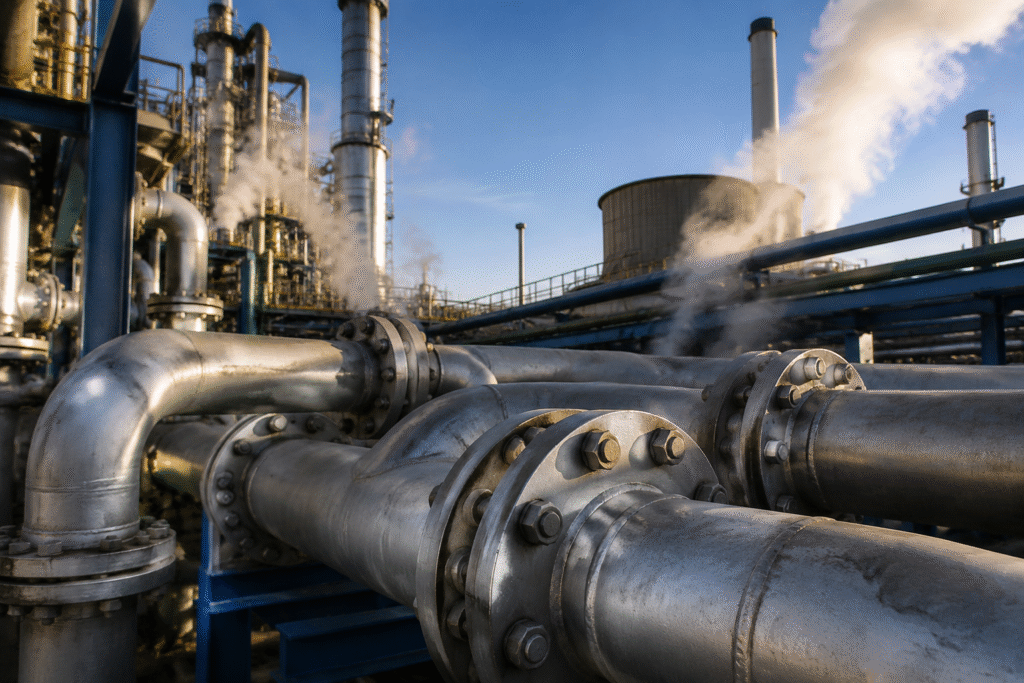
Memilih Flensa Stainless Steel untuk Tekanan dan Masa Pakai
Itu flensa pipa baja tahan karat market is expanding as global process industries invest in corrosion-resistant piping systems. Menurut Penelitian Grand View (2024), pasar flensa industri global dihargai $5.8 miliar masuk 2023 dan diperkirakan akan tercapai $7.2 miliar oleh 2030.
Untuk tim pengadaan dan insinyur perpipaan, that growth reflects a clear priority: masa pakai lebih lama, safer joints, and stronger compliance in demanding systems. Karena itu, buyers now expect more than stock availability from a flange supplier.
Why the Stainless Steel Pipe Flange Market Keeps Growing
Industrial demand for Stainless, Baja, Flanges continues to rise across refinery upgrades, desalination projects, platform lepas pantai, and pharmaceutical plants. Menurut Statista (2024), industri minyak dan gas menyumbang sekitar 35% konsumsi flensa global.
That figure matters because oil and gas applications require reliable sealing under pressure cycling, temperature fluctuation, dan media korosif. Sebagai akibat, stainless steel pipe flange products remain a preferred choice for critical service lines.
Regional manufacturing concentration also shapes sourcing strategy. Menurut IBISWorld (2024), Asia-Pasifik menyumbang lebih dari itu 45% produksi flensa global, dengan Tiongkok sebagai produsen terbesar.
This concentration gives buyers access to scale, wider alloy selection, and shorter lead times when they source from established manufacturers. Namun, supplier qualification remains essential because dimensional accuracy, ketertelusuran, and metallurgical consistency directly affect field performance.
Many competitor pages focus on SKU volume, basic sizes, and cart-based ordering. Sebaliknya, serious B2B buyers also need application guidance on 304 melawan 316, tipe muka flensa, kelas tekanan, dan dokumentasi inspeksi.
As piping engineer Mark Jensen, Senior Process Piping Consultant, negara bagian: “A flange is never just a commodity part; it is a pressure boundary component that must match process chemistry, suhu, beban baut, and assembly practice.” That insight explains why technical content now influences purchasing decisions as much as price.
Secara praktis, buyers compare several variables before placing a PO. These include alloy chemistry, ASTM/ASME conformity, toleransi pemesinan, hydrostatic or PMI test support, and document packages such as EN 10204 3.1 sertifikat.
SASA FLANGE supports this expectation with ISO 9001:2015 dan sertifikasi PED 2014/68/EU, while supplying stainless steel flanges and fittings for Oil & Gas, Petrokimia, Kekuatan, Laut, dan sektor Pengolahan Air. Buyers looking for project support can review capabilities at https://sasaflange.com/about-us/.
The market also favors suppliers that can cover both standard and engineered requirements. Karena itu, produsen dengan mesin CNC, broad raw material sourcing, and custom production flexibility hold a measurable advantage in complex bids.
Menurut Intelijen Mordor (2024), global investment in process industry infrastructure continues to support mid-single-digit annual demand growth for industrial piping components. Lebih-lebih lagi, corrosion-related maintenance still represents one of the largest avoidable lifecycle costs in processing plants.
That is why a well-selected stainless steel pipe flange often reduces total installed cost even when the unit price is higher than carbon steel. Longer maintenance intervals and lower replacement frequency usually outweigh the initial premium.
How to Select a Stainless Steel Pipe Flange for Pressure, Korosi, and Service Life
Flange selection starts with service conditions, not with catalog sorting. Engineers first define fluid chemistry, tekanan desain, suhu desain, ukuran garis, tunjangan korosi, and the preferred joint configuration.
Misalnya, a Threaded flange may suit low-pressure utility lines or systems where welding is impractical. Namun, for severe cyclic service or high-integrity process lines, weld neck designs usually provide better stress distribution.
Menurut ASME B16.5, peringkat tekanan-suhu bervariasi menurut kelompok bahan dan kelas, jadi a 600# Flange cannot be evaluated by pressure class alone. Kelas materi, jenis paking, lari, and actual operating temperature all affect performance (ASME, 2023).
That is where many purchasing mistakes occur. A buyer may assume all 600# stainless products perform equally, even though ASTM A182 F304, F316, rangkap 2205, dan super dupleks 2507 have different corrosion resistance and mechanical profiles.
Sebagai Dr. Elena Morris, Ilmuwan Material di bidang teknik korosi, negara bagian: “The best flange alloy is the one that resists the actual process environment over time, not the one with the lowest upfront cost.” Her point is especially relevant in chloride-bearing media and marine exposure.
For most commercial applications, 304 Stainless Steel Flanges offer good general corrosion resistance and cost efficiency. Namun, 316 and 316L grades provide improved resistance to chlorides and many chemical environments due to added molybdenum.
Engineers should also assess whether low-carbon grades are needed after welding. Karena itu, 316L often becomes the preferred option for process lines that require better weldability and lower risk of sensitization.
- 304 / 304L: Suitable for general industrial service, pengolahan makanan, and non-aggressive water systems.
- 316 / 316L: Preferred for chemical, laut, dan lingkungan yang mengandung klorida.
- 904L: Used for highly corrosive media, including certain acids and aggressive process streams.
- 2205 Rangkap: Offers high strength and strong resistance to pitting and stress corrosion cracking.
- 2507 Super Dupleks: Chosen for offshore, desalinasi, and severe chloride service.
Dimensionally, flange choice must align with the mating Pipe specification and schedule. Tergelincir, leher las, buta, las soket, sambungan pangkuan, and Threaded options each impose different fit-up, membosankan, and welding considerations.
Buyers often ask whether blind or weld neck designs cost more over a full project. Menurut Riset Pasar Masa Depan (2024), end users increasingly prioritize lifecycle reliability over initial component cost in engineered piping procurement, especially in energy and chemical processing.
Face type also matters because sealing performance depends on the full joint system. Wajah terangkat, wajah datar, and RTJ configurations each require correct gasket selection and bolt load control.
Typical specification checks should include the following points before procurement approval. These checks reduce mismatch risk and help avoid costly site rework.
- ASME B16.5 atau ASME B16.47 kepatuhan dimensi.
- ASTM A182 material grade confirmation.
- Kelas tekanan seperti 150, 300, atau 600#.
- Tipe menghadap: Federasi Rusia, FF, atau RTJ.
- NPS size and wall schedule compatibility.
- Heat number traceability and PMI availability.
- EN 10204 3.1 certification when required.
- PED or project-specific documentation needs.
SASA FLANGE manufactures stainless steel pipe flange products in 304, 316, 316L, 904L, 2205, Dan 2507, while also offering elbows, kaos, reduksi, and caps for integrated package sourcing. Lebih-lebih lagi, its factory supports custom sizes from 1/2 inci ke 60 inci dengan harga langsung pabrik yang kompetitif, which helps EPC buyers consolidate vendors.
That integrated supply model matters because many projects need more than one Flange type. A single supplier that can machine Blind, Tergelincir, Leher Las, and Stainless Steel Threaded Pipe Flange items while controlling quality can simplify both inspection and logistics.
Procurement managers should also ask for evidence of manufacturing discipline. This includes raw material traceability, calibrated inspection tools, identifikasi material positif, and documented final dimensional checks.
Menurut panduan manajemen mutu ISO, process consistency directly improves defect prevention in repetitive industrial manufacturing (ISO, 2023). Karena itu, certified systems can reduce the risk of receiving mixed heats, incorrect drilling, or surface finish deviations.
If you need engineering support on flange type, paduan, atau dimensi khusus, you can contact SASA FLANGE for project-specific guidance. Selain itu, buyers can review the broader product scope at https://sasaflange.com/products/.
ASME, ASTM, DIN, dan Persyaratan EN untuk Flensa Baja Tahan Karat
Standards determine interchangeability, integritas tekanan, dan ekspektasi inspeksi. Karena itu, a stainless steel pipe flange should always be purchased against a clearly defined dimensional and material standard.
In North American and many international projects, ASME B16.5 mengatur dimensi, toleransi, peringkat tekanan-suhu, menandai, dan pengujian flensa hingga NPS 24. Larger sizes typically reference ASME B16.47, while buttweld fittings commonly follow ASME B16.9.
Material specification usually points to ASTM A182 untuk flensa pipa paduan dan baja tahan karat yang ditempa atau digulung. Selain itu, some projects require supplementary testing, kontrol ferit, batas kekerasan, or impact test requirements depending on service conditions.
Proyek Eropa mungkin menentukan EN 1092 dimensi dan kepatuhan PED. German and Japanese end users may also request DIN or JIS equivalents, especially for replacement work or mixed-origin systems.
Untuk layanan asam atau lingkungan hidrokarbon korosif, material selection must also consider NACE requirements where applicable. Lebih-lebih lagi, offshore and marine projects may impose DNV, NORWEGIA, or owner-specific approval requirements.
- ASME B16.5: Dimensions and ratings for pipe flanges and flanged fittings.
- ASME B16.47: Flensa baja berdiameter besar.
- ASTM A182: Forged or rolled alloy and stainless steel flanges and fittings.
- ASME B16.9: Perlengkapan pengelasan buttwelding buatan pabrik.
- EN 1092: Dimensi flensa Eropa dan sebutan tekanan.
- PED 2014/68/UE: Kerangka peraturan untuk peralatan tekanan di UE.
Buyers should confirm the exact edition and project notes because standards evolve. Selain itu, penyelarasan lubang baut, menghadapi selesai, and bore machining details must match the mating component standard.
Teks alternatif gambar: stainless steel pipe flange dimensions and ASME compliance inspection in industrial factory.
A practical comparison helps when evaluating cross-market procurement. Kelas ASME 150, 300, Dan 600# ratings are not directly interchangeable with every PN designation under EN systems, even if nominal sizes appear similar.
As flange specialist Robert Hale, PE., catatan: “Dimensional similarity is not proof of compatibility; pengeboran, menghadap, and rating systems must be verified before installation.” This is especially important in retrofit projects where legacy DIN, ANSI, and EN items may coexist.
For documentation, serious B2B buyers commonly request:
- Mill test certificates to EN 10204 3.1.
- Heat treatment records where applicable.
- PMI reports for alloy confirmation.
- Laporan inspeksi dimensi.
- Hydrotest or NDE support if project specifications require it.
- Packing lists and traceable marking records.
SASA FLANGE aligns with these expectations through ISO 9001:2015, PED 2014/68/UE, dan IKLAN 2000 supported manufacturing practices. Didukung oleh permesinan CNC canggih dan pengujian kualitas yang komprehensif, the company supplies flange and fitting packages for customers in more than 50 negara.
For engineers who need direct standard references, consult the official ASME site at https://www.asme.org/. Using primary standards during specification review reduces ambiguity and helps prevent field nonconformance.
Panduan Aplikasi Minyak dan Gas Bumi, Kimia, Kekuatan, and Marine Piping Systems
Konteks aplikasi harus mendorong setiap keputusan flensa pipa baja tahan karat. The same nominal size and pressure class can behave very differently in offshore seawater, uap bersuhu tinggi, or acid service.
Dalam minyak dan gas, flange reliability directly affects shutdown risk and safety. Menurut Statista (2024), this sector accounts for roughly 35% konsumsi flensa global, which reflects the sheer number of pressure-containing joints across upstream, tengah sungai, dan aset hilir.
For hydrocarbon service, common choices include weld neck flanges in ASTM A182 F316/F316L, rangkap 2205, or higher alloys where chlorides and sour conditions demand stronger corrosion resistance. Sebaliknya, utility systems may use Threaded or slip-on options when code and service conditions allow.
Chemical processing often requires closer review of media composition, konsentrasi, dan suhu. Karena itu, 316L, 904L, Monel, Hastelloy, or titanium-based solutions may become necessary in highly aggressive environments.
Power generation places heavy emphasis on pressure class, temperature resistance, dan stabilitas dimensi. Sebagai akibat, alloy selection and flange design often follow stricter mechanical and thermal performance criteria than those used in general utility systems.
Marine and shipbuilding applications prioritize chloride resistance, coating compatibility, and long-term exposure performance. Duplex and super duplex grades therefore remain attractive when owners need lower maintenance and higher structural strength.
- Minyak & Gas: Prefer weld neck or RTJ designs for critical pressure service and vibration resistance.
- Kimia: Match alloy to media chemistry and verify gasket compatibility.
- Kekuatan: Confirm pressure-temperature ratings and thermal cycling tolerance.
- Laut: Evaluate chloride resistance, crevice corrosion risk, and traceable metallurgy.
- Pengolahan Air: Use 316L or duplex grades where chloride content is elevated.
Buyers also need to think about supply chain efficiency. A supplier that can deliver flanges and matching fittings reduces package fragmentation, inspection delays, and the risk of dimensional mismatch.
SASA FLANGE supports custom manufacturing for standard and non-standard requirements, termasuk siku, kaos, reduksi, and caps that align with project piping systems. That capability is useful for EPC contractors managing mixed-material packages or urgent shutdown maintenance.
Selection should also consider practical field details. Misalnya, 4 inch stainless steel pipe flange requirements may differ between a Class 150 water line and a Class 600 process line due to bore, menghadap, lari, and corrosion demands.
Juga, pembeli mencari flensa stainless steel 2 inch products should confirm whether they need NPT Threaded, tergelincir, or weld neck construction. Small-bore assemblies frequently create confusion because end connection type is often omitted in fast RFQ requests.
To reduce delays, RFQs should include:
- Nominal Pipe Size and schedule.
- Kelas tekanan seperti 150, 300, atau 600#.
- Material grade such as F304, F316L, atau 2205.
- Facing type and gasket preference.
- Standar yang berlaku seperti ASME B16.5 atau EN 1092.
- Persyaratan dokumentasi termasuk EN 10204 3.1.
- Kuantitas, tujuan, and delivery window.
Untuk proyek yang membutuhkan pengeboran khusus, menghadap khusus, or non-standard dimensions, direct coordination with SASA FLANGE can streamline engineering review. Lebih-lebih lagi, factory-level support often improves quotation accuracy and lead-time planning.
Teks alternatif gambar: stainless steel pipe flange installation in refinery piping system with fittings and valves.
Prospek Masa Depan untuk Flensa Baja Tahan Karat dan Rekomendasi Pembelian Strategis
The outlook for Stainless Steel Flanges remains positive as infrastructure spending, proyek transisi energi, and water treatment expansion continue. Menurut Penelitian Grand View (2024), pasar diperkirakan akan tumbuh $5.8 miliar masuk 2023 ke $7.2 miliar oleh 2030.
That growth will likely favor suppliers with alloy breadth, dokumentasi kualitas, and flexible production. Selain itu, procurement teams increasingly value suppliers that can support both standard catalog needs and engineered project requirements.
According to industry tracking from IBISWorld (2024), Asia-Pacific remains the dominant global production base, dengan berakhir 45% of flange output. Karena itu, buyers who source from China should focus on qualification, communication speed, and documentation discipline rather than unit price alone.
Digital procurement will also reshape this market. Namun, unlike simple commodity listings, technical buyers still need engineering context on flange types, material differences, kepatuhan, dan nilai siklus hidup.
That creates an opportunity for manufacturers that combine production scale with technical responsiveness. Suppliers able to explain 304 melawan 316, Threaded versus weld neck, Dan 150 melawan 600# Flange selection will outperform sellers that only publish SKU grids.
Practical recommendations for B2B buyers include:
- Standardize approved material grades and flange types by application.
- Require full RFQ data to avoid quotation ambiguity.
- Verify standard compliance before price comparison.
- Minta MTC, PMI, and traceability for critical service.
- Evaluate lifecycle cost, tidak hanya harga beli.
- Consolidate flanges and fittings with one qualified source when possible.
For buyers seeking dependable stainless steel pipe flange supply, ukuran khusus, and certified manufacturing support, working with an experienced producer can reduce both technical and commercial risk. Dengan ISO 9001:2015 dan sertifikasi PED 2014/68/EU, SASA FLANGE remains a practical partner for engineers and procurement managers sourcing Stainless, Baja, Flanges for global industrial projects.
Pertanyaan yang Sering Diajukan
Untuk apa flensa baja tahan karat??
●Flensa baja tahan karat digunakan untuk menyambung bagian Pipa, katup, pompa, dan peralatan dalam sistem yang membutuhkan kekuatan, ketahanan terhadap korosi, dan penyegelan yang andal.
●Menurut Statista (2024), the oil and gas industry alone accounts for about 35% konsumsi flensa global, which shows how critical these components are in pressure-containing service.
●They are commonly installed in Oil & Gas, petrokimia, pembangkit listrik, laut, pengolahan makanan, and water treatment lines where 304, 316, or duplex grades help resist moisture, bahan kimia, and temperature variation.
●Common uses include maintenance-friendly joints, equipment isolation points, blind terminations, and transitions between piping and rotating equipment.
●For projects requiring traceable materials, ASME B16.5 ukuran, Dan EN 10204 3.1 sertifikasi, bekerja dengan produsen mapan seperti SASA FLANGE helps ensure fit, kepatuhan, dan keandalan jangka panjang.
Sebutkan tiga jenis flensa?
●The three most widely referenced flange types in general industrial use are weld neck, tergelincir, dan flensa buta.
●Weld neck flanges are preferred for higher integrity service because their tapered hub improves stress distribution under pressure and thermal cycling, while slip-on flanges are often selected for easier alignment and lower fabrication cost.
●Blind flanges close the end of a piping system, which makes them useful for isolation, pengujian, and future expansion points in refinery, kimia, dan sistem utilitas.
●Menurut ASME B16.5 (2023), each type has defined dimensions, pola pengeboran, and pressure-temperature rating criteria that must match the mating component and service conditions.
●When a project includes aggressive media, suhu tinggi, atau 600# duty, buyers should ask for engineering guidance before ordering, and experienced suppliers such as SASA FLANGE can help confirm the best configuration.
Apa sajakah jenis flensa baja tahan karat?
●Jenis utama flensa baja tahan karat termasuk leher las, tergelincir, buta, las soket, sambungan pangkuan, dan desain berulir, with RTJ and reducing variants also used in specialized systems.
●Setiap jenis memiliki tujuan yang berbeda, because joint strength, kemudahan instalasi, akses pemeliharaan, and leakage control all vary by geometry and service condition.
●Misalnya, Stainless Steel Threaded Pipe Flange products are useful where welding is restricted, while weld neck flanges are preferred for severe pressure cycling and critical process lines.
●Menurut Penelitian Grand View (2024), pasar flensa yang lebih luas tercapai $5.8 miliar masuk 2023, which reflects sustained global demand for multiple flange types across energy, kimia, dan sektor infrastruktur.
●To avoid ordering errors, buyers should specify the NPS, kelas tekanan, menghadap, ASTM A182 nilai, dan standar seperti ASME B16.5 before placing an RFQ with a qualified supplier.
Bahan apa yang terbaik untuk flensa?
●The best flange material depends on the actual service environment, because pressure, suhu, klorida, keasaman, and maintenance expectations all influence material performance.
●304 stainless is cost-effective for many general services, ketika 316 and 316L perform better in chloride-containing or marine environments, dan dupleks 2205 atau 2507 often suits more aggressive process conditions.
●Sebagai ilmuwan material Dr. Elena Morris states, the right alloy is the one that survives the real chemistry over time rather than the one with the lowest initial price.
●Menurut IBISWorld (2024), Asia-Pasifik menghasilkan lebih banyak 45% flensa global, so buyers have broad access to stainless, paduan, and duplex options but still need to verify metallurgical and dimensional quality carefully.
●Untuk sistem kritis, menentukan ASTM A182 nilai, request PMI and 3.1 sertifikasi, and consult an experienced manufacturer when comparing carbon steel, 304, 316L, and duplex alternatives.
Berapa ukuran yang tersedia untuk produk flange pipa stainless steel?
●Ukuran flensa pipa baja tahan karat standar biasanya dimulai dari 1/2 inci dan rentangkan ke 24 inci di bawah ASME B16.5, with larger diameters covered under ASME B16.47 and custom production available for many projects.
●Small sizes such as 2 inch and common mid-range sizes such as 4 inch stainless steel pipe flange products are widely used in process lines, tergelincir, header utilitas, dan nozel peralatan.
●Namun, size alone is not enough because buyers must also match schedule, membosankan, tipe menghadap, dan kelas tekanan seperti 150, 300, atau 600#.
●According to ASME standards guidance (2023), dimensional compliance and bolt-hole accuracy are essential for interchangeability and leak-free assembly, especially when components come from multiple sources.
●For custom dimensions, pengeboran non-standar, or matching flanges and fittings in one package, menghubungi SASA FLANGE can simplify technical review and procurement planning.
Bagaimana cara memilih di antara keduanya 304 Dan 316 jenis flensa baja tahan karat?
●Memilih 304 stainless steel flange types for general corrosion resistance and cost-sensitive industrial service, dan pilih 316 atau 316L ketika klorida, paparan laut, atau bahan kimia yang lebih agresif terdapat.
●The added molybdenum in 316 improves resistance to pitting and crevice corrosion, which is why it is often preferred for coastal, kimia, dan sistem pengolahan air.
●In welded systems, 316L may provide an additional advantage because its lower carbon content helps reduce sensitization risk after fabrication.
●Menurut Riset Pasar Masa Depan (2024), industrial buyers increasingly prioritize lifecycle cost over initial purchase price, which supports the use of higher-performance alloys where maintenance and failure risk are significant.
●Sebagai aturan praktis, confirm process chemistry, suhu operasi, rezim pembersihan, and certification requirements before deciding, and request technical support if the system operates in chloride-rich or regulated service.
Posting Terkait
Selesai Wajah Flange: Penjelasan Gerigi Konsentris vs Spiral
Gerigi konsentris dan spiral keduanya merupakan penyelesaian permukaan flensa yang dikerjakan dengan mesin…
Rangkap 2205 vs Flensa 316L: Bahan Mana Yang Harus Anda Pilih?
Jawaban cepat: Rangkap 2205 flensa biasanya merupakan kandidat yang lebih kuat…

Definisi Flensa Lubang, Detail dan Ikhtisar Flensa ASME B16.36: Data Pasar, Panduan Seleksi dan Wawasan Kepatuhan
Pasar flensa industri global dihargai $5.8 miliar…

Panduan Pasar Flensa Pembuangan Hitam: Bahan, 3.5″ Kesesuaian, dan Data Sumber B2B untuk Flensa Wastafel Dapur
Permintaan flensa pembuangan hitam meningkat sebagai pembeli perlengkapan dapur…