
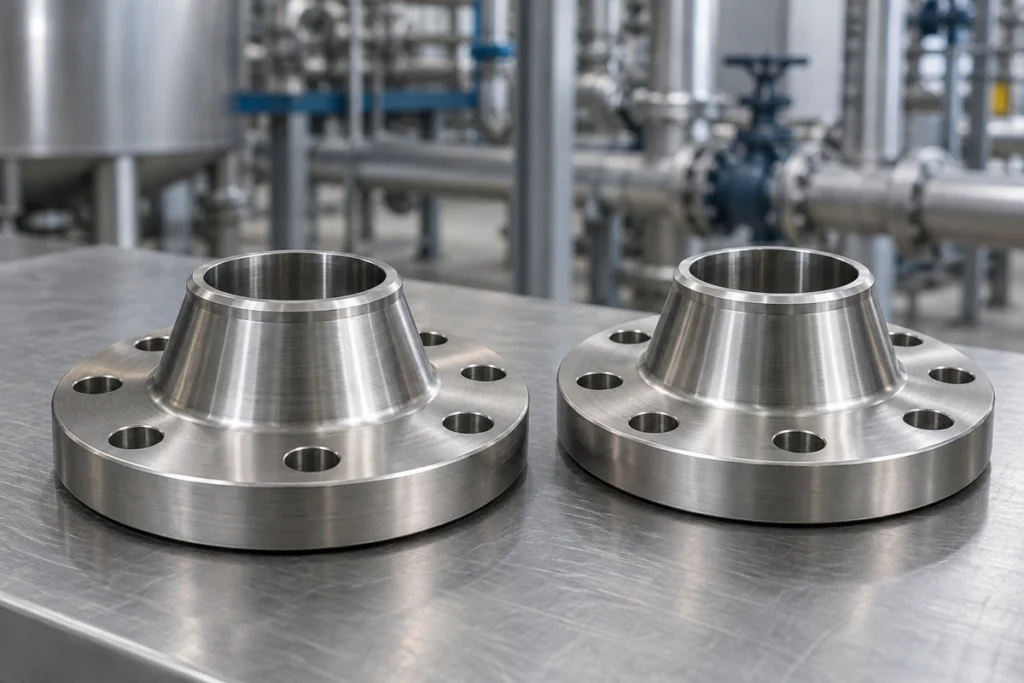
インコロイ 825 vsインコネル 625 フランジ: 選び方
インコロイ 825 インコネルと 625 are different nickel alloys, not interchangeable flange grades. 合金 825 (UNS N08825) is a candidate for sulfuric and phosphoric acid service. 合金 625 (UNS N06625) is a candidate where demanding chloride exposure and strength requirements need closer evaluation.
一般的にどちらが優れているというわけではありません. Select the material against the actual fluid and design conditions, 鍛造仕様を確認します, heat-treatment condition and flange pressure-temperature rating. A higher alloy content alone does not approve a substitution.
Before comparing Alloy 825 と合金 625 flange quotations, freeze three evidence sets.
流体, 集中, 塩化物, 汚染物質, 正常な温度と異常な温度.
アメリカストレート, ASTM B564 版, required heat-treatment condition and project restrictions.
標準, NPS, クラス, タイプ, 直面している, ボア, inspection and document package.
Without all three, a price comparison can mix different corrosion bases, material conditions or finished-flange scopes.

The Composition Differences That Matter
The following selected ranges are limiting chemical compositions published in the manufacturer’s technical bulletins, in weight percent. They are not typical mechanical properties, a complete purchase specification or test results for a supplied heat.
| 要素 | 合金 825 | 合金 625 |
|---|---|---|
| ニッケル | 38.0–46.0% | 58.0% 分. |
| クロム | 19.5–23.5% | 20.0–23.0% |
| モリブデン | 2.5–3.5% | 8.0–10.0% |
| 鉄 | 22.0% 分. | 5.0% 最大. |
合金 825 additionally contains 1.5–3.0% copper and 0.6–1.2% titanium. 合金 625 contains 3.15–4.15% niobium plus tantalum. Consult the full Special Metals alloy 825 速報 そして 合金 625 速報 for their complete compositions and qualifications.
These differences help explain the alloys’ behavior: copper and molybdenum contribute to 825’s resistance in reducing acid environments, while molybdenum and niobium strengthen 625’s nickel-chromium matrix. Appearance is not a dependable way to distinguish them.
Start With the Corrosion Problem, Not the Alloy Name
酸処理: 評価する 825 against the actual solution
合金 825 is used in sulfuric and phosphoric acid applications, but an acid name is not a complete service description. Request the concentration range, operating and upset temperatures, 不純物, cleaning chemicals and available corrosion experience. Do not approve a flange from a room-temperature compatibility chart when the process operates hot or changes concentration.
Chlorides and crevices: 評価する 625 without assuming immunity
の 625 bulletin identifies strong resistance to pitting, crevice corrosion and chloride stress-corrosion cracking. For a flange joint, turn that general material information into a review of the actual wetted geometry, including the gasket region and stagnant areas. Ask whether the available evidence represents the proposed temperature, chloride level and operating conditions.
These are screening questions, not a universal corrosion ranking. If the service envelope is incomplete, keep the material decision open rather than replace missing information with an unsupported “625 is always better” rule.
Heat-Treatment Condition Can Change the Buying Decision
ASTM B564-25, Nickel Alloy Forgings, includes both UNS N08825 そして UNS N06625. Its public scope distinguishes annealed Grade 1 and solution-annealed Grade 2 for N06625. An RFQ that says only “B564 625” can therefore leave an important condition unresolved. Specify the governing edition and required condition rather than assuming that every 625 forging has the same mechanical properties.
のために 825, the manufacturer emphasizes stabilization and heat treatment for corrosion performance. It also warns that exposure above about 540°C can cause microstructural changes that reduce ductility and impact strength. This is a material-selection caution, not a permitted flange operating temperature.
When reviewing a property table or quotation, separate three kinds of information:
- Specification requirement: the acceptance limit in the ordered standard, 版, 商品の形状や状態.
- Typical value: reference data for a stated sample or product condition. It is not a guaranteed minimum for the order.
- Actual result: a reported result traceable to the delivered heat or test lot. Check the certificate against the purchase requirements.
A tensile-strength number without that context is a poor basis for choosing between these two flange materials.
Why a Stronger Alloy Does Not Automatically Mean a Higher Flange Rating
ASME B16.5 covers flange pressure-temperature ratings, 材料, dimensions and related joint requirements. Material selection and flange rating must be checked together under the project’s governing documents.
For a proposed 825-to-625 substitution, ask the responsible engineer to confirm material acceptance, the applicable rating basis and design temperature. Keep the flange type, サイズ, 直面している, mating component, gasket and bolting in the review. A matching bolt pattern proves neither corrosion suitability nor an acceptable pressure-temperature rating.
同様に, do not transfer a general alloy bulletin’s maximum service-temperature statement directly onto a flange data sheet. A bolted piping joint needs a verified design basis, not just a material temperature headline.
Compare Quotations on the Same Technical Basis
For product-specific inquiries, を参照してください ASTM B564 合金 825 フランジ そして ASTM B564 合金 625 フランジ ページ. Identify the UNS designation in the RFQ so that a commercial name or older URL wording does not create ambiguity.
Use this checklist before comparing offers:
- Service envelope: 流体組成, 集中, 汚染物質, 正常な温度と異常な温度, design pressure and corrosion-selection basis.
- 材料: UNS N08825 またはN06625, forging specification and edition, required heat-treatment condition, およびプロジェクト固有の制限事項.
- 繋がり: フランジの規格とエディション, NPS/DN, 圧力クラス, フランジタイプ, 直面している, mating pipe dimensions and approved drawing.
- Acceptance documents: required material certificate type, ヒートトレーサビリティ, dimensional records and any additional tests with their acceptance criteria. Confirm what is included rather than assuming every test is standard.
- 商用範囲: 量, 配送先, required date, inspection scope and quotation validity. Ask suppliers to identify deviations explicitly.
例えば, an offer for N06625 without a stated heat-treatment condition should be clarified before it is compared with one that specifies the required condition and documentation. 同じく, a lower-priced 825 offer is not a valid substitute if the approved line specification requires N06625.
No fixed price premium is assumed here. Compare current quotations for the same dimensions, 状態, inspection and delivery scope; do not compare a raw-material price with the price of a finished, documented flange.
よくある質問
Can alloy 625 replace alloy 825?
Only after the substitution is approved for the actual service and design. Review corrosion suitability, the material specification and condition, joint compatibility and required documentation. A higher nickel or molybdenum content is not an approval by itself.
Is “Inconel 825” the correct purchase designation?
The manufacturer’s brand designation is INCOLOY alloy 825. 調達用, state UNS N08825 and the applicable product specification. INCOLOY and INCONEL are Special Metals trademarks; using these names for comparison does not identify the manufacturer of any offered material.
Which alloy should I choose if process data are missing?
Do not finalize the choice yet. Obtain the fluid and temperature envelope, design requirements and material-selection approval first. An incomplete process specification cannot be resolved reliably by choosing the more expensive alloy.
Requesting 825 または 625 フランジ? Send your approved material designation, フランジ図, 数量と検査要件. If you are evaluating alternatives, identify that request separately from the approved purchase specification.