
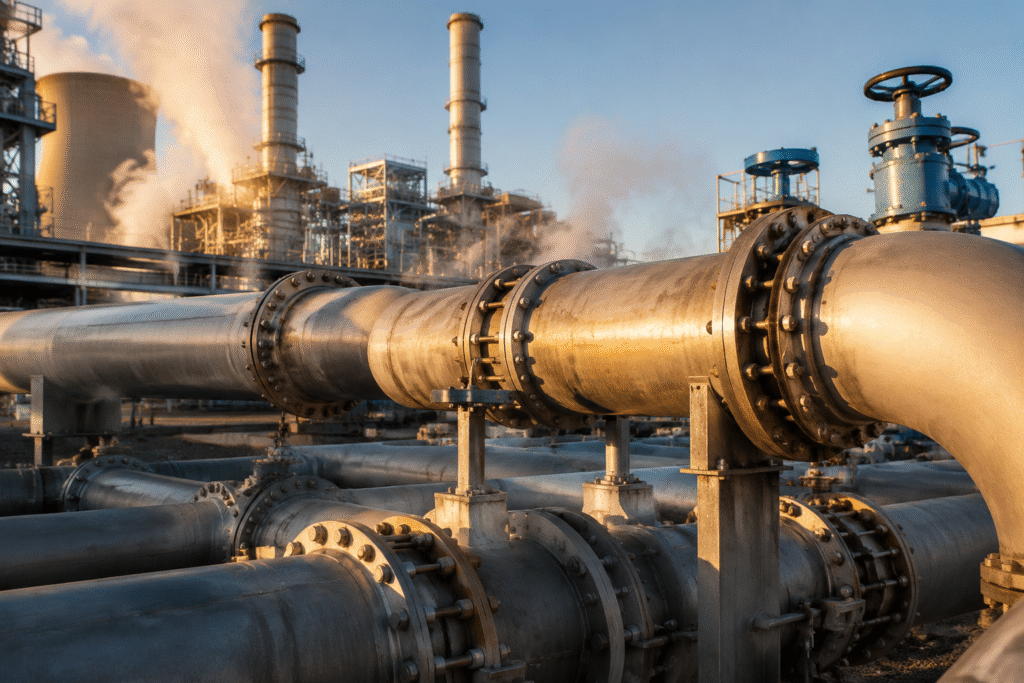
Seleção de flanges de aço inoxidável por pressão e risco de corrosão
A demanda por flanges para tubos de aço inoxidável continua a aumentar à medida que os projetos industriais priorizam a resistência à corrosão, integridade de pressão, e valor do ciclo de vida. De acordo com a pesquisa Grand View (2024), o mercado global de flanges industriais foi avaliado em $5.8 bilhão em 2023 e está projetado para atingir $7.2 bilhão por 2030.
Para engenheiros e equipes de compras, que o crescimento reflete uma realidade prática. Inoxidável, aço, and alloy Flanges remain critical in Oil & Gás, petroquímico, poder, marinho, and water treatment systems where leakage risk, tempo de inatividade, and compliance costs are high.
Industrial Market Context for Stainless Steel Pipe Flange Procurement
The market for industrial flanges is expanding because process plants are upgrading aging piping infrastructure and specifying higher-performance materials. De acordo com IBISWorld (2024), Ásia-Pacífico é responsável por mais de 45% da produção global de flanges, sendo a China o maior fabricante.
That regional manufacturing strength matters for buyers who need volume, rastreabilidade, e prazos curtos. It also explains why global sourcing teams increasingly evaluate Chinese suppliers with strong machining, inspeção, and export documentation capabilities.
A procura de utilização final continua concentrada na indústria pesada. De acordo com Statista (2024), a indústria de petróleo e gás é responsável por aproximadamente 35% do consumo global de flanges, making pressure-rated connections a core procurement category.
Além disso, flange purchasing decisions are becoming more technical. Buyers now compare not only price, but also ASTM grade, ASME pressure class, EN compliance, Disponibilidade do CTM, tolerância à corrosão, e custo total instalado.
Para aplicações de flange de tubo de aço inoxidável, 304, 316, 316eu, 904eu, 2205, e 2507 are frequently specified because they balance corrosion resistance and mechanical performance. In chloride service, no entanto, engineers often move from standard austenitic grades toward duplex or super duplex to reduce pitting risk.
De acordo com a Inteligência Mordor (2024), industrial process modernization and energy infrastructure investment are accelerating demand for higher-integrity piping components worldwide. Como resultado, standard catalog items are no longer enough for many EPC and MRO buyers.
They increasingly require custom bores, perfuração fora do padrão, acabamentos de revestimento especiais, and project-specific packaging. Portanto, manufacturer capability has become nearly as important as material grade.
SASA FLANGE opera neste ambiente com ISO 9001:2015 e certificações PED 2014/68/EU, serving customers across Oil & Gás, Petroquímica, Poder, e indústrias marítimas. Apoiado por usinagem CNC avançada e testes de qualidade abrangentes, a empresa fornece flanges de aço inoxidável, flanges de aço carbono, flanges de liga, and pipe fittings in materials from 304 and 316L to 904L, 2205, 2507, Inconel, Monel, Hastelloy, e titânio.
Em termos práticos de fornecimento, this matters because flange reliability depends on manufacturing precision. Altura do rosto elevada, bore tolerance, bolt hole alignment, acabamento serrilhado, and heat traceability all affect fit-up and sealing performance.
According to ISO-aligned quality management principles, process consistency reduces rework, inspection disputes, and field installation delays (ISO, 2024). Além disso, third-party documentation such as EN 10204 3.1 certification is often mandatory for regulated and export-driven projects.
Procurement teams should also look beyond the basic question of Flanges? Types and Uses are only part of the evaluation. The Hidden Advantages often come from quality systems, controle de metalurgia, and the ability to support ASME B16.5, ASME B16.47, DIN, JIS, GOST, e PT 1092 dimensional requirements from one factory source.
Tipos de flange de tubo de aço inoxidável, Vantagens ocultas, e insights de seleção de especialistas
There are many stainless steel pipe flange Types, yet the correct selection always depends on pressure class, médio, temperatura, carga cíclica, e estratégia de manutenção. Como resultado, choosing between weld neck, escorregar, cego, rosqueado, junta sobreposta, and socket weld Flange designs should be driven by engineering data rather than habit.
As John Breslin, Engenheiro de Tubulação Sênior, estados: “A flange is not a commodity when service conditions become aggressive; acabamento frontal, metalurgia, and dimensional accuracy directly affect leak-free performance.” That view aligns with field experience in refineries, Terminais de GNL, e plataformas offshore.
De acordo com ASME B16.5, dimensional standardization for NPS 1/2 através 24 supports interchangeability and consistent sealing performance across manufacturers (ASME, 2024). Para diâmetros maiores, ASME B16.47 cobre NPS 26 através 60 and becomes essential in transmission, armazenar, e projetos de infraestrutura hídrica (ASME, 2024).
Portanto, specifying the right standard is the first step. The second is matching the flange design to fabrication and service conditions.
- Flange de pescoço soldado: Melhor para alta pressão, alta temperatura, e serviço cíclico porque o cubo cônico melhora a distribuição de tensão.
- Deslizamento no flange: Cost-effective and easy to align, especially for low to moderate pressure systems and fabrication-friendly projects.
- Flange cego: Usado para isolar linhas, terminate piping systems, and support future expansion points.
- Flange Rosqueada: Útil onde a soldagem é restrita, although it is generally limited to lower pressure and non-severe service.
- Flange de solda de soquete: Common in small-bore, high-pressure lines where a smooth bore and strong joint are needed.
- Flange de junta sobreposta: Preferred for systems requiring frequent dismantling and where corrosion-resistant stub ends optimize cost.
A seleção do material é igualmente importante. ASTM A182 is the primary forged fitting and flange specification for many stainless and alloy grades, enquanto ASTM A240 is relevant when plate products are used in associated fabrication and clad systems (ASTM, 2024).
Among austenitic grades, 304 and 304L remain versatile and economical. No entanto, 316 and 316L offer better resistance in chloride-bearing environments because molybdenum improves pitting and crevice corrosion resistance.
De acordo com a Pesquisa de Mercado Futuro (2024), corrosion-resistant alloys are seeing above-average demand growth in process industries due to stricter reliability and maintenance targets. Além disso, operators are increasingly calculating total lifecycle cost rather than just purchase price.
That shift explains the growing use of duplex grades such as 2205 e 2507. These materials offer higher strength than standard 300-series stainless grades, which can support thinner wall design or improved safety margins in demanding service.
Como Dr.. Elena Markovic, Cientista de Materiais, estados: “The best flange selection balances corrosion mode, temperatura operacional, and inspection philosophy, not just alloy prestige.” Her point is especially relevant in offshore, serviço azedo, e aplicações de dessalinização.
For engineers comparing common stainless grades, the following matrix provides a practical overview.
- 304/304eu: General industrial use, boa soldabilidade, suitable for water treatment, food-grade utilities, e serviço químico suave.
- 316/316eu: Melhor resistência ao cloreto, preferred in marine, químico, and coastal environments.
- 904eu: Strong resistance in acidic and chloride-rich service, often specified for aggressive chemical processing.
- 2205 Dúplex: Higher strength and strong chloride stress corrosion cracking resistance for offshore and process duty.
- 2507 Superduplex: Premium performance in high-chloride and seawater systems with severe corrosion exposure.
De acordo com as orientações da NACE para controle de corrosão, material mismatch in bolted flange joints can accelerate localized failure under aggressive conditions (NACE, 2024). Consequentemente, flange, junta, aparafusamento, and pipe material should be reviewed as one system.
Dimensional details also affect how buyers Choose correctly. Tipo de rosto, such as RF, RTJ, and FF, must match the gasket design and service class.
Por exemplo, ring type joint Flanges are common in high-pressure hydrocarbon duty because the metal-to-metal groove geometry supports reliable sealing. Em contraste, flat face connections are often used with cast iron or low-bolt-load equipment nozzles.
SASA FLANGE oferece tamanhos personalizados de 1/2" para 60" with competitive factory-direct pricing and supports ANSI B16.5, ANSI B16.47, ASME B16.9, DIN, JIS, GOST, e PT 1092 requisitos. Adicionalmente, the company can manufacture elbows, camisetas, redutores, and caps in matching grades, which simplifies package procurement for complete Pipe systems.
Para grandes projetos, supplier integration reduces administration and inspection complexity. Instead of managing multiple vendors for Flange and fitting packages, EPC teams can centralize material certificates, Registros PMI, e relatórios dimensionais.
This approach also lowers the risk of cross-supplier tolerance mismatch. Portanto, it can improve site productivity during spool assembly and turnaround work.
ASME B16.5, B16.47, ASTM, DIN, and EN Compliance for Stainless Steel Flange Supply
Standards compliance is not a paperwork issue alone. It is the framework that ensures a stainless steel pipe flange will fit, selo, and perform safely in service.
ASME B16.5 cobre flanges de tubos e acessórios flangeados da NPS 1/2 para 24. ASME B16.47 applies to larger diameters from NPS 26 para 60, and it is divided into Series A and Series B with different bolt patterns and masses (ASME, 2024).
ASTM material standards define chemistry and mechanical properties. Para flanges inoxidáveis forjados, ASTM A182 is a key specification, while corresponding pipe and plate standards must be checked for system compatibility (ASTM, 2024).
Os projetos europeus exigem frequentemente EN 1092 dimensions and PED compliance. Além disso, petrochemical and offshore buyers may ask for NACE MR0175 análise, DNV-related documentation, or customer-specific QA plans depending on media and jurisdiction.
- ASME B16.5: Standard for flanges up to NPS 24, widely used in refinery, petroquímico, e projetos de energia.
- ASME B16.47: Standard for large-diameter flanges from NPS 26 para 60 for transmission and infrastructure systems.
- ASTM A182: Material specification for forged or rolled alloy and stainless steel pipe flanges and forged fittings.
- EN 1092: European flange dimensional standard widely used in EU and export projects.
- NACE MR0175: Corrosion-related material guidance for sour service environments.
- PED 2014/68/EU: Marco regulatório para equipamentos sob pressão no mercado europeu.
Buyers should also request the right inspection and documentation package. Typical requirements include MTC EN 10204 3.1, PMI, hardness testing where applicable, inspeção dimensional, hydrostatic or pneumatic test evidence at system level, and marking traceability.
According to DNV-oriented supply chain practice, traceability and certification quality strongly influence approval speed for critical industrial components (DNV, 2024). Como resultado, well-documented flange manufacturers often reduce project bottlenecks more effectively than low-price suppliers with weak paperwork control.
There is also an important distinction between dimensional compliance and actual quality execution. A flange may technically match ASME B16.5 dimensões, yet poor forging quality, acabamento superficial, or heat traceability can still create installation and audit problems.
Por esse motivo, procurement specifications should define more than standard numbers. They should state material grade, classificação de classe, tipo de revestimento, escopo de teste, coating or passivation needs, packaging requirements, and certificate expectations.
Com ISO 9001:2015, PED 2014/68/EU, e ANÚNCIO 2000 certificações, SASA FLANGE supports quality-driven procurement for export and regulated markets. The company also manufactures flanges in 304, 316, 904eu, 2205, 2507 e outras notas premium, apoiado por usinagem CNC avançada e testes de qualidade abrangentes.
From a compliance perspective, that matters in audits and bid evaluations. Engineers can compare suppliers more clearly when the manufacturer provides dimensional reports, números de calor, rastreabilidade de matéria-prima, and standard-specific conformity records.
Além disso, mixed-standard projects require careful coordination. A system may combine ASME piping classes with EN equipment interfaces, so bolt circles, face forms, and pressure nomenclature must be reviewed line by line.
Portanto, experienced flange manufacturers provide technical clarification before production begins. That early review prevents expensive remake costs and avoids site-fit disputes later in the project.
Guia de aplicação: How to Choose Stainless Steel Pipe Flange by Industry, Pressão, and Corrosion Risk
The best way to Choose a stainless steel pipe flange is to start with actual service conditions. Médio, temperatura, classe de pressão, teor de cloreto, inspection interval, and shutdown cost should all shape the final decision.
Em óleo & Gás, flange failure can create severe production losses. Portanto, weld neck and RTJ Flanges in ASTM A182 F316/F316L, duplex 2205, ou super duplex 2507 are common in corrosive and high-pressure applications.
De acordo com Statista (2024), o setor de petróleo e gás representa cerca de 35% do consumo global de flanges. That scale explains why this sector often drives higher standards for documentation, revisão de serviço azedo, e consistência dimensional.
Em plantas petroquímicas e químicas, corrosion mechanism usually governs material choice. Ácidos, cloretos, and elevated temperatures may justify 316L, 904eu, Hastelloy, or Monel depending on concentration and process upset risk.
Power generation projects often emphasize pressure class, ciclagem térmica, and outage reliability. Como resultado, weld neck and socket weld connections are frequently selected for steam, condensado, and auxiliary high-pressure lines.
Marine and shipbuilding environments add external chloride exposure to the challenge. Consequentemente, 316L is often the baseline, while duplex grades become attractive for seawater, lastro, e sistemas de utilidade offshore.
Water treatment and desalination projects require careful balancing of budget and corrosion performance. For less aggressive service, 304L may be acceptable, but 316L, 2205, ou 2507 are often preferred where chloride levels are high.
- Media compatibility: Verifique cloretos, compostos de enxofre, acidez, sólidos, e produtos químicos de limpeza.
- Temperatura operacional: Confirm whether the grade is suitable for sustained elevated temperature service.
- Classe de pressão: Match Class 150, 300, 600, 900, 1500, ou 2500 to design conditions and code basis.
- Tipo de flange: Escolha o pescoço de solda, escorregar, cego, rosqueado, solda de soquete, or lap joint based on fabrication and stress profile.
- Facing style: Verifique RF, RTJ, or FF compatibility with the gasket and mating equipment.
- Escopo da inspeção: Define MTC 3.1, PMI, EQM, ferrita, dureza, or third-party witness needs.
- Project logistics: Review MOQ, tempo de espera, embalagem, marcação, e documentação de exportação.
According to API-oriented project procurement practices, standardization of component classes reduces inventory complexity and maintenance downtime (API, 2024). No entanto, over-standardization can be costly if the material grade is excessive for the real service environment.
That is why experienced engineering review is essential. A lower initial price can become more expensive if corrosion, vazamento, or replacement frequency increases over time.
SASA FLANGE supports custom manufacturing for industrial buyers needing non-standard sizes, perfuração especial, large-diameter dimensions, or matching fittings in one package. Servindo 50+ países em todo o petróleo & Gás, Petroquímica, Poder, e indústrias marítimas, the company can help procurement teams align technical requirements with practical delivery schedules.
Por exemplo, a marine contractor may need 4 inch stainless steel pipe flange items in 316L with EN 1092 perfuração, while an EPC contractor may require ASME B16.5 Aula 300 flanges de pescoço de solda em 2205 com EN 10204 3.1 certificados. These are very different applications, even when the word Stainless appears in both RFQs.
De forma similar, buyers searching for stainless steel flange 2 polegada, stainless steel pipe flange sizes, or Stainless Steel Threaded Pipe Flange options should verify more than nominal size. Bore schedule, tipo de rosto, classificação de pressão, and welding procedure compatibility all affect suitability.
Future Outlook for Stainless Steel Pipe Flange Supply and Strategic Sourcing Recommendations
The outlook for stainless steel pipe flange sourcing remains positive because industrial decarbonization, LNG expansion, water treatment investment, and asset replacement all support long-term demand. De acordo com a pesquisa Grand View (2024), espera-se que o mercado de flange industrial atinja $7.2 bilhão por 2030.
Ao mesmo tempo, sourcing expectations are becoming stricter. Buyers increasingly want digital documentation, heat-level traceability, faster inspection turnaround, and integrated supply of flanges plus fittings.
De acordo com IBISWorld (2024), Asia-Pacific continues to dominate flange production, which gives global buyers access to scale and competitive pricing. No entanto, procurement success will depend on selecting qualified manufacturers rather than chasing the lowest quote.
Portanto, strategic buyers should build supplier scorecards around five factors. These are standards compliance, material breadth, qualidade da documentação, precisão de usinagem, and on-time delivery performance.
It is also wise to segment purchases by criticality. Standard utility Flanges can often be sourced on price efficiency, while offshore, serviço azedo, and high-temperature items should be sourced on technical reliability and certification strength.
As industrial specifications become more demanding, manufacturers that combine ASME, ASTM, DIN, EN, and PED familiarity will gain an advantage. That is especially true for projects spanning multiple geographies and end-user approval systems.
For procurement managers evaluating long-term partners, the Hidden Advantages usually appear in execution. These include responsive engineering support, project-level customization, consistent markings, and complete quality dossiers.
Companies seeking a dependable supplier for stainless steel pipe flange, flange de liga, and matching fittings can review capabilities through SASA FLANGE. For projects that require certified materials, dimensões personalizadas, e documentação pronta para exportação, early technical engagement typically shortens procurement cycles and reduces total project risk.
Perguntas frequentes
Quais são os diferentes tipos de flanges de aço inoxidável?
●Os principais tipos de flange de aço inoxidável são pescoço de solda, escorregar, cego, rosqueado, solda de soquete, e junta sobreposta, com ASME B16.5 covering most sizes from NPS 1/2 para 24 (ASME, 2024).
●Each type serves a different function because stress distribution, método de soldagem, acesso de manutenção, and sealing performance vary by design.
●For projects requiring accurate type selection and full certification, trabalhando com fabricantes estabelecidos como SASA FLANGE helps ensure the flange matches pressure class, tipo de rosto, e grau de material.
O que é melhor 304 ou 420 aço inoxidável?
●Para a maioria das aplicações de flanges de tubos de aço inoxidável, 304 geralmente é melhor do que 420 because it offers stronger corrosion resistance and easier weldability in industrial piping service.
●Nota 420 is a martensitic stainless steel used more often where hardness and wear resistance matter, but it is less suitable for corrosive process piping and standard flange fabrication.
●When engineers need flange materials for water, químico, marinho, or general industrial duty, 304 ou 316 grades are usually the safer and more common choice under ASTM A182 supply practice.
Quais são os três tipos de flanges?
●Os três tipos de flange mais comumente referenciados em discussões industriais básicas são pescoço de solda, escorregar, and blind flanges because they cover many connection, conjunto, and isolation needs.
●Weld neck flanges are preferred for higher pressure and cyclic duty, slip on flanges simplify fabrication for moderate service, and blind flanges close the end of a line or nozzle.
●If the service includes elevated pressure, cloretos, or strict code review, buyers should request a technical recommendation based on ASME B16.5 aula, tipo de revestimento, and ASTM grade.
Qual é o código ASME para flanges de aço inoxidável?
●Os principais padrões ASME para flanges de aço inoxidável são ASME B16.5 para NPS 1/2 para 24 e ASME B16.47 para NPS 26 para 60, enquanto ASTM A182 commonly governs forged stainless material (ASME, 2024; ASTM, 2024).
●Esses padrões definem dimensões, perfuração, classificações de pressão-temperatura, tolerâncias, and material reference frameworks that support interchangeability and safe installation.
●Para projetos de exportação ou regulamentados, buyers should also confirm related EN 1092, PED 2014/68/EU, e EN 10204 3.1 documentation requirements before placing the order.
O que afeta o preço do flange do tubo de aço inoxidável?
●O preço do flange do tubo de aço inoxidável é afetado principalmente pelo tipo de liga, tamanho, classe de pressão, tipo de flange, complexidade de usinagem, escopo de inspeção, e volume de pedidos, while volatile nickel and molybdenum costs can significantly change 316L and higher-alloy pricing.
●De acordo com a pesquisa Grand View (2024), continued market growth and industrial demand are keeping corrosion-resistant flange categories strategically important across global supply chains.
●Para comparar cotações com precisão, procurement teams should review whether the price includes MTC 3.1, PMI, acabamento frontal, embalagem de exportação, and any third-party inspection requirements.
Como escolho um fabricante ou fornecedor de flanges para projetos industriais?
●A strong flange manufacturer should demonstrate ASME and ASTM familiarity, ISO 9001:2015 controle de qualidade, rastreabilidade de materiais, precisão de usinagem, and documented export experience for Oil & Gás, Poder, Marinho, or Water Treatment projects.
●De acordo com IBISWorld (2024), A Ásia-Pacífico produz mais de 45% de flanges globais, so supplier evaluation should focus on capability and compliance rather than geography alone.
●For buyers needing custom sizes, premium grades like 2205 ou 2507, and complete documentation packages, entrando em contato SASA FLANGE é um próximo passo prático.
Posts Relacionados
Acabamento da face do flange: Serrilhas concêntricas vs espirais explicadas
As serrilhas concêntricas e espirais são acabamentos de face de flange usinados…
Dúplex 2205 vs Flanges 316L: Qual material você deve escolher?
Resposta rápida: Dúplex 2205 flanges são geralmente o candidato mais forte…

Definição de flange de orifício, Detalhes e visão geral dos flanges ASME B16.36: Dados de mercado, Guia de seleção e insights de conformidade
O mercado global de flanges industriais foi avaliado em $5.8 bilhão…

Guia de mercado de flange de descarte preto: Materiais, 3.5″ Compatibilidade, e dados de fornecimento B2B para flanges de pia de cozinha
A demanda por flanges descartáveis pretos está aumentando à medida que os compradores de utensílios de cozinha…