
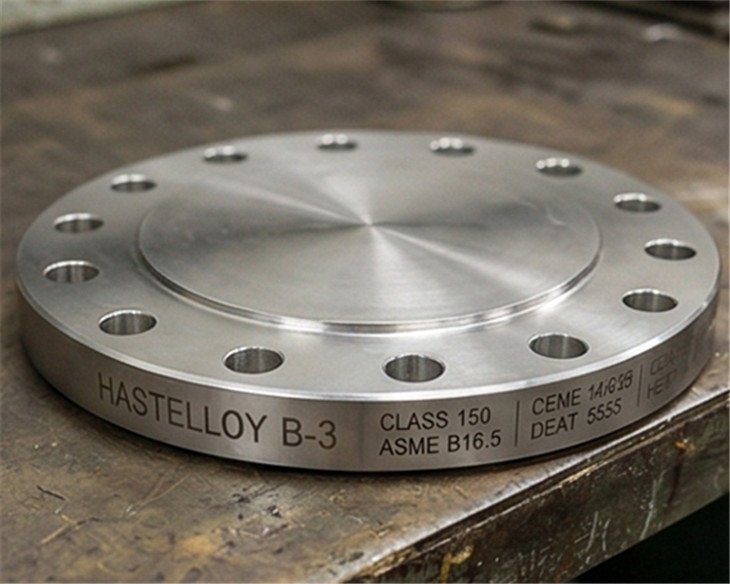
Mặt bích thép hợp kim và thép carbon cho dịch vụ áp suất cao
Trả lời trực tiếp
High pressure alone does not automatically require alloy steel. Carbon steel may be suitable when its material-specific ASME rating and service limits meet the design. Alloy steel is selected when temperature strength, oxidation behaviour or another grade-specific property is required. Áp lực, nhiệt độ, medium, line class and fabrication requirements must be evaluated together.
Bài học chính
- Pressure class is not a material grade and does not select the metallurgy.
- Low-alloy chrome-moly steel is not equivalent to stainless steel corrosion resistance.
- Lifecycle cost includes welding, xử lý nhiệt, điều tra, lead time and maintenance—not only forging price.
Carbon steel remains appropriate in many pressure systems
ASTM A105 carbon-steel flanges are widely used because they are available, weldable under established procedures and cost-effective. When design temperature, áp lực , toughness and corrosion conditions are within the approved line class, carbon steel can be the technically correct choice.
For low-temperature, sour, severe cyclic or highly corrosive service, additional requirements or another material specification may be necessary.
Why chrome-moly alloy steel is selected
Grades such as F11, F22 and F91 are evaluated for elevated-temperature strength and oxidation behaviour. Their benefit appears within an engineered alloy system and a suitable fabrication route. They also introduce stricter heat-treatment, consumable and PWHT controls.
Alloy content does not guarantee resistance to wet process corrosion. The corrosion study must address the actual medium, water content, chất gây ô nhiễm, shutdown conditions and external environment.
A practical selection matrix
| Factor | Thép cacbon | Chrome-moly alloy steel |
|---|---|---|
| General availability | Usually broad | Grade and condition dependent |
| Khả năng chịu nhiệt độ cao | Code-limited | Often the primary selection driver |
| Chế tạo | Established controls | More grade-specific heat-treatment controls |
| Wet corrosion | Requires evaluation/protection | Still requires evaluation/protection |
| Total cost | Lower material cost in many sizes | Higher material and quality-control cost |
Questions to resolve before specifying the flange
- What pressure and temperature apply simultaneously?
- Which material group and pressure-temperature table governs?
- Is creep, quá trình oxy hóa, low-temperature toughness or corrosion the controlling damage mechanism?
- Can the fabricator perform the required welding and heat treatment?
- Are matching pipe, phụ kiện, valves and bolting available?
- What inspection and documentation does the owner require?
Câu hỏi thường gặp
Are alloy steel flanges more corrosion-resistant?
Not necessarily. Chrome-moly low-alloy grades are primarily selected for temperature-related properties. Stainless and nickel alloys form different corrosion-resistant material families.
Can carbon steel be used for Class 1500?
A carbon-steel flange may be available in a high class, but the permitted pressure at design temperature and all service limits must be checked for the exact material and standard.
Is alloy steel always more expensive overall?
Material and fabrication costs are often higher, but lifecycle economics depend on reliability, nhiệt độ hoạt động, maintenance and the cost of failure.
Tiêu chuẩn cơ bản được tham chiếu
- ASTM A105/A105M-26 — Carbon Steel Forgings for Piping Applications
- ASTM A182/A182M-26 — Forged or Rolled Alloy and Stainless Steel Piping Components
- ASME B16.5-2025 — Mặt bích ống và phụ kiện mặt bích, NPS 1/2 Thông qua NPS 24
Luôn xác minh phiên bản được chỉ định trong đơn đặt hàng và đạt được tiêu chuẩn được kiểm soát hoàn chỉnh về thiết kế và nghiệm thu.
Yêu cầu báo giá mặt bích thép hợp kim
Gửi lớp vật liệu, tiêu chuẩn, NPS, lớp áp lực, loại mặt bích, đối mặt, lịch trình đường ống, yêu cầu về số lượng và kiểm tra. SASA FLANGE sẽ xem xét mô tả kỹ thuật trước khi báo giá.
bài viết liên quan
Mặt bích C-2000 so với C22: Lựa chọn vật liệu và kiểm tra RFQ
So sánh nhận dạng vật liệu mặt bích C-2000 và C22, điều kiện dịch vụ, forging…
Phương pháp kiểm tra NDT đối với mặt bích thép hợp kim rèn
Hướng dẫn tập trung vào người mua về các phương pháp thử nghiệm không phá hủy đối với hợp kim rèn…

Yêu cầu kiểm tra độ cứng cho F11, Mặt bích F22 và F91
Hướng dẫn thực tế để xác định và giải thích các phép thử độ cứng trên…
Cách đọc dấu mặt bích ASTM A182
Hướng dẫn hiện trường để giải thích ASTM A182 và ASME B16.5…