
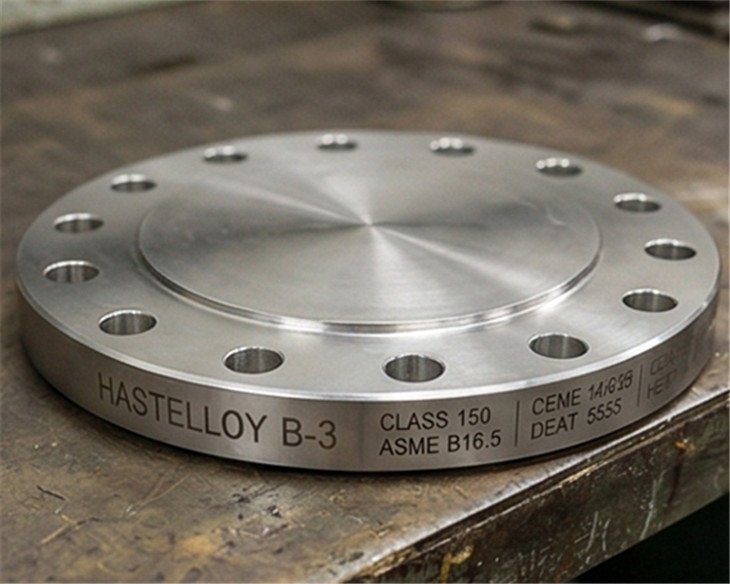
โลหะผสมเหล็กและหน้าแปลนเหล็กคาร์บอนสำหรับบริการแรงดันสูง
Direct answer
High pressure alone does not automatically require alloy steel. Carbon steel may be suitable when its material-specific ASME rating and service limits meet the design. Alloy steel is selected when temperature strength, oxidation behaviour or another grade-specific property is required. ความดัน, อุณหภูมิ, medium, line class and fabrication requirements must be evaluated together.
Key takeaways
- Pressure class is not a material grade and does not select the metallurgy.
- Low-alloy chrome-moly steel is not equivalent to stainless steel corrosion resistance.
- Lifecycle cost includes welding, การรักษาความร้อน, การตรวจสอบ, lead time and maintenance—not only forging price.
Carbon steel remains appropriate in many pressure systems
ASTM A105 carbon-steel flanges are widely used because they are available, weldable under established procedures and cost-effective. When design temperature, ความดัน, toughness and corrosion conditions are within the approved line class, carbon steel can be the technically correct choice.
For low-temperature, sour, severe cyclic or highly corrosive service, additional requirements or another material specification may be necessary.
Why chrome-moly alloy steel is selected
Grades such as F11, F22 and F91 are evaluated for elevated-temperature strength and oxidation behaviour. Their benefit appears within an engineered alloy system and a suitable fabrication route. They also introduce stricter heat-treatment, consumable and PWHT controls.
Alloy content does not guarantee resistance to wet process corrosion. The corrosion study must address the actual medium, water content, สารปนเปื้อน, shutdown conditions and external environment.
A practical selection matrix
| Factor | เหล็กกล้าคาร์บอน | Chrome-moly alloy steel |
|---|---|---|
| General availability | Usually broad | Grade and condition dependent |
| ความสามารถในอุณหภูมิสูง | Code-limited | Often the primary selection driver |
| Fabrication | Established controls | More grade-specific heat-treatment controls |
| Wet corrosion | Requires evaluation/protection | Still requires evaluation/protection |
| Total cost | Lower material cost in many sizes | Higher material and quality-control cost |
Questions to resolve before specifying the flange
- What pressure and temperature apply simultaneously?
- Which material group and pressure-temperature table governs?
- Is creep, ออกซิเดชัน, low-temperature toughness or corrosion the controlling damage mechanism?
- Can the fabricator perform the required welding and heat treatment?
- Are matching pipe, ฟิตติ้ง, valves and bolting available?
- What inspection and documentation does the owner require?
คำถามที่พบบ่อย
Are alloy steel flanges more corrosion-resistant?
Not necessarily. Chrome-moly low-alloy grades are primarily selected for temperature-related properties. Stainless and nickel alloys form different corrosion-resistant material families.
Can carbon steel be used for Class 1500?
A carbon-steel flange may be available in a high class, but the permitted pressure at design temperature and all service limits must be checked for the exact material and standard.
Is alloy steel always more expensive overall?
Material and fabrication costs are often higher, but lifecycle economics depend on reliability, อุณหภูมิในการทำงาน, maintenance and the cost of failure.
Primary standards referenced
- ASTM A105/A105M-26 — Carbon Steel Forgings for Piping Applications
- ASTM A182/A182M-26 — Forged or Rolled Alloy and Stainless Steel Piping Components
- ASME B16.5-2025 — Pipe Flanges and Flanged Fittings, กรมอุทยานฯ 1/2 Through NPS 24
Always verify the edition specified by the purchase order and obtain the complete controlled standard for design and acceptance.
Request an alloy steel flange quotation
Send the material grade, มาตรฐาน, กรมอุทยานฯ, ระดับความดัน, ประเภทหน้าแปลน, หันหน้าไปทาง, pipe schedule, ข้อกำหนดด้านปริมาณและการตรวจสอบ. SASA FLANGE will review the technical description before quotation.
โพสต์ที่เกี่ยวข้อง
วิธีการตรวจสอบ NDT สำหรับหน้าแปลนเหล็กโลหะผสมฟอร์จ
A buyer-focused guide to non-destructive testing methods for forged alloy…

ข้อกำหนดการทดสอบความแข็งสำหรับ F11, หน้าแปลน F22 และ F91
A practical guide to specifying and interpreting hardness tests on…
วิธีอ่านเครื่องหมายหน้าแปลน ASTM A182
A field guide to interpreting ASTM A182 and ASME B16.5…
ฟอร์จ vs หน้าแปลนหล่อ: ซึ่งปลอดภัยกว่าสำหรับการวางท่อที่สำคัญ?
A balanced engineering comparison of forged and cast flanges for…