
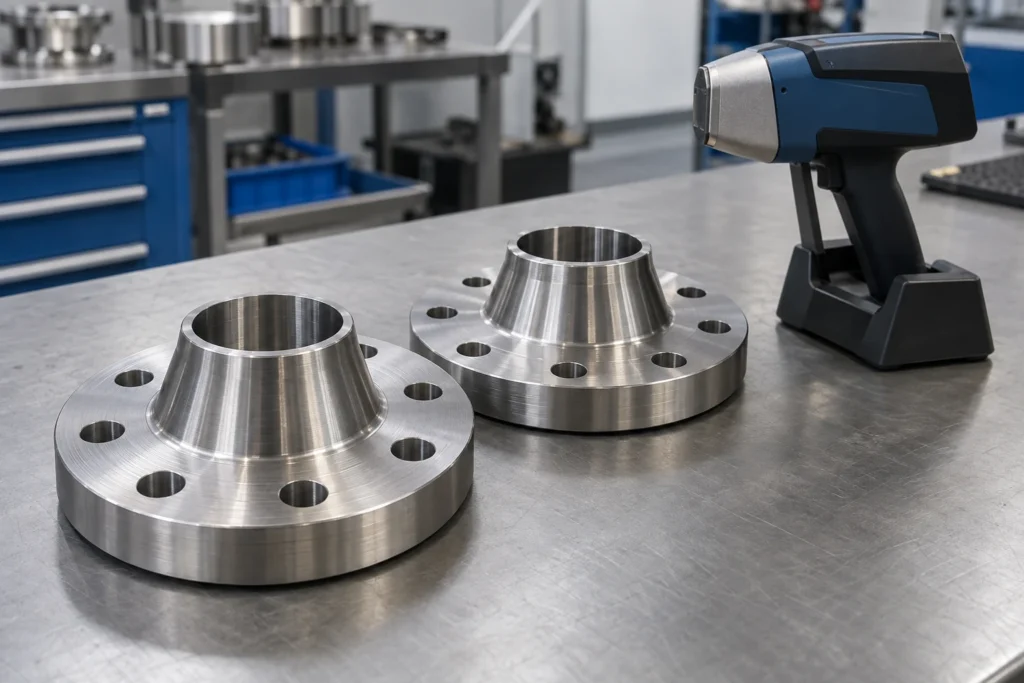
XRF có thể xác định mặt bích thép không gỉ 316L?
Trả lời nhanh
KHÔNG: handheld XRF alone cannot confirm the low-carbon requirement of a 316L stainless steel flange. It can check alloying elements such as chromium, niken và molypden, but it does not measure carbon. A displayed grade match is therefore not proof of the “L” designation. Buyers should review traceable material documentation and specify a suitable carbon-capable method when additional verification is required.

Xem ASTM A182 F316L Weld Neck Flanges
This distinction matters when receiving flanges for a welding project or reviewing a supplier’s positive material identification (PMI) report. A report can be useful without answering every acceptance question. The first step is to identify what the instrument actually measured.
What handheld XRF can and cannot tell you
Handheld X-ray fluorescence is useful for checking the measured alloy composition against the expected material family. Tuy nhiên, carbon is outside its measurement capability. Thermo Fisher explains this limitation in its comparison of XRF and LIBS.
For purchasing decisions, separate three questions:
- Does the measured alloy chemistry look consistent with the ordered family? An XRF result can support this check for elements it measures.
- Does the material meet the required carbon limit? An XRF-only report cannot establish this.
- Does the finished flange meet the purchase specification? Chemistry alone does not establish dimensions, xử lý nhiệt, mechanical properties or all other specified requirements.
A grade name on the instrument screen is not a substitute for the elemental results, the method’s limitations or the agreed acceptance criteria.
Which methods can check carbon?
| Method or record | What it can support | Buyer limitation |
|---|---|---|
| XRF cầm tay | Screening alloy-family elements such as chromium, niken và molypden | Does not measure carbon, so it cannot by itself prove the 316L low-carbon designation |
| Spark OES | Carbon measurement when the instrument, calibration and procedure suit the required range | Needs suitable surface preparation and leaves a local test mark |
| Carbon-capable LIBS | Low-carbon measurement with a specifically capable instrument and approved procedure | Capability is configuration-dependent; do not assume every LIBS analyzer is suitable |
| Giấy chứng nhận vật liệu | Traceable production chemistry and other ordered test records | It is not the same record as site PMI; item-to-heat traceability still needs checking |
Spark optical emission spectroscopy
A suitably configured spark optical emission spectrometer (OES) can measure carbon in steel. Hitachi High-Tech’s metals analysis guidance identifies carbon among the elements covered by OES. Ask the inspection provider to confirm that its calibration and working range suit the grade and acceptance limit.
Carbon-capable LIBS
Some laser-induced breakdown spectroscopy (LIBS) analyzers are designed to measure low carbon levels and distinguish stainless steel L grades, as described in this manufacturer’s stainless steel application note. Do not assume that every handheld LIBS instrument has that capability. Confirm the specific instrument configuration, sample preparation and approved procedure with the testing provider.
Sampling and test location also need agreement. Spark OES and LIBS can leave a local test mark; any preparation or testing on a finished flange should be approved beforehand. Keep sealing surfaces and other critical features protected. Select a method because it answers the acceptance question, not simply because it is portable.
Review the certificate and the physical flange together
For a forging ordered as ASTM A182 F316L, use the specification edition stated in the purchase order. các ASTM A182/A182M scope and abstract describe requirements beyond chemistry, including heat treatment and mechanical properties. A PMI result does not replace those requirements.
- Identify the item. Match the flange marking, heat identification and packing records to the certificate. Resolve any broken traceability before acceptance.
- Read the reported chemistry. Confirm that carbon is reported and compare the results with the applicable ordered grade requirements. Do not infer carbon from a nickel or molybdenum reading.
- Understand the document. Check whether it reports heat analysis, a product test or a separate site PMI check. These are different records, not interchangeable labels.
- Check the remaining scope. Review the specified heat treatment, kết quả cơ học, dimensions and additional inspection records as applicable.
- Resolve discrepancies in writing. Request clarification or agreed retesting when markings, certificates and inspection results do not align.
For a broader document review, sử dụng của chúng tôi ASTM A182 Danh sách kiểm tra người mua mặt bích MTC. This article focuses specifically on the carbon-verification gap in XRF-only checks.
Specify the verification scope before ordering
When sourcing ASTM A182 Mặt bích cổ hàn F316L, include the material verification requirements alongside the size, lớp áp lực, facing and pipe interface. “PMI required” alone leaves too much room for different interpretations.
Suggested inquiry note — adapt to your project:
Please identify the proposed PMI method, measured elements, inspection coverage and reporting format. If separate verification of the low-carbon requirement is required, propose a carbon-capable method for purchaser approval. Link each report to the relevant item or heat, identify the acceptance criteria, and agree test locations and any surface preparation before testing.
This is a procurement starting point, not a universal testing requirement. The purchaser’s engineering and quality teams should define the final scope, including how borderline results and measurement uncertainty will be assessed. Obtain written agreement before material release.
Buyer questions
Does an XRF result labelled “316” mean a 316L flange is wrong?
Not by itself. Because handheld XRF does not measure carbon, that label cannot resolve the low-carbon designation. Review the actual chemistry, traceable certificate and any additional verification required by the order before deciding.
Does every 316L flange need separate carbon retesting?
Đừng giả định một yêu cầu phổ quát. Follow the purchase specification and approved inspection plan. Missing traceability, conflicting records or project-specific requirements may call for additional verification.
Can a PMI pass replace the material certificate?
KHÔNG. A PMI report documents a defined inspection; a material certificate addresses a different documentation scope. Require the records specified by the order and check that they refer to the supplied material.
Preparing a 316L flange inquiry?
Gửi SASA FLANGE the flange type, kích thước, Số lượng, required specification and inspection scope. Include any carbon-verification or documentation requirements so they can be reviewed as part of the quotation.
Technical procurement guidance, not a material acceptance certificate. Apply the complete standards and project documents specified in your order. No instrument, test result or inspection service described here is a claim about SASA FLANGE’s equipment or an individual shipment.