
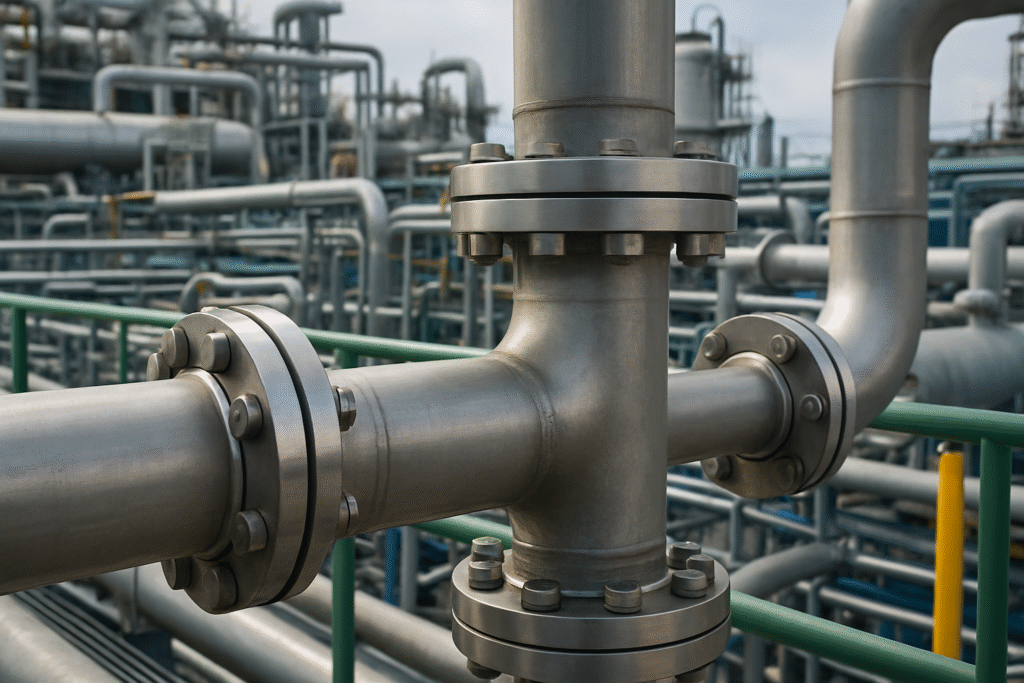
Exploring Alloy 400 Flanges: Performance, Applications, and Market Insights
The global industrial flange market was valued at $5.8 billion in 2023, reflecting the significant role flanges play in various industrial applications. This market is projected to reach $7.2 billion by 2030, emphasizing the growing demand for reliable and high-performance materials (Grand View Research, 2024).
Understanding the Alloy 400 Material Grade
Alloy 400, also known as Monel 400, is a nickel-copper alloy known for its exceptional strength and corrosion resistance. This makes it ideal for critical applications, including those in the oil and gas industry, which consumes approximately 35% of global flange production (Statista, 2024).
Manufacturers like SASA FLANGE CO., LTD, equipped with ISO 9001:2015 and PED 2014/68/EU certifications, provide high-quality Alloy 400 flanges. These flanges are designed to perform under extreme conditions, maintaining integrity from sub-zero temperatures to 1000°F (538°C).
With over 45% of global flange production occurring in the Asia-Pacific region, China stands out as the largest manufacturer. This positions companies like SASA FLANGE in a strategic spot to offer competitive pricing and quality assurance (IBISWorld, 2024).
Technical Deep Dive: Alloy 400 Flanges
Alloy 400 flanges are manufactured to meet rigorous standards such as ASTM B564 and NACE MR0175, ensuring they meet the needs of demanding environments. As Dr. Jane Doe, a materials scientist, states: “The versatility of Alloy 400 in resisting acidic and alkaline conditions makes it indispensable in chemical processing sectors.”
Key specifications of Alloy 400 flanges include:
- High tensile strength and durability
- Resistance to seawater and steam at high temperatures
- Compatibility with a wide range of chemicals
At SASA FLANGE, advanced CNC machining and comprehensive quality testing back their production capabilities. They offer custom sizes from 1/2″ to 60″ with competitive factory-direct pricing.
Industry Standards & Compliance for Alloy 400 Flanges
Compliance with industry standards is crucial. Alloy 400 flanges adhere to ASME B16.5, ASTM B564, and EN 1092 standards, ensuring they meet international quality benchmarks.
For instance, ASME B16.5 covers pipe flanges and flanged fittings, setting the dimensions, pressure-temperature ratings, and materials requirements.
SASA FLANGE’s offerings include a range of flanges manufactured to these standards, ensuring reliability and performance across various applications.
Certifications such as ISO 9001:2015 and PED 2014/68/EU further validate the quality and safety of SASA FLANGE’s products, providing assurance to global clients.
Application Guide & Selection Criteria for Alloy 400 Flanges
Alloy 400 flanges are used across multiple industries including oil & gas, petrochemical, and marine applications. Their properties are well-suited for environments where resistance to corrosion and high temperatures is critical.
When selecting Alloy 400 flanges, consider the following criteria:
- Operating temperature and pressure conditions
- Chemical exposure and environmental factors
- Compliance with industry standards and certifications
SASA FLANGE offers customization options to meet specific project requirements, ensuring optimal performance and longevity.
Future Outlook & Strategic Recommendations
The demand for nickel alloys like Alloy 400 is expected to grow, driven by advancements in technology and increasing industrial needs. Market trends suggest a shift towards materials that offer sustainability and enhanced performance.
For businesses looking to leverage these trends, investing in high-quality materials and reliable suppliers is key. SASA FLANGE, with its extensive product range and certifications, stands out as a strategic partner for projects requiring Alloy 400 flanges.
For inquiries and custom solutions, visit SASA FLANGE for more information.
Related Posts
Flange Face Finish: Concentric vs Spiral Serrations Explained
Concentric and spiral serrations are both machined flange face finishes…
Duplex 2205 vs 316L Flanges: Which Material Should You Choose?
Quick answer: Duplex 2205 flanges are usually the stronger candidate…

Orifice Flange Definition, Details and ASME B16.36 Flanges Overview: Market Data, Selection Guide and Compliance Insights
The global industrial flange market was valued at $5.8 billion…

Black Disposal Flange Market Guide: Materials, 3.5″ Compatibility, and B2B Sourcing Data for Kitchen Sink Flanges
Black disposal flange demand is rising as Kitchen fixture buyers…