
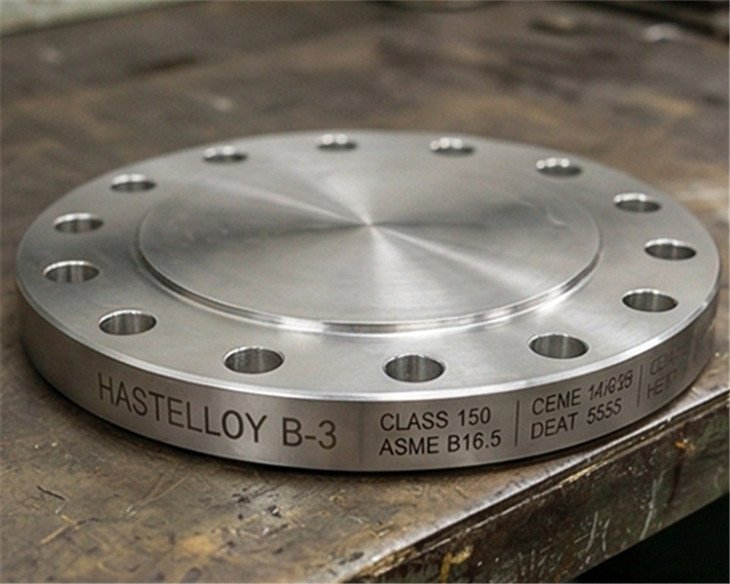
Was Käufer bei einem ASTM A182-Flansch-MTC beachten sollten
Direkte Antwort
Ein ASTM A182 flange MTC should identify the manufacturer, purchaser and order; the exact specification, edition, grade and product; heat number and item traceability; chemical analysis; Wärmebehandlung; mechanical and hardness results; required supplementary tests and NDE; dimensional or marking references where specified; and an authorized validation. Buyers must compare every entry with the purchase order rather than accepting the certificate title alone.
Wichtige Erkenntnisse
- The MTC must match the purchase order, flange marking and physical item.
- Actual test values are more useful than a generic statement of compliance.
- EN 10204 3.1 describes the document type; it does not replace product requirements.
First check identity and traceability
Start at the top of the document. Confirm the legal manufacturer, certificate number, issue date, purchaser, PO number and item number. The product description should agree with the order: ASTM A182 Grad, ASME standard, NPS, Klasse, Flanschtyp, facing and quantity.
The heat number on the certificate must match the permanent flange marking and packing list. If components were split, re-marked or processed by another organization, review the traceability chain and any endorsed copies. A technically correct certificate that cannot be linked to the physical flange is not sufficient evidence.
Review chemistry, heat treatment and mechanical results
| MTC section | Buyer check | Common warning sign |
|---|---|---|
| Chemie | Actual heat analysis, required elements and grade limits | Wrong grade, missing elements or copied generic values |
| Wärmebehandlung | Method, temperatures or condition as required, and traceable batch | Only “heat treated” with no usable detail |
| Tensile test | Yield, zugfest, elongation and applicable specimen information | Pass statement without actual values |
| Härte | Scale, readings and compliance with material/project limits | Unidentified scale or values outside the approved range |
For F91 and other heat-treatment-sensitive grades, the relationship between chemistry, thermal history, mechanical properties and hardness deserves close attention. PMI alone cannot close that review.
Check supplementary testing and declarations
Compare the certificate with the material requisition and inspection plan. If the order requires PMI, UT, magnetic-particle examination, Schlagprüfung, grain size, corrosion testing or third-party witnessing, the MTC or attached reports should identify the results and traceable report numbers.
EN 10204 Typ 3.1 is commonly requested for metallic products. It defines an inspection document validated by the manufacturer’s authorized inspection representative independent of manufacturing. It does not decide which chemistry, hardness or NDE requirements apply; those come from the product standard and purchase order.
Ten-point MTC approval checklist
- Manufacturer and manufacturing location are identified.
- PO, item, quantity and product description match.
- Specification edition and exact ASTM A182 grade are correct.
- Heat number matches the flange and packing records.
- Chemical analysis includes required actual values.
- Heat treatment matches the ordered grade and condition.
- Mechanical and hardness results meet the applicable limits.
- Supplementary tests and NDE match the order.
- Deviations, retests and repairs are disclosed and approved.
- The document is validated by the appropriate authorized representative.
Resolve discrepancies before release or installation. Do not edit a supplier certificate locally to make it match; request a controlled correction from the issuing organization.
Häufig gestellte Fragen
Is an MTC the same as a certificate of conformity?
Not necessarily. An MTC normally reports material-specific test results, while a certificate of conformity may only declare compliance. The purchase order should state the required document type.
What is the most important number on a flange MTC?
The heat number is central to traceability, but approval still requires the correct grade, results, Wärmebehandlung, product identity and validation.
Does EN 10204 3.1 guarantee that every test was witnessed by a third party?
NEIN. Typ 3.1 uses the manufacturer’s authorized inspection representative independent of manufacturing. Typ 3.2 involves additional purchaser or official inspection validation as defined by the standard.
Primäre Standards, auf die verwiesen wird
- ASTM A182/A182M – Geschmiedete oder gewalzte Rohrleitungskomponenten aus Legierung und Edelstahl
- BS EN 10204:2004 – Metallic Products: Types of Inspection Documents
Die Standards wurden anhand der Herausgeberseiten überprüft 3 August 2026. Kaufen und wenden Sie immer die vom Projekt angegebene Edition an.
Fordern Sie ein Angebot für einen Flansch aus legiertem Stahl an
Senden Sie die Materialqualität, Standard, NPS, Druckklasse, Flanschtyp, gegenüber, Rohrplan, Mengen- und Prüfanforderungen. Unser Team wird die technische Beschreibung vor dem Angebot prüfen.
Verwandte Beiträge
ASTM A182 F51 vs. F60 Flansche: S31803 vs. S32205 erklärt
Vergleichen Sie die Duplexflansche ASTM A182 F51 und F60, including S31803/S32205…
UNS S32750 vs. S32760 Flansche: ASTM A182 F53 oder F55?
Vergleichen Sie die Super-Duplex-Flansche S32750 und S32760, einschließlich ASTM A182…

Kann ein PN16-Flansch mit einer ASME-Klasse kombiniert werden? 150 Ventil?
Kann einen PN16-Flansch mit einer ASME-Klasse 150 verschrauben…
Kann EN 1092-1 Typ B1/B2-Verbindung mit ASME-Raised-Flanschen?
Kann EN 1092-1 Typ B1 oder B2 passen zu einem…