
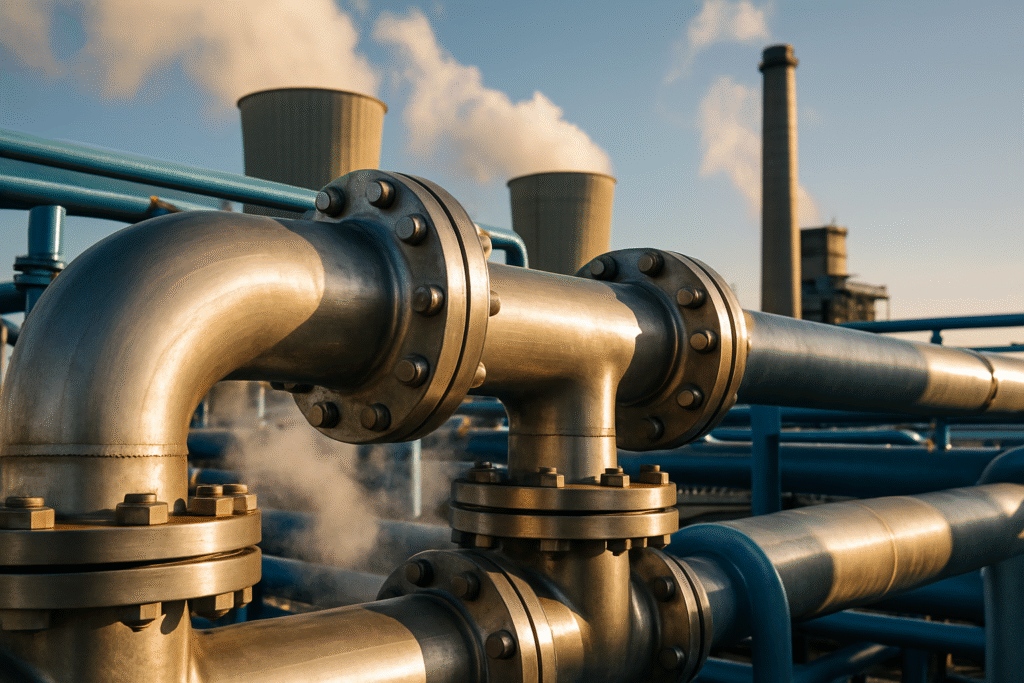
Markt für Edelstahlrohrflansche 2024: Versteckte Vorteile, Typen, Verwendungsmöglichkeiten, und wie man verschiedene Flansche auswählt
Laut Grand View Research (2024), Der globale Markt für Industrieflansche wurde mit bewertet $5.8 Milliarden in 2023 und wird voraussichtlich erreicht werden $7.2 Milliarden von 2030. That growth is one reason the stainless steel pipe flange remains a critical component for industrial use, especially where reliability, Korrosionsbeständigkeit, and code compliance drive procurement decisions.
Für Ingenieure und Einkäufer, the hidden advantages of stainless steel pipe flange selection go beyond corrosion performance alone. Verschiedene Flanschtypen, Druckklassen, Legierungen, and manufacturing controls directly affect lifecycle cost, Abschaltrisiko, and long-term pipe system safety.
Why the Stainless Steel Pipe Flange Market Keeps Expanding Across Industrial Sectors
Industrial demand for stainless steel pipe flange products continues to rise because operators need longer service life in aggressive media. Laut Statista (2024), auf die Öl- und Gasindustrie entfallen ca 35% des weltweiten Flanschverbrauchs, which shows how strongly energy projects shape flange demand.
Darüber hinaus, regional manufacturing concentration matters for sourcing strategy. Laut IBISWorld (2024), Der asiatisch-pazifische Raum macht mehr als aus 45% der weltweiten Flanschproduktion, wobei China der größte Hersteller ist.
That production scale gives buyers wider access to ASTM A182 forged stainless grades, larger size ranges, and shorter replenishment cycles. Jedoch, procurement teams still need to verify traceability, Wärmebehandlungskontrolle, PMI-Tests, and dimensional compliance against ASME B16.5, ASME B16.47, DIN, JIS, GOST, und EN 1092 Anforderungen.
The stainless steel pipe flange is widely specified in Oil & Gas, Petrochemie, Marine, Wasseraufbereitung, and power generation because stainless grades perform well in humid, chloridhaltig, and cyclic-temperature environments. Im Gegensatz, lower-cost carbon steel options may require coating systems, more frequent maintenance, or replacement in corrosive duty.
Laut Mordor-Geheimdienst (2024), industrial processing investments in energy, Wasserinfrastruktur, and chemicals continue to support steady demand for corrosion-resistant piping components. daher, buyers increasingly compare total installed cost rather than only initial flange price.
As material engineer Dr. Helen Morris, Korrosionsspezialist, Staaten: “The most economical flange is rarely the cheapest forged piece; it is the component that minimizes leakage risk, maintenance exposure, and unplanned shutdown over the asset life.” That view is especially relevant when comparing 304, 316L, 904L, Duplex 2205, und Super-Duplex 2507 for different media.
In praktischer Hinsicht, different flanges serve different mechanical and maintenance priorities. Weld neck flange designs handle severe cyclic service well, slip-on flanges support less critical systems economically, and blind flanges isolate lines safely during testing or maintenance.
Buyers also look beyond material to supplier capability. SASA FLANGE, Portion 50+ Länder in ganz Öl & Gas, Petrochemie, Leistung, und Marineindustrie, supports projects requiring forged stainless steel flanges, Flansche aus Legierung, and matching pipe fittings in standards such as ANSI B16.5, ANSI B16.47, ASME B16.9, DIN, JIS, GOST, und EN 1092.
Mit ISO 9001:2015 und PED 2014/68/EU-Zertifizierungen, manufacturers can better align with documentation-heavy projects in Europe and export markets. Zusätzlich, EN 10204 3.1 Materialzertifikate, Aufzeichnungen über hydrostatische Tests, PMI-Berichte, and dimensional inspection reports help reduce approval delays.
Aus Beschaffungssicht, the hidden advantages of a high-quality stainless steel pipe flange include reduced corrosion allowance, more predictable maintenance planning, stronger resale value of plant assets, and easier compliance with owner specifications. Infolge, technical procurement teams increasingly prioritize qualified suppliers over spot-price vendors.
Technischer Deep Dive: Intriguing Stainless Steel Pipe Flange Advantages, Typen, und Materialauswahl
The stainless steel pipe flange family includes many forged and plate-based configurations, each suited to different pipe layouts and pressure classes. Entsprechend ASME B16.5, Flanschabmessungen, Verkleidungstypen, Bohren, and pressure-temperature ratings must match the designated class and material group (ASME, 2023).
In engineering practice, material choice usually begins with media, Chloridkonzentration, Betriebstemperatur, and expected maintenance interval. Jedoch, designers must also consider gasket compatibility, Schraubenlast, external vibration, and whether the joint will be disassembled frequently.
As piping consultant James Ortega, Leitender Rohrleitungsingenieur, Staaten: “Most flange failures begin with a mismatch between service conditions and selection assumptions, not with the forging itself.” daher, the best way to choose different flanges is to align alloy, gegenüber, Klasse, and connection type with the actual process envelope.
Common stainless steel grades used in a stainless steel pipe flange include 304, 304L, 316, 316L, 321, 347, 904L, Duplex 2205, und Super-Duplex 2507. ASTM A182 covers many forged or rolled alloy and stainless steel pipe flanges, geschmiedete Beschläge, Ventile, und Teile für den Hochtemperaturbetrieb (ASTM, 2024).
Among these grades, 304 and 304L are popular for general industrial use because they balance cost, Formbarkeit, und Korrosionsbeständigkeit. Im Gegensatz, 316 and 316L include molybdenum, Dies verbessert die Lochfraßbeständigkeit in chloridhaltigen Umgebungen.
For higher chloride content or sour service, duplex and super duplex alloys often provide better strength-to-weight ratio and stronger resistance to stress corrosion cracking. NACE MR0175 Und ISO 15156 should guide material acceptance for H2S-containing environments where sulfide stress cracking risks increase (NACE, 2023).
- 304/304L: general utility systems, milder chemischer Service, Lebensmittelverarbeitung, and indoor water lines.
- 316/316L: Marine, Küste, pharmazeutisch, and chloride-exposed piping.
- 904L: stronger resistance in sulfuric and aggressive chemical environments.
- 2205 Duplex: higher strength and improved chloride stress corrosion cracking resistance.
- 2507 Super-Duplex: severe offshore and high-salinity applications.
Different flange types also influence fatigue performance and assembly efficiency. The most common types include weld neck, Slip-on, blind, Muffenschweißen, mit Gewinde, und Überlappungsflansche.
- Vorschweißflansch: bevorzugt für Hochdruck, hohe Temperatur, und zyklischer Dienst.
- Aufsteckflansch: easier alignment and lower fabrication cost for moderate duty.
- Blindflansch: used for line blanking, Testen, und Wartungsisolation.
- Muffenschweißflansch: common in small-bore, Hochdrucksysteme.
- Gewindeflansch: useful where welding is impractical or restricted.
- Überlappungsflansch: supports systems requiring frequent dismantling.
Laut Market Research Future (2024), corrosion-resistant alloys are gaining share in process industries because operators seek longer maintenance intervals and lower leak probability. Außerdem, alloy upgrades can reduce replacement frequency in lines exposed to seawater, Ätzen, or mixed chemical streams.
Pressure class is another key variable. In ASME B16.5 Systeme, Übliche Bewertungen umfassen Klasse 150, 300, 600, 900, 1500, Und 2500, while larger diameters may fall under ASME B16.47 Series A or B depending on project specification.
Procurement managers should not assess price by diameter alone. A 4 Zoll-Rohrflansch aus Edelstahl der Klasse 316L 300, RF finish, mit EN 10204 3.1 certification and PMI testing, differs significantly in cost from a 304 slip-on flange of the same nominal size.
Unterstützt durch fortschrittliche CNC-Bearbeitung und umfassende Qualitätsprüfungen, SASA FLANGE stellt Flansche her 304, 316, 316L, 904L, 2205, 2507, A105, A182, Inconel, Monel, Hastelloy, und Titan. That range helps EPC contractors consolidate sourcing across both corrosion-resistant and high-temperature alloy systems.
In vielen Projekten, buyers also need elbows, T-Shirts, Reduzierstücke, and caps from the same source to avoid dimensional mismatch. Seit ASME B16.9 governs many butt weld fitting dimensions, pairing flanges and fittings from a supplier familiar with the same tolerances simplifies fit-up on site.
Laut ISO (2023), quality management discipline lowers nonconformance risk when production, Inspektion, and documentation follow controlled procedures. Folglich, a certified system such as ISO 9001:2015 often matters as much as nominal material grade.
Another hidden advantage of the stainless steel pipe flange is cleanliness. Stainless surfaces are easier to maintain in pharmaceutical, Essen, Reinstwasser, and high-spec process systems where contamination control matters.
Als Metallurge Dr. Aaron Patel, Materialwissenschaftler, Staaten: “Selecting a stainless flange is an exercise in balancing chemistry, Metallurgie, Druckdesign, and fabrication practicality.” That is why experienced manufacturers evaluate not just different flanges, but the whole piping envelope.
Standards, Testen, and Compliance Requirements for Stainless Steel Pipe Flange Procurement
Compliance is often the difference between a smooth project release and a delayed shipment. Für einen Rohrflansch aus Edelstahl, the most referenced standards include ASME B16.5, ASME B16.47, ASTM A182, ASTM A240, EN 1092-1, DIN-Normen, and project-specific specifications from API, NORWEGEN, DNV, or end users.
ASME B16.5 deckt Flansche und Flanschanschlüsse für NPS ab 1/2 durch 24. ASME B16.47 applies to larger steel flanges from NPS 26 durch 60, depending on series and pressure class (ASME, 2023).
ASTM A182 addresses forged or rolled alloy and stainless steel components for high-temperature service. ASTM A240, im Gegensatz dazu, is usually referenced for chromium and chromium-nickel stainless plate, Blatt, and strip used for vessels and general applications (ASTM, 2024).
Für europäische Projekte ist möglicherweise EN erforderlich 1092-1 dimensional compliance and PED 2014/68/EU documentation. daher, manufacturers supplying to EU-regulated pressure equipment markets must maintain material traceability and conformity assessment records carefully.
- Maßstandards: ASME B16.5, ASME B16.47, EN 1092-1, DIN, JIS, GOST.
- Materialstandards: ASTM A182, ASTM A240, ASTM A276, customer-approved MDS.
- Testing and documentation: PMI, Härte, Hydrotest, Ferritprüfung, intergranular corrosion test, EN 10204 3.1.
- Service-specific requirements: NACE MR0175, ISO 15156, PED 2014/68/EU, ANZEIGE 2000.
Below is a practical comparison used by many buyers during technical review.
| Standard | Main Focus | Typische Verwendung |
|---|---|---|
| ASME B16.5 | Abmessungen, Bewertungen, gegenüber | NPS 1/2 Zu 24 Prozessleitungen |
| ASME B16.47 | Large diameter flange dimensions | NPS 26 Zu 60 Pipelines |
| ASTM A182 | Forged stainless and alloy materials | Forged flange procurement |
| EN 1092-1 | Europäische Flanschabmessungen und PN-Werte | EU projects and PED scope |
| NACE MR0175 | Sour service material suitability | H2S-containing environments |
Laut DNV (2023), offshore and marine projects increasingly demand stricter documentation, Rückverfolgbarkeit, and corrosion-resistance validation due to lifecycle safety requirements. Zusätzlich, many owners request positive material identification for all critical alloy flanges before installation.
When buyers compare different flanges, they should verify both manufacturing and inspection scope. A compliant flange should meet dimensional tolerances, Verkleidungsende, Bolzenlochausrichtung, Markierungsregeln, and required test frequency.
Mit ISO 9001:2015, PED 2014/68/EU, und AD 2000 Anmeldeinformationen, SASA FLANGE supports projects that require controlled quality systems and export documentation. Herstellung von Flanschen in 304, 316, 904L, 2205, 2507 und andere Premiumqualitäten, the company serves buyers who need certified materials for energy, Wasser, Marine, und Chemieservice.
Für kritische Anwendungen, documentation should include heat number traceability, raw material certificates, Maßkontrollberichte, Und EN 10204 3.1 Zertifikate. Darüber hinaus, Oberflächenzustand, Verzahnungsfinish, and flange facing type must match gasket design to ensure leak-tight assembly.
Buyers should also confirm whether the supplier can produce custom sizes from 1/2 Zoll zu 60 Zoll, Nicht standardmäßige Bohrungen, and special alloy combinations. That flexibility is valuable when revamps must interface with legacy DIN, ANSI, and mixed-spec piping systems.
For formal code reference, engineers can review current requirements at ASME. That step is helpful when project documents cite the latest edition rather than a generic standard name.
Anwendungsleitfaden: So wählen Sie verschiedene Flansche für Öl aus, Gas, Chemisch, Leistung, und Meeressysteme
Choosing the right stainless steel pipe flange starts with service conditions rather than catalog habit. Ingenieure sollten den Druck definieren, Temperatur, Flüssigkeitschemie, Korrosionszuschlag, Wartungshäufigkeit, and installation method before selecting a type.
In Öl & Gas, flange selection often prioritizes pressure containment, Sauerservice-Eignung, und Ermüdungsleistung. daher, weld neck designs in ASTM A182 F316L, F51, or higher-alloy materials are common in upstream, Mittelstrom, and refinery process units.
Laut Statista (2024), etwa 35% des weltweiten Flanschverbrauchs entfallen auf Öl und Gas. That share explains why API-aligned project documentation, Rückverfolgbarkeit der Mühle, and NACE compatibility frequently shape purchasing requirements.
In der petrochemischen und chemischen Verarbeitung, the hidden advantages of stainless and duplex flanges appear in corrosive media handling. 316L may suit moderate chloride and solvent service, während 904L, Hastelloy, or duplex alloys are often chosen for stronger acid or mixed-chemistry exposure.
Power generation applications focus on thermal cycling, Dampfservice, und Abschaltsicherheit. Infolge, engineers often specify forged flange materials with stable mechanical properties and verified heat treatment records.
Marine and shipbuilding systems need strong pitting resistance in saline environments. daher, 316L, 2205 Duplex, Und 2507 super duplex often outperform standard materials in seawater-adjacent pipe systems, Ballastleitungen, and deck utility services.
- For corrosive water lines, prioritize 316L or duplex over 304 where chlorides are elevated.
- For high-pressure cyclic service, choose weld neck over slip-on whenever design permits.
- For shutdown blinds and hydrotest points, specify blind flanges with correct facing and bolt load.
- For small-bore high-pressure service, evaluate socket weld flanges carefully.
- For maintenance-intensive systems, lap joint assemblies may simplify dismantling.
Procurement teams should also compare fabrication and field installation cost. Although slip-on flanges can reduce initial machining and fit-up complexity, weld neck flanges often provide better long-term performance in demanding service.
Different flange faces affect gasket choice and leak integrity. In Prozessanlagen kommt es häufig zu erhabenen Flächen, ring type joint is used in higher-pressure critical service, and flat face appears in certain low-pressure or cast equipment connections.
When buyers ask how to choose a pipe flange for industrial use, these criteria usually matter most.
- Materialqualität und Korrosionsbeständigkeit.
- Druckklasse und Temperaturbereich.
- Flange type and connection method.
- Applicable standards and project approvals.
- Testumfang, Zertifikate, und Rückverfolgbarkeit.
- Vorlaufzeit, Mindestbestellmenge, and logistics capability.
Wir bieten maßgeschneiderte Größen von an 1/2 Zoll zu 60 Zoll mit wettbewerbsfähigen Direktpreisen ab Werk, SASA FLANGE supports standard and custom production for EPC contractors and distributors. Zusätzlich, Das Unternehmen liefert Ellbogen, T-Shirts, Reduzierstücke, and caps to simplify package procurement for complete pipe systems.
Zum Beispiel, a water treatment plant may use 304L slip-on flanges in non-chlorinated utility lines, while specifying 316L or duplex flanges in higher-chloride process areas. Ähnlich, an offshore skid may require 2205 Schweißhalsflansche, ASME B16.5 Klasse 600, NACE-compliant, mit EN 10204 3.1 und PMI-Aufzeichnungen.
If your project requires mixed materials, individuelles Bohren, or rapid technical review, kontaktieren SASA FLANGE early can shorten approval cycles. Early supplier engagement also helps avoid mismatches between pipe schedule, Bohrungsmaß, and flange hub geometry.
Future Outlook for Stainless Steel Pipe Flange Sourcing and Strategic Recommendations for Buyers
The outlook for stainless steel pipe flange demand remains positive because industrial operators continue investing in resilience, Korrosionsschutz, and longer asset life. Laut Grand View Research (2024), Der Markt wird voraussichtlich wachsen $5.8 Milliarden in 2023 Zu $7.2 Milliarden von 2030.
That trend is reinforced by infrastructure modernization, water treatment expansion, and energy transition projects that still require robust pipe connections. Darüber hinaus, stricter leakage prevention and documentation expectations favor qualified manufacturers with established testing systems.
Laut IBISWorld (2024), Asia-Pacific maintains over 45% der weltweiten Flanschproduktion, so supply chain strategy should combine cost advantage with quality verification. daher, buyers should prequalify suppliers based on certification, alloy capability, Inspektionsressourcen, und Exporterfahrung.
Strategisch, B2B buyers should standardize flange selection logic across sites. A clear matrix for media, Temperatur, Druckklasse, and approved materials reduces engineering variation and simplifies inventory planning.
They should also request lifecycle-based comparisons instead of unit-price-only quotes. In vielen Fällen, the hidden advantages of upgraded stainless or duplex flanges include fewer failures, lower coating cost, and reduced downtime exposure.
Recommended actions for procurement and engineering teams include the following.
- Create an approved materials list tied to service conditions and standards.
- Erfordern EN 10204 3.1 certificates and PMI for critical alloys.
- Confirm dimensional standard, Verblendungstyp, und Plankompatibilität vor der PO-Veröffentlichung.
- Review supplier capability for both flanges and matching ASME B16.9 Beschläge.
- Assess total cost across maintenance, Ersatz, and outage risk.
For buyers evaluating different flanges, a capable manufacturing partner should offer metallurgical depth, Bearbeitungsgenauigkeit, und Dokumentationsdisziplin. That is why many global projects prefer suppliers that can combine stainless, Duplex, Nickellegierung, and custom flange production under one controlled system.
For upcoming tenders involving stainless steel flanges and fittings, early technical coordination with an experienced manufacturer can improve bid accuracy and delivery confidence. Für Projekte, die zertifizierte Materialien erfordern, benutzerdefinierte Abmessungen, or export-ready documentation, mit arbeiten SASA FLANGE ist ein praktischer nächster Schritt.
Häufig gestellte Fragen
Wofür werden Edelstahlflansche verwendet??
●Zur Rohrverbindung werden Edelstahlflansche verwendet, Ventile, Pumps, und Druckgeräte in Systemen, die Korrosionsbeständigkeit erfordern, Gebrauchstauglichkeit, and pressure-tight sealing.
●Laut Statista (2024), Öl und Gas machen etwa aus 35% des weltweiten Flanschverbrauchs, which shows how common these components are in critical process lines.
●Sie werden häufig in petrochemischen Anlagen eingesetzt, Schiffsrohrleitungen, Wasseraufbereitungsanlagen, Lebensmittelverarbeitungssysteme, and power generation units because grades such as 304, 316L, Und 2205 handle moisture, Chemikalien, and temperature changes better than many coated carbon steel options.
●Common use points include pump suction and discharge nozzles, tank connections, Instrumentenzweige, Utility-Header, and removable spool joints where maintenance access matters.
●Engineers usually select the flange by matching material, Druckklasse, gegenüber, and type to the process fluid and piping code, wie zum Beispiel ASME B16.5 oder EN 1092-1.
●For projects requiring corrosion-resistant forged flanges with EN 10204 3.1 Dokumentation, Zusammenarbeit mit etablierten Herstellern wie SASA FLANGE helps ensure dimensional consistency and traceability.
Stellen sie Rohrverbindungsstücke aus Edelstahl her??
●Ja, manufacturers make stainless steel pipe fittings such as elbows, T-Shirts, Reduzierstücke, Kappen, Kupplungen, und Stummelenden für geschweißte und mit Gewinde versehene Rohrleitungssysteme.
●Entsprechend ASME B16.9, many butt weld fittings follow standardized dimensions that help maintain fit-up consistency across process piping systems (ASME, 2023).
●These fittings are commonly produced in grades like 304, 304L, 316, 316L, 904L, 2205, Und 2507, depending on corrosion level, Druck, Temperatur, and owner specification.
●In der Praxis, buyers often source flanges and fittings together because mixed suppliers can create tolerance conflicts, weld-end mismatch, or documentation gaps during inspection and site assembly.
●Industries such as petrochemical, Marine, Arzneimittel, and water treatment typically require stainless fittings where corrosion control, Hygiene, or long service life matter more than the lowest initial purchase price.
●For buyers who need coordinated supply of stainless steel flanges and fittings under one quality system, Hersteller mögen SASA FLANGE can simplify procurement and inspection planning.
Was ist die stärkste Art von Rohrleitungsflansch??
●The weld neck flange is generally considered the strongest type of piping flange for high-pressure, hohe Temperatur, und zyklischer Dienst.
●Its tapered hub improves stress distribution between the flange and pipe, which is why it is widely specified in refinery units, Offshore-Skids, and power plant systems where vibration or pressure cycling is severe.
●ASME B16.5 includes weld neck flanges across multiple pressure classes, inklusive Klasse 150 durch 2500, and that range supports both moderate and very demanding process conditions.
●Blind flanges can also be very robust for line closure, but they serve a different function because they isolate the end of a piping run rather than connect two piping components.
●Strength still depends on more than flange style because material grade, Wandstärke, Schraubenlast, Verblendungstyp, Dichtungsauswahl, and operating temperature all affect joint integrity.
●Für kritische Anwendungen, engineers should verify design conditions and choose forged code-compliant products from experienced suppliers such as SASA FLANGE.
What is the difference between MS flange and SS flange?
●The main difference is that an MS flange is made from mild steel, while an SS flange is made from stainless steel with chromium-based corrosion resistance.
●Stainless steel typically contains at least 10.5% Chrom, which forms a passive film that helps protect the surface in wet or chemically active environments (ASTM, 2024).
●MS flanges usually cost less at the start, but they often need painting, Verzinken, or other corrosion protection in outdoor or process service where rusting can occur quickly.
●SS flanges such as 304 or 316L cost more initially, yet they often deliver lower lifecycle cost in marine, chemisch, hygienisch, and water-treatment systems because they need less maintenance and replacement.
●Another practical difference is cleanliness because stainless steel is often preferred where contamination control, washdown durability, or aesthetic appearance matters.
●For buyers comparing lifecycle performance instead of unit price alone, etablierte Anbieter mögen SASA FLANGE can help evaluate the right option by media, Druckklasse, und Projektstandard.
Was ist der ASME-Code für Edelstahlflansche??
●The most common ASME dimensional code for stainless steel flanges is ASME B16.5, while large-diameter steel flanges are commonly covered by ASME B16.47.
●ASME B16.5 gilt für NPS 1/2 durch 24 and defines dimensions, Druck-Temperatur-Werte, facings, Toleranzen, and marking for many flanged connections (ASME, 2023).
●Material itself is usually specified separately under ASTM standards, Und ASTM A182 is one of the most common specifications for forged stainless steel pipe flanges and forged fittings.
●That means a complete purchase order often references both a dimensional standard and a material standard, wie zum Beispiel ASME B16.5 plus ASTM A182 F316L.
●European projects may instead reference EN 1092-1, and mixed-standard systems must be reviewed carefully because bolt patterns, Dicke, and pressure ratings may differ.
●For technical procurement, it is best to confirm the latest code edition and project note set with a qualified flange manufacturer before finalizing production.
How do I choose the right stainless steel pipe flange?
●You should choose the right stainless steel pipe flange by matching material grade, Flanschtyp, Druckklasse, gegenüber, and inspection scope to the actual process conditions.
●Laut Grand View Research (2024), Es wird erwartet, dass der Markt für Industrieflansche an Bedeutung gewinnt $7.2 Milliarden von 2030, which reflects how much industrial spending depends on reliable and application-specific flange selection.
●Zum Beispiel, 304 kann für allgemeine Versorgungsdienste geeignet sein, 316L is often preferred for chloride exposure, Und 2205 oder 2507 may be better for offshore or high-salinity systems where stronger corrosion resistance is required.
●Weld neck flanges are usually chosen for high-pressure or cyclic service, while slip-on and threaded designs may suit less severe duties or installation constraints.
●Buyers should also review ASME B16.5 oder EN 1092-1 Einhaltung, Anfrage EN 10204 3.1 Zertifikate, and confirm pipe schedule compatibility to avoid fit-up errors in fabrication.
●For projects with custom dimensions, Sonderlegierungen, or strict documentation requirements, erfahrene Lieferanten mögen SASA FLANGE can provide practical selection support.
Verwandte Beiträge
Flanschoberflächenfinish: Konzentrische vs. spiralförmige Verzahnungen erklärt
Konzentrische und spiralförmige Verzahnungen sind beide bearbeitete Flanschflächenoberflächen…
Duplex 2205 vs. 316L-Flansche: Welches Material sollten Sie wählen??
Schnelle Antwort: Duplex 2205 Flansche sind normalerweise der stärkere Kandidat…

Definition des Öffnungsflansches, Details und Übersicht über ASME B16.36-Flansche: Marktdaten, Auswahlhilfe und Compliance-Einblicke
Der globale Markt für Industrieflansche wurde mit bewertet $5.8 Milliarde…

Marktführer für schwarze Entsorgungsflansche: Materialien, 3.5″ Kompatibilität, und B2B-Beschaffungsdaten für Küchenspülenflansche
Die Nachfrage nach schwarzen Entsorgungsflanschen steigt bei Käufern von Küchenarmaturen…