
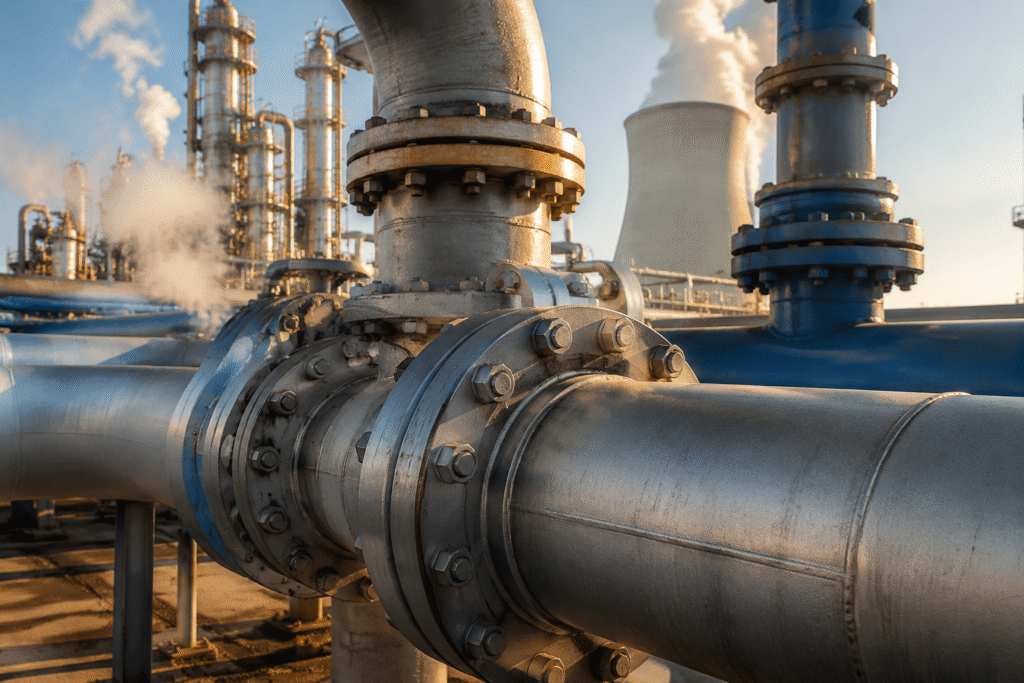
Marktführer für Edelstahlrohrflansche: ASME B16.5, B16.47, Typen, Verwendungsmöglichkeiten und versteckte Vorteile in 2025
Der Edelstahlrohrflansch bleibt ein Kernbestandteil moderner Prozessrohrleitungen, und die Marktnachfrage im Energiebereich steigt weiter, Wasser, und Meeressektoren. Laut Grand View Research (2024), Der globale Markt für Industrieflansche wurde mit bewertet $5.8 Milliarden in 2023 und wird voraussichtlich erreicht werden $7.2 Milliarden von 2030.
Für Beschaffungsteams, the most Intriguing factor is not only price, but the Hidden Advantages of Stainless Steel performance, Lebenszykluskosten, und Code-Compliance. daher, buyers increasingly compare Flanges by durability, Korrosionsbeständigkeit, Rückverfolgbarkeit, and certification rather than by nominal size alone.
Globale Nachfragetrends prägen die Beschaffung von Edelstahlrohrflanschen
Industrial buyers now source flanges in a more data-driven way because downtime costs are rising in every continuous process industry. Laut IBISWorld (2024), Der asiatisch-pazifische Raum macht mehr als aus 45% der weltweiten Flanschproduktion, wobei China der größte Hersteller ist.
That production concentration matters for lead time, Mühlenverfügbarkeit, and custom machining capacity. Infolge, many EPC contractors and stockists look to qualified Chinese manufacturers that can supply ASME, DIN, JIS, GOST, and EN dimensions from one source.
Demand remains especially strong in upstream and downstream energy. Laut Statista (2024), auf die Öl- und Gasindustrie entfallen ca 35% des weltweiten Flanschverbrauchs, was erklärt, warum Druckklasse, Materialrückverfolgbarkeit, and NACE compliance remain central purchase criteria.
Gleichzeitig, stainless grades continue gaining share in aggressive service. Laut Mordor-Geheimdienst (2024), corrosion-resistant alloy demand in industrial piping is increasing as operators seek longer maintenance intervals and lower total ownership cost.
The Hidden Advantages of stainless over coated carbon steel become clear in wet chloride, Off-Shore-, und chemische Umgebungen. Although initial unit cost is higher, replacement frequency is lower, and inspection intervals may improve when the correct alloy is selected.
Als Werkstoffingenieur Dr. Helen Morris erklärt: “Im korrosiven Einsatz, the cheapest flange is rarely the lowest-cost flange over a full operating cycle.” That view aligns with current procurement practice, where lifecycle economics now influence supplier approval more than headline piece price.
Standards also shape sourcing behavior. ASME B16.5 umfasst Rohrflansche und Flanschverbindungen aus NPS 1/2 durch 24, während ASME B16.47 deckt Flansche mit großem Durchmesser aus NPS ab 26 durch 60 (ASME, 2023).
Für geschmiedete Edelstahlflansche, ASTM A182 remains the benchmark specification for many pressure applications. Im Gegensatz, plate flange projects may reference ASTM A240 je nach Design und Fertigungsweg (ASTM, 2023).
Buyers therefore need a supplier that understands both code and manufacturing detail. Mit ISO 9001:2015 und PED 2014/68/EU-Zertifizierungen, SASA FLANGE supports global industrial projects requiring dimensional accuracy, Materialrückverfolgbarkeit, Und EN 10204 3.1 Dokumentation.
Darüber hinaus, supply flexibility has become a differentiator. Herstellung von Flanschen in 304, 316, 316L, 904L, 2205, 2507, A105, A182, Inconel, Monel, Hastelloy, and Titanium allows one vendor to support both standard and critical applications.
Laut Market Research Future (2024), the broader industrial pipe components market is growing at above 4% CAGR, supported by refinery upgrades, water treatment expansion, and power infrastructure investment. daher, flange buyers should expect continued pressure on lead times for large diameters and exotic alloys.
Für Ingenieure und Einkaufsmanager, the key takeaway is clear. The right stainless steel pipe flange strategy balances standards compliance, Legierungsauswahl, Bearbeitungsqualität, and supply reliability rather than focusing only on upfront price.
stainless steel pipe flange technical overview: Typen, Verwendungsmöglichkeiten, Versatility and durability
The performance of a stainless steel pipe flange depends on four variables. These variables are flange type, Legierungsgrad, Druckklasse, and actual process conditions including temperature, Chloride, zyklische Belastung, and media composition.
Stainless Steel Flanges deliver strong Versatility because one material family can cover sanitary, Dienstprogramm, and severe service systems. Jedoch, each grade has limits, so proper selection requires more than a simple 304 gegen 316 comparison.
Als Rohrleitungsberater Mark Ellison, PE, Staaten: “The safest flange selection starts with the service fluid, then works outward to temperature, Druckklasse, gegenüber, and joint integrity.” That process reduces misapplication, especially where gasket selection and bolting are equally critical.
Common flange Types used in industrial piping include the following.
- Vorschweißflansche für Hochdruck, hohe Temperatur, und zyklischer Dienst.
- Slip-on flanges for lower pressure utility lines and easier alignment.
- Blind flanges for line end isolation, Testen, and future expansion.
- Threaded flanges for small bore systems where welding is restricted.
- Socket weld flanges for small diameter high-pressure piping.
- Lap joint flanges where frequent dismantling is required.
Each type has distinct installation economics. Zum Beispiel, weld neck designs cost more initially, yet they often improve fatigue resistance because the tapered hub distributes stress more smoothly into the pipe wall.
Ebenso wichtig ist die Materialauswahl. 304 and 304L remain widely used in water, Essen, und allgemeine Industriesysteme, während 316 and 316L offer improved pitting resistance because molybdenum enhances chloride performance.
Für aggressivere Medien, engineers may specify 904L, Duplex 2205, oder Super-Duplex 2507. These alloys increase strength and corrosion resistance, which can allow thinner wall designs or longer operating life in seawater and sour service.
Gemäß NACE-Richtlinien für korrosive Umgebungen, Chloridkonzentration, Temperatur, and oxygen content all influence localized attack risk (NACE, 2023). daher, alloy selection must match the actual process chemistry rather than the generic industry label.
When comparing ASME pressure classes, engineers usually consider Class 150, 300, 600, 900, 1500, Und 2500. Yet actual pressure-temperature limits depend on material group and the tables in ASME B16.5 oder B16.47, not on class number alone.
Important selection factors include the following.
- Nominal pipe size and flange standard.
- Druckklasse und Auslegungstemperatur.
- Face type such as RF, FF, RTJ, oder Nut und Feder.
- Material grade and corrosion allowance.
- Schweißmethode, PWHT requirements, und Inspektionsumfang.
- Document package including MTC, PMI, Hydrotest, Und EN 10204 3.1.
For large diameter projects, ASME B16.47 Series A and Series B require careful review because bolt patterns and weights differ. In praktischer Hinsicht, that affects interchangeability, freight cost, and field assembly time.
The Uses of stainless flanges also vary by sector. Bei Öl und Gas, engineers prioritize pressure containment and sour service resistance, while in food and water systems they often focus on cleanliness, Korrosionsschutz, und wartungsarm.
Gemäß DNV-Richtlinien für Offshore-Systeme, marine atmosphere and seawater exposure accelerate corrosion risk where material selection is inadequate (DNV, 2023). Infolge, duplex and super duplex flanges often justify their premium in topside and coastal applications.
Another Hidden advantage is inventory simplification. A supplier that can offer flanges plus elbows, T-Shirts, Reduzierstücke, and caps in matching metallurgy reduces qualification steps and lowers mismatch risk during fabrication.
Unterstützt durch fortschrittliche CNC-Bearbeitung und umfassende Qualitätsprüfungen, SASA FLANGE supplies stainless steel flanges and pipe fittings in standard and custom sizes for global EPCs, Fachhändler, und Hersteller. Wir bieten maßgeschneiderte Größen ab 1/2 an" bis 60" with competitive factory-direct pricing also helps buyers align technical need with budget discipline.
Procurement teams should also compare delivered value, nicht nur der Preis ab Werk. Machining tolerance, Fasengenauigkeit, Verkleidungsende, and PMI reliability all affect field fit-up and installation cost.
According to ISO-aligned quality studies cited by industrial manufacturers, nonconformance in piping components can increase project rework cost by double-digit percentages when discovered late in fabrication. daher, source inspection and document control remain essential for critical flanged systems.
For buyers evaluating products online, it helps to review a manufacturer’s full range before requesting a quote. Der SASA FLANGE Produktportfolio covers stainless, Kohlenstoffstahl, Legierung, and high-performance materials for diverse operating environments.
Zusamenfassend, the best way to Choose a stainless steel pipe flange is to begin with service data, then confirm type, Standard, Legierung, Druckklasse, gegenüber, und Dokumentation. This method produces safer systems and more predictable long-term cost.
ASME B16.5, B16.47 and stainless steel flange standards that drive compliance
Code compliance is not optional in industrial piping. It directly affects interchangeability, Druckintegrität, project approval, and cross-border shipment acceptance.
ASME B16.5 remains the most referenced standard for standard-size flanges in process piping. Es deckt Dimensionen ab, Toleranzen, Druck-Temperatur-Werte, Markierung, and testing for flanges from NPS 1/2 Zu 24 (ASME, 2023).
ASME B16.47 extends the framework to larger diameters. It addresses NPS 26 durch 60 and separates products into Series A and Series B, which differ in bolt circle and flange mass.
ASTM-Standards definieren Materialchemie und mechanische Eigenschaften. ASTM A182 commonly applies to forged or rolled alloy and stainless steel flanges, während ASTM A240 may apply to plate products used in fabricated components (ASTM, 2023).
European and international projects often add DIN or EN references. EN 1092 is a key flange standard in EU projects, especially where PED 2014/68/EU conformity is required for pressure equipment placed on the European market.
For corrosive oilfield and process conditions, NACE MR0175 oder ISO 15156 kann auch die Spezifikation eingeben. These standards are important where sulfide stress cracking or sour service resistance must be verified.
Buyers should confirm at least the following data points before release.
- Standard: ASME B16.5, ASME B16.47, DIN, JIS, GOST, oder EN 1092.
- Materialspezifikation: ASTM A182 F304, F316L, F51, F53, and similar grades.
- Druckklasse oder PN-Bewertung.
- Art und Ausführung der Verkleidung.
- Required certification such as ISO 9001:2015, PED, ANZEIGE 2000, oder EN 10204 3.1.
- Special testing such as PMI, Ferritkontrolle, Härte, Auswirkungen, or corrosion testing.
The following quick comparison helps engineers and buyers review the most common framework.
| Standard | Typical Scope | Allgemeiner Gebrauch |
|---|---|---|
| ASME B16.5 | NPS 1/2 Zu 24 | Prozessleitungen, Raffinerien, Leistung, chemisch |
| ASME B16.47 | NPS 26 Zu 60 | Large diameter transmission and plant systems |
| ASTM A182 | Forged stainless and alloy materials | Material compliance for pressure parts |
| EN 1092 | Europäische Flanschabmessungen und Druckstufen | EU projects and PED-linked applications |
Gemäß dem Rahmenwerk der Europäischen Kommission für PED 2014/68/EU, pressure equipment supplied to the EU may require conformity assessment based on category and application. daher, documentation discipline is just as important as machining quality when exporting to Europe.
As metallurgist Prof. David Chen states: “Traceability is the bridge between metallurgy and liability.” That insight explains why leading buyers request heat number traceability, MTCs, and inspection records for every critical flange lot.
Mit ISO 9001:2015, PED 2014/68/EU, und AD 2000 Anmeldeinformationen, SASA FLANGE aligns manufacturing and documentation with international project expectations. Portion 50+ Länder in ganz Öl & Gas, Petrochemie, Leistung, and Marine industries further supports supplier confidence in multi-standard projects.
Engineers should also verify dimensions against authoritative sources such as ASME before final purchase release. This is particularly important when replacing large-diameter flanges in brownfield systems where legacy drawings may be incomplete.
In der Praxis, compliance means more than ticking a box. It means the flange fits, Siegel, survives service, and arrives with the documentation needed for inspection, turnover, and audit.
How to choose stainless steel pipe flange products for oil, Gas, chemisch, power and marine service
The best procurement decisions begin with the operating envelope. Buyers should define fluid, Chloridgehalt, Druck, Temperatur, shutdown interval, inspection philosophy, and required design life before comparing suppliers.
Für Öl- und Gassysteme, Vorschweißflansche aus 316L, Duplex 2205, oder Super-Duplex 2507 often provide stronger long-term value than basic austenitic grades in chloride-rich or sour environments. Zusätzlich, RTJ facings may be preferred at higher classes where joint integrity is critical.
For petrochemical plants, 304L and 316L remain common in utility and process lines, but media-specific review is essential. Organische Säuren, Chloride, Schwefelverbindungen, and cleaning chemicals can change the correct alloy choice quickly.
Power generation projects often prioritize thermal cycling performance and dimensional consistency. daher, Schweißvorbereitung, Nabengeometrie, and bolt load control become as important as nominal material grade.
Marine and shipbuilding projects face continuous atmospheric chloride exposure. Infolge, 2205 Und 2507 are frequently selected for seawater, Ballast, Entsalzung, und Offshore-Versorgungssysteme.
Die Auswahlkriterien sollten Folgendes umfassen.
- Corrosion resistance versus actual media composition.
- Pressure-temperature rating to ASME B16.5 oder B16.47.
- Flange type based on stress profile and maintenance frequency.
- Compatibility with gasket, Verschraubung, and mating flange standard.
- Verfügbarkeit, Lieferplan, und Gesamtinstallationskosten.
- Testing package, Rückverfolgbarkeit, und Exportkonformität.
Laut Statista (2024), Öl und Gas machen immer noch etwa aus 35% des weltweiten Flanschverbrauchs, so buyers in this sector usually see the broadest range of approved vendor requirements. That often includes PMI, Härteprüfungen, NTE, and sour-service review.
Zur Wasseraufbereitung, 304L may be sufficient in less aggressive services, while 316L or duplex grades perform better in brackish or coastal systems. daher, water chemistry and disinfectant strategy should be reviewed before material release.
Flange sizes also influence choice. Small-bore threaded or socket weld designs can reduce fabrication time, while large-bore B16.47 flanges demand closer attention to handling, bolt-up sequence, und Dichtungssitzspannung.
Procurement teams should also compare local stock versus project manufacturing. Standard 2 Zoll, 4 Zoll, and common Class 150 oder 300 items may be available quickly, but exotic alloys, nicht standardmäßiges Bohren, and large diameters often require factory production.
That is where supplier capability matters. SASA FLANGE unterstützt kundenspezifische Fertigung, CNC-Bearbeitung, and matching pipe fittings including elbows, T-Shirts, Reduzierstücke, and caps for integrated package supply.
For EPC and distributor buyers, package consolidation reduces complexity. One technically competent source can align dimensions, Metallurgie, and documentation across the full piping component set.
When evaluating quotations, ask for these details up front.
- Exact material grade and dual certification if applicable.
- Manufacturing route such as forged, Platte, oder fabriziert.
- Lead time by size range and pressure class.
- Inspection scope including PMI and third-party witness options.
- Document list including MTC, Packliste, und Konformitätszertifikate.
Laut IBISWorld (2024), China remains the largest manufacturing base for flanges, which gives buyers scale advantages but also requires careful vendor qualification. daher, audits, sample approvals, and documentation review remain best practice before large purchase orders.
In vielen Projekten, the Hidden Advantages of a stronger supplier are fewer delays, lower mismatch risk, and better after-sales support. Those factors may save far more than a small difference in unit price.
Future outlook for stainless steel pipe flange procurement and strategic sourcing
The outlook for industrial flange demand remains positive because energy investment, Ausbau der Wasserinfrastruktur, and process plant modernization continue across key regions. Laut Grand View Research (2024), Es wird erwartet, dass der Markt für Industrieflansche weiter wachsen wird $5.8 Milliarden in 2023 Zu $7.2 Milliarden von 2030.
Darüber hinaus, corrosion-resistant materials should outperform basic commodity segments in value growth. Laut Market Research Future (2024), higher spending on long-life industrial assets is increasing demand for premium alloys and engineered piping components.
Digital procurement will also change the buying process. Engineers now expect faster access to drawings, Zertifikate, dimensional confirmation, and cross-standard support before issuing technical approval.
As industry analyst Rebecca Stone notes: “The next competitive edge in industrial components is documentation speed combined with manufacturing consistency.” That statement reflects what global buyers already expect from approved flange suppliers.
Strategisch, buyers should build a dual focus. Erste, standardize frequently used flange specifications across sites. Zweite, maintain approved sources for custom and critical materials such as 904L, 2205, 2507, Inconel, Monel, Hastelloy, und Titan.
Recommended actions for procurement and engineering teams include the following.
- Prequalify vendors against ISO 9001:2015, PED, and project-specific standards.
- Lock key dimensions and facing requirements to reduce field mismatch.
- Use lifecycle costing for corrosive services rather than lowest-price bidding.
- Request clear documentation packages and heat traceability.
- Consolidate flanges and fittings where possible to simplify quality control.
For companies sourcing globally, factory-direct relationships can improve both pricing and technical coordination. Manufacturers with strong export experience often respond faster on packing, Markierung, and multi-standard compliance.
That is why many buyers engage suppliers early in the specification phase. Für Projekte, die Edelstahl erfordern, Duplex, or alloy flange packages, kontaktieren SASA FLANGE early can improve material selection, lead time planning, and documentation readiness before procurement becomes urgent.
Häufig gestellte Fragen
Was sind die Flanschgrößen von Edelstahlrohren??
●Stainless steel pipe flange sizes typically range from NPS 1/2 Zu 24 unter ASME B16.5 and from NPS 26 Zu 60 unter ASME B16.47.
●Common project demand centers on 2 Zoll, 4 Zoll, 6 Zoll, Und 8 inch sizes, but the correct choice depends on pipe schedule, Druckklasse, und Gesichtstyp.
●Buyers should verify dimensions, Bohren, and pressure-temperature ratings against ASME standards before ordering from an approved manufacturer.
How do I choose between stainless steel flange types?
●Schweißhals, Slip-on, blind, mit Gewinde, Muffenschweißen, and lap joint are the main stainless steel flange types used in industrial piping systems.
●Entsprechend ASME B16.5, flange dimensions and ratings vary by class and facing, so the best type depends on stress level, Wartungshäufigkeit, und Installationsmethode.
●For critical pressure or thermal cycling service, engineers usually prefer weld neck flanges and should confirm alloy grade, Dichtungskompatibilität, and inspection scope before purchase.
What is the typical stainless steel pipe flange price?
●Stainless steel pipe flange price varies by size, Druckklasse, Legierung, machining route, und Prüfanforderungen, with duplex and nickel alloys costing significantly more than 304 oder 316 Noten.
●Laut Grand View Research (2024), rising global flange demand is supporting long-term market growth, which can affect lead times and pricing for large diameters and premium materials.
●Um die Gesamtkosten zu kontrollieren, buyers should compare delivered documentation, Inspektion, and field fit-up quality rather than relying on unit price alone.
Was ist ein 4 inch stainless steel pipe flange used for?
●A 4 inch stainless steel pipe flange is widely used in process lines, Versorgungsleitungen, Wassersysteme, and skid packages because it balances flow capacity with manageable installation weight.
●Klasse 150 Und 300 versions are common, but the final selection should match process pressure, Temperatur, Korrosionsgefahr, and the mating flange standard.
●For repeated service in corrosive media, buyers should consider 316L or duplex grades and request EN 10204 3.1 certification from the supplier.
Are stainless steel flanges and fittings better sourced from one supplier?
●Sourcing stainless steel flanges and fittings from one qualified supplier can reduce dimensional mismatch, simplify traceability, and improve project documentation control.
●Laut IBISWorld (2024), Der asiatisch-pazifische Raum produziert über 45% der Flansche der Welt, so integrated sourcing from a capable manufacturer can also improve lead time coordination.
●For EPC and fabrication projects, buyers should prioritize suppliers that can provide matching elbows, T-Shirts, Reduzierstücke, Kappen, and flanges in the same certified metallurgy.
Wann sollte ich einen Edelstahl-Rohrflansch mit Gewinde verwenden??
●A stainless steel threaded pipe flange is usually selected for small-bore systems where welding is difficult, eingeschränkt, or undesirable for maintenance reasons.
●These flanges are practical in utility service and some low-to-moderate pressure applications, but engineers must still confirm code limits, vibration risk, and leak tightness requirements.
●For higher stress service, a weld neck or socket weld design is often safer, and consulting an experienced supplier like SASA FLANGE can help confirm the best option.
Verwandte Beiträge
Flanschoberflächenfinish: Konzentrische vs. spiralförmige Verzahnungen erklärt
Konzentrische und spiralförmige Verzahnungen sind beide bearbeitete Flanschflächenoberflächen…
Duplex 2205 vs. 316L-Flansche: Welches Material sollten Sie wählen??
Schnelle Antwort: Duplex 2205 Flansche sind normalerweise der stärkere Kandidat…

Definition des Öffnungsflansches, Details und Übersicht über ASME B16.36-Flansche: Marktdaten, Auswahlhilfe und Compliance-Einblicke
Der globale Markt für Industrieflansche wurde mit bewertet $5.8 Milliarde…

Marktführer für schwarze Entsorgungsflansche: Materialien, 3.5″ Kompatibilität, und B2B-Beschaffungsdaten für Küchenspülenflansche
Die Nachfrage nach schwarzen Entsorgungsflanschen steigt bei Käufern von Küchenarmaturen…