
Leitfaden zur Konstruktion von Edelstahlrohrflanschen: Marktdaten, ASME B16.5 & B16.47 Typen, Verwendungsmöglichkeiten, und wie man wählt
Laut Grand View Research (2024), Der globale Markt für Industrieflansche wurde mit bewertet $5.8 Milliarden in 2023 und wird voraussichtlich erreicht werden $7.2 Milliarden von 2030. Dieses Wachstum macht das Rohrflansch aus Edelstahl a critical component for engineers and buyers who need corrosion resistance, Druckintegrität, und lange Lebensdauer.
Für Beschaffungsteams, the real challenge is not finding a flange supplier. It is choosing the right material grade, Druckklasse, gegenüber, and standard for a specific process line.
Globale Nachfragetrends prägen die Beschaffung von Edelstahlrohrflanschen
Industrial flange demand remains closely tied to capital spending in energy, Wasser, und Prozessindustrien. Laut Statista (2024), auf die Öl- und Gasindustrie entfallen ca 35% des weltweiten Flanschverbrauchs.
That number matters because oil and gas projects often require higher alloy content, traceable documentation, and strict compliance with ASME and ASTM specifications. daher, buyers increasingly evaluate total lifecycle value instead of unit price alone.
Laut IBISWorld (2024), Der asiatisch-pazifische Raum macht mehr als aus 45% der weltweiten Flanschproduktion, wobei China der größte Hersteller ist. Infolge, global sourcing strategies now depend on supplier quality systems, Bearbeitungsfähigkeit, and export experience as much as geographic cost advantage.
In praktischer Hinsicht, buyers want faster lead times, broader grade availability, and consistent dimensional accuracy. Darüber hinaus, they want mill test reports, EN 10204 3.1 Dokumentation, and predictable communication from quotation through shipment.
The stainless steel segment remains especially strong because corrosion-related failure still drives major maintenance costs across pipelines and process systems. According to NACE International, corrosion costs the global economy more than $2.5 Billionen pro Jahr, was ungefähr gleich ist 3.4% des globalen BIP (NACE, cited widely in industry literature).
That is why stainless grades such as 304, 316, 316L, 904L, 2205, Und 2507 remain standard choices in desalination, verfeinern, chemische Verarbeitung, und Marineservice. In contrast to carbon steel, these materials typically offer better pitting resistance, sauberere Serviceleistung, and lower replacement frequency in aggressive media.
Als SASA FLANGE betreut Kunden im gesamten Ölsektor & Gas, Petrochemie, Stromerzeugung, Schiffbau & Marine, Wasseraufbereitung, und Bauwesen, the company aligns its production with these global demand patterns. Mit ISO 9001:2015 und PED 2014/68/EU-Zertifizierungen, SASA FLANGE supports export-oriented projects that require documented quality assurance and dimensional compliance.
Buyers also increasingly request broader sourcing from a single partner. That includes flanges, Ellenbogen, T-Shirts, Reduzierstücke, and caps in matching metallurgy for complete piping packages.
Aus diesem Grund, manufacturers with both flange and pipe fitting capability often reduce procurement complexity. Außerdem, integrated supply can improve heat traceability and streamline inspection coordination.
Typen von Edelstahlflanschen, Verwendungsmöglichkeiten, and How to Choose for Engineering Performance
The best flange selection starts with process conditions, keine Katalogfreundlichkeit. Engineers must evaluate pressure class, Auslegungstemperatur, Chloridgehalt, Medienkomposition, Schweißverfahren, and required inspection level before locking in a material or facing.
Entsprechend ASME B16.5, Abmessungen, Toleranzen, Druck-Temperatur-Werte, and marking requirements form the baseline for flanges up to NPS 24. Für größere Durchmesser, ASME B16.47 governs dimensions and ratings for large diameter steel flanges (ASME, latest edition).
Als John Reynolds, a materials and corrosion specialist in the refining sector, Staaten: “Most flange failures are selection failures before they become product failures.” That observation highlights why material grade and service environment must be evaluated together.
Für allgemeine Industriedienstleistungen, 304 and 304L remain common because they combine good corrosion resistance, Schweißbarkeit, und Kosteneffizienz. Jedoch, 316 and 316L usually perform better in chloride-bearing environments because molybdenum improves pitting resistance.
Für aggressiveren Service, 904L, Duplex 2205, und Super-Duplex 2507 offer stronger resistance to localized corrosion and stress corrosion cracking. daher, they often appear in offshore, Meerwasser, and chemical dosing systems where 300-series stainless may be insufficient.
Laut Market Research Future (2024), demand for corrosion-resistant alloy components in energy and desalination projects is rising at a CAGR above 4% in several regional subsegments. Zusätzlich, offshore specification packages now more frequently include duplex and super duplex materials for reduced maintenance risk.
Engineers typically compare stainless steel flanges by several core factors:
- Materialqualität: 304, 304L, 316, 316L, 904L, 2205, 2507, Inconel, Monel, Hastelloy, Titan.
- Flanschtyp: Hals schweißen, reinschlüpfen, blind, Muffenschweißen, mit Gewinde, Überlappungsgelenk, langer Schweißhals.
- Druckklasse: Klasse 150, 300, 600, 900, 1500, 2500.
- Gegenüber: erhabenes Gesicht, flaches Gesicht, Ringverbindung.
- Dimensions and standard: ASME B16.5, ASME B16.47, DIN, JIS, GOST, EN 1092.
- Inspektionsunterlagen: MTC, PMI, Hydrotest-Berichte, EN 10204 3.1, and third-party inspection release.
Each flange type serves a different purpose in piping design. Weld neck flanges provide a tapered hub that distributes stress efficiently, while slip on flanges offer easier alignment and lower fabrication cost for lower pressure services.
Blind flanges isolate systems for maintenance, zukünftige Anknüpfungspunkte, or hydrotesting. In der Zwischenzeit, socket weld and threaded flanges can suit smaller bore lines where installation conditions justify those designs.
Als Dr. M. Kannan, a metallurgical consultant, Staaten: “When chloride concentration, Temperatur, and fabrication details intersect, duplex grades often deliver the best balance of strength and corrosion resistance.” That quote reflects the engineering logic behind rising duplex adoption in marine and water treatment systems.
Für Käufer zum Vergleich Intriguing Stainless Steel Flanges Types Uses Choose ASME B16.5 B16.47 Pipe Flanges? Flange Engineering Guide style searches, the real value lies in matching flange geometry to process risk. A 4 Zoll-Edelstahlrohrflansch in der Klasse 150 for clean water requires a very different specification than a 4 inch weld neck flange in Class 600 for sour hydrocarbon service.
Material pairing also matters across the entire line. Zum Beispiel, a 316L flange connected to 304 piping in chloride service may undermine the corrosion strategy if weld filler, Dichtungskompatibilität, and bolting are not reviewed together.
Bei SASA FLANGE, manufacturing covers stainless steel flanges, Flansche aus Kohlenstoffstahl, Flansche aus Legierung, und Rohrverschraubungen 304, 316, 316L, 904L, 2205, 2507, A105, A182, Inconel, Monel, Hastelloy, und Titan. Unterstützt durch fortschrittliche CNC-Bearbeitung und umfassende Qualitätsprüfungen, the company supports custom sizes from 1/2" bis 60" mit wettbewerbsfähigen Direktpreisen ab Werk.
Laut Mordor-Geheimdienst (2024), industrial water treatment infrastructure investment continues to expand worldwide, especially in regions facing water stress and discharge regulation upgrades. Infolge, stainless and duplex flange packages are increasingly specified for desalination skids, RO trains, and chemical dosing lines.
Wenn sich Ingenieure für einen Rohrflansch aus Edelstahl entscheiden, they should review these questions first:
- What is the design pressure and temperature?
- Does the media contain chlorides, Sulfide, or acidic compounds?
- Is low carbon material needed for welding and sensitization control?
- Ist NACE MR0175 or sour service compliance required?
- Will the flange operate outdoors, Off-Shore-, or in splash-zone exposure?
- What testing and traceability documents must the supplier provide?
That approach reduces late-stage redesign and field mismatch. Darüber hinaus, it improves bid accuracy and lowers the chance of unplanned shutdowns.
ASME B16.5, B16.47, ASTM, DIN, und EN-Konformität für Edelstahlflansche
Die Einhaltung von Normen ist die Grundlage für eine sichere Flanschleistung. It controls dimensions, Toleranzen, Bohren, Druck-Temperatur-Werte, and material chemistry across the supply chain.
For most process piping projects, ASME B16.5 deckt Flansche aus NPS ab 1/2 durch NPS 24. ASME B16.47 applies to large diameter steel flanges from NPS 26 durch NPS 60, and it includes Series A and Series B dimensional options (ASME, latest edition).
Ebenso wichtig sind Materialstandards. ASTM A182 commonly governs forged or rolled alloy and stainless steel pipe flanges, geschmiedete Beschläge, und Ventile für den Hochtemperaturbetrieb, während ASTM A240 covers chromium and chromium-nickel stainless plate used in various fabricated products (ASTM International, latest edition).
European and global projects often call for EN 1092 oder DIN-Flanschabmessungen, vor allem im Wasser, Schiffbau, and industrial utility networks. daher, procurement teams must verify whether the project basis is ASME or EN before ordering to avoid drilling or facing mismatch.
- ASME B16.5: Standard für Rohrflansche und Flanschverbindungen bis NPS 24.
- ASME B16.47: Standard for large diameter steel flanges from NPS 26 zum NPS 60.
- ASME B16.9: Standard for factory-made wrought buttwelding fittings.
- ASTM A182: Standard specification for forged or rolled alloy and stainless steel flanges and fittings.
- EN 1092: European flange standard widely used in industrial and water systems.
- NACE MR0175: Material requirements for sour service resistance in H2S-containing environments.
Laut ISO, documented quality management systems improve process consistency, Rückverfolgbarkeit, and corrective action effectiveness across manufacturing operations (ISO, quality management guidance). daher, accredited systems are not simply commercial badges. They are practical tools for reducing variation in machining, Markierung, und Inspektion.
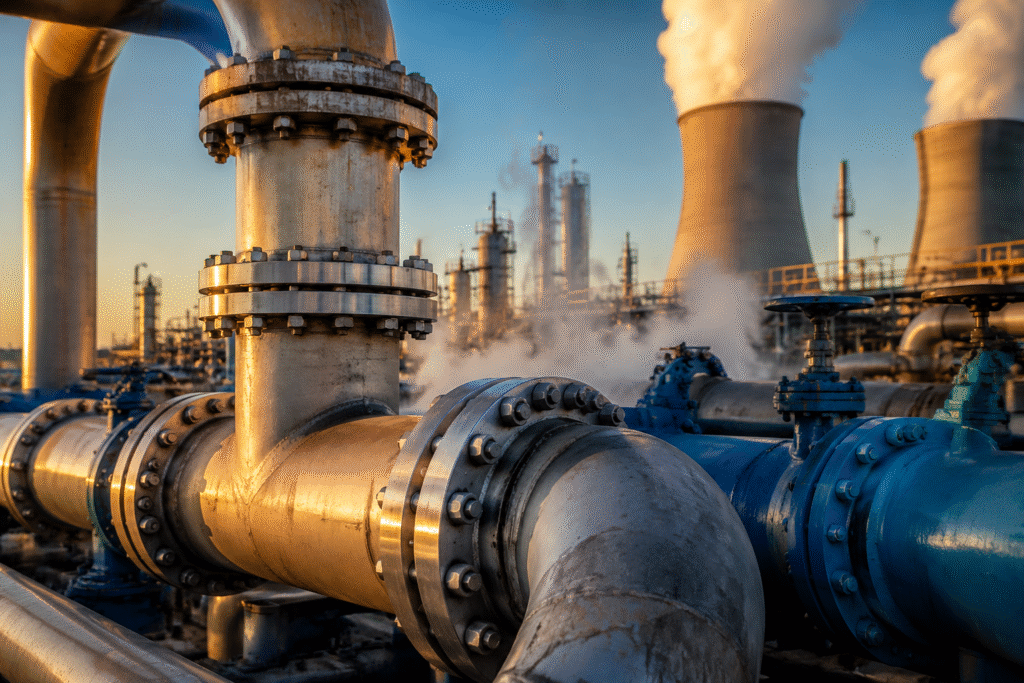
For image planning, the alt text should include the keyphrase Rohrflansch aus Edelstahl. That supports both accessibility and on-page SEO alignment.
Pressure Equipment Directive requirements also affect sourcing for EU-bound projects. PED 2014/68/EU requires conformity assessment for pressure equipment and related assemblies sold into the European market, depending on category and application.
SASA FLANGE hält ISO 9001:2015, PED 2014/68/EU, und AD 2000 Zertifizierungen, which supports projects requiring European compliance pathways. Zusätzlich, customers can request EN 10204 3.1 documentation and project-specific inspection coordination through SASA FLANGE.
Procurement teams should also compare the commercial impact of standards selection:
- ASME systems often dominate refinery, Petrochemie, and power plant EPC packages.
- EN and DIN systems are common in European utility, Marine, and mechanical projects.
- NACE requirements become critical in sour oil and gas service.
- Duplex and super duplex often need stricter PMI and heat traceability controls.
For direct reference, engineers can verify current standards at ASME.org. That step is valuable because revisions, addenda, and project specifications can alter the acceptable dimensional basis.
As Laura Bennett, a senior piping engineer, Staaten: “Dimensional compliance prevents installation issues, but document compliance prevents project claims.” In large EPC work, both are equally important.
Application-Based Selection Guide for Oil, Gas, Chemisch, Leistung, und Meeresprojekte
Application-specific selection creates better outcomes than one-size-fits-all purchasing. The same nominal pipe size can require different flange types, Noten, and facings across industries.
Bei Öl und Gas, the specification often begins with pressure class, saure Servicebedingungen, und Korrosionszuschlagsphilosophie. Laut Statista (2024), Dieser Sektor verbraucht ca 35% von globalen Flanschen, which explains why API-adjacent requirements and stringent traceability often shape market expectations.
Typical oil and gas guidance includes:
- Use weld neck flanges for higher pressure and cyclic loading.
- Rezension NACE MR0175 when H2S exposure is possible.
- Consider 316L, Duplex 2205, oder Super-Duplex 2507 in chloride-rich offshore systems.
- Use RTJ facings for critical high-pressure sealing where specified.
In der petrochemischen und chemischen Verarbeitung, media compatibility drives the decision. Zum Beispiel, 316L works well in many general corrosive environments, während 904L, Hastelloy, or Monel may be needed for stronger acids or mixed chemical streams.
Power generation introduces another set of variables. Hohe Temperatur, Temperaturwechsel, Dampfservice, and shutdown frequency can all affect flange performance and gasket reliability.
For marine and shipbuilding, seawater exposure and splash-zone corrosion often justify duplex selection. According to DNV guidance used widely in marine practice, material resistance and traceability are essential where seawater and cyclic service intersect (DNV, industry guidance).
Water treatment and desalination systems often combine stainless and duplex components across skids, Mannigfaltigkeiten, and pump lines. daher, buyers should check chloride level, Betriebstemperatur, and cleaning chemical exposure before finalizing 304 versus 316L versus duplex.
A practical selection matrix often looks like this:
- Clean water and low chloride utility lines: 304 or 304L slip on or weld neck.
- General chemical and moderate chloride service: 316 oder 316L, usually raised face.
- Offshore and seawater service: 2205 oder 2507, often with stricter PMI requirements.
- High temperature aggressive service: alloy grades such as Inconel or Hastelloy where specified.
- Shutdown isolation and terminal ends: blind flange in matching metallurgy and class.
In addition to standard production, SASA FLANGE supports custom manufacturing for project drawings, Nicht standardmäßige Abmessungen, and mixed piping packages. Portion 50+ Länder in ganz Öl & Gas, Petrochemie, Leistung, und Marineindustrie, the company helps buyers consolidate flange and fitting procurement under one source.
Custom capability matters when projects require special bore, facing modification, drilled pattern changes, or uncommon grades. Außerdem, factory-side CNC machining shortens revision cycles compared with multi-vendor sourcing.
Buyers should request these details during supplier evaluation:
- Size range and pressure class coverage.
- Available grades in forged and plate flange forms.
- PMI, ultrasonic, hydrostatisch, and dimensional inspection options.
- Lead time for standard and made-to-order items.
- Oberflächenbeschaffenheit, Markierung, Verpackung, and export documentation practices.
When these points are clarified early, bid comparisons become more accurate. Infolge, procurement managers can avoid hidden costs from rework, schedule delays, or inspection rejection.
Zukunftsaussichten für Edelstahlflansche und strategische Kaufempfehlungen
The flange market outlook remains positive as infrastructure renewal, Projekte zur Energiewende, and water treatment investment continue. Laut Grand View Research (2024), Es wird erwartet, dass der Markt steigen wird $5.8 Milliarden in 2023 Zu $7.2 Milliarden von 2030.
That growth will likely favor suppliers who combine technical support, broad metallurgy coverage, und Exportkonformität. Im Gegensatz, purely price-driven sourcing may create larger lifecycle costs when traceability or corrosion performance falls short.
Digital procurement is also changing buyer behavior. Engineers increasingly expect faster RFQ turnaround, downloadable documentation, and direct access to dimensional and material support before issuing a purchase order.
According to industry analysts at Mordor Intelligence (2024), project owners are placing more emphasis on reliability, maintenance reduction, and corrosion-resistant materials in long-life assets. daher, stainless and duplex flanges should remain a strategic category rather than a commodity purchase in critical systems.
Recommended actions for B2B buyers include:
- Standardize approved flange types and grades by application.
- Require ASME, ASTM, DIN, or EN dimensional confirmation before release.
- Specify documentation such as MTC, EN 10204 3.1, and PMI where needed.
- Review lifecycle corrosion risk instead of comparing only unit price.
- Qualify suppliers with ISO 9001:2015 and project-relevant certifications.
For teams sourcing a stainless steel pipe flange for global projects, the strongest procurement strategy combines technical clarity with supplier validation. When material expertise, compliance documentation, and machining quality are aligned, buyers gain lower risk and better installation performance.
For current projects involving ASME B16.5, ASME B16.47, or custom stainless flange packages, engineers can streamline evaluation by discussing specifications directly with SASA FLANGE. That approach helps convert design intent into manufacturable, nachvollziehbar, and commercially efficient supply.
Häufig gestellte Fragen
Was sind die Flanschgrößen von Edelstahlrohren??
●Die Größen der Flansche von Edelstahlrohren reichen typischerweise von 1/2 Zoll zu 60 inches under standards such as ASME B16.5 Und ASME B16.47.
●ASME B16.5 deckt im Allgemeinen den NPS ab 1/2 durch NPS 24, während ASME B16.47 deckt Flansche mit großem Durchmesser aus NPS ab 26 durch NPS 60.
●Buyers should confirm whether the project follows ASME, DIN, oder EN 1092 dimensions before ordering because bolt drilling and flange thickness can differ by standard.
What is the typical stainless steel pipe flange price?
●Stainless steel pipe flange price depends heavily on size, Druckklasse, Materialqualität, und Prüfumfang, with duplex and nickel alloys costing significantly more than 304 oder 316L.
●Laut Grand View Research (2024), der globale Markt für Industrieflansche erreicht $5.8 Milliarden in 2023, which reflects strong demand and ongoing raw material sensitivity in industrial supply chains.
●Für eine genaue Budgetierung, buyers should request quotes that include material grade, Standard, gegenüber, Dokumentation, and inspection requirements from established manufacturers like SASA FLANGE.
Was sind die wichtigsten Flanschtypen aus Edelstahl??
●Die wichtigsten Edelstahlflanschtypen sind Vorschweißflansche, reinschlüpfen, blind, Muffenschweißen, mit Gewinde, Überlappungsgelenk, und lange Vorschweißflansche.
●Vorschweißflansche werden für höhere Drücke und zyklischen Betrieb bevorzugt, while slip on flanges are often used in lower pressure lines where fabrication simplicity matters.
●Engineers should choose flange type based on pressure class, Schweißverfahren, Wartungszugang, and process criticality rather than selecting by price alone.
Wie wähle ich zwischen 304, 316L, und Duplex-Edelstahlflansche?
●304 suits general service, 316L performs better in chloride-bearing environments, und Duplex-Sorten wie 2205 offer higher strength and stronger resistance to pitting and stress corrosion cracking.
●Laut Market Research Future (2024), corrosion-resistant alloy demand continues to rise in water treatment and energy projects, which supports greater use of duplex materials in aggressive service.
●For chloride-rich, Off-Shore-, or critical process conditions, buyers should review operating temperature, Medienchemie, and welding requirements with a qualified supplier before selecting the final grade.
Was ist der Unterschied zwischen ASME B16.5 Und ASME B16.47 Flansche?
●ASME B16.5 deckt Rohrflansche und Flanschverbindungen bis NPS ab 24, während ASME B16.47 applies to large diameter steel flanges from NPS 26 zum NPS 60.
●ASME B16.47 also includes Series A and Series B designs, which differ in dimensions, Schraubenmuster, and weight depending on the application.
●Procurement teams should verify the exact standard and series on project drawings because an incorrect dimensional basis can cause field installation failure.
How do I find a reliable flange manufacturer or flange vendor?
●A reliable flange manufacturer should offer standards compliance, rückverfolgbare Materialien, Bearbeitungsgenauigkeit, Inspektionsunterstützung, und Zertifizierungen wie z ISO 9001:2015 or PED 2014/68/EU.
●Laut IBISWorld (2024), Der asiatisch-pazifische Raum produziert mehr als 45% von globalen Flanschen, so supplier qualification is essential when sourcing internationally from high-volume manufacturing regions.
●Für Projekte, die individuelle Größen erfordern, EN 10204 3.1 Unterlagen, and broad grade availability, working with experienced suppliers like SASA FLANGE helps reduce commercial and technical risk.
Verwandte Beiträge
Flanschoberflächenfinish: Konzentrische vs. spiralförmige Verzahnungen erklärt
Konzentrische und spiralförmige Verzahnungen sind beide bearbeitete Flanschflächenoberflächen…
Duplex 2205 vs. 316L-Flansche: Welches Material sollten Sie wählen??
Schnelle Antwort: Duplex 2205 Flansche sind normalerweise der stärkere Kandidat…

Definition des Öffnungsflansches, Details und Übersicht über ASME B16.36-Flansche: Marktdaten, Auswahlhilfe und Compliance-Einblicke
Der globale Markt für Industrieflansche wurde mit bewertet $5.8 Milliarde…

Marktführer für schwarze Entsorgungsflansche: Materialien, 3.5″ Kompatibilität, und B2B-Beschaffungsdaten für Küchenspülenflansche
Die Nachfrage nach schwarzen Entsorgungsflanschen steigt bei Käufern von Küchenarmaturen…