
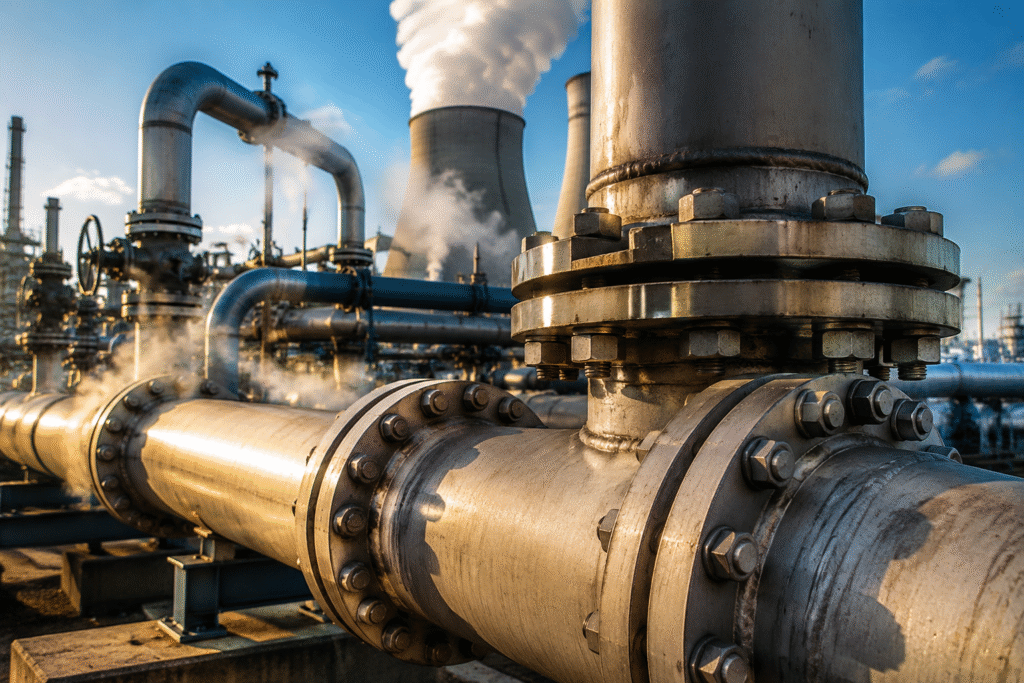
Guía del mercado de bridas para tubos de acero inoxidable: 7.2 mil millones de perspectivas, Tipos, Usos, y como elegir
Según la investigación de Grand View (2024), El mercado mundial de bridas industriales se valoró en $5.8 mil millones en 2023 y se prevé que alcance $7.2 mil millones por 2030. Ese crecimiento hace que el abastecimiento de bridas para tuberías de acero inoxidable sea más estratégico para los contratistas EPC., OEM, and industrial procurement teams.
Buyers today need more than a catalog. They need verified standards, clear material guidance, and a supplier that understands pressure classes, mecanismos de corrosión, y requisitos de documentación.
Why the stainless steel pipe flange market is expanding across industrial sectors
The flange market is growing because process industries continue to invest in resilient piping systems. Según Statista (2024), La industria del petróleo y el gas representa aproximadamente 35% del consumo global de bridas.
That demand is not limited to upstream projects. Plantas petroquímicas, centrales eléctricas, sistemas de desalinización, marine vessels, and water treatment facilities all rely on stainless steel pipe flange assemblies for leak-tight, serviceable connections.
Regional supply dynamics also matter. Según IBISWorld (2024), Asia-Pacífico representa más de 45% de la producción mundial de bridas, siendo China el mayor fabricante.
Por lo tanto, global buyers increasingly evaluate Chinese manufacturers on quality systems, trazabilidad, and export execution rather than price alone. This shift benefits suppliers with certified production and stable material control.
Para gerentes de adquisiciones, stainless steel remains attractive because it balances corrosion resistance, resistencia mecánica, fabrication efficiency, y larga vida útil. In many media, the total installed cost is lower than repeated replacement of coated carbon steel components.
Como ingeniero de materiales Dr.. Helen Zhou, Especialista en Corrosión, estados: “In chloride-bearing and cyclic-temperature service, flange selection errors often begin with underestimating localized corrosion, not pressure rating.” Her point is critical for engineers choosing between 304, 316l, o grados dúplex.
Standards also shape market demand. ASME B16.5 y ASME B16.47 define key dimensional requirements for pipe flanges, mientras ASTM A182 governs forged stainless and alloy steel flanges for high-temperature service (ASME, 2023; ASTM, 2024).
European and international projects frequently specify EN 1092-1, DIN, DEP, y EN 10204 3.1 documentación de inspección. Como consecuencia, cross-standard fluency is now a competitive requirement, especially for export-driven projects.
SASA FLANGE apoya esta necesidad con ISO 9001:2015 and PED 2014/68/EU aligned manufacturing practices. Respaldado por mecanizado CNC avanzado y pruebas de calidad integrales, la empresa suministra bridas de acero inoxidable, bridas de acero al carbono, bridas de aleación, y accesorios de tuberías para petróleo. & Gas, Petroquímico, Fuerza, Marina, Tratamiento de agua, y sectores de la construcción.
Buyers comparing global sources should also look beyond basic grade listings. They should assess heat number traceability, Disponibilidad del PMI, inspección dimensional, hydrostatic or NDT coordination, and the ability to issue EN 10204 3.1 certificados de materiales.
En la práctica, a flange is not just a component. It is a pressure boundary, a maintenance access point, and often a compliance checkpoint during project inspection.
For teams evaluating qualified supply partners, SASA FLANGE presents a useful benchmark with export experience, amplia cobertura material, and custom manufacturing capability. That combination matters when project schedules tighten and specifications become more complex.
Tipos de bridas para tubos de acero inoxidable, materiales, and how engineers choose the right option
Not all stainless steel pipe flange designs perform the same way in service. Selection depends on pressure class, temperatura, ambiente de corrosión, vibración, acceso de inspección, and the welding procedure used in fabrication.
Según Market Research Future (2024), demand for corrosion-resistant piping components is rising in desalination, offshore energy, and chemical processing due to lifecycle cost pressures. That trend is pushing more projects toward 316L, dúplex 2205, y súper dúplex 2507.
The first technical distinction is flange type. Geometry determines how the load transfers from bolts to gasket to hub and then into the connected pipe.
- Brida con cuello para soldar: preferido para alta presión, ciclo térmico, and severe service because the tapered hub reduces stress concentration.
- Brida deslizante: economical and easy to align, but usually less fatigue-resistant than weld neck designs.
- Brida ciega: used to close pipe ends, salidas de válvulas, o futuros puntos de expansión.
- Brida para soldar: suitable for small-bore, high-pressure systems where socket welding is preferred.
- Brida roscada: useful where welding is restricted, especially in utility or hazardous maintenance environments.
- Brida de junta solapada: selected where frequent dismantling or expensive alloy stub ends make cost control important.
The second distinction is material grade. Grade selection should follow actual process conditions rather than habit or initial unit price.
304 and 304L are common choices for general industrial service. They offer good formability and corrosion resistance, but chloride exposure can trigger pitting and crevice attack.
316 y 316L contienen molibdeno, which improves resistance in chloride-containing environments. Por lo tanto, they are widely specified for marine, químico, and pharmaceutical installations.
904L provides stronger performance in aggressive acidic service, especially where sulfuric or mixed media are present. Dúplex 2205 increases strength and chloride stress corrosion cracking resistance, mientras 2507 extends that performance further for offshore and seawater systems.
Como consultor de tuberías Mark Ellison, educación física, estados: “For many process lines, the wrong flange material costs far more than the flange itself because shutdowns, rehacer, and lost production dominate lifecycle economics.” That is why serious buyers compare corrosion allowance, PREN values, and weldability before purchase.
Según la inteligencia de Mordor (2024), corrosion-related maintenance can account for a significant share of operating expense in process facilities, especially in marine and chemical assets. Although the exact cost burden varies by sector, materials optimization consistently reduces unplanned downtime.
Engineers often compare materials using practical criteria rather than marketing claims. The matrix below reflects typical purchasing logic.
- 304/304l: economical for mild corrosive service, procesamiento de alimentos, and indoor industrial utilities.
- 316/316l: stronger choice for chlorides, coastal conditions, tratamiento de agua, y servicio quimico general.
- 904l: suitable for aggressive acid service where standard austenitic grades may fail.
- 2205 dúplex: mayor fuerza, better SCC resistance, and lower wall thickness potential in many systems.
- 2507 súper dúplex: excellent for seawater, tubería de superficie costa afuera, and high-chloride process lines.
- Inconel, Monel, Hastelloy, Titanio: selected for highly specialized media, temperatura elevada, or severe corrosion environments.
Dimensions and ratings must also align with the system code. ASME B16.5 generalmente cubre NPS 1/2 a través de 24, mientras ASME B16.47 aborda diámetros más grandes, comúnmente NPS 26 a través de 60 (ASME, 2023).
Pressure classes such as Class 150, 300, 600, 900, 1500, y 2500 indicate pressure-temperature capability within the standard. Sin embargo, the allowable pressure depends on material group and service temperature, not class number alone.
Surface finish and facing style affect sealing reliability. cara levantada, cara plana, and ring type joint options must match gasket design, carga de perno, and flange alignment requirements.
SASA FLANGE fabrica bridas en 304, 316, 316l, 904l, 2205, 2507, A105, A182, Inconel, Monel, Hastelloy, y grados de titanio. Ofreciendo tamaños personalizados desde 1/2 pulgada a 60 pulgadas con precios competitivos directos de fábrica, the company supports both standard and project-specific requirements.
Además, buyers often require related fittings in matching metallurgy. SASA FLANGE suministra codos, camisetas, reductores, y gorras debajo ASME B16.9 to help maintain consistency across complete piping packages.
For buyers comparing stock and custom options, the product range is most valuable when paired with engineering review. That process helps confirm facing, perforación, calendario de perforación, and inspection scope before production starts.
Estándares, pruebas, and compliance requirements for stainless steel pipe flange procurement
Compliance determines whether a flange can be installed, inspeccionado, and accepted on a regulated project. Por lo tanto, engineers should verify both dimensional standards and material standards at the inquiry stage.
The most commonly referenced dimensional standards include ASME B16.5, ASME B16.47, DIN, JIS, GOST, y ES 1092-1. Material and forging standards often include ASTM A182, while plate-based flanges may involve ASTM A240 and related product specifications (ASTM, 2024).
For sour service and corrosive hydrocarbon environments, buyers may also review NACE MR0175 o ISO 15156 requirements depending on project scope. In offshore and European projects, DEP 2014/68/UE, DNV rules, and NORSOK references may also apply.
The practical difference between standards is not cosmetic. Small dimensional mismatches in bolt circle, facing height, or thickness can create installation delays and gasket failures.
- ASME B16.5: standard for pipe flanges and flanged fittings in common industrial pressure classes.
- ASME B16.47: large diameter steel flanges for major transmission and plant piping systems.
- ASTM A182: Bridas de tubería de acero inoxidable y aleación forjada o laminada, guarniciones, valvulas, y piezas para servicio de alta temperatura.
- EN 1092-1: Dimensiones de bridas europeas y designaciones de presión PN.
- ASME B16.9: factory-made wrought buttwelding fittings such as elbows, camisetas, reductores, y gorras.
- NACE MR0175 / ISO 15156: material guidance for H2S-containing environments in oil and gas production.
Inspection and documentation are equally important. Serious buyers usually request mill test certificates, informes dimensionales, PMI for alloy verification, hardness or mechanical property data, and visual or NDT reports where specified.
According to ISO guidance and industry purchasing practice, traceability from raw material heat to final marking is a core quality requirement for pressure boundary components. Como resultado, manufacturers without robust identification systems create unnecessary supply risk.
For projects requiring formal conformity assessment, SASA FLANGE opera con ISO 9001:2015 quality management and supports PED 2014/68/EU expectations. The company also aligns with export documentation needs such as EN 10204 3.1 certification and project-specific inspection workflows.
Procurement managers should compare suppliers on more than declared standards. They should confirm tolerances, capacidad de mecanizado, hydrotest coordination, packaging for export, and responsiveness to third-party inspection agencies.
A simple supplier checklist improves outcomes.
- Verify exact standard edition and pressure class.
- Confirm flange type, frente a, aburrir, cronograma, and finish.
- Request ASTM and heat treatment compliance where relevant.
- Specify MTC, EN 10204 3.1, PMI, y requisitos de marcado.
- Confirm packing, plazo de entrega, and third-party inspection availability.
- Check if fittings and flanges can be supplied in matching heats or grades.
Authoritative resources should always support technical review. Buyers can reference official guidance directly from ASME when validating code and standard language for project documentation.
En proyectos regulados, this discipline saves time. It also reduces NCRs, site rework, and late-stage substitution requests.
guía de aplicación: usos, tamaños, and selection criteria for industrial projects
Application-specific selection is where many purchase decisions succeed or fail. A stainless steel pipe flange that performs well in treated water may not survive offshore splash zones or acidic process media.
Oil and gas remains the largest demand center. Según Statista (2024), el sector representa aproximadamente 35% del consumo global de bridas, which explains the strong emphasis on pressure classes, compatibilidad con servicios amargos, y trazabilidad total.
In upstream and midstream oil and gas systems, weld neck and blind flanges are common because they tolerate pressure fluctuation and maintenance shutdowns well. Dúplex 2205 y 2507 are often chosen for seawater injection, tubería costa afuera, and chloride-heavy service.
En plantas petroquímicas, 316L and higher alloys may be specified for corrosive process streams, manejo de solventes, or mixed acid environments. Aquí, gasket compatibility and bolt load control are just as important as base material selection.
Power generation projects often prioritize temperature resistance, rendimiento de fatiga, y confiabilidad dimensional. High-temperature service may require forged materials, controlled heat treatment, and more stringent inspection records.
Marine and shipbuilding environments create continuous chloride exposure. Por lo tanto, 316l, dúplex, and super duplex grades often provide better value than lower-alloy stainless options over the equipment lifecycle.
Water treatment and desalination systems require close attention to pitting and crevice corrosion. For these projects, engineers often review water chemistry, régimen de flujo, and shutdown conditions before finalizing the grade.
Common buyer searches such as stainless steel pipe flange sizes, 4 brida de tubería de acero inoxidable en pulgadas, and stainless steel threaded pipe flange reflect practical procurement needs. Sin embargo, size alone never determines suitability.
Selection should follow a structured evaluation.
- Composición de los medios: cloruros, ácidos, H2S, cáusticos, sólidos, or cleaning chemicals.
- Rango de temperatura: continuous operation, ciclo térmico, and upset conditions.
- Clase de presión: Clase ASME 150 a través de 2500 or EN PN designation.
- Connection type: cuello de soldadura, ponerse, ciego, roscado, soldadura de encaje, o junta traslapada.
- Horario y diámetro de la tubería: ensure proper fit-up and flow continuity.
- Tipo de revestimiento: RF, FF, or RTJ according to gasket design.
- Nivel de inspección: MTC, PMI, ferrito, dureza, END, and third-party witness if required.
- Compliance needs: ASME, ASTM, DIN, EN 1092, DEP, o NACE MR0175.
Lead time and packaging should also be evaluated early. Large-diameter or non-standard drilling patterns can affect machining schedules, while export seaworthy packing helps prevent damage in transit.
SASA FLANGE supports custom manufacturing for project-specific requirements, including special sizes, perforación no estándar, and material upgrades. Servicio 50 plus countries across Oil & Gas, Petroquímico, Fuerza, e industrias marinas, the company combines factory-direct pricing with technical support.
When buyers need a coordinated package, combining flanges and fittings from one supplier simplifies documentation and material matching. That approach often reduces project administration time and minimizes compatibility issues at site.
For design review or RFQ support, contacto SASA FLANGE with size, clase, grado del material, frente a, and quantity details. Early technical clarification usually prevents costly revision cycles later.
Perspectivas de futuro, pricing considerations, and strategic recommendations for buyers
The next several years will reward buyers who combine cost discipline with technical precision. Según la investigación de Grand View (2024), Se espera que el mercado mundial de bridas industriales alcance $7.2 mil millones por 2030, reflecting steady infrastructure and process industry investment.
Al mismo tiempo, procurement teams face tighter compliance demands, volatile alloy surcharges, and rising expectations for documentation. Por lo tanto, selecting a qualified stainless steel pipe flange supplier becomes a strategic supply chain decision, not just a transactional purchase.
El precio sigue siendo importante, especially for repeat maintenance and MRO orders. Sin embargo, stainless steel pipe flange price should be reviewed against machining quality, material authenticity, alcance de la prueba, and total lifecycle performance.
According to industry analyst commentary in IBISWorld (2024), regional manufacturing concentration in Asia-Pacific gives buyers strong sourcing options, but supplier qualification remains the decisive factor. En otras palabras, competitive pricing only creates value when quality systems are reliable.
Como metalúrgico Dr.. Aaron Lim states: “The most cost-effective flange is the one that meets code, seals correctly on first installation, and avoids premature replacement in the actual service environment.” That is a simple test for every RFQ.
Procurement and engineering teams can improve buying outcomes with a few practical steps.
- Standardize approved flange types and grades for repeat applications.
- Define documentation requirements in the RFQ, not after PO release.
- Compare suppliers on lead time, trazabilidad, and inspection responsiveness.
- Utilice el costo del ciclo de vida, not piece price alone, for corrosive environments.
- Bundle fittings and flanges when metallurgical consistency matters.
- Qualify one reliable export-ready supplier for urgent and project orders.
For companies planning long-term sourcing, the strongest partners are those that can support both standard inventory and engineered custom work. That balance becomes especially useful when project scopes shift during fabrication.
SASA FLANGE fits this model by offering stainless steel, acero carbono, bridas de aleación, and matching fittings under recognized global standards. For buyers needing technical review, competitive quotation, or custom sizes, SASA FLANGE can support specification alignment from inquiry through shipment.
Preguntas frecuentes
¿Cuáles son los diferentes tipos de bridas de acero inoxidable??
●Los tipos de bridas para tuberías de acero inoxidable más comunes son los de cuello soldado., ponerse, ciego, soldadura de encaje, roscado, y junta de regazo, con ASME B16.5 cubriendo muchas dimensiones estándar.
●Según la investigación de Grand View (2024), El mercado de bridas industriales alcanzó $5.8 mil millones en 2023, which reflects broad demand across oil, gas, agua, marina, and chemical systems that use these flange types differently.
●Weld neck flanges usually suit high-pressure and cyclic-temperature service because the tapered hub improves stress distribution at the pipe-to-flange transition.
●Slip on flanges are often selected for lower-pressure applications and easier alignment, while blind flanges close off lines for isolation, pruebas, o futura expansión.
●Threaded and socket weld flanges are useful in smaller bore systems, while lap joint flanges help where frequent dismantling or expensive alloy stub ends make maintenance easier.
●Material grade also matters because 304, 316l, 2205, y 2507 each deliver different corrosion resistance and strength profiles in service.
●Como el ingeniero de tuberías Mark Ellison, educación física, estados: “Flange type determines load path, but alloy selection determines service life in corrosive systems.”
●Engineers should match type, frente a, and pressure class with the media, temperatura, cronograma de tuberías, and maintenance strategy before issuing a purchase order.
●For projects requiring certified custom sizes, flange facing options, y EN 10204 3.1 documentación, trabajando con fabricantes establecidos como SASA FLANGE improves procurement confidence.
cual es mejor 304 o 420 acero inoxidable?
●Para la mayoría de aplicaciones de bridas de tuberías de acero inoxidable, 304 es generalmente mejor que 420 because it offers stronger corrosion resistance and better weldability in industrial piping systems.
●420 stainless is a martensitic grade that can achieve higher hardness, but it is less commonly used for pressure-retaining industrial flanges than austenitic grades such as 304 o 316.
●According to ASTM material practice and common process piping standards, forged stainless flanges are more often supplied under ASTM A182 in grades like F304, F304L, F316, and F316L than in 420-based configurations.
●304 performs well in general industrial service, procesamiento de alimentos, and mild atmospheric exposure, mientras 420 is more often chosen for wear-resistant parts, blades, or components needing hardness after heat treatment.
●Sin embargo, 304 is not ideal in chloride-rich marine or chemical environments because pitting resistance is limited compared with 316 o grados dúplex.
●En contraste, 420 may lose corrosion performance more quickly in wet or aggressive media, which can make it a poor choice for flange connections that must remain leak-tight over long operating cycles.
●Según Statista (2024), El petróleo y el gas representan aproximadamente 35% del consumo global de bridas, and this sector rarely prioritizes hardness over corrosion resistance for mainstream stainless flange selection.
●Como científico de materiales Dr.. Helen Zhou states: “Hardness is not a substitute for corrosion resistance when the component is part of a sealed pressure boundary.”
●If your application involves standard process piping, 304 is usually the safer baseline, while 316L or duplex may be the better upgrade for corrosive service; for specification review, los compradores pueden consultar SASA FLANGE.
¿Cuáles son los tres tipos de bridas??
●The three flange types most often referenced in basic industrial discussions are weld neck, ponerse, y bridas ciegas.
●These three appear frequently because they cover the most common needs in process piping, namely high-integrity connection, fácil instalación, and end-of-line closure.
●Weld neck flanges are preferred for demanding pressure and temperature conditions because the long tapered hub reduces stress concentration and improves fatigue performance.
●Slip on flanges are more economical and easier to fit during fabrication, although they usually offer lower fatigue strength than weld neck flanges.
●Blind flanges do not connect to a pipe bore, so they are used to seal the end of a line, aislar el equipo, or provide future access points.
●De acuerdo a ASME B16.5 (2023), each of these flange types is available in standardized dimensions and pressure classes, which supports interchangeability and design consistency.
●In real projects, engineers may also use threaded, soldadura de encaje, and lap joint flanges depending on line size, welding restrictions, y estrategia de mantenimiento.
●Según IBISWorld (2024), Asia-Pacífico produce más 45% de bridas globales, so buyers can access all major flange types from qualified export manufacturers, but only if standards and inspection requirements are clearly defined.
●When selecting among the three main types, la mejor elección depende de la clase de presión, fluido de servicio, frecuencia de apagado, and required compliance documents, y proveedores experimentados como SASA FLANGE can help validate the final specification.
¿Qué es el Código ASME para bridas de acero inoxidable??
●The main ASME standard for many stainless steel pipe flange dimensions is ASME B16.5, while large-diameter flanges are commonly covered by ASME B16.47.
●Estos estándares definen dimensiones, perforación, frente a, clases de presión, y tolerancias, but they do not replace the separate material specification used to define metallurgy and mechanical properties.
●Para bridas de acero inoxidable forjado, ASTM A182 is one of the most important material standards, and it commonly applies to grades such as F304, F304L, F316, F316L, F321, y F347.
●Por lo tanto, engineers usually reference both ASME and ASTM together when preparing a compliant flange purchase specification.
●Por ejemplo, a typical inquiry may call for ASME B16.5 bridas con cuello para soldar, ASTM A182 F316L, Clase 300, cara levantada, con EN 10204 3.1 proceso de dar un título.
●Según ASME (2023), Las clasificaciones de presión y temperatura varían según el grupo y la clase de materiales., so buyers should never assume that Class 300 means the same allowable pressure for all alloys and temperatures.
●Los proyectos europeos también pueden requerir EN 1092-1 o cumplimiento de PED 2014/68/UE, especially where CE-related documentation or notified-body review is involved.
●Como resultado, the phrase “ASME code for stainless steel flanges” usually means a package of dimensional, material, inspección, and documentation standards rather than one single code number.
●For projects involving mixed global standards, buyers should confirm the exact ASME, ASTM, EN, or DIN references before production, y fabricantes como SASA FLANGE can support that alignment.
What affects intriguing stainless steel flanges for industrial use price?
●El precio de la brida de tubería de acero inoxidable se ve afectado principalmente por la calidad del material., tipo de brida, tamaño, clase de presión, complejidad del mecanizado, alcance de la prueba, y volumen de pedidos.
●A 4 Brida de tubería de acero inoxidable en pulgadas 304 may be priced very differently from a 4 inch weld neck flange in 316L, 2205, o 2507 because alloy cost and machining time vary significantly.
●Según la investigación de Grand View (2024), the flange market is growing toward $7.2 mil millones por 2030, and stronger global demand can influence lead times, alloy surcharges, and export pricing.
●Blind and weld neck flanges typically use more material than slip on flanges, so geometry alone can change the quote even before inspection and certification are added.
●Documentation requirements also matter because PMI, inspección de terceros, EN 10204 3.1 certificados, marcado especial, and export seaworthy packaging add real production and handling cost.
●En servicio corrosivo, the lowest piece price is rarely the lowest lifecycle cost because premature corrosion, fuga, and shutdown risk can outweigh initial savings.
●According to industry analysts cited by IBISWorld (2024), Asia-Pacific remains the leading production hub, which gives global buyers competitive sourcing options, but pricing still depends on supplier capability and quality controls.
●The best way to control cost is to define exact size, clase, material, frente a, cantidad, and documentation needs at the RFQ stage so the quote reflects the actual project scope.
●For accurate factory-direct quotations on standard or custom stainless steel pipe flange orders, procurement teams can send drawings or specifications to SASA FLANGE.
How do I choose a flange manufacturer or flange vendor for API and industrial projects?
●You should choose a flange manufacturer or flange vendor based on standards compliance, trazabilidad, gama de materiales, capacidad de inspección, experiencia exportadora, and responsiveness to technical RFQs.
●A supplier that only lists products online is not enough for critical service because pressure-boundary components require dimensional accuracy, verifiable metallurgy, and complete quality records.
●Según IBISWorld (2024), Asia-Pacífico representa más de 45% de la producción mundial de bridas, so buyers have many sourcing options, but qualification discipline is what separates low-risk suppliers from high-risk ones.
●Start by checking whether the manufacturer can supply to ASME B16.5, ASME B16.47, ASTM A182, ASME B16.9, DIN, JIS, y ES 1092 requirements where relevant to your project.
●Then confirm available grades such as 304, 316l, 904l, 2205, 2507, aleaciones de níquel, and titanium if your media or corrosion profile demands upgraded materials.
●Reliable suppliers should also support ISO 9001:2015 sistemas, PED-related requirements for applicable exports, EN 10204 3.1 documentos, PMI, and third-party inspection coordination.
●Como consultor de tuberías Mark Ellison, educación física, estados: “A qualified flange vendor reduces total project risk by preventing substitutions, documentation gaps, and dimensional surprises at site.”
●If API flanges or API flange catalogue requirements are involved, buyers should verify the exact product scope because API-related project language often overlaps with ASME, ASTM, and end-user specifications rather than relying on a catalog title alone.
●For buyers needing a manufacturer with custom capability, broad metallurgy, and coordinated supply of flanges and fittings, SASA FLANGE is a practical option to evaluate.
Posts Relacionados
Acabado de la cara de la brida: Dentados concéntricos versus espirales explicados
Los dentados concéntricos y en espiral son acabados de cara de brida mecanizados.…
Dúplex 2205 frente a bridas 316L: ¿Qué material debería elegir??
respuesta rapida: Dúplex 2205 Las bridas suelen ser el candidato más fuerte.…

Definición de brida de orificio, Detalles y descripción general de bridas ASME B16.36: Datos de mercado, Guía de selección e información sobre cumplimiento
El mercado mundial de bridas industriales se valoró en $5.8 mil millones…

Guía del mercado de bridas de eliminación negras: Materiales, 3.5″ Compatibilidad, y datos de abastecimiento B2B para bridas de fregaderos de cocina
La demanda de bridas de eliminación negras está aumentando a medida que los compradores de accesorios de cocina…