
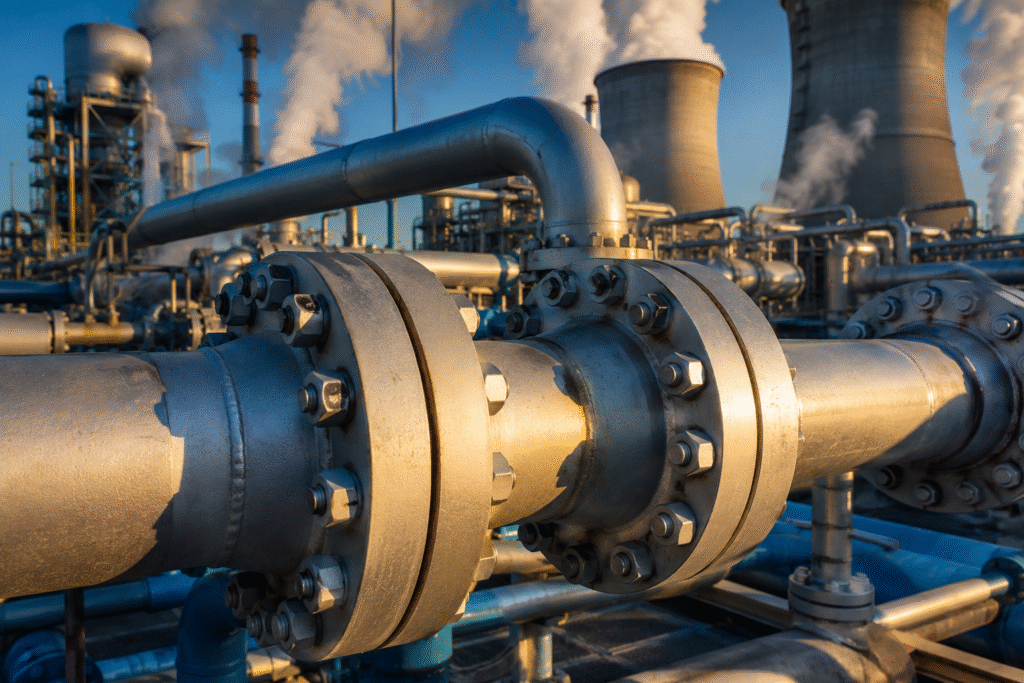
Panduan Pengadaan Global untuk Flensa Pipa Stainless Steel
Menurut Penelitian Grand View (2024), pasar flensa industri global dihargai $5.8 miliar masuk 2023 dan diperkirakan akan tercapai $7.2 miliar oleh 2030. Pertumbuhan itu menjadikan flensa pipa baja tahan karat komponen strategis bagi para insinyur dan pembeli yang membutuhkan ketahanan terhadap korosi, ketertelusuran, and long service life in critical piping systems.
Untuk tim pengadaan, the most intriguing question is not only which stainless, baja, and flange grade to buy. It is how to uncover the hidden advantages, jenis, kegunaan, and selection factors that help choose the most common flanges for oil and gas, petrokimia, kekuatan, laut, dan proyek pengolahan air.
Global Market Demand Is Reshaping Stainless Steel Pipe Flange Sourcing
The industrial piping supply chain remains highly active across energy and infrastructure sectors. Menurut IBISWorld (2024), Asia-Pasifik menyumbang lebih dari itu 45% produksi flensa global, dengan Tiongkok sebagai produsen terbesar.
That concentration matters for project planning because manufacturing scale affects lead time, cost stability, dan ketersediaan bahan baku. Sebagai akibat, buyers increasingly evaluate suppliers on machining capacity, metallurgy expertise, and documentation control rather than price alone.
End-use demand also explains why stainless steel pipe flange products receive sustained attention. Menurut Statista (2024), industri minyak dan gas menyumbang sekitar 35% konsumsi flensa global.
Namun, demand is no longer limited to upstream plants. Pengolahan air, sistem kelautan, pengolahan makanan, and power generation continue to adopt stainless flanges because they resist corrosion better than many carbon steel options in wet or chemically aggressive environments.
Menurut Intelijen Mordor (2024), industrial stainless steel demand is rising steadily in desalination and chemical processing applications due to lifecycle cost advantages. Karena itu, many EPC contractors now prioritize total cost of ownership over initial purchase price.
Secara praktis, that means a lower maintenance frequency, lebih sedikit penutupan, and stronger reliability under cyclic temperature and pressure conditions. For flange assemblies, gasket performance and bolting integrity also improve when the mating materials suit the operating media.
Standards remain central to buying decisions. ASME B16.5 mencakup flensa pipa dan fitting flensa dari NPS 1/2 melalui NPS 24, ketika ASME B16.47 extends dimensional requirements for larger diameters (ASME, 2023).
Material compliance is equally important. ASTM A182 commonly governs forged stainless steel flanges, sementara DI 1092 and DIN flange systems remain widely specified across European and export projects (ASTM, 2023; EN, 2022).
Di sinilah kemampuan pemasok menjadi relevan secara komersial. SASA FLANGE memproduksi flensa dan fitting di 304, 316, 316L, 904L, 2205, 2507, nilai A182, and other premium alloys for industrial service.
Dengan ISO 9001:2015 dan sertifikasi PED 2014/68/EU, the company supports projects that require dimensional accuracy, ketertelusuran material, dan dokumentasi siap ekspor. Lebih-lebih lagi, its production range covers stainless steel flanges, flensa baja karbon, flensa paduan, siku, kaos, reduksi, dan penutup untuk paket perpipaan terintegrasi.
Menurut Riset Pasar Masa Depan (2024), infrastructure modernization and process-industry expansion are expected to sustain flange demand growth above 3% annually through the decade. Karena itu, long-term sourcing strategies should include qualified manufacturers that can support both standard and custom flange dimensions.
For buyers comparing vendors, the real issue is not simply who offers flanges for sale. It is who can deliver the right stainless steel pipe flange standard, menghadap, kelas tekanan, and inspection documents on time for project-critical installation windows.
Jenis Flange Pipa Stainless Steel, Bahan, and Hidden Advantages in Industrial Service
The phrase stainless steel pipe flange covers a wide range of designs. Ini termasuk leher las, mengenakan, buta, las soket, berulir, sambungan pangkuan, and ring type joint configurations, each suited to different loads, suhu, dan praktik pemeliharaan.
Seperti John Breen, Insinyur Perpipaan Senior, negara bagian: “Flange selection fails when teams focus only on price and ignore fatigue loading, tunjangan korosi, and bolt load retention.” That point is especially relevant in plants where vibration, siklus termal, or chloride exposure accelerate failure mechanisms.
Menurut panduan ASME, weld neck flanges are preferred for severe service because the tapered hub improves stress distribution (ASME, 2023). Sebaliknya, slip on flanges often support lower-pressure systems where simpler alignment and lower fabrication cost are priorities.
Material grade has equal importance. 304 and 304L remain the most common stainless options for general service, ketika 316 and 316L provide better resistance in chloride-bearing environments because of molybdenum content.
According to ASTM material data and common industry practice, low-carbon grades such as 304L and 316L reduce sensitization risk after welding. Karena itu, they are widely used in fabricated spool systems, garis higienis, and field-welded process piping.
Untuk media yang agresif, pembeli dapat mempertimbangkan 904L, rangkap 2205, atau super dupleks 2507. These grades improve pitting resistance, ketahanan retak korosi tegangan, and strength-to-weight performance in seawater, layanan asam, and offshore applications.
- 304/304Flensa pipa baja tahan karat L: Hemat biaya, serbaguna, and widely used in water, makanan, dan sistem industri umum.
- 316/316Flensa pipa baja tahan karat L: Better chloride and chemical resistance for marine, kimia, dan jalur farmasi.
- 904L mengarah: Suitable for highly corrosive acids and demanding chemical process duty.
- 2205 flensa dupleks: Higher strength and improved chloride resistance compared with standard austenitic grades.
- 2507 flensa super dupleks: Used in offshore, desalinasi, and severe corrosion environments.
According to NACE and industry corrosion studies, chloride stress corrosion cracking remains a key risk in warm saline service (NACE, 2023). Sebagai akibat, material upgrades often deliver measurable savings by reducing leaks, siklus penggantian, dan waktu henti yang tidak direncanakan.
Sebagai Dr. Lena Hoffmann, Ilmuwan Material, negara bagian: “The hidden advantages of duplex and super duplex flanges are not only corrosion resistance but also higher mechanical strength, which can reduce wall thickness and weight.” That insight matters in marine skids and offshore modules where weight reduction supports broader design efficiency.
Facing type also affects performance. Raised face flanges remain the most common in ASME B16.5 sistem, while ring type joint faces are preferred in high-pressure and high-temperature service where tighter sealing is required.
Buyers should also review pressure class and pipe schedule compatibility. A flange rated Class 150, 300, 600, or higher must align with system design pressure, pemilihan paking, lari, and actual operating temperature.
- Most common flange types: leher las, mengenakan, buta.
- Most common ASME pressure classes: 150, 300, 600, 900, 1500, 2500.
- Common stainless standards: ASTM A182 F304/F304L, F316/F316L, F51, F53.
- Common sizes: 1/2 inci ke 24 inci di bawah ASME B16.5, with larger sizes under B16.47.
According to ISO and PED requirements, documentation and traceability are increasingly critical for pressure equipment exports (ISO, 2023; PED, 2014/68/UE). Karena itu, many B2B buyers now request EN 10204 3.1 sertifikat materi, pengujian PMI, and dimensional inspection reports as standard deliverables.
SASA FLANGE supports these requirements with advanced CNC machining, forged and machined flange production, dan pengujian kualitas yang komprehensif. Backed by ISO 9001:2015, PED 2014/68/UE, dan IKLAN 2000 kredensial, the company supplies custom sizes from 1/2 inci ke 60 inch across stainless, paduan, and duplex grades.
For projects comparing intriguing material options, the right guide should explain more than generic uses. It should help engineers choose the most common flanges based on corrosion mechanism, kelas tekanan, metode pengelasan, akses pemeliharaan, and lifetime cost.
ASME, ASTM, DIN, dan Persyaratan Kepatuhan EN untuk Pengadaan Flange Pipa Stainless Steel
Industrial buyers rarely approve a flange order on dimensions alone. They review standard compliance, raw material origin, ruang lingkup pengujian, peringkat tekanan-suhu, and required inspection documents before issuing purchase orders.
For ASME projects, B16.5 and B16.47 define key dimensions, pengeboran, ketebalan, and tolerances for flanges. Sementara itu, ASTM A182 mendefinisikan flensa pipa baja tahan karat dan paduan tempa atau canai, perlengkapan palsu, dan katup untuk layanan suhu tinggi (ASTM, 2023).
European and export projects may specify EN 1092-1 or DIN flange systems instead of ASME dimensions. Sebaliknya, mixed-specification projects require extra control because bolt patterns, peringkat tekanan, and facing details may not interchange directly.
The practical result is clear. A stainless steel pipe flange that appears similar on paper can become unusable if the standard, tipe wajah, or drilling pattern does not match the connected equipment.
- ASME B16.5: NPC 1/2 ke 24 flensa dan alat kelengkapan bergelang.
- ASME B16.47: Flensa baja berdiameter besar.
- ASTM A182: Forged stainless and alloy steel flange material specification.
- ASME B16.9: Perlengkapan las pantat tempa buatan pabrik.
- EN 1092-1: Dimensi flensa Eropa dan sebutan tekanan.
- DIN/JIS/GOST: Regional flange systems for specific project requirements.
Pressure equipment compliance adds another layer. PED 2014/68/EU applies to many products entering the European market, and supporting documents often include material traceability, pemeriksaan dimensi, and test records.
Corrosion-sensitive sectors may also request NACE MR0175 atau ISO 15156 alignment for sour service materials. Karena itu, procurement teams should verify whether the flange material, perlakuan panas, and hardness limits match the service environment before approval.
The table below summarizes common procurement checkpoints for engineers and buyers.
- Verifikasi materi: kelas ASTM, nomor panas, PMI, Dan EN 10204 3.1 sertifikat.
- Kepatuhan dimensi: ASME, DIN, EN, or JIS standard confirmation.
- Sifat mekanik: Kekuatan tarik, kekuatan hasil, kekerasan, and impact test if required.
- Kelas tekanan: Kelas 150 ke 2500 or PN rating verification.
- Facing inspection: Federasi Rusia, FF, RTJ, lidah dan alur, or male and female details.
- Surface and NDT: Visual, PT, UT, or additional project-specific testing.
Menurut panduan DNV untuk komponen kelautan dan lepas pantai, documentation quality is a major part of supplier qualification (DNV, 2023). Sebagai akibat, manufacturers with controlled quality systems are better positioned for approved vendor lists and international EPC frameworks.
SASA FLANGE integrates these compliance expectations into production and export workflows. Flensa manufaktur masuk 304, 316, 904L, 2205, 2507 dan nilai premium lainnya, perusahaan mendukung inspeksi dimensi, sertifikat materi, and project documentation for global buyers.
Untuk referensi teknis, buyers can also review published standards directly through ASME. That step helps engineering teams validate rating tables, ukuran, and scope before issuing final data sheets.
In competitive sourcing, compliance is often the difference between a usable component and a costly delay. Karena itu, standard alignment should be confirmed before pricing comparisons begin.
Panduan Aplikasi: Cara Memilih Solusi Flange Pipa Stainless Steel untuk Oli, Gas, Kekuatan, Laut, dan Sistem Air
Application context drives proper flange selection. A 4 inch stainless steel pipe flange in a clean water line may work well in 304L, while the same nominal size in offshore splash zones may require 316L, rangkap 2205, or even super duplex 2507.
Oil and gas projects often prioritize pressure integrity, kesesuaian layanan asam, and resistance to chlorides and H2S-related damage. Karena itu, weld neck and RTJ flanges frequently appear in upstream, tengah sungai, and refinery units.
Menurut Statista (2024), minyak dan gas mewakili tentang 35% konsumsi flensa global. That share explains why buyers in this sector pay close attention to ASTM grades, Dimensi ASME, and NACE-related material considerations.
Chemical and petrochemical plants face another challenge. Corrosion can vary greatly based on acid concentration, suhu, kadar klorida, and cleaning cycle frequency.
Dalam kasus tersebut, material selection should not rely on generic stainless assumptions. Engineers should compare actual media compatibility against 304, 316L, 904L, and higher-alloy alternatives before finalizing the bill of materials.
Power generation systems often involve elevated temperatures, siklus termal, and strict maintenance windows. Sebagai akibat, penyelesaian muka flensa, pramuat baut, and gasket compatibility become just as important as basic flange type.
Marine and shipbuilding applications add salinity, kelembaban, and galvanic corrosion concerns. Karena itu, flange selection should consider duplex materials, external coating interfaces, and drainage or maintenance access where crevice corrosion may develop.
- Untuk minyak dan gas: Consider weld neck or RTJ flanges, ulasan NACE, dan Kelas 600+ ratings where required.
- Untuk pemrosesan kimia: Prioritize media compatibility, low-carbon grades, and documented corrosion performance.
- Untuk pembangkit listrik: Match temperature rating, beban baut, and gasket design to operating cycles.
- For marine systems: Evaluate chloride resistance, crevice corrosion risk, dan opsi dupleks.
- Untuk pengolahan air: Seimbangkan ketahanan terhadap korosi, anggaran, dan interval pemeliharaan.
Selection also depends on connection method. Stainless steel threaded pipe flange designs are useful where welding is impractical, while slip on flanges can reduce fabrication complexity in lower-pressure systems.
Blind flanges serve a different use. They terminate or isolate piping sections, and they are common in maintenance planning because they allow future expansion or inspection access.
Harga tetap penting, but it should be interpreted correctly. Stainless steel pipe flange price varies with raw material grade, ukuran, kesesuaian jadwal, kelas tekanan, kompleksitas pemesinan, dan ruang lingkup sertifikasi.
According to procurement benchmarks cited by industry analysts, documentation-heavy export orders can cost more initially but reduce rejection risk and project delay exposure. Karena itu, the apparent cheapest flange vendor may not deliver the best landed cost.
Buyers should evaluate these commercial and technical points together.
- Standar yang diperlukan: ASME B16.5, B16.47, DIN, EN 1092, atau JIS.
- Kelas materi: 304/304L, 316/316L, 904L, 2205, 2507, atau paduan nikel.
- Kisaran ukuran: from small bore to large diameter, including custom drilling.
- Peringkat tekanan: Kelas 150 ke 2500 or project-specific PN values.
- Sertifikasi: ISO 9001:2015, PED, IKLAN 2000, EN 10204 3.1.
- Inspeksi: PMI, UT, PT, hydro test support, dan laporan dimensi.
- Waktu memimpin: saham, made-to-order, or project lot manufacturing.
SASA FLANGE offers custom manufacturing for stainless steel flanges and pipe fittings across oil and gas, petrokimia, kekuatan, pembuatan kapal, dan sektor pengolahan air. Porsi 50+ negara, the company supports factory-direct sourcing with forged, dikerjakan dengan mesin, and inspection-ready products for project and distributor buyers.
For engineering teams that need stainless steel flanges and fittings in one package, integrated sourcing can improve coordination. Siku, kaos, reduksi, dan topi diproduksi untuk ASME B16.9 standards help maintain consistency across the piping system.
Future Outlook for Stainless Steel Pipe Flange Demand and Strategic Buying Recommendations
Prospek pasar tetap positif. Menurut Penelitian Grand View (2024), pasar flensa industri diperkirakan akan tumbuh $5.8 miliar masuk 2023 ke $7.2 miliar oleh 2030.
That growth will likely favor suppliers with stronger quality systems, broader material portfolios, and better export documentation. Lebih-lebih lagi, buyers will continue shifting toward lifecycle-based sourcing rather than lowest-price purchasing.
Menurut IBISWorld (2024), Asia-Pasifik sudah mewakili lebih dari 45% produksi flensa global. Karena itu, qualification of Chinese manufacturers will remain a key procurement activity for EPC firms, distributor, and OEMs.
Digital sourcing will also influence the market. Buyers increasingly compare flange manufacturers by certificate availability, technical response speed, and custom machining capability before requesting formal quotations.
Seperti Mark Ellison, Analis Pasar Industri, negara bagian: “In industrial components, trust is built when suppliers answer technical questions with standards, data pemeriksaan, and realistic lead times.” That is particularly true for stainless steel pipe flange projects where deviations can affect plant safety and schedule performance.
Secara strategis, procurement teams should take four actions. Pertama, standardize approved materials by service environment. Kedua, qualify suppliers on compliance and documentation. Ketiga, compare total installed cost instead of unit price. Keempat, lock in technical reviews early for custom or mixed-standard projects.
Bagi banyak pembeli, the most intriguing hidden advantage is simplicity. When flange type, nilai, sertifikasi, and fitting package come from a capable manufacturer, coordination risk falls and project execution improves.
For current RFQs involving 304, 316L, rangkap, or custom stainless steel pipe flange requirements, engineers and sourcing managers can review options through SASA FLANGE. Dengan mesin CNC canggih dan pengujian kualitas yang komprehensif, the company supports specification-driven supply for demanding industrial service.
Pertanyaan yang Sering Diajukan
Untuk apa flensa baja tahan karat??
●Flensa baja tahan karat digunakan untuk menyambung pipa, katup, pompa, dan peralatan dalam sistem yang membutuhkan kekuatan, ketahanan terhadap korosi, dan kemudahan servis.
●Menurut Statista (2024), industri minyak dan gas menyumbang sekitar 35% konsumsi flensa global, which shows how critical flanged joints are in process piping.
●Mereka banyak digunakan dalam minyak dan gas, petrokimia, laut, pengolahan air, pengolahan makanan, and power generation because they allow easier inspection and maintenance than permanent welded closures.
●Common uses include line connection, equipment nozzle attachment, end closure with blind flanges, and transition points between piping sections with different maintenance needs.
●Dalam praktiknya, engineers select a stainless steel pipe flange when corrosion resistance, kebersihan, or lifecycle cost is more important than the lower initial cost of carbon steel.
Apakah mereka membuat alat kelengkapan pipa stainless steel?
●Ya, produsen memproduksi alat kelengkapan pipa stainless steel seperti siku, kaos, reduksi, and caps for pressure piping systems.
●ASME B16.9 is the most common dimensional standard for factory-made wrought butt welding fittings in industrial piping systems (ASME, 2023).
●These fittings are available in grades such as 304, 304L, 316, 316L, 904L, 2205, Dan 2507 to match corrosion, kekuatan, and fabrication requirements.
●Using compatible fittings and flanges in the same grade helps reduce galvanic mismatch, simplifies welding procedure qualification, and improves traceability across the piping package.
●For projects requiring stainless steel flanges and fittings under one source, bekerja dengan produsen mapan seperti SASA FLANGE supports consistent quality documents and dimensional control.
Flensa apa yang terbuat dari baja tahan karat?
●Many flange types are made of stainless steel, termasuk leher las, mengenakan, buta, las soket, berulir, dan desain sambungan pangkuan.
●Menurut ASME B16.5 (2023), these flanges cover common dimensional requirements from NPS 1/2 melalui NPS 24 for many industrial systems.
●They are commonly manufactured in ASTM A182 F304/F304L, F316/F316L, rangkap 2205, super dupleks 2507, and higher-alloy stainless grades for severe service.
●Raised face flanges are the most common in general service, while ring type joint flanges are preferred in higher-pressure applications that demand stronger sealing performance.
●Selection should align the flange type, stainless grade, and pressure class with actual media, suhu, dan persyaratan pemeliharaan daripada penampilan saja.
Jenis flensa pipa apa yang paling kuat?
●Weld neck flange is generally considered the strongest common piping flange because its tapered hub distributes stress effectively under pressure and thermal cycling.
●ASME design practice consistently favors weld neck flanges for severe service, terutama di tempat yang bergetar, tekanan tinggi, or repeated temperature changes are expected (ASME, 2023).
●Namun, actual strength also depends on material grade, ketebalan dinding, beban baut, pemilihan paking, and whether the assembly is properly installed and aligned.
●Misalnya, a duplex weld neck flange can outperform a standard austenitic slip on flange in both mechanical strength and chloride resistance under the right service conditions.
●Untuk sistem kritis, buyers should request engineering review of pressure class, tipe menghadap, and material specification before finalizing the flange design.
Bagaimana Anda memilih di antara keduanya 304 Dan 316 nilai flensa pipa baja tahan karat?
●304 is the most common stainless choice for general service, ketika 316 usually performs better in chloride-containing or chemically aggressive environments.
●According to ASTM and standard industry corrosion data, molibdenum di 316 improves resistance to pitting and crevice corrosion compared with 304 in many saline conditions.
●Artinya 304 often fits indoor water, makanan, and light industrial applications, sedangkan 316 is preferred for marine, farmasi, and coastal process systems.
●Price differences should be weighed against maintenance cost because a lower-cost 304 flange may fail earlier if the medium contains chlorides or cleaning chemicals.
●For projects requiring a documented material recommendation, suppliers with metallurgy and application experience like SASA FLANGE can help match grade selection to service conditions.
What standards apply to stainless steel pipe flange sizes and specifications?
●ASME B16.5, ASME B16.47, ASTM A182, EN 1092-1, DIN, JIS, and project-specific specifications are the main standards used for stainless steel pipe flange sizing and compliance.
●Menurut ASME (2023), B16.5 covers dimensions, toleransi, bahan, menandai, and pressure-temperature ratings for many common flange applications.
●ASTM A182 governs forged stainless material, sementara DI 1092-1 and DIN systems are widely used in European and export markets with different dimensional conventions.
●Buyers should confirm standard, kelas tekanan, tipe menghadap, and drilling pattern together because similar-looking flanges from different systems are often not interchangeable.
●For export and pressure equipment projects, it is also wise to require EN 10204 3.1 certification and verify whether PED or other regulatory documentation is needed.
Posting Terkait
Selesai Wajah Flange: Penjelasan Gerigi Konsentris vs Spiral
Gerigi konsentris dan spiral keduanya merupakan penyelesaian permukaan flensa yang dikerjakan dengan mesin…
Rangkap 2205 vs Flensa 316L: Bahan Mana Yang Harus Anda Pilih?
Jawaban cepat: Rangkap 2205 flensa biasanya merupakan kandidat yang lebih kuat…

Definisi Flensa Lubang, Detail dan Ikhtisar Flensa ASME B16.36: Data Pasar, Panduan Seleksi dan Wawasan Kepatuhan
Pasar flensa industri global dihargai $5.8 miliar…

Panduan Pasar Flensa Pembuangan Hitam: Bahan, 3.5″ Kesesuaian, dan Data Sumber B2B untuk Flensa Wastafel Dapur
Permintaan flensa pembuangan hitam meningkat sebagai pembeli perlengkapan dapur…