
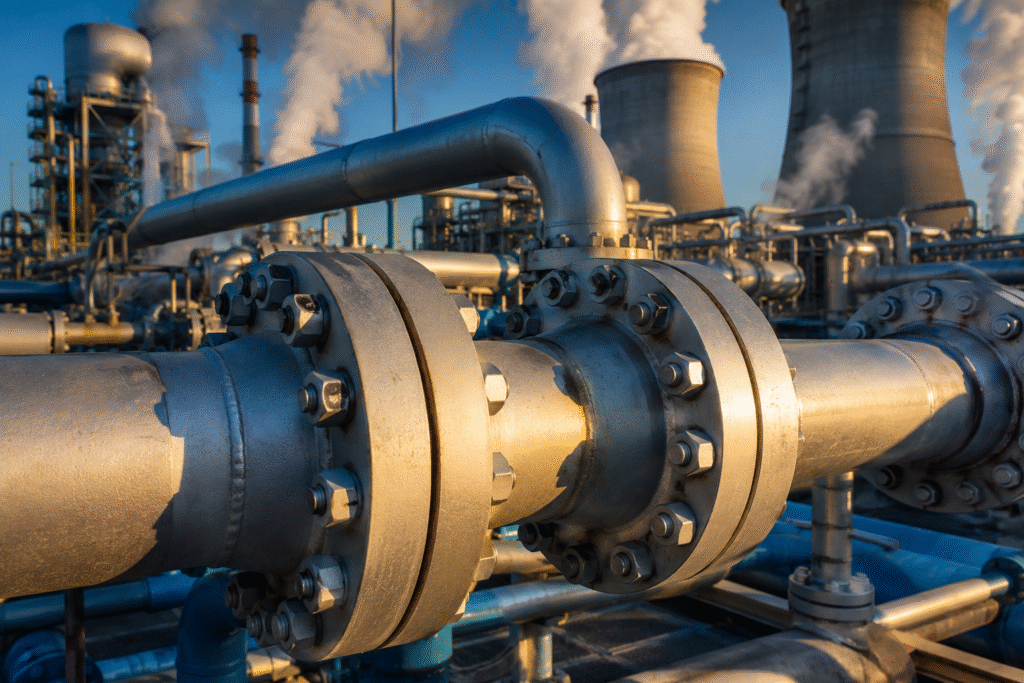
Guia global de fornecimento de flanges para tubos de aço inoxidável
De acordo com a pesquisa Grand View (2024), o mercado global de flanges industriais foi avaliado em $5.8 bilhão em 2023 e está projetado para atingir $7.2 bilhão por 2030. Esse crescimento faz com que flange de tubo de aço inoxidável um componente estratégico para engenheiros e compradores que necessitam de resistência à corrosão, rastreabilidade, and long service life in critical piping systems.
Para equipes de compras, the most intriguing question is not only which stainless, aço, and flange grade to buy. It is how to uncover the hidden advantages, tipos, usa, and selection factors that help choose the most common flanges for oil and gas, petroquímico, poder, marinho, e projetos de tratamento de água.
Global Market Demand Is Reshaping Stainless Steel Pipe Flange Sourcing
The industrial piping supply chain remains highly active across energy and infrastructure sectors. De acordo com IBISWorld (2024), Ásia-Pacífico é responsável por mais de 45% da produção global de flanges, sendo a China o maior fabricante.
That concentration matters for project planning because manufacturing scale affects lead time, cost stability, and raw material availability. Como resultado, buyers increasingly evaluate suppliers on machining capacity, experiência em metalurgia, and documentation control rather than price alone.
End-use demand also explains why stainless steel pipe flange products receive sustained attention. De acordo com Statista (2024), a indústria de petróleo e gás é responsável por aproximadamente 35% do consumo global de flanges.
No entanto, demand is no longer limited to upstream plants. Tratamento de água, sistemas marinhos, processamento de alimentos, and power generation continue to adopt stainless flanges because they resist corrosion better than many carbon steel options in wet or chemically aggressive environments.
De acordo com a Inteligência Mordor (2024), industrial stainless steel demand is rising steadily in desalination and chemical processing applications due to lifecycle cost advantages. Portanto, many EPC contractors now prioritize total cost of ownership over initial purchase price.
Em termos práticos, that means a lower maintenance frequency, menos desligamentos, and stronger reliability under cyclic temperature and pressure conditions. For flange assemblies, gasket performance and bolting integrity also improve when the mating materials suit the operating media.
Standards remain central to buying decisions. ASME B16.5 cobre flanges de tubos e acessórios flangeados da NPS 1/2 através do NPS 24, enquanto ASME B16.47 extends dimensional requirements for larger diameters (ASME, 2023).
Material compliance is equally important. ASTM A182 commonly governs forged stainless steel flanges, enquanto DENTRO 1092 and DIN flange systems remain widely specified across European and export projects (ASTM, 2023; EN, 2022).
É aqui que a capacidade do fornecedor se torna comercialmente relevante. SASA FLANGE fabrica flanges e acessórios em 304, 316, 316eu, 904eu, 2205, 2507, Classes A182, and other premium alloys for industrial service.
Com ISO 9001:2015 e certificações PED 2014/68/EU, the company supports projects that require dimensional accuracy, rastreabilidade de materiais, e documentação pronta para exportação. Além disso, its production range covers stainless steel flanges, flanges de aço carbono, flanges de liga, cotovelos, camisetas, redutores, e tampas para pacotes de tubulação integrados.
De acordo com a Pesquisa de Mercado Futuro (2024), infrastructure modernization and process-industry expansion are expected to sustain flange demand growth above 3% annually through the decade. Portanto, long-term sourcing strategies should include qualified manufacturers that can support both standard and custom flange dimensions.
Para compradores comparando fornecedores, the real issue is not simply who offers flanges for sale. It is who can deliver the right stainless steel pipe flange standard, enfrentando, classe de pressão, and inspection documents on time for project-critical installation windows.
Tipos de flange de tubo de aço inoxidável, Materiais, and Hidden Advantages in Industrial Service
The phrase stainless steel pipe flange covers a wide range of designs. These include weld neck, escorregar, cego, solda de soquete, rosqueado, junta sobreposta, and ring type joint configurations, each suited to different loads, temperaturas, e práticas de manutenção.
Como John Breen, Engenheiro de Tubulação Sênior, estados: “Flange selection fails when teams focus only on price and ignore fatigue loading, tolerância à corrosão, and bolt load retention.” That point is especially relevant in plants where vibration, ciclagem térmica, or chloride exposure accelerate failure mechanisms.
De acordo com a orientação da ASME, weld neck flanges are preferred for severe service because the tapered hub improves stress distribution (ASME, 2023). Em contraste, slip on flanges often support lower-pressure systems where simpler alignment and lower fabrication cost are priorities.
Material grade has equal importance. 304 and 304L remain the most common stainless options for general service, enquanto 316 and 316L provide better resistance in chloride-bearing environments because of molybdenum content.
According to ASTM material data and common industry practice, low-carbon grades such as 304L and 316L reduce sensitization risk after welding. Portanto, they are widely used in fabricated spool systems, linhas higiênicas, and field-welded process piping.
Para mídia agressiva, buyers may consider 904L, duplex 2205, ou super duplex 2507. These grades improve pitting resistance, resistência à corrosão sob tensão, and strength-to-weight performance in seawater, serviço azedo, e aplicações offshore.
- 304/304Flange de tubo de aço inoxidável L: Econômico, versátil, and widely used in water, comida, e sistemas industriais em geral.
- 316/316Flange de tubo de aço inoxidável L: Better chloride and chemical resistance for marine, químico, e linhas farmacêuticas.
- 904Flange L: Suitable for highly corrosive acids and demanding chemical process duty.
- 2205 flange duplex: Higher strength and improved chloride resistance compared with standard austenitic grades.
- 2507 flange super duplex: Used in offshore, dessalinização, and severe corrosion environments.
According to NACE and industry corrosion studies, chloride stress corrosion cracking remains a key risk in warm saline service (NACE, 2023). Como resultado, material upgrades often deliver measurable savings by reducing leaks, replacement cycles, and unplanned downtime.
Como Dr.. Lena Hoffmann, Cientista de Materiais, estados: “The hidden advantages of duplex and super duplex flanges are not only corrosion resistance but also higher mechanical strength, which can reduce wall thickness and weight.” That insight matters in marine skids and offshore modules where weight reduction supports broader design efficiency.
Facing type also affects performance. Raised face flanges remain the most common in ASME B16.5 sistemas, while ring type joint faces are preferred in high-pressure and high-temperature service where tighter sealing is required.
Buyers should also review pressure class and pipe schedule compatibility. A flange rated Class 150, 300, 600, or higher must align with system design pressure, seleção de juntas, aparafusamento, and actual operating temperature.
- Most common flange types: Pescoço de solda, escorregar, cego.
- Most common ASME pressure classes: 150, 300, 600, 900, 1500, 2500.
- Common stainless standards: ASTM A182 F304/F304L, F316/F316L, F51, F53.
- Common sizes: 1/2 polegada para 24 polegada abaixo ASME B16.5, with larger sizes under B16.47.
De acordo com os requisitos ISO e PED, documentation and traceability are increasingly critical for pressure equipment exports (ISO, 2023; DEP, 2014/68/UE). Portanto, many B2B buyers now request EN 10204 3.1 certificados de materiais, Teste PMI, and dimensional inspection reports as standard deliverables.
SASA FLANGE supports these requirements with advanced CNC machining, forged and machined flange production, e testes de qualidade abrangentes. Backed by ISO 9001:2015, PED 2014/68/EU, e ANÚNCIO 2000 credenciais, the company supplies custom sizes from 1/2 polegada para 60 inch across stainless, liga, and duplex grades.
For projects comparing intriguing material options, the right guide should explain more than generic uses. It should help engineers choose the most common flanges based on corrosion mechanism, classe de pressão, método de soldagem, acesso de manutenção, and lifetime cost.
ASME, ASTM, DIN, and EN Compliance Requirements for Stainless Steel Pipe Flange Procurement
Industrial buyers rarely approve a flange order on dimensions alone. They review standard compliance, raw material origin, escopo de teste, classificação de pressão-temperatura, and required inspection documents before issuing purchase orders.
For ASME projects, B16.5 and B16.47 define key dimensions, perfuração, grossura, and tolerances for flanges. Enquanto isso, ASTM A182 define flanges de tubos de liga forjada ou laminada e aço inoxidável, acessórios forjados, e válvulas para serviço em alta temperatura (ASTM, 2023).
European and export projects may specify EN 1092-1 or DIN flange systems instead of ASME dimensions. Em contraste, mixed-specification projects require extra control because bolt patterns, classificações de pressão, and facing details may not interchange directly.
The practical result is clear. A stainless steel pipe flange that appears similar on paper can become unusable if the standard, tipo de rosto, or drilling pattern does not match the connected equipment.
- ASME B16.5: NPS 1/2 para 24 flanges e acessórios flangeados.
- ASME B16.47: Flanges de aço de grande diâmetro.
- ASTM A182: Forged stainless and alloy steel flange material specification.
- ASME B16.9: Acessórios para soldagem de topo forjado feitos de fábrica.
- EN 1092-1: Dimensões europeias de flange e designações de pressão.
- DIN/JESUS/GOST: Regional flange systems for specific project requirements.
Pressure equipment compliance adds another layer. PED 2014/68/EU applies to many products entering the European market, and supporting documents often include material traceability, verificações dimensionais, and test records.
Corrosion-sensitive sectors may also request NACE MR0175 ou ISO 15156 alignment for sour service materials. Portanto, procurement teams should verify whether the flange material, tratamento térmico, and hardness limits match the service environment before approval.
The table below summarizes common procurement checkpoints for engineers and buyers.
- Verificação de materiais: Grau ASTM, número de calor, PMI, e EN 10204 3.1 certificado.
- Conformidade dimensional: ASME, DIN, EN, or JIS standard confirmation.
- Propriedades mecânicas: Resistência à tracção, força de rendimento, dureza, and impact test if required.
- Classe de pressão: Aula 150 para 2500 or PN rating verification.
- Facing inspection: RF, FF, RTJ, língua e sulco, or male and female details.
- Surface and NDT: Visual, PT, UT, or additional project-specific testing.
De acordo com as orientações da DNV para componentes marítimos e offshore, documentation quality is a major part of supplier qualification (DNV, 2023). Como resultado, manufacturers with controlled quality systems are better positioned for approved vendor lists and international EPC frameworks.
SASA FLANGE integrates these compliance expectations into production and export workflows. Fabricação de flanges em 304, 316, 904eu, 2205, 2507 e outras notas premium, a empresa apoia inspeção dimensional, certificados de materiais, and project documentation for global buyers.
For technical reference, buyers can also review published standards directly through ASME. That step helps engineering teams validate rating tables, dimensões, and scope before issuing final data sheets.
In competitive sourcing, compliance is often the difference between a usable component and a costly delay. Portanto, standard alignment should be confirmed before pricing comparisons begin.
Guia de aplicação: Como escolher soluções de flange de tubo de aço inoxidável para petróleo, Gás, Poder, Marinho, e Sistemas de Água
Application context drives proper flange selection. UM 4 inch stainless steel pipe flange in a clean water line may work well in 304L, while the same nominal size in offshore splash zones may require 316L, duplex 2205, or even super duplex 2507.
Oil and gas projects often prioritize pressure integrity, adequação do serviço ácido, and resistance to chlorides and H2S-related damage. Portanto, weld neck and RTJ flanges frequently appear in upstream, meio do caminho, and refinery units.
De acordo com Statista (2024), petróleo e gás representam cerca de 35% do consumo global de flanges. That share explains why buyers in this sector pay close attention to ASTM grades, ASME dimensions, and NACE-related material considerations.
Chemical and petrochemical plants face another challenge. Corrosion can vary greatly based on acid concentration, temperatura, nível de cloreto, and cleaning cycle frequency.
Nesses casos, material selection should not rely on generic stainless assumptions. Engineers should compare actual media compatibility against 304, 316eu, 904eu, and higher-alloy alternatives before finalizing the bill of materials.
Power generation systems often involve elevated temperatures, ciclagem térmica, and strict maintenance windows. Como resultado, acabamento da face do flange, pré-carga do parafuso, and gasket compatibility become just as important as basic flange type.
Marine and shipbuilding applications add salinity, umidade, and galvanic corrosion concerns. Portanto, flange selection should consider duplex materials, external coating interfaces, and drainage or maintenance access where crevice corrosion may develop.
- Para petróleo e gás: Consider weld neck or RTJ flanges, Revisão da NACE, e classe 600+ ratings where required.
- Para processamento químico: Prioritize media compatibility, low-carbon grades, and documented corrosion performance.
- Para usinas de energia: Match temperature rating, carga do parafuso, and gasket design to operating cycles.
- For marine systems: Evaluate chloride resistance, crevice corrosion risk, e opções duplex.
- Para tratamento de água: Equilibre a resistência à corrosão, orçamento, e intervalos de manutenção.
Selection also depends on connection method. Stainless steel threaded pipe flange designs are useful where welding is impractical, while slip on flanges can reduce fabrication complexity in lower-pressure systems.
Blind flanges serve a different use. They terminate or isolate piping sections, and they are common in maintenance planning because they allow future expansion or inspection access.
O preço continua importante, but it should be interpreted correctly. Stainless steel pipe flange price varies with raw material grade, tamanho, compatibilidade de horários, classe de pressão, complexidade de usinagem, e escopo de certificação.
According to procurement benchmarks cited by industry analysts, documentation-heavy export orders can cost more initially but reduce rejection risk and project delay exposure. Portanto, the apparent cheapest flange vendor may not deliver the best landed cost.
Buyers should evaluate these commercial and technical points together.
- Padrão exigido: ASME B16.5, B16.47, DIN, EN 1092, ou JIS.
- Grau do material: 304/304eu, 316/316eu, 904eu, 2205, 2507, or nickel alloy.
- Faixa de tamanho: from small bore to large diameter, including custom drilling.
- Classificação de pressão: Aula 150 para 2500 or project-specific PN values.
- Certificação: ISO 9001:2015, DEP, ANÚNCIO 2000, EN 10204 3.1.
- Inspeção: PMI, UT, PT, hydro test support, e relatórios dimensionais.
- Tempo de espera: estoque, made-to-order, or project lot manufacturing.
SASA FLANGE offers custom manufacturing for stainless steel flanges and pipe fittings across oil and gas, petroquímico, poder, construção naval, e setores de tratamento de água. Servindo 50+ países, the company supports factory-direct sourcing with forged, usinado, and inspection-ready products for project and distributor buyers.
For engineering teams that need stainless steel flanges and fittings in one package, integrated sourcing can improve coordination. Cotovelos, camisetas, redutores, e bonés fabricados para ASME B16.9 standards help maintain consistency across the piping system.
Perspectivas Futuras para a Demanda de Flanges de Tubos de Aço Inoxidável e Recomendações Estratégicas de Compra
A perspectiva do mercado permanece positiva. De acordo com a pesquisa Grand View (2024), espera-se que o mercado de flange industrial cresça de $5.8 bilhão em 2023 para $7.2 bilhão por 2030.
That growth will likely favor suppliers with stronger quality systems, broader material portfolios, and better export documentation. Além disso, buyers will continue shifting toward lifecycle-based sourcing rather than lowest-price purchasing.
De acordo com IBISWorld (2024), A Ásia-Pacífico já representa mais de 45% da produção global de flanges. Portanto, qualification of Chinese manufacturers will remain a key procurement activity for EPC firms, distribuidores, and OEMs.
Digital sourcing will also influence the market. Buyers increasingly compare flange manufacturers by certificate availability, technical response speed, and custom machining capability before requesting formal quotations.
Como Mark Ellison, Analista de Mercado Industrial, estados: “In industrial components, trust is built when suppliers answer technical questions with standards, inspection data, and realistic lead times.” That is particularly true for stainless steel pipe flange projects where deviations can affect plant safety and schedule performance.
Estrategicamente, procurement teams should take four actions. Primeiro, standardize approved materials by service environment. Segundo, qualify suppliers on compliance and documentation. Terceiro, compare total installed cost instead of unit price. Quarto, lock in technical reviews early for custom or mixed-standard projects.
Para muitos compradores, the most intriguing hidden advantage is simplicity. When flange type, nota, certificação, and fitting package come from a capable manufacturer, coordination risk falls and project execution improves.
For current RFQs involving 304, 316eu, duplex, or custom stainless steel pipe flange requirements, engineers and sourcing managers can review options through SASA FLANGE. Com usinagem CNC avançada e testes de qualidade abrangentes, the company supports specification-driven supply for demanding industrial service.
Perguntas frequentes
Para que são usados os flanges de aço inoxidável?
●Flanges de aço inoxidável são usadas para conectar tubos, válvulas, bombas, e equipamentos em sistemas que exigem resistência, resistência à corrosão, and serviceability.
●De acordo com Statista (2024), a indústria de petróleo e gás é responsável por aproximadamente 35% do consumo global de flanges, which shows how critical flanged joints are in process piping.
●Eles são amplamente utilizados em petróleo e gás, petroquímico, marinho, tratamento de água, processamento de alimentos, and power generation because they allow easier inspection and maintenance than permanent welded closures.
●Os usos comuns incluem conexão de linha, equipment nozzle attachment, end closure with blind flanges, and transition points between piping sections with different maintenance needs.
●Na prática, engineers select a stainless steel pipe flange when corrosion resistance, higiene, or lifecycle cost is more important than the lower initial cost of carbon steel.
Eles fazem acessórios para tubos de aço inoxidável?
●Sim, os fabricantes produzem acessórios para tubos de aço inoxidável, como cotovelos, camisetas, redutores, and caps for pressure piping systems.
●ASME B16.9 is the most common dimensional standard for factory-made wrought butt welding fittings in industrial piping systems (ASME, 2023).
●These fittings are available in grades such as 304, 304eu, 316, 316eu, 904eu, 2205, e 2507 to match corrosion, força, and fabrication requirements.
●Using compatible fittings and flanges in the same grade helps reduce galvanic mismatch, simplifies welding procedure qualification, and improves traceability across the piping package.
●For projects requiring stainless steel flanges and fittings under one source, trabalhando com fabricantes estabelecidos como SASA FLANGE supports consistent quality documents and dimensional control.
Quais flanges são feitas de aço inoxidável?
●Many flange types are made of stainless steel, incluindo pescoço de solda, escorregar, cego, solda de soquete, rosqueado, e projetos de juntas sobrepostas.
●De acordo com ASME B16.5 (2023), these flanges cover common dimensional requirements from NPS 1/2 através do NPS 24 for many industrial systems.
●They are commonly manufactured in ASTM A182 F304/F304L, F316/F316L, duplex 2205, superduplex 2507, and higher-alloy stainless grades for severe service.
●Raised face flanges are the most common in general service, while ring type joint flanges are preferred in higher-pressure applications that demand stronger sealing performance.
●Selection should align the flange type, stainless grade, and pressure class with actual media, temperatura, and maintenance requirements rather than appearance alone.
Qual é o tipo mais resistente de flange de tubulação?
●Weld neck flange is generally considered the strongest common piping flange because its tapered hub distributes stress effectively under pressure and thermal cycling.
●ASME design practice consistently favors weld neck flanges for severe service, especially where vibration, alta pressão, or repeated temperature changes are expected (ASME, 2023).
●No entanto, actual strength also depends on material grade, espessura da parede, carga do parafuso, seleção de juntas, and whether the assembly is properly installed and aligned.
●Por exemplo, a duplex weld neck flange can outperform a standard austenitic slip on flange in both mechanical strength and chloride resistance under the right service conditions.
●Para sistemas críticos, buyers should request engineering review of pressure class, tipo de revestimento, and material specification before finalizing the flange design.
Como você escolhe entre 304 e 316 classes de flange de tubo de aço inoxidável?
●304 is the most common stainless choice for general service, enquanto 316 usually performs better in chloride-containing or chemically aggressive environments.
●According to ASTM and standard industry corrosion data, the molybdenum in 316 improves resistance to pitting and crevice corrosion compared with 304 in many saline conditions.
●Isso significa 304 often fits indoor water, comida, and light industrial applications, enquanto 316 is preferred for marine, farmacêutico, and coastal process systems.
●Price differences should be weighed against maintenance cost because a lower-cost 304 flange may fail earlier if the medium contains chlorides or cleaning chemicals.
●For projects requiring a documented material recommendation, suppliers with metallurgy and application experience like SASA FLANGE can help match grade selection to service conditions.
What standards apply to stainless steel pipe flange sizes and specifications?
●ASME B16.5, ASME B16.47, ASTM A182, EN 1092-1, DIN, JIS, and project-specific specifications are the main standards used for stainless steel pipe flange sizing and compliance.
●De acordo com a ASME (2023), B16.5 covers dimensions, tolerâncias, materiais, marcação, and pressure-temperature ratings for many common flange applications.
●ASTM A182 governs forged stainless material, enquanto DENTRO 1092-1 and DIN systems are widely used in European and export markets with different dimensional conventions.
●Buyers should confirm standard, classe de pressão, tipo de revestimento, and drilling pattern together because similar-looking flanges from different systems are often not interchangeable.
●For export and pressure equipment projects, it is also wise to require EN 10204 3.1 certification and verify whether PED or other regulatory documentation is needed.
Posts Relacionados
Acabamento da face do flange: Serrilhas concêntricas vs espirais explicadas
As serrilhas concêntricas e espirais são acabamentos de face de flange usinados…
Dúplex 2205 vs Flanges 316L: Qual material você deve escolher?
Resposta rápida: Dúplex 2205 flanges são geralmente o candidato mais forte…

Definição de flange de orifício, Detalhes e visão geral dos flanges ASME B16.36: Dados de mercado, Guia de seleção e insights de conformidade
O mercado global de flanges industriais foi avaliado em $5.8 bilhão…

Guia de mercado de flange de descarte preto: Materiais, 3.5″ Compatibilidade, e dados de fornecimento B2B para flanges de pia de cozinha
A demanda por flanges descartáveis pretos está aumentando à medida que os compradores de utensílios de cozinha…