
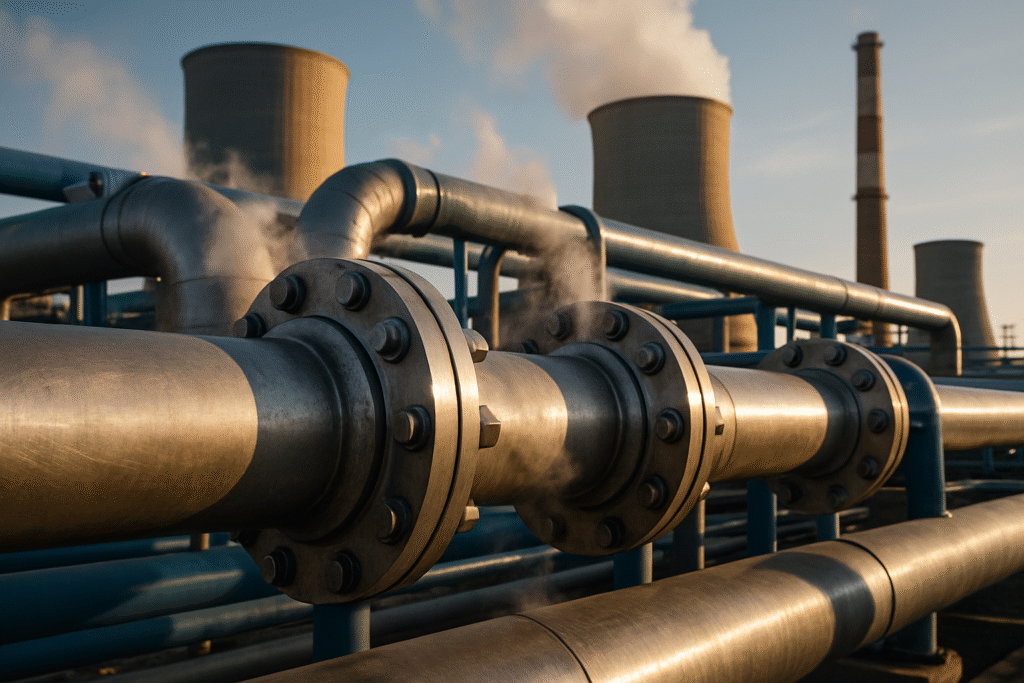
Flange de tubo de aço inoxidável: Dados intrigantes, Vantagens ocultas, Tipos, Usos, e como escolher os flanges mais comuns
O flange de tubo de aço inoxidável market is expanding with industrial investment, padrões de segurança mais rígidos, e maiores expectativas de desempenho contra corrosão. De acordo com a pesquisa Grand View (2024), o mercado global de flanges industriais foi avaliado em $5.8 bilhão em 2023 e está projetado para atingir $7.2 bilhão por 2030.
Para engenheiros e gerentes de compras, que o crescimento reflete uma realidade prática. Stainless steel flanges remain one of the most reliable connection solutions for pressure piping, especially where corrosion resistance, higiene, and lifecycle cost matter.
Além disso, buyers now expect more than material availability. They want full traceability, Conformidade ASTM e ASME, EN 10204 3.1 documentação, and manufacturing partners that can support custom dimensions, aulas de pressão, and demanding end-use industries.
Tendências de demanda global moldando a aquisição de flanges para tubos de aço inoxidável
Industrial buyers are sourcing stainless steel pipe flange products in a market defined by regional production concentration and sector-specific demand. De acordo com IBISWorld (2024), Ásia-Pacífico é responsável por mais de 45% da produção global de flanges, sendo a China o maior fabricante.
That concentration matters because it affects lead time, price stability, and access to broader material grades. It also explains why global EPC contractors increasingly evaluate Chinese manufacturers on quality systems, experiência de exportação, e conformidade com padrões, em vez de apenas preço.
Em paralelo, end-use demand remains heavily tied to energy infrastructure. De acordo com Statista (2024), a indústria de petróleo e gás é responsável por aproximadamente 35% do consumo global de flanges.
No entanto, demand is no longer limited to upstream and refinery projects. Tratamento de água, construção naval, processamento de alimentos, produtos farmacêuticos, and power generation increasingly specify stainless steel pipe flange assemblies where carbon steel would require more maintenance or expensive coatings.
De acordo com a Inteligência Mordor (2024), industrial process equipment demand in corrosion-sensitive applications is rising as operators seek lower lifecycle maintenance costs. Portanto, graus inoxidáveis, como 304, 316, 316eu, 904eu, 2205, e 2507 are seeing stronger specification in both greenfield and retrofit projects.
Como o engenheiro de materiais Dr.. Helen Carter, a corrosion consulting specialist, estados: “Selecting the right flange alloy is not a purchase decision alone. It is a risk-management decision that affects leakage probability, shutdown cost, and inspection frequency.”
This is where supplier capability becomes strategically important. SASA FLANGE supports global B2B buyers with stainless steel flanges, flanges de aço carbono, flanges de liga, and pipe fittings manufactured to ANSI B16.5, ANSI B16.47, ASME B16.9, DIN, JIS, GOST, e PT 1092 requisitos.
Com ISO 9001:2015 e certificações PED 2014/68/EU, SASA FLANGE aligns manufacturing with the compliance expectations of regulated sectors. Adicionalmente, the company offers grades such as 304, 316, 316eu, 904eu, 2205, 2507, A105, A182, Inconel, Monel, Hastelloy, and Titanium for diverse service environments.
Procurement teams also care about export readiness and documentation quality. De acordo com a Pesquisa de Mercado Futuro (2024), industrial component buyers increasingly rank quality certification and on-time delivery among the top three supplier selection criteria in process industries.
Portanto, a stainless steel pipe flange supplier must deliver more than catalog coverage. It must offer dimensional consistency, Suporte ao PMI, rastreabilidade térmica, precisão da classe de pressão, and tested machining for raised face, cara plana, RTJ, rosqueado, and welded configurations.
Aprofundamento técnico: Vantagens ocultas, Tipos, Usos, and How to Choose a Stainless Steel Pipe Flange
The hidden advantages of a stainless steel pipe flange extend well beyond corrosion resistance. Em muitos sistemas industriais, stainless steel reduces total ownership cost by minimizing coating failures, reducing replacement frequency, and improving system cleanliness.
De acordo com as orientações de aplicação ASTM e ASME, a correctly specified flange assembly improves sealing integrity when paired with the right gasket, aparafusamento, and installation torque sequence. Consequentemente, material grade and flange type must be evaluated together rather than separately.
The most common stainless steel flange grades are 304/304L and 316/316L. Nota 304 offers strong general corrosion resistance and good weldability, enquanto 316 adds molybdenum for better pitting resistance in chloride environments.
According to industry pricing analyses reported by procurement platforms and stainless mill market summaries in 2024, 316/316L components typically carry a noticeable premium over 304/304L. No entanto, that higher upfront cost is often justified in coastal, químico, and saline service.
Como engenheiro de tubulação Mark Ellison, Senior Project Consultant, estados: “The most common flange failures I see are not caused by pressure class errors alone. They come from poor material matching to media, temperatura, and external atmosphere.”
That statement reflects a key buying principle. Escolhendo entre 304, 316eu, 904eu, or duplex grades depends on chloride level, temperatura de projeto, química de limpeza, classificação de pressão, and whether the line is cyclic or static.
- 304/304Flange de tubo de aço inoxidável L: Best for general industrial service, sistemas de água, processamento de alimentos, e ambientes de corrosão moderada.
- 316/316Flange de tubo de aço inoxidável L: Better for marine exposure, processamento químico, and chloride-containing media.
- 904Flange L: Suitable for aggressive acid service where superior corrosion resistance is needed.
- 2205 flange duplex: Delivers higher strength and improved chloride stress corrosion cracking resistance.
- 2507 flange super duplex: Used in severe offshore, submarino, and desalination environments.
Flange type also affects assembly behavior, distribuição de tensão, e acessibilidade de manutenção. A weld neck flange usually provides the best mechanical performance for high-pressure and high-temperature service because its tapered hub reduces stress concentration.
Slip-on flanges can lower fabrication cost in lower-pressure systems. Threaded flanges help where welding is restricted, while socket weld flanges suit smaller bore high-pressure lines.
Blind flanges are used to isolate line ends, pressure test segments, ou futuros pontos de expansão. Lap joint flanges support frequent dismantling where alignment flexibility is useful, especially with stub-end systems.
- Flange de pescoço soldado: Preferred for critical process piping and cyclic loading.
- Flange deslizante: Common in utility and moderate-duty service.
- Flange cega: Used for closure, testando, e isolamento de linha.
- Flange roscada: Útil onde a soldagem é impraticável.
- Flange de solda de soquete: Chosen for smaller diameter, higher-pressure piping.
- Flange de junta sobreposta: Practical for systems needing frequent disassembly.
De acordo com ASME B16.5, dimensões padrão do flange, tolerâncias, classificações de pressão-temperatura, and marking rules are defined for NPS 1/2 através 24. ASME B16.47 estende a cobertura para diâmetros maiores, which is crucial for large process and transmission systems.
Buyers searching terms like stainless steel pipe flange sizes, 4 flange de tubo de aço inoxidável de polegada, or stainless steel threaded pipe flange are usually comparing four factors. They are material grade, classe de pressão, tipo de revestimento, e rota de fabricação.
Important selection criteria include the following:
- Classe de pressão como Classe 150, 300, 600, 900, 1500, ou 2500.
- Tipo de revestimento incluindo RF, FF, e RTJ.
- Compatibilidade com cronograma de tubulação, como SCH 10, SCH 40, SCH 80, or XXS.
- Temperatura operacional e pressão de projeto.
- Composição média, especialmente cloretos, ácidos, or sour service exposure.
- Required material standard, por exemplo ASTM A182 F304/F304L or F316/F316L.
- Inspection and certification needs such as PMI, suporte para hidroteste, e EN 10204 3.1.
SASA FLANGE supports these variables with custom sizes from 1/2 polegada para 60 inch and competitive factory-direct supply. Apoiado por usinagem CNC avançada e testes de qualidade abrangentes, a empresa atende Petróleo & Gás, Petroquímica, Poder, Marinho, Tratamento de Água, e projetos de construção em 50+ países.
According to ISO-aligned manufacturing best practices, dimensional control and surface finish consistency directly affect sealing performance and installation efficiency. Portanto, flange machining quality is not cosmetic. It is a functional requirement tied to gasket seating and leak prevention.
Padrões, Material Specifications, e conformidade para flanges de aço inoxidável
Compliance is one of the biggest differentiators in B2B flange sourcing. Engineers do not simply buy a stainless steel pipe flange by size alone. They buy to a defined code, padrão de materiais, inspection regime, e pacote de documentação.
O padrão dimensional mais referenciado é ASME B16.5 for standard pipe flanges and flanged fittings. Para diâmetros maiores, ASME B16.47 applies and is commonly specified in transmission, terminal, and heavy process installations.
On the material side, ASTM A182 is a primary forged or rolled alloy and stainless flange specification. As notas comuns incluem ASTM A182 F304, F304L, F316, F316L, F51, e F53, depending on corrosion and strength requirements.
ASTM A240, por contraste, covers plate material used in some stainless components and related product forms. Buyers should verify whether the flange is forged, plate-cut, or machined from bar because the material route affects mechanical properties, rastreabilidade, and sometimes project approval.
Projetos europeus e internacionais exigem frequentemente DIN, EN 1092, DEP, e ANÚNCIO 2000 alinhamento. Além disso, projects in sour service or chloride-stressed systems may require NACE MR0175 or additional corrosion qualification.
De acordo com a estrutura PED 2014/68/UE da Comissão Europeia, pressure equipment supplied into the EU must meet strict conformity assessment obligations. Portanto, export-oriented flange manufacturers need both process discipline and document control to support compliant delivery.
Os principais padrões e referências de conformidade incluem:
- ASME B16.5: Dimensions and pressure-temperature ratings for NPS 1/2 para 24.
- ASME B16.47: Flanges de aço de grande diâmetro.
- ASTM A182: Forged or rolled alloy and stainless steel pipe flanges and fittings.
- ASME B16.9: Acessórios para soldagem de topo forjados feitos na fábrica.
- EN 1092: European flange requirements.
- NACE MR0175: Requisitos de materiais para ambientes contendo H2S.
- EN 10204 3.1: Inspection certificate format commonly required for traceability.
A practical comparison helps procurement teams reduce specification errors:
- 304/304eu: Menor custo, ampla disponibilidade, adequado para serviço geral.
- 316/316eu: Melhor resistência ao cloreto, stronger choice for marine and chemical use.
- 2205 duplex: Maior resistência, often allows wall-thickness optimization in some systems.
- 2507 superduplex: Premium solution for severe corrosive service.
- 904eu: Chosen for highly aggressive acidic environments.
According to DNV and offshore engineering guidance, seawater and splash-zone systems require particularly careful alloy selection due to localized corrosion risk. Como resultado, material substitution based only on price can create high downstream failure costs.
Com ISO 9001:2015, PED 2014/68/EU, e ANÚNCIO 2000 credenciais, SASA FLANGE gives project teams stronger compliance assurance for export and regulated applications. Buyers needing technical review, tamanhos personalizados, or material verification can connect directly through SASA FLANGE for project support.
Guia de aplicação: How to Choose the Right Flange for Oil, Gás, Químico, Poder, e Sistemas Marítimos
Every industry uses stainless steel pipe flange products differently because media, pressão, and maintenance conditions vary. Portanto, engineers should treat flange selection as an application decision rather than a commodity purchase.
Em petróleo e gás, a confiabilidade do flange afeta diretamente a segurança e o tempo de atividade. De acordo com Statista (2024), this sector represents approximately 35% do consumo global de flanges, which shows how critical flange integrity is to hydrocarbon infrastructure.
Para sistemas upstream e midstream, flanges de pescoço soldado em 316L, duplex, or super duplex are common where corrosion and pressure are significant. Em serviço azedo ou offshore, NACE compliance and chloride resistance often move duplex grades ahead of standard austenitic options.
No processamento petroquímico e químico, media compatibility is the first filter. Ácidos, cloretos, produtos químicos de limpeza, and process temperatures may require 316L, 904eu, or nickel alloy solutions rather than 304.
Na geração de energia, thermal cycling and pressure class become especially important. Flange selection must consider creep exposure, gasket stress retention, and repeated startup-shutdown cycles.
Na marinha e na construção naval, salt-laden air and direct seawater exposure accelerate localized attack. Portanto, 316L is often the minimum practical choice, while duplex grades are preferred for more severe chloride environments.
Projetos de tratamento de água e dessalinização também exigem uma seleção cuidadosa de ligas. Além disso, designers often compare the upfront stainless steel pipe flange price with the long-term savings from reduced replacement and lower coating maintenance.
Os critérios de seleção devem incluir:
- Service medium composition and chloride content.
- Pressão de projeto, temperatura de projeto, and operating excursions.
- Flange type and facing compatibility with the gasket system.
- Required standard such as ASME B16.5, EN 1092, ou DIN.
- Rastreabilidade de materiais, PMI, e EN 10204 3.1 documentação.
- Installation constraints, including whether welding is allowed onsite.
- Lifecycle cost rather than purchase price alone.
Por exemplo, um 4 flange de tubo de aço inoxidável de polegada na classe 150 for treated water service may be acceptable in 304L. No entanto, the same nominal size in coastal chemical service may require 316L or duplex with stricter inspection and gasket selection.
Da mesma maneira, stainless steel flanges and fittings should be sourced as a matched system whenever possible. That approach reduces mismatch risk across metallurgy, dimensões, acabamento superficial, e classificação de pressão.
As industry analyst Robert Keane states: “Procurement performance improves when buyers standardize flange specifications by service class instead of ordering each line item independently.” That advice is valuable for EPC firms managing multi-site projects, shutdown packages, or framework agreements.
SASA FLANGE supports custom manufacturing across elbows, camisetas, redutores, bonés, and multiple flange types to simplify package sourcing. Adicionalmente, the company can help align material grade, dimensões, and compliance documentation for complex industrial applications through consulta técnica direta.
Perspectivas Futuras, Estratégia de Aquisições, and Recommendations for Buyers
The outlook for stainless steel pipe flange demand remains positive because process industries continue upgrading safety, eficiência, e desempenho contra corrosão. De acordo com a pesquisa Grand View (2024), espera-se que o mercado de flange industrial atinja $7.2 bilhão por 2030, indicating sustained global demand.
Ao mesmo tempo, as expectativas do comprador estão aumentando. De acordo com IBISWorld (2024), China remains the largest manufacturing base in the Asia-Pacific region, which now accounts for over 45% da produção global de flanges.
That means global procurement teams have access to broad supply capacity. No entanto, it also means supplier qualification is more important than ever, especially for high-specification stainless, duplex, e graus de liga.
Smart buyers should focus on total project risk. That includes lead time reliability, precisão da documentação, suporte de conformidade, qualidade de usinagem, and post-order technical communication.
Recommended procurement actions include:
- Standardize approved grades by service condition to avoid ad hoc substitutions.
- Specify dimensional and material standards clearly on every RFQ.
- Solicitar EN 10204 3.1 certificados, números de calor, and PMI where needed.
- Confirme a classe de pressão, tipo de revestimento, e agendar compatibilidade antes do lançamento do PO.
- Evaluate suppliers on quality systems, experiência de exportação, e capacidade de resposta técnica.
Além disso, buyers should review whether the most common flanges in their plant are also the most economical over ten years of service. Em muitos casos, a slightly higher-grade stainless steel pipe flange lowers maintenance events and unplanned downtime.
Para projetos que exigem dimensões personalizadas, notas premium, or mixed packages of stainless steel flanges and fittings, working with an established manufacturer reduces coordination complexity. Companies seeking a reliable supply partner can explore SASA FLANGE para suporte técnico, competitive factory-direct pricing, and compliant export documentation.
Perguntas frequentes
O que é melhor 304 ou 420 aço inoxidável?
●304 stainless steel is generally better for stainless steel pipe flange applications because it offers superior corrosion resistance and weldability compared with 420.
●According to ASTM material application practices, 420 is a martensitic stainless grade better known for hardness and wear resistance rather than flange service in corrosive piping systems.
●Para tubulação de processo, procurement teams should usually choose ASTM A182 F304 or F304L when they need a reliable balance of fabrication ease, higiene, and general corrosion performance.
Qual é o código ASME para flanges de aço inoxidável?
●The main ASME code for stainless steel flanges is ASME B16.5 para NPS 1/2 através 24, enquanto ASME B16.47 cobre diâmetros maiores.
●Esses padrões definem dimensões, classificações de pressão-temperatura, tolerâncias, and marking requirements that engineers use to specify flange compatibility.
●Buyers should also pair ASME dimensional standards with ASTM A182 material grades such as F304, F316L, F51, or F53 to avoid specification gaps.
Quais são os 5 tipos de aço inoxidável?
●As cinco principais famílias de aços inoxidáveis são austeníticas, ferrítico, martensítico, duplex, e aços inoxidáveis endurecidos por precipitação.
●Na fabricação de flanges, austenitic grades like 304 e 316 são os mais comuns, enquanto as classes duplex, como 2205 e 2507 are selected for higher strength and chloride resistance.
●For industrial piping projects, engineers should choose the stainless family based on corrosion mechanism, mechanical load, and code compliance rather than alloy cost alone.
Qual indústria usa mais aço inoxidável?
●The oil and gas sector is one of the largest users of industrial flanges, e de acordo com Statista (2024), é responsável por aproximadamente 35% do consumo global de flanges.
●No entanto, stainless steel demand is also strong in petrochemical, marinho, tratamento de água, processamento de alimentos, and power generation due to corrosion and hygiene requirements.
●When media is aggressive or maintenance access is limited, stainless steel flanges often provide better lifecycle value than coated carbon steel alternatives.
Quais são os tipos de flange de aço inoxidável mais comuns?
●Os tipos de flange de aço inoxidável mais comuns são pescoço de solda, deslizamento, cego, rosqueado, solda de soquete, e flanges de junta sobreposta.
●ASME B16.5 governs many of these configurations and helps ensure dimensional interchangeability across standard piping systems.
●For critical pressure and temperature service, engineers usually prefer weld neck flanges because they distribute stress more effectively than simpler designs.
Como escolho o tamanho correto do flange do tubo de aço inoxidável e a classe de pressão?
●The correct flange selection depends on nominal pipe size, cronograma de tubulação, tipo de revestimento, classe de pressão, and material grade working together.
●Por exemplo, um 4 inch stainless steel pipe flange must match the connected pipe outside diameter, cronograma de parede, and required class such as 150, 300, ou 600.
●For projects requiring traceability, usinagem personalizada, or multi-standard supply, buyers should work with qualified manufacturers like SASA FLANGE to confirm technical fit before ordering.
Posts Relacionados
Acabamento da face do flange: Serrilhas concêntricas vs espirais explicadas
As serrilhas concêntricas e espirais são acabamentos de face de flange usinados…
Dúplex 2205 vs Flanges 316L: Qual material você deve escolher?
Resposta rápida: Dúplex 2205 flanges são geralmente o candidato mais forte…

Definição de flange de orifício, Detalhes e visão geral dos flanges ASME B16.36: Dados de mercado, Guia de seleção e insights de conformidade
O mercado global de flanges industriais foi avaliado em $5.8 bilhão…

Guia de mercado de flange de descarte preto: Materiais, 3.5″ Compatibilidade, e dados de fornecimento B2B para flanges de pia de cozinha
A demanda por flanges descartáveis pretos está aumentando à medida que os compradores de utensílios de cozinha…