
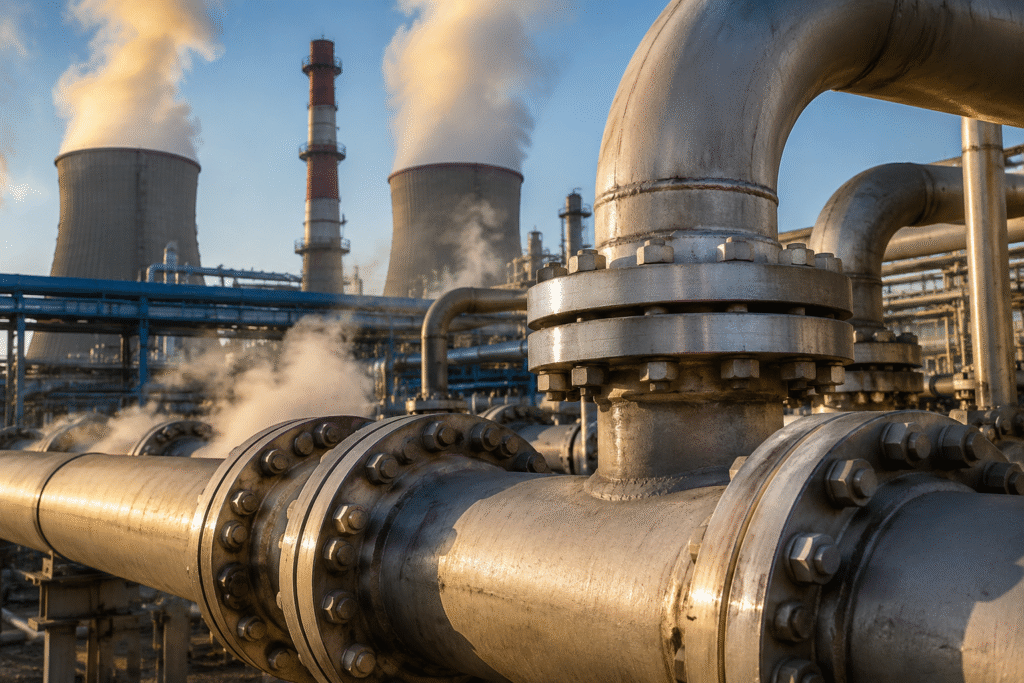
Mercado de flanges de tubos de aço inoxidável por US$ 5,8 bilhões: Vantagens ocultas, Tipos, Usos, e como escolher o flange certo
De acordo com a pesquisa Grand View (2024), o mercado global de flanges industriais foi avaliado em $5.8 bilhão em 2023 e está projetado para atingir $7.2 bilhão por 2030. That growth makes stainless steel pipe flange selection more strategic for engineers and procurement teams who need durability, resistência à corrosão, e valor do ciclo de vida a longo prazo.
Em tubulações industriais, the hidden advantages of stainless steel pipe flange products go far beyond basic connection points. Versatilidade de materiais intrigante, integridade de pressão, and maintenance savings now influence how buyers choose flange types, tamanhos, and standards across Oil & Gás, Poder, Tratamento de Água, and Marine systems.
A demanda industrial por soluções de flanges para tubos de aço inoxidável está acelerando
Global demand remains strong because industrial plants continue to expand capacity, replace aging infrastructure, and tighten compliance requirements. De acordo com IBISWorld (2024), Ásia-Pacífico é responsável por mais de 45% da produção global de flanges, sendo a China o maior fabricante.
That production concentration matters for procurement strategy. Buyers increasingly evaluate not only price, mas também rastreabilidade do moinho, documentação de inspeção, e confiabilidade de entrega.
The oil and gas sector remains the largest consuming industry. De acordo com Statista (2024), a indústria de petróleo e gás é responsável por aproximadamente 35% do consumo global de flanges, which explains the heavy demand for ASME-rated stainless, aço carbono, and alloy flange products.
Ao mesmo tempo, tratamento de água, petroquímico, and shipbuilding projects keep expanding stainless specifications. Inteligência Mordor (2024) notes that corrosion-resistant materials continue gaining share in aggressive media applications because downtime costs often exceed initial component premiums.
For buyers comparing industrial flanges, stainless steel pipe flange products offer a strong balance of corrosion resistance, resistência mecânica, e flexibilidade de fabricação. As notas comuns incluem ASTM A182 F304, F304L, F316, F316L, duplex F51, and super duplex F53 for higher chloride exposure and improved pitting resistance.
Como Dr.. James Hollis, Engenheiro de Materiais e consultor de corrosão, estados: “A flange is rarely a commodity in aggressive service. Grau do material, qualidade de forjamento, and compliance documentation determine whether the joint will perform for years or fail early.”
This is where supplier capability becomes critical. Com ISO 9001:2015 e certificações PED 2014/68/EU, SASA FLANGE supports international projects that require dimensional accuracy, EN 10204 3.1 certificação, and dependable export execution.
Além disso, factory capability affects lead time and consistency. De acordo com a Pesquisa de Mercado Futuro (2024), industrial buyers increasingly favor suppliers that combine machining, testando, and documentation under one quality system because this reduces project coordination risk.
For EPC contractors and distributors, stainless flange sourcing is no longer only about available stock. It is about choosing a partner that understands standards, aulas de pressão, metalurgia, and end-use risk.
Fabricação de flanges em 304, 316, 904eu, 2205, 2507 e outras notas premium, SASA FLANGE serves projects across 50+ países em petróleo & Gás, Petroquímica, Poder, Marinho, e Construção. Portanto, buyers can align material selection with both project specifications and long-term operating performance.
Aprofundamento técnico: Vantagens ocultas, Versatilidade, Durabilidade, and Flange Types
The strongest case for a stainless steel pipe flange lies in lifecycle economics. Stainless materials usually cost more upfront than carbon steel, yet they often reduce repainting, corrosion failures, and replacement frequency in wet, químico, or saline service.
According to NACE guidance on corrosion control and materials selection, corrosion-related costs consume a meaningful share of industrial maintenance budgets worldwide (NACE, 2023). Portanto, selecting the right stainless flange grade can directly reduce total cost of ownership.
Engineers usually start with grade selection, then match pressure class, enfrentando, and flange type to service conditions. ASTM A182 cobre flanges de tubos de liga forjada ou laminada e aço inoxidável, acessórios forjados, e válvulas para serviço em alta temperatura, enquanto ASME B16.5 rege as dimensões, tolerâncias, classificações, and markings for NPS 1/2 através 24.
Para diâmetros maiores, ASME B16.47 aplica-se. Em projetos europeus, DIN e EN 1092 standards often define dimensions, perfuração, and pressure designations, portanto, a intercambialidade deve ser verificada cuidadosamente.
Como Michael Trent, Engenheiro de Tubulação Sênior, estados: “The wrong flange type can undermine a good material choice. A 316L flange in the wrong facing or pressure class still creates leakage and maintenance risk.”
The main types of stainless flanges each serve different piping priorities. Slip on flanges simplify alignment and installation. Weld neck flanges deliver superior stress distribution. Blind flanges terminate systems for testing, isolamento, ou expansão futura.
- Flange de pescoço soldado: Melhor para alta pressão, carregamento cíclico, e linhas de processo críticas.
- Deslizamento no flange: Common for lower pressure utility systems and cost-sensitive fabrication.
- Flange de solda de soquete: Adequado para furo pequeno, serviço de alta pressão.
- Flange Rosqueada: Useful where welding is restricted or field assembly must remain simple.
- Flange de junta sobreposta: Preferred where frequent dismantling is required.
- Flange cego: Used for closure, hidroteste, e isolamento de manutenção.
Material choice then determines hidden advantages in specific environments. F304/F304L remains widely used for general process service because it offers good corrosion resistance and weldability. F316/F316L adds molybdenum, which improves resistance in chloride-bearing media and marine-adjacent environments.
Duplex and super duplex stainless grades raise performance further. Their higher strength can support wall-thickness optimization, while superior resistance to chloride stress corrosion cracking makes them attractive in offshore and desalination systems.
According to ASTM and industry application data, 316L is commonly specified where lower carbon content helps reduce sensitization after welding (ASTM, 2024). That makes it a practical choice for process plants with extensive field welding and post-installation inspection requirements.
Pressure class also matters when buyers choose pipe flanges. Aulas ASME 150, 300, 600, 900, 1500, e 2500 define pressure-temperature capabilities, but exact limits depend on material group and operating temperature under ASME rules.
Face type affects sealing performance. Raised Face remains the most common general industrial option. Ring Type Joint supports higher pressure and more severe service. Flat Face is often selected for cast iron or low-bolt-load mating equipment.
De acordo com ASME B16.5, aparafusamento, compatibilidade da junta, and surface finish all influence final joint integrity (ASME, 2024). Portanto, flange selection must always consider the full assembly, not only the forged component.
Apoiado por usinagem CNC avançada e testes de qualidade abrangentes, SASA FLANGE oferece tamanhos personalizados de 1/2" para 60" in stainless steel, aço carbono, liga, liga de níquel, and titanium grades. This capability helps buyers consolidate sourcing for flanges and pipe fittings such as elbows, camisetas, redutores, e bonés.
Procurement teams also look at practical manufacturing details. These include heat treatment, PMI, inspeção dimensional, suporte para teste hidrostático, ferrite control where required, and traceable raw material records.
- Common stainless grades: 304, 304eu, 316, 316eu, 904eu, 2205, 2507.
- Relevant forged flange specs: ASTM A182, ASME B16.5, ASME B16.47, EN 1092.
- Documentação típica: EN 10204 3.1, pressure test records, Relatórios PMI, dimension reports.
- Tipos de rosto comuns: RF, FF, RTJ.
- Typical end industries: Óleo & Gás, Petroquímica, Poder, Tratamento de Água, Marinho.
That combination of versatility, durabilidade, and standards compliance explains why stainless steel flanges remain essential in severe service piping. Em contraste, selecting purely on unit price can create hidden costs through leakage, unplanned shutdowns, or faster replacement cycles.
Padrões, Conformidade, and Quality Assurance for Stainless Steel Pipe Flange Procurement
Industrial buyers rarely approve flanges without standards compliance. ASME, ASTM, DIN, EN, API, ISO, and PED references define how the flange is designed, forjado, usinado, marcado, testado, and documented.
ASTM A182 is one of the most important material standards for forged stainless steel flange products. It covers chemical composition, propriedades mecânicas, heat treatment requirements, and grade identification for forged flanges and fittings.
ASME B16.5 governs dimensions and pressure-temperature ratings for pipe flanges and flanged fittings from NPS 1/2 através 24. ASME B16.47 estende os requisitos dimensionais para diâmetros maiores, typically from NPS 26 através 60.
European projects frequently specify EN 1092 flange dimensions and pressure classes such as PN10, PN16, PN25, e PN40. Portanto, engineers must verify drilling patterns and thickness compatibility before mixing ASME and EN components.
De acordo com ISO (2024), documented quality systems improve consistency in manufacturing and traceability for pressure equipment supply chains. Por isso ISO 9001:2015 certification remains a strong baseline for approved vendor evaluation.
Pressure equipment regulation also matters in export markets. PED 2014/68/EU applies to pressure equipment supplied into the European Economic Area, and proper conformity assessment is essential for compliant project delivery.
For sour service or sulfide stress environments, material review may also include NACE MR0175 and related project-specific requirements. In offshore projects, DNV and NORSOK references may further define inspection, testando, and documentation expectations.
Image alt text: stainless steel pipe flange manufacturing and inspection under ASME standards.
Below is a practical compliance checklist used by many engineering teams when evaluating flange suppliers.
- Material standard confirmation: ASTM A182, ASTM A105, or project-specified equivalent.
- Dimensional standard confirmation: ASME B16.5, ASME B16.47, DIN, JIS, GOST, ou PT 1092.
- Pressure class verification: 150 para 2500 or project-specific PN rating.
- Traceability documents: número de calor, CTM, EN 10204 3.1.
- Escopo da inspeção: PMI, dureza, dimensões, visual, NDE if required.
- Marking and packaging: standard stamping, export-safe packing, moisture protection.
As Laura Mendel, Analista de Mercado Industrial, estados: “Compliance documentation now influences award decisions almost as much as price. Buyers want fewer surprises during inspection and commissioning.”
That is especially true in multinational projects with third-party inspections. Procurement teams often need fast access to drawings, CTMs, Declarações PED, and coating or preservation details before shipment approval.
Com ISO 9001:2015, PED 2014/68/EU, e ANÚNCIO 2000 certificações, SASA FLANGE aligns production and documentation with demanding project environments. Além disso, the company supports materials including 304, 316, 316eu, 904eu, 2205, 2507, A105, A182, Inconel, Monel, Hastelloy, e titânio.
Buyers should also compare dimensional capability. Flanges de grande diâmetro, custom bores, perfuração fora do padrão, Ranhuras RTJ, and special facing finishes all require machining expertise, not just material availability.
Por esta razão, many project teams prefer manufacturers that integrate forging coordination, Usinagem CNC, testando, and export packaging under one system. You can review capabilities or discuss project drawings through SASA FLANGE when complex compliance requirements apply.
For deeper standards reference, buyers should also verify the latest dimensional and pressure guidance directly from ASME. Current editions always take precedence over secondary summaries.
Guia de aplicação: How to Choose Stainless Steel Pipe Flange Types for Real-World Uses
A escolha do flange de tubo de aço inoxidável certo começa com as condições de serviço, não preferência de catálogo. Engineers must evaluate media chemistry, temperatura, pressão, cargas cíclicas, tolerância à corrosão, and inspection access before specifying a flange.
Em óleo & Gas systems, flanges de pescoço soldado em 316L, duplex, or super duplex grades often support process, offshore, and produced-water lines. Higher pressure classes and RTJ facings become common in severe hydrocarbon service.
Em plantas petroquímicas, 304L and 316L flanges often serve utility and process lines depending on chloride level and media concentration. No entanto, stronger acids or chlorides may justify 904L, Hastelloy, ou opções de liga de níquel.
Power generation systems present a different profile. Ciclismo térmico, serviço de vapor, and pressure fluctuations push designers toward forged materials with strong dimensional accuracy and reliable bolting performance.
Marine and shipbuilding applications place a premium on chloride resistance. Portanto, 316eu, duplex 2205, e superduplex 2507 often outperform standard austenitic grades in splash zones, sistemas de água do mar, e tubulação do convés.
Water treatment and desalination systems also benefit from stainless selection. According to industry desalination case data summarized by DNV-related technical references, duplex materials often deliver improved resistance in chloride-rich water systems where lower-alloy materials deteriorate faster (DNV, 2023).
Below are practical selection criteria that help engineers and purchasing teams choose pipe flanges more accurately.
- Mídia: água, vapor, hidrocarbonetos, ácidos, cloretos, gás ácido, água do mar.
- Temperatura: ambiente, elevado, or cyclic thermal service.
- Classe de pressão: ASME 150 para 2500 or EN PN rating.
- Tipo de flange: pescoço de solda, escorregar, cego, solda de soquete, rosqueado, junta sobreposta.
- Tipo de rosto: RF, FF, RTJ.
- Grau do material: 304/304eu, 316/316eu, 904eu, 2205, 2507, liga de níquel.
- Documentação: EN 10204 3.1, PMI, dureza, EQM, PED as required.
- Project logistics: tempo de espera, embalagem, pontos de retenção de inspeção, prontidão para exportação.
There are also hidden advantages in supplier coordination. When a manufacturer can provide both flange and fittings, dimensional matching becomes easier and procurement administration becomes faster.
That matters in shutdowns and brownfield modifications where schedule risk is high. Oferecendo tamanhos personalizados de 1/2" para 60" com preços competitivos direto da fábrica, SASA FLANGE helps buyers consolidate flanges, cotovelos, camisetas, redutores, and caps under one sourcing plan.
Common buying scenarios illustrate how selection changes by application.
- Offshore seawater header: 2205 ou 2507 weld neck flange with RF or RTJ depending on design pressure.
- Chemical transfer line: 316L or 904L slip on or weld neck based on corrosion study and operating pressure.
- Power plant steam line: forged alloy or stainless weld neck flange in suitable ASME pressure class.
- Water treatment skid: 304L or 316L slip on flange where fabrication efficiency and corrosion resistance both matter.
- Maintenance isolation point: blind flange with correct gasket and bolting set for hydrotest or shutdown control.
Procurement managers should ask suppliers a few direct questions before placing orders. Can they provide MTCs quickly. Can they support third-party inspection. Can they machine special bores or RTJ grooves. Can they maintain traceability through packing and shipment.
Those questions often reveal more than a price sheet. Na prática, a capable manufacturer reduces risk long before the flange arrives on site.
Perspectivas Futuras para Flanges de Aço Inoxidável e Recomendações Estratégicas de Compra
Market fundamentals remain positive for stainless and alloy flange products. De acordo com a pesquisa Grand View (2024), o mercado está projetado para atingir $7.2 bilhão por 2030, driven by energy, industrial processing, and infrastructure upgrades.
Ao mesmo tempo, buyers face pressure from volatile alloy costs, compliance expectations, and tighter project schedules. Portanto, strategic sourcing should balance price with corrosion performance, garantia de qualidade, e capacidade de resposta do fornecedor.
One clear trend is the shift toward lifecycle-based procurement. Engineers increasingly justify better stainless grades by showing lower replacement rates, fewer leaks, and better reliability in corrosive systems.
Another trend is documentation digitization. Manufacturers that provide fast access to MTCs, desenhos, registros de inspeção, and PED or ISO certificates can accelerate approval cycles and reduce site delays.
De acordo com a Pesquisa de Mercado Futuro (2024), industrial procurement teams are placing greater value on supplier transparency and integrated manufacturing support. Como resultado, producers with strong quality systems and technical communication are better positioned in global tenders.
For buyers evaluating intriguing stainless steel flanges for industrial use, the best approach is straightforward. Match flange type to load condition. Match grade to corrosion risk. Match supplier capability to project documentation and schedule requirements.
Em termos práticos, that means avoiding generic substitutions without engineering review. It also means confirming standards, classe de pressão, enfrentando, escopo de inspeção, and country-specific compliance before order release.
When projects demand stainless steel pipe flange products in 304, 316, 904eu, 2205, 2507, ou ligas especiais, working with experienced exporters improves execution. For detailed quotations, custom drawings, or urgent project support, engineers and sourcing teams can connect with SASA FLANGE to align specifications, documentação, and lead time early in the procurement cycle.
Perguntas frequentes
Quais são os diferentes tipos de flanges de aço inoxidável?
●Os tipos de flange de aço inoxidável mais comuns são pescoço de solda, escorregar, cego, solda de soquete, rosqueado, e junta sobreposta, com ASME B16.5 covering standard dimensions for NPS 1/2 através 24.
●Each flange type suits a different piping requirement because weld neck flanges handle higher stress, slip on flanges simplify fabrication, and blind flanges isolate or terminate a line.
●Para projetos que exigem seleção correta do tipo, rastreabilidade de materiais, e conformidade com padrões, trabalhando com fabricantes estabelecidos como SASA FLANGE helps ensure the flange matches pressure class, enfrentando, e condições de serviço.
O que é melhor 304 ou 420 aço inoxidável?
●For most industrial stainless steel pipe flange applications, 304 is usually the better choice because it offers stronger corrosion resistance and better weldability than 420.
●Nota 420 is a martensitic stainless steel used more often where hardness and wear resistance matter, enquanto ASTM A182 F304 is widely specified for forged flange service in piping systems.
●If the application involves corrosive media, fabrication welding, or process piping standards, buyers should generally prioritize 304 ou 316 grades and confirm suitability with a qualified supplier such as SASA FLANGE.
Qual indústria usa mais aço inoxidável?
●De acordo com Statista (2024), a indústria de petróleo e gás é responsável por aproximadamente 35% do consumo global de flanges, making it one of the largest industrial users of stainless and alloy flange products.
●No entanto, petroquímico, tratamento de água, marinho, processamento de alimentos, and power generation also use significant volumes of stainless steel because corrosion resistance and hygiene or durability requirements are critical.
●When buyers serve multiple end-use sectors, selecting a manufacturer that supports broad material grades, padrões, and export documentation improves sourcing flexibility and long-term supply consistency.
Quais são os três tipos de flanges?
●The three flange types most commonly referenced in general industrial purchasing are weld neck, escorregar, and blind flanges because they cover most process piping, fabricação, and isolation needs.
●Weld neck flanges perform best in high-pressure or cyclic service, slip on flanges support easier installation in lower-pressure systems, and blind flanges close the end of a pipe or vessel nozzle.
●Procurement teams should still review full operating conditions because threaded, junta sobreposta, and socket weld designs may be better choices in specialized service or small-bore systems.
O que afeta o preço do flange do tubo de aço inoxidável?
●O preço do flange do tubo de aço inoxidável depende principalmente do tipo de material, tamanho, classe de pressão, tipo de flange, complexidade de usinagem, escopo de teste, and required documentation such as EN 10204 3.1.
●De acordo com a pesquisa Grand View (2024), continued market growth and alloy demand are influencing industrial flange sourcing, which means 316L, duplex, and super duplex products typically cost more than standard 304 notas.
●Para controlar o custo total, buyers should compare not only unit price but also compliance, tempo de espera, apoio à inspeção, and lifecycle durability before finalizing a purchase decision.
Como escolho um flange deslizante de aço inoxidável ou um flange de tubo roscado?
●A stainless steel slip on flange is usually chosen for easier alignment and economical fabrication, while a threaded pipe flange is selected where welding is impractical or restricted by site conditions.
●ASME B16.5 dimensions and project pressure-temperature requirements should be checked carefully because installation convenience does not replace proper mechanical or sealing performance.
●For applications involving aggressive media, unusual bore sizes, ou usinagem personalizada, a technical review with an experienced flange manufacturer is the safest way to confirm the correct design.
Posts Relacionados
Acabamento da face do flange: Serrilhas concêntricas vs espirais explicadas
As serrilhas concêntricas e espirais são acabamentos de face de flange usinados…
Dúplex 2205 vs Flanges 316L: Qual material você deve escolher?
Resposta rápida: Dúplex 2205 flanges são geralmente o candidato mais forte…

Definição de flange de orifício, Detalhes e visão geral dos flanges ASME B16.36: Dados de mercado, Guia de seleção e insights de conformidade
O mercado global de flanges industriais foi avaliado em $5.8 bilhão…

Guia de mercado de flange de descarte preto: Materiais, 3.5″ Compatibilidade, e dados de fornecimento B2B para flanges de pia de cozinha
A demanda por flanges descartáveis pretos está aumentando à medida que os compradores de utensílios de cozinha…