
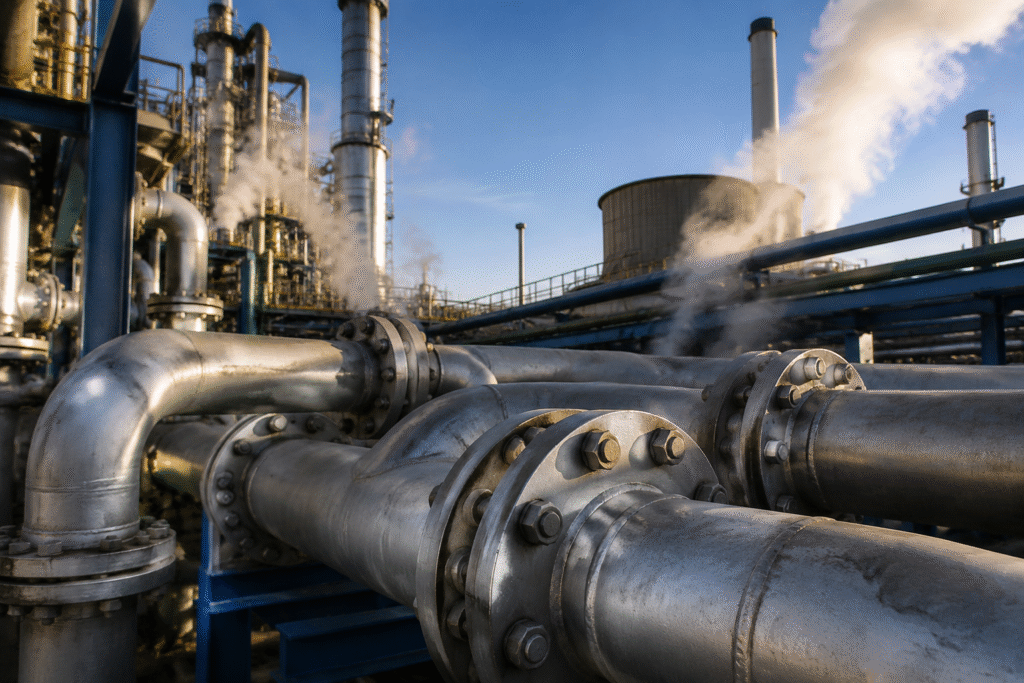
Seleção de flanges de aço inoxidável para pressão e vida útil
O flange de tubo de aço inoxidável market is expanding as global process industries invest in corrosion-resistant piping systems. De acordo com a pesquisa Grand View (2024), o mercado global de flanges industriais foi avaliado em $5.8 bilhão em 2023 e está projetado para atingir $7.2 bilhão por 2030.
Para equipes de compras e engenheiros de tubulação, that growth reflects a clear priority: vida útil mais longa, safer joints, and stronger compliance in demanding systems. Portanto, buyers now expect more than stock availability from a flange supplier.
Why the Stainless Steel Pipe Flange Market Keeps Growing
Industrial demand for Stainless, Aço, Flanges continues to rise across refinery upgrades, desalination projects, plataformas offshore, and pharmaceutical plants. De acordo com Statista (2024), a indústria de petróleo e gás é responsável por aproximadamente 35% do consumo global de flanges.
That figure matters because oil and gas applications require reliable sealing under pressure cycling, temperature fluctuation, e meios corrosivos. Como resultado, stainless steel pipe flange products remain a preferred choice for critical service lines.
Regional manufacturing concentration also shapes sourcing strategy. De acordo com IBISWorld (2024), Ásia-Pacífico é responsável por mais de 45% da produção global de flanges, sendo a China o maior fabricante.
This concentration gives buyers access to scale, wider alloy selection, and shorter lead times when they source from established manufacturers. No entanto, supplier qualification remains essential because dimensional accuracy, rastreabilidade, and metallurgical consistency directly affect field performance.
Many competitor pages focus on SKU volume, basic sizes, and cart-based ordering. Em contraste, serious B2B buyers also need application guidance on 304 contra 316, flange face type, classe de pressão, e documentação de inspeção.
As piping engineer Mark Jensen, Consultor Sênior de Tubulação de Processo, estados: “A flange is never just a commodity part; it is a pressure boundary component that must match process chemistry, temperatura, carga do parafuso, and assembly practice.” That insight explains why technical content now influences purchasing decisions as much as price.
Em termos práticos, buyers compare several variables before placing a PO. These include alloy chemistry, ASTM/ASME conformity, tolerância de usinagem, hydrostatic or PMI test support, and document packages such as EN 10204 3.1 certificados.
SASA FLANGE supports this expectation with ISO 9001:2015 e certificações PED 2014/68/EU, while supplying stainless steel flanges and fittings for Oil & Gás, Petroquímica, Poder, Marinho, e setores de Tratamento de Água. Buyers looking for project support can review capabilities at https://sasaflange.com/about-us/.
The market also favors suppliers that can cover both standard and engineered requirements. Portanto, fabricantes com usinagem CNC, broad raw material sourcing, and custom production flexibility hold a measurable advantage in complex bids.
De acordo com a Inteligência Mordor (2024), global investment in process industry infrastructure continues to support mid-single-digit annual demand growth for industrial piping components. Além disso, corrosion-related maintenance still represents one of the largest avoidable lifecycle costs in processing plants.
That is why a well-selected stainless steel pipe flange often reduces total installed cost even when the unit price is higher than carbon steel. Longer maintenance intervals and lower replacement frequency usually outweigh the initial premium.
How to Select a Stainless Steel Pipe Flange for Pressure, Corrosão, and Service Life
Flange selection starts with service conditions, not with catalog sorting. Engineers first define fluid chemistry, pressão de projeto, temperatura de projeto, tamanho da linha, tolerância à corrosão, and the preferred joint configuration.
Por exemplo, a Threaded flange may suit low-pressure utility lines or systems where welding is impractical. No entanto, for severe cyclic service or high-integrity process lines, weld neck designs usually provide better stress distribution.
De acordo com ASME B16.5, as classificações de pressão-temperatura variam de acordo com o grupo e a classe do material, então um 600# Flange cannot be evaluated by pressure class alone. Grau do material, tipo de junta, aparafusamento, and actual operating temperature all affect performance (ASME, 2023).
That is where many purchasing mistakes occur. A buyer may assume all 600# stainless products perform equally, even though ASTM A182 F304, F316, duplex 2205, e superduplex 2507 have different corrosion resistance and mechanical profiles.
Como Dr.. Elena Morris, Cientista de Materiais em Engenharia de Corrosão, estados: “The best flange alloy is the one that resists the actual process environment over time, not the one with the lowest upfront cost.” Her point is especially relevant in chloride-bearing media and marine exposure.
For most commercial applications, 304 Stainless Steel Flanges offer good general corrosion resistance and cost efficiency. No entanto, 316 and 316L grades provide improved resistance to chlorides and many chemical environments due to added molybdenum.
Engineers should also assess whether low-carbon grades are needed after welding. Portanto, 316L often becomes the preferred option for process lines that require better weldability and lower risk of sensitization.
- 304 / 304eu: Suitable for general industrial service, processamento de alimentos, and non-aggressive water systems.
- 316 / 316eu: Preferred for chemical, marinho, e ambientes contendo cloreto.
- 904eu: Used for highly corrosive media, including certain acids and aggressive process streams.
- 2205 Dúplex: Offers high strength and strong resistance to pitting and stress corrosion cracking.
- 2507 Superduplex: Chosen for offshore, dessalinização, and severe chloride service.
Dimensionally, flange choice must align with the mating Pipe specification and schedule. Deslizamento, pescoço de solda, cego, solda de soquete, junta sobreposta, and Threaded options each impose different fit-up, chato, and welding considerations.
Buyers often ask whether blind or weld neck designs cost more over a full project. De acordo com a Pesquisa de Mercado Futuro (2024), end users increasingly prioritize lifecycle reliability over initial component cost in engineered piping procurement, especially in energy and chemical processing.
Face type also matters because sealing performance depends on the full joint system. Rosto levantado, cara plana, and RTJ configurations each require correct gasket selection and bolt load control.
Typical specification checks should include the following points before procurement approval. These checks reduce mismatch risk and help avoid costly site rework.
- ASME B16.5 ou ASME B16.47 conformidade dimensional.
- ASTM A182 material grade confirmation.
- Classe de pressão como 150, 300, ou 600#.
- Tipo de revestimento: RF, FF, ou RTJ.
- NPS size and wall schedule compatibility.
- Heat number traceability and PMI availability.
- EN 10204 3.1 certification when required.
- PED or project-specific documentation needs.
SASA FLANGE manufactures stainless steel pipe flange products in 304, 316, 316eu, 904eu, 2205, e 2507, while also offering elbows, camisetas, redutores, and caps for integrated package sourcing. Além disso, its factory supports custom sizes from 1/2 polegada para 60 polegada com preços competitivos direto da fábrica, which helps EPC buyers consolidate vendors.
That integrated supply model matters because many projects need more than one Flange type. A single supplier that can machine Blind, Deslizamento, Pescoço de solda, and Stainless Steel Threaded Pipe Flange items while controlling quality can simplify both inspection and logistics.
Procurement managers should also ask for evidence of manufacturing discipline. This includes raw material traceability, calibrated inspection tools, identificação positiva de material, and documented final dimensional checks.
De acordo com as orientações de gestão de qualidade ISO, process consistency directly improves defect prevention in repetitive industrial manufacturing (ISO, 2023). Portanto, certified systems can reduce the risk of receiving mixed heats, incorrect drilling, or surface finish deviations.
If you need engineering support on flange type, liga, or custom dimensions, you can contact SASA FLANGE for project-specific guidance. Adicionalmente, buyers can review the broader product scope at https://sasaflange.com/products/.
ASME, ASTM, DIN, e Requisitos EN para Flanges de Aço Inoxidável
Standards determine interchangeability, integridade de pressão, e expectativas de inspeção. Portanto, a stainless steel pipe flange should always be purchased against a clearly defined dimensional and material standard.
In North American and many international projects, ASME B16.5 rege as dimensões, tolerâncias, classificações de pressão-temperatura, marcação, e testes para flanges até NPS 24. Larger sizes typically reference ASME B16.47, while buttweld fittings commonly follow ASME B16.9.
Material specification usually points to ASTM A182 para flanges de tubos de liga forjada ou laminada e aço inoxidável. Além disso, some projects require supplementary testing, controle de ferrite, limites de dureza, or impact test requirements depending on service conditions.
Os projetos europeus podem especificar EN 1092 dimensions and PED compliance. German and Japanese end users may also request DIN or JIS equivalents, especially for replacement work or mixed-origin systems.
For sour service or corrosive hydrocarbon environments, material selection must also consider NACE requirements where applicable. Além disso, offshore and marine projects may impose DNV, NORUEGA, or owner-specific approval requirements.
- ASME B16.5: Dimensions and ratings for pipe flanges and flanged fittings.
- ASME B16.47: Flanges de aço de grande diâmetro.
- ASTM A182: Forged or rolled alloy and stainless steel flanges and fittings.
- ASME B16.9: Acessórios para soldagem de topo forjados feitos na fábrica.
- EN 1092: Dimensões europeias de flange e designações de pressão.
- PED 2014/68/EU: Quadro regulamentar para equipamentos sob pressão na UE.
Buyers should confirm the exact edition and project notes because standards evolve. Além disso, bolt hole alignment, acabamento frontal, and bore machining details must match the mating component standard.
Image alt text: stainless steel pipe flange dimensions and ASME compliance inspection in industrial factory.
A practical comparison helps when evaluating cross-market procurement. Classe ASME 150, 300, e 600# ratings are not directly interchangeable with every PN designation under EN systems, even if nominal sizes appear similar.
As flange specialist Robert Hale, PE, notas: “Dimensional similarity is not proof of compatibility; perfuração, enfrentando, and rating systems must be verified before installation.” This is especially important in retrofit projects where legacy DIN, ANSI, and EN items may coexist.
For documentation, serious B2B buyers commonly request:
- Mill test certificates to EN 10204 3.1.
- Heat treatment records where applicable.
- PMI reports for alloy confirmation.
- Relatórios de inspeção dimensional.
- Hydrotest or NDE support if project specifications require it.
- Packing lists and traceable marking records.
SASA FLANGE aligns with these expectations through ISO 9001:2015, PED 2014/68/EU, e ANÚNCIO 2000 supported manufacturing practices. Apoiado por usinagem CNC avançada e testes de qualidade abrangentes, the company supplies flange and fitting packages for customers in more than 50 países.
For engineers who need direct standard references, consult the official ASME site at https://www.asme.org/. Using primary standards during specification review reduces ambiguity and helps prevent field nonconformance.
Guia de Aplicação para Petróleo e Gás, Químico, Poder, and Marine Piping Systems
Application context should drive every stainless steel pipe flange decision. The same nominal size and pressure class can behave very differently in offshore seawater, vapor de alta temperatura, or acid service.
Em petróleo e gás, flange reliability directly affects shutdown risk and safety. De acordo com Statista (2024), this sector accounts for roughly 35% do consumo global de flanges, which reflects the sheer number of pressure-containing joints across upstream, meio do caminho, and downstream assets.
For hydrocarbon service, common choices include weld neck flanges in ASTM A182 F316/F316L, duplex 2205, or higher alloys where chlorides and sour conditions demand stronger corrosion resistance. Em contraste, utility systems may use Threaded or slip-on options when code and service conditions allow.
Chemical processing often requires closer review of media composition, concentração, e temperatura. Portanto, 316eu, 904eu, Monel, Hastelloy, or titanium-based solutions may become necessary in highly aggressive environments.
Power generation places heavy emphasis on pressure class, temperature resistance, e estabilidade dimensional. Como resultado, alloy selection and flange design often follow stricter mechanical and thermal performance criteria than those used in general utility systems.
Marine and shipbuilding applications prioritize chloride resistance, coating compatibility, and long-term exposure performance. Duplex and super duplex grades therefore remain attractive when owners need lower maintenance and higher structural strength.
- Óleo & Gás: Prefer weld neck or RTJ designs for critical pressure service and vibration resistance.
- Químico: Match alloy to media chemistry and verify gasket compatibility.
- Poder: Confirm pressure-temperature ratings and thermal cycling tolerance.
- Marinho: Evaluate chloride resistance, crevice corrosion risk, and traceable metallurgy.
- Tratamento de Água: Use 316L or duplex grades where chloride content is elevated.
Buyers also need to think about supply chain efficiency. A supplier that can deliver flanges and matching fittings reduces package fragmentation, inspection delays, and the risk of dimensional mismatch.
SASA FLANGE oferece suporte à fabricação personalizada para requisitos padrão e não padrão, incluindo cotovelos, camisetas, redutores, and caps that align with project piping systems. That capability is useful for EPC contractors managing mixed-material packages or urgent shutdown maintenance.
Selection should also consider practical field details. Por exemplo, 4 inch stainless steel pipe flange requirements may differ between a Class 150 water line and a Class 600 process line due to bore, enfrentando, aparafusamento, and corrosion demands.
Da mesma maneira, buyers searching for stainless steel flange 2 inch products should confirm whether they need NPT Threaded, deslizamento, or weld neck construction. Small-bore assemblies frequently create confusion because end connection type is often omitted in fast RFQ requests.
To reduce delays, RFQs should include:
- Nominal Pipe Size and schedule.
- Classe de pressão como 150, 300, ou 600#.
- Material grade such as F304, F316L, ou 2205.
- Facing type and gasket preference.
- Padrão aplicável, como ASME B16.5 ou PT 1092.
- Documentation requirements including EN 10204 3.1.
- Quantidade, destino, and delivery window.
Para projetos que exigem perfuração personalizada, revestimento especial, or non-standard dimensions, direct coordination with SASA FLANGE can streamline engineering review. Além disso, factory-level support often improves quotation accuracy and lead-time planning.
Image alt text: stainless steel pipe flange installation in refinery piping system with fittings and valves.
Perspectivas Futuras para Flanges de Aço Inoxidável e Recomendações Estratégicas de Compra
The outlook for Stainless Steel Flanges remains positive as infrastructure spending, projetos de transição energética, and water treatment expansion continue. De acordo com a pesquisa Grand View (2024), espera-se que o mercado cresça a partir $5.8 bilhão em 2023 para $7.2 bilhão por 2030.
That growth will likely favor suppliers with alloy breadth, documentação de qualidade, and flexible production. Além disso, procurement teams increasingly value suppliers that can support both standard catalog needs and engineered project requirements.
According to industry tracking from IBISWorld (2024), Asia-Pacific remains the dominant global production base, com mais 45% of flange output. Portanto, buyers who source from China should focus on qualification, communication speed, and documentation discipline rather than unit price alone.
Digital procurement will also reshape this market. No entanto, unlike simple commodity listings, technical buyers still need engineering context on flange types, material differences, conformidade, e valor do ciclo de vida.
That creates an opportunity for manufacturers that combine production scale with technical responsiveness. Suppliers able to explain 304 contra 316, Threaded versus weld neck, e 150 contra 600# Flange selection will outperform sellers that only publish SKU grids.
Practical recommendations for B2B buyers include:
- Standardize approved material grades and flange types by application.
- Require full RFQ data to avoid quotation ambiguity.
- Verify standard compliance before price comparison.
- Solicitar CTMs, PMI, and traceability for critical service.
- Avalie o custo do ciclo de vida, não apenas o preço de compra.
- Consolidate flanges and fittings with one qualified source when possible.
For buyers seeking dependable stainless steel pipe flange supply, tamanhos personalizados, and certified manufacturing support, working with an experienced producer can reduce both technical and commercial risk. Com ISO 9001:2015 e certificações PED 2014/68/EU, SASA FLANGE remains a practical partner for engineers and procurement managers sourcing Stainless, Aço, Flanges for global industrial projects.
Perguntas frequentes
Para que são usados os flanges de aço inoxidável?
●Flanges de aço inoxidável são usadas para conectar seções de tubos, válvulas, bombas, e equipamentos em sistemas que exigem resistência, resistência à corrosão, e vedação confiável.
●De acordo com Statista (2024), the oil and gas industry alone accounts for about 35% do consumo global de flanges, which shows how critical these components are in pressure-containing service.
●They are commonly installed in Oil & Gás, petroquímico, geração de energia, marinho, processamento de alimentos, and water treatment lines where 304, 316, or duplex grades help resist moisture, produtos químicos, and temperature variation.
●Common uses include maintenance-friendly joints, equipment isolation points, blind terminations, and transitions between piping and rotating equipment.
●For projects requiring traceable materials, ASME B16.5 dimensões, e EN 10204 3.1 certificação, trabalhando com fabricantes estabelecidos como SASA FLANGE helps ensure fit, conformidade, e confiabilidade a longo prazo.
Quais são os três tipos de flanges?
●The three most widely referenced flange types in general industrial use are weld neck, deslizamento, e flanges cegas.
●Weld neck flanges are preferred for higher integrity service because their tapered hub improves stress distribution under pressure and thermal cycling, while slip-on flanges are often selected for easier alignment and lower fabrication cost.
●Blind flanges close the end of a piping system, which makes them useful for isolation, testando, and future expansion points in refinery, químico, e sistemas utilitários.
●De acordo com ASME B16.5 (2023), each type has defined dimensions, padrões de perfuração, and pressure-temperature rating criteria that must match the mating component and service conditions.
●When a project includes aggressive media, alta temperatura, ou 600# duty, buyers should ask for engineering guidance before ordering, e fornecedores experientes, como SASA FLANGE can help confirm the best configuration.
Quais são os diferentes tipos de flanges de aço inoxidável?
●Os principais tipos de flanges de aço inoxidável incluem pescoço de solda, deslizamento, cego, solda de soquete, junta sobreposta, and Threaded designs, with RTJ and reducing variants also used in specialized systems.
●Cada tipo serve a um propósito diferente, because joint strength, facilidade de instalação, acesso de manutenção, and leakage control all vary by geometry and service condition.
●Por exemplo, Stainless Steel Threaded Pipe Flange products are useful where welding is restricted, while weld neck flanges are preferred for severe pressure cycling and critical process lines.
●De acordo com a pesquisa Grand View (2024), o mercado mais amplo de flanges alcançou $5.8 bilhão em 2023, which reflects sustained global demand for multiple flange types across energy, químico, e setores de infraestrutura.
●To avoid ordering errors, buyers should specify the NPS, classe de pressão, enfrentando, ASTM A182 nota, e padrão como ASME B16.5 before placing an RFQ with a qualified supplier.
What is the best material for flanges?
●The best flange material depends on the actual service environment, because pressure, temperatura, cloretos, acidez, and maintenance expectations all influence material performance.
●304 stainless is cost-effective for many general services, enquanto 316 and 316L perform better in chloride-containing or marine environments, e duplex 2205 ou 2507 often suits more aggressive process conditions.
●Como o cientista de materiais Dr.. Elena Morris afirma, the right alloy is the one that survives the real chemistry over time rather than the one with the lowest initial price.
●De acordo com IBISWorld (2024), A Ásia-Pacífico produz mais de 45% de flanges globais, so buyers have broad access to stainless, liga, and duplex options but still need to verify metallurgical and dimensional quality carefully.
●Para sistemas críticos, especificar ASTM A182 nota, solicitar PMI e 3.1 certificação, and consult an experienced manufacturer when comparing carbon steel, 304, 316eu, and duplex alternatives.
What sizes are available for stainless steel pipe flange products?
●Os tamanhos padrão de flanges de tubos de aço inoxidável geralmente começam em 1/2 inch and extend to 24 polegada abaixo ASME B16.5, with larger diameters covered under ASME B16.47 and custom production available for many projects.
●Small sizes such as 2 inch and common mid-range sizes such as 4 inch stainless steel pipe flange products are widely used in process lines, derrapagens, cabeçalhos de utilitário, and equipment nozzles.
●No entanto, size alone is not enough because buyers must also match schedule, chato, tipo de revestimento, and pressure class such as 150, 300, ou 600#.
●According to ASME standards guidance (2023), dimensional compliance and bolt-hole accuracy are essential for interchangeability and leak-free assembly, especially when components come from multiple sources.
●For custom dimensions, perfuração fora do padrão, or matching flanges and fittings in one package, entrando em contato SASA FLANGE can simplify technical review and procurement planning.
Como faço para escolher entre 304 e 316 tipos de flange de aço inoxidável?
●Escolher 304 stainless steel flange types for general corrosion resistance and cost-sensitive industrial service, e escolha 316 ou 316L quando cloretos, exposição marinha, or more aggressive chemicals are present.
●The added molybdenum in 316 improves resistance to pitting and crevice corrosion, which is why it is often preferred for coastal, químico, e sistemas de tratamento de água.
●In welded systems, 316L may provide an additional advantage because its lower carbon content helps reduce sensitization risk after fabrication.
●De acordo com a Pesquisa de Mercado Futuro (2024), industrial buyers increasingly prioritize lifecycle cost over initial purchase price, which supports the use of higher-performance alloys where maintenance and failure risk are significant.
●As a practical rule, confirm process chemistry, temperatura operacional, regime de limpeza, and certification requirements before deciding, and request technical support if the system operates in chloride-rich or regulated service.
Posts Relacionados
Acabamento da face do flange: Serrilhas concêntricas vs espirais explicadas
As serrilhas concêntricas e espirais são acabamentos de face de flange usinados…
Dúplex 2205 vs Flanges 316L: Qual material você deve escolher?
Resposta rápida: Dúplex 2205 flanges são geralmente o candidato mais forte…

Definição de flange de orifício, Detalhes e visão geral dos flanges ASME B16.36: Dados de mercado, Guia de seleção e insights de conformidade
O mercado global de flanges industriais foi avaliado em $5.8 bilhão…

Guia de mercado de flange de descarte preto: Materiais, 3.5″ Compatibilidade, e dados de fornecimento B2B para flanges de pia de cozinha
A demanda por flanges descartáveis pretos está aumentando à medida que os compradores de utensílios de cozinha…