
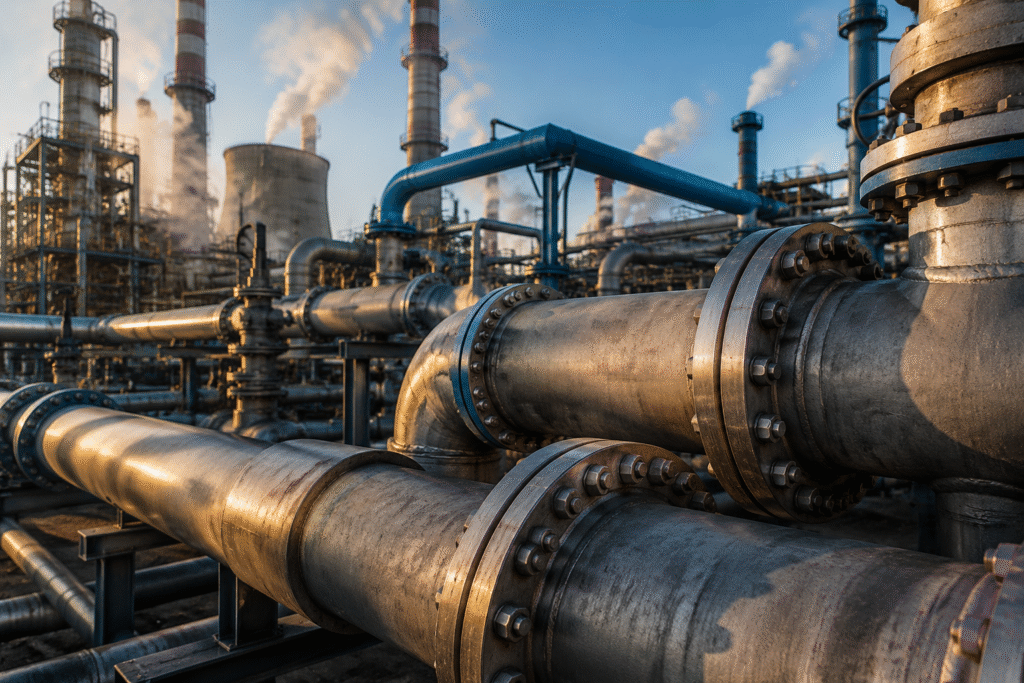
Guia de flange de tubo de aço inoxidável: Tipos, Usos, Como escolher flanges em um mercado de US$ 5,8 bilhões
A demanda por flanges para tubos de aço inoxidável continua aumentando à medida que os sistemas industriais exigem maior resistência à corrosão, desempenho de vedação mais apertado, e maior vida útil. De acordo com a pesquisa Grand View (2024), o mercado global de flanges industriais foi avaliado em $5.8 bilhão em 2023 e está projetado para atingir $7.2 bilhão por 2030, which highlights how critical flanges are for modern piping infrastructure.
Para engenheiros e gerentes de compras, o desafio mais comum não é encontrar flanges, but choosing the right stainless steel pipe flange for pressure class, ambiente de corrosão, método de fabricação, e conformidade com o código. Portanto, this guide explains the intriguing material options, tipos de flange comuns, usa, padrões, and buying criteria that matter in real projects.
Demanda de mercado, Manufacturing Trends, and Why Stainless Steel Pipe Flange Selection Matters
Industrial buyers are sourcing more stainless steel components because downtime costs continue to increase across oil and gas, processamento químico, poder, e setores marinhos. De acordo com Statista (2024), a indústria de petróleo e gás é responsável por aproximadamente 35% do consumo global de flanges, which makes flange reliability a direct operational priority.
Regional supply dynamics also influence sourcing strategy. De acordo com IBISWorld (2024), Ásia-Pacífico é responsável por mais de 45% da produção global de flanges, sendo a China o maior fabricante, so buyers increasingly evaluate supplier quality systems alongside price and lead time.
These numbers matter because flange failure is rarely an isolated event. A wrong material grade, poor facing finish, or incorrect pressure-temperature rating can trigger leakage, unplanned shutdowns, and expensive maintenance work.
Como resultado, purchasing teams now ask deeper technical questions about ASTM grades, EN compatibility, documentação de inspeção, e rastreabilidade. This shift favors manufacturers that combine material range, precisão de usinagem, e conformidade de exportação.
SASA FLANGE operates in this quality-focused segment with stainless steel flanges, flanges de aço carbono, flanges de liga, and pipe fittings for demanding industrial systems. Com ISO 9001:2015 e certificações PED 2014/68/EU, the company supplies projects that require verified dimensional accuracy, rastreabilidade de materiais, and international code alignment.
Adicionalmente, stainless grades remain attractive because they support a wide range of service conditions. Os materiais comuns incluem 304, 316, 316eu, 904eu, duplex 2205, superduplex 2507, and high-performance nickel alloys for aggressive media.
De acordo com a Inteligência Mordor (2024), global investment in water treatment and process infrastructure continues to expand, increasing demand for corrosion-resistant piping assemblies. In contrast to commodity carbon steel components, stainless steel pipe flange products often reduce lifecycle cost in wet, contendo cloreto, or hygienic applications.
Procurement professionals should also consider the broader cost equation. Initial unit price is important; no entanto, replacement frequency, mão de obra de manutenção, media compatibility, and inspection burden often have a greater long-term impact.
That is why the most common specification packages now include flange standard, padrão de materiais, tipo de revestimento, classe de pressão, requisitos de teste, and certificate level. Por exemplo, muitos compradores solicitam EN 10204 3.1 certificados, PMI, registros de testes hidrostáticos, e NACE MR0175 compliance for sour service projects.
Manufacturing capability is another differentiator. Apoiado por usinagem CNC avançada e testes de qualidade abrangentes, SASA FLANGE suporta tamanhos personalizados de 1/2" para 60" across ANSI B16.5, ANSI B16.47, DIN, JIS, GOST, e PT 1092 configurações.
Para compradores comparando fornecedores, this means fewer sourcing gaps between design intent and delivered product. It also means faster alignment when projects require mixed standards, perfuração especial, or non-standard dimensions.
Tipos de flange de tubo de aço inoxidável, Materiais, and Uses Engineers Most Commonly Compare
The most common buying question is simple: which flange type and grade fit the service conditions best. Na prática, the answer depends on pressure, temperatura, química de fluidos, cronograma de tubulação, método de soldagem, e acesso para manutenção.
As John Rezai, Engenheiro de Tubulação Sênior, estados: “A flange should never be selected by material alone; the sealing face, classe de pressão, and joint design are just as important as corrosion resistance.” This is why engineers evaluate the entire joint assembly, not only the stainless designation.
Material selection starts with understanding environment severity. ASTM A182 F304 and F304L are widely used for general process service, while F316 and F316L are preferred where chlorides, mild acids, or marine exposure increase corrosion risk.
De acordo com a Pesquisa de Mercado Futuro (2024), stainless and alloy flanges are gaining share in high-spec process systems due to stricter safety and maintenance standards. Além disso, duplex and super duplex materials continue to expand in offshore and desalination applications where high strength and chloride resistance matter.
For many projects, these are the stainless steel pipe flange material options buyers most often compare:
- 304 and 304L for general corrosion resistance, boa soldabilidade, and broad availability.
- 316 and 316L for improved pitting resistance due to molybdenum addition.
- 904L for severe chemical service with enhanced resistance in acidic environments.
- 2205 duplex for higher strength and better chloride stress corrosion cracking resistance.
- 2507 super duplex for aggressive offshore, água do mar, e condições de alto teor de cloreto.
- Inconel, Monel, Hastelloy, and Titanium for highly specialized process duties.
The intriguing part of stainless selection is that higher alloy content does not automatically mean better value. Em vez de, the correct grade is the one that meets corrosion allowance, conformidade do código, and service life targets without unnecessary cost escalation.
Engineers also compare flange designs based on connection type and maintenance strategy. Slip-on flanges are common in lower-pressure systems because they are easier to align, while weld neck flanges are preferred for cyclic loading, choque térmico, and high-pressure service.
Solda de soquete, rosqueado, junta sobreposta, and blind flanges serve more specific uses. Portanto, understanding the mechanical behavior of each design is essential before final procurement.
- Flange de pescoço soldado: melhor para alta pressão, alta temperatura, e linhas de processo críticas.
- Flange deslizante: economical for moderate service and easier shop fit-up.
- Flange cega: used to terminate, isolar, or future-proof line ends.
- Flange de solda de soquete: suitable for small-bore high-pressure piping.
- Flange roscada: practical where welding is restricted or field work is limited.
- Flange de junta sobreposta: useful when frequent dismantling and stub end rotation are needed.
De acordo com ASME B16.5, dimensões do flange, tolerâncias, classificações de pressão-temperatura, and facing requirements must align with designated class and material groups (ASME, 2023). Como resultado, the same nominal size can perform very differently depending on class 150, 300, 600, ou classificações mais altas.
Como Dr.. Meera Khanna, Materials Consultant, estados: “Em sistemas contendo cloreto, moving from 304L to 316L or duplex can dramatically improve reliability, but only if fabrication and welding controls are equally robust.” That observation is especially relevant for water treatment, marinho, e linhas químicas.
SASA FLANGE fabrica flanges em 304, 316, 904eu, 2205, 2507 and other premium grades for industrial users that need consistency across large procurement packages. Além disso, the company can match flange supply with elbows, camisetas, redutores, and caps to simplify sourcing and inspection.
Procurement teams should also verify dimensional series and mating compatibility before ordering. A stainless steel pipe flange built to EN 1092 may not directly interchange with an ASME B16.5 mating flange without careful review of drilling, grossura, e designação de pressão.
For buyers handling mixed-project requirements, SASA FLANGE capacidades do produto support standard and custom manufacturing for oil and gas, petroquímico, geração de energia, construção naval, marinho, tratamento de água, e construção. This flexibility helps engineers choose flanges based on service conditions rather than supplier limitations.
ASME, ASTM, DIN, and EN Standards That Define Stainless Steel Flanges Compliance
Standards determine whether a flange is acceptable for design, inspeção, and plant operation. Portanto, every serious purchase order should reference both dimensional and material standards, not just a generic stainless description.
The most common dimensional standards include ASME B16.5 para NPS 1/2 através 24 e ASME B16.47 para diâmetros maiores. Na Europa e em muitos projetos de exportação, EN 1092 and DIN flange standards remain common, while JIS and GOST apply in specific regional markets.
Os padrões de materiais são igualmente importantes. ASTM A182 cobre flanges de tubos de liga forjada ou laminada e aço inoxidável, acessórios forjados, válvulas, e peças para serviços em altas temperaturas, enquanto ASTM A240 covers stainless plate, folha, e tira para vasos de pressão e aplicações gerais (ASTM, 2024).
In corrosive upstream service, buyers may also require NACE MR0175 ou ISO 15156 compliance for sour environments. Adicionalmente, PED 2014/68/EU may apply where pressure equipment enters regulated European markets.
Below is a practical comparison of the most common standards engineers review:
- ASME B16.5: dimensões, classificações, tolerâncias, and facings for common flange sizes.
- ASME B16.47: large-diameter flanges for larger pipeline systems.
- ASME B16.9: dimensions for buttweld pipe fittings used with flange-connected systems.
- ASTM A182: stainless and alloy forged flange material specification.
- EN 1092-1: Dimensões europeias de flange e designações de pressão.
- Padrões DIN: legacy and application-specific metric flange systems.
- NACE MR0175: requisitos de materiais para ambientes contendo H2S.
- EN 10204 3.1: inspection certificate confirming test results and traceability.
De acordo com ISO (2023), traceability and documented quality controls are central to risk reduction in pressure equipment supply chains. That is why top-tier projects increasingly request heat number traceability, PMI, hardness reports, and third-party inspection releases.
Facing type is another critical area that buyers sometimes underestimate. Rosto levantado, cara plana, junta tipo anel, and tongue-and-groove arrangements all influence gasket performance and bolt load distribution.
As Michael Turner, Piping Systems Analyst, estados: “Most flange leakage events are not caused by one defect; they result from small errors in standard selection, gasket choice, and installation torque stacking together.” Consequentemente, technical review before ordering often prevents expensive commissioning delays.
SASA FLANGE apoia este requisito com ISO 9001:2015, PED 2014/68/EU, e ANÚNCIO 2000 aligned manufacturing documentation for export-oriented projects. Além disso, buyers can request material certificates, relatórios de inspeção dimensional, and other quality records based on project scope.
Para gerentes de compras, a useful rule is to specify at least these data points on every RFQ:
- Flange type and nominal size.
- Classe de pressão ou classificação PN.
- Material grade and standard.
- Facing type and surface finish requirement.
- Quantidade, application medium, and design temperature.
- Certificados necessários, como EN 10204 3.1, DEP, or NACE.
- Testing such as PMI, suporte para hidroteste, dureza, or dye penetrant when applicable.
Detailed specifications reduce quotation ambiguity. They also help manufacturers provide the correct stainless steel pipe flange solution without repeated clarification cycles.
For deeper standards reference, engineers can review official dimensional requirements directly at ASME.org. No entanto, many buyers prefer working with suppliers that can interpret those standards and convert them into production-ready deliverables.
Como escolher flanges para óleo & Gás, Químico, Poder, Marinho, and Water Treatment Projects
Choosing flanges begins with the process environment, not the catalog page. The right selection balances corrosion resistance, integridade de pressão, fabrication practicality, necessidades de inspeção, e custo do ciclo de vida.
Em sistemas de petróleo e gás, alta pressão, vibração, and sour media often push designers toward weld neck flanges in ASTM A182 F316L, duplex 2205, or higher alloy grades. De acordo com Statista (2024), this sector represents around 35% da demanda global de flanges, so proven reliability under cyclic service remains a top concern.
Em serviços petroquímicos e químicos, fluid chemistry usually drives grade selection. 316L works well in many moderate chloride environments, enquanto 904L, Hastelloy, or other high-performance alloys may be necessary for more aggressive acids or mixed chemical streams.
Power generation projects often prioritize thermal stability and pressure capability. Portanto, engineers frequently choose forged flanges with controlled metallurgy and strict dimensional tolerances for steam, condensado, e linhas de processo auxiliares.
Marine and shipbuilding applications bring a different challenge because seawater exposure increases the risk of pitting and crevice corrosion. In these uses, 2205 e 2507 duplex grades often deliver a stronger strength-to-corrosion-resistance balance than standard austenitic stainless options.
Water treatment plants typically need dependable corrosion resistance, facilidade de limpeza, e eficiência de custos. Como resultado, 304eu, 316eu, and duplex materials are common depending on chloride content, disinfection chemistry, and system pressure.
Buyers should evaluate these criteria before they choose flanges:
- Pressão operacional, temperatura, and pressure cycling frequency.
- Composição fluida, nível de cloreto, pH, and contamination risk.
- Tipo de flange necessário, enfrentando, and mating component compatibility.
- Pipe schedule and welding procedure compatibility.
- Inspeção, certificação, and regional compliance requirements.
- Maintenance access and disassembly frequency.
- Tempo de espera, total installed cost, e vida útil esperada.
According to DNV guidance for marine and offshore systems (DNV, 2023), material selection should account for both nominal design conditions and upset scenarios. This is important because localized corrosion often accelerates when actual operating chemistry differs from design assumptions.
Por exemplo, um 4 flange de tubo de aço inoxidável de polegada na classe 150 may suit a utility water header, while the same line in a chloride-rich marine skid may require 316L or duplex with a different facing and gasket arrangement. De forma similar, a large-diameter process line may demand ASME B16.47 dimensions rather than B16.5.
Custom manufacturing becomes especially valuable when projects combine non-standard drilling, special wall thickness transitions, or mixed international standards. SASA FLANGE suporta tamanhos personalizados de 1/2" para 60" with factory-direct supply for projects that need tailored dimensions, alloy matching, or special documentation.
Adicionalmente, combining flanges and fittings from one source can reduce mismatch risk during site assembly. Buyers handling EPC packages often prefer this approach because it simplifies quality control, logística, e inspeção final.
For companies comparing stainless steel flange price against lifecycle performance, the best decision is usually evidence-based rather than purely budget-based. A slightly higher-grade flange can reduce replacement frequency and leakage exposure, which often delivers a stronger total cost position over time.
That is why many project teams involve engineering, Controle de qualidade, and procurement in the same supplier evaluation. When material expertise and manufacturing capability are aligned, the flange selection process becomes faster and more accurate.
Perspectivas Futuras para Flanges de Aço Inoxidável e Recomendações Estratégicas de Compra
The market outlook remains positive as infrastructure renewal, energy projects, and water treatment investment continue to expand. De acordo com a pesquisa Grand View (2024), espera-se que o mercado de flange industrial cresça de $5.8 bilhão em 2023 para $7.2 bilhão por 2030, indicating sustained purchasing activity across multiple sectors.
Ao mesmo tempo, specification complexity is increasing. Buyers now expect traceability, global standard compatibility, and material options that can handle more aggressive process conditions with fewer maintenance events.
De acordo com a Inteligência Mordor (2024), industrial processing growth in Asia and the Middle East is increasing demand for corrosion-resistant piping components. Portanto, suppliers that offer broad material coverage, documentação de exportação, and precision machining will gain a larger share of high-value projects.
Estrategicamente, buyers should standardize approved flange grades and dimensions wherever possible. This reduces spare part complexity, improves installation consistency, and shortens future procurement cycles.
It is also wise to qualify suppliers beyond unit price alone. Review certification scope, capacidade de usinagem, recursos de inspeção, confiabilidade de entrega, and responsiveness to technical deviations.
For many procurement teams, the most common mistake is under-specifying critical details during RFQ release. Em contraste, detailed technical inquiry packages improve quote accuracy and make supplier comparison much easier.
SASA FLANGE serve 50+ países em todo o petróleo & Gás, Petroquímica, Poder, and Marine industries with stainless steel flanges and fittings built for international project requirements. For buyers seeking a dependable manufacturing partner with premium grades, global standard coverage, e suporte técnico responsivo, conectando-se com SASA FLANGE early in the design or bidding stage can simplify both selection and supply planning.
Perguntas frequentes
Quais são os diferentes tipos de flanges de aço inoxidável?
●De acordo com ASME B16.5 (ASME, 2023), the most common stainless steel flange designs include weld neck, deslizamento, cego, solda de soquete, rosqueado, e tipos de juntas sobrepostas.
●Each type serves a different mechanical purpose, because weld neck flanges suit high-pressure and thermal cycling service while slip-on flanges are often chosen for easier alignment and lower-cost fabrication.
●For projects requiring exact type selection, revisão de classe de pressão, e EN 10204 3.1 documentação, trabalhando com fabricantes estabelecidos como SASA FLANGE helps ensure the flange matches the piping duty and standard requirement.
O que é melhor 304 ou 420 aço inoxidável?
●For flange applications, 304 stainless steel is usually the better option because it offers stronger corrosion resistance and broader use in process piping than 420, which is a martensitic grade more often selected for hardness.
●De acordo com as classificações de materiais ASTM e práticas comuns da indústria, ASTM A182 F304 is widely used in flange manufacturing, enquanto 420 is less common for pressure piping flanges due to lower corrosion performance in many wet industrial environments.
●If the service includes moisture, produtos químicos, ou exposição ao ar livre, buyers should generally specify 304, 316, or duplex grades rather than 420, and they should confirm suitability with a qualified supplier such as SASA FLANGE.
Quais são os três tipos de flanges?
●Os três tipos de flange mais comumente referenciados em discussões básicas sobre tubulação são pescoço de solda, deslizamento, and blind flanges because they cover the majority of standard connection and isolation needs.
●Weld neck flanges perform best in critical service, slip-on flanges are common in moderate-duty lines, and blind flanges are used to close pipe ends or provide future expansion points.
●Although these three are the most common, engineers should also consider socket weld, rosqueado, and lap joint designs when operating pressure, frequência de manutenção, or installation restrictions make another option more suitable.
Qual é o código ASME para flanges de aço inoxidável?
●The primary ASME dimensional code for stainless steel flanges is ASME B16.5 para tamanhos NPS 1/2 através 24, enquanto ASME B16.47 covers many larger-diameter flange dimensions.
●Material compliance is usually specified separately through ASTM standards such as ASTM A182 para flanges de aço inoxidável forjado, so buyers should reference both the ASME and ASTM standards on the purchase order.
●To avoid mismatch between dimensions, classe de pressão, e grau de material, procurement teams should request complete technical quotations from manufacturers that understand ASME, ASTM, DIN, e requisitos EN.
Quais tamanhos de flanges de tubos de aço inoxidável são mais comuns em projetos industriais?
●Industrial projects most commonly use stainless steel pipe flange sizes from 1/2 polegada para 24 polegadas abaixo ASME B16.5, although larger sizes are widely used in transmission, utilidade, and process systems under ASME B16.47.
●According to ASME standard scope and common market demand, small and mid-size flanges dominate facility maintenance and skid fabrication, while larger diameters are more common in water, marinho, and major process infrastructure.
●Buyers should always confirm nominal pipe size, classe de pressão, and facing type together, porque um 4 inch stainless steel pipe flange can vary significantly in thickness, padrão de parafuso, and weight depending on the governing standard.
How do I choose the right stainless steel pipe flange for corrosive service?
●Choosing the right flange for corrosive service starts with fluid chemistry, concentração de cloreto, temperatura operacional, e pressão, because these factors determine whether 304L, 316eu, 904eu, 2205, ou 2507 é apropriado.
●De acordo com a DNV (2023) and common materials engineering guidance, chloride-rich and marine environments often require 316L or duplex grades instead of 304L to reduce pitting and crevice corrosion risk.
●For corrosive applications, buyers should request material traceability, conformidade padrão, and quality documents such as EN 10204 3.1, and they should consult an experienced manufacturer before finalizing the grade and flange type.
Posts Relacionados
Acabamento da face do flange: Serrilhas concêntricas vs espirais explicadas
As serrilhas concêntricas e espirais são acabamentos de face de flange usinados…
Dúplex 2205 vs Flanges 316L: Qual material você deve escolher?
Resposta rápida: Dúplex 2205 flanges são geralmente o candidato mais forte…

Definição de flange de orifício, Detalhes e visão geral dos flanges ASME B16.36: Dados de mercado, Guia de seleção e insights de conformidade
O mercado global de flanges industriais foi avaliado em $5.8 bilhão…

Guia de mercado de flange de descarte preto: Materiais, 3.5″ Compatibilidade, e dados de fornecimento B2B para flanges de pia de cozinha
A demanda por flanges descartáveis pretos está aumentando à medida que os compradores de utensílios de cozinha…