
Orifice Flange Definition, Details and ASME B16.36 Flanges Overview: Market Data, Selection Guide and Compliance Insights
The global industrial flange market was valued at $5.8 billion in 2023 and is projected to reach $7.2 billion by 2030, according to Grand View Research (2024). In that expanding market, the orifice flange remains a critical component for differential pressure flow measurement, especially in oil, gas, chemical, and power piping systems.
Engineers searching for the definition, details, Orifice, ASME, B16.36, Flanges, They, B16.36.pdf, ANSI, ORIFICE, FLANGES, overview usually need more than a basic glossary. They need a practical, standards-based guide that connects design, materials, dimensions, installation, and procurement decisions.
This article provides that overview with a technical focus for engineers and buyers. It also explains how manufacturers such as SASA FLANGE support demanding projects with ISO 9001:2015 and PED 2014/68/EU certified production.
Industrial Demand for Orifice Flange Systems in Modern Piping Networks
According to Statista (2024), the oil and gas industry accounts for approximately 35% of global flange consumption. Therefore, components designed for reliable pressure tapping and repeatable flow measurement have strong relevance in upstream, midstream, and refining applications.
According to IBISWorld (2024), Asia-Pacific accounts for over 45% of global flange production, with China being the largest manufacturer. As a result, procurement teams increasingly compare lead time, machining accuracy, traceability, and testing capability when sourcing specialized ASME B16.36 flanges.
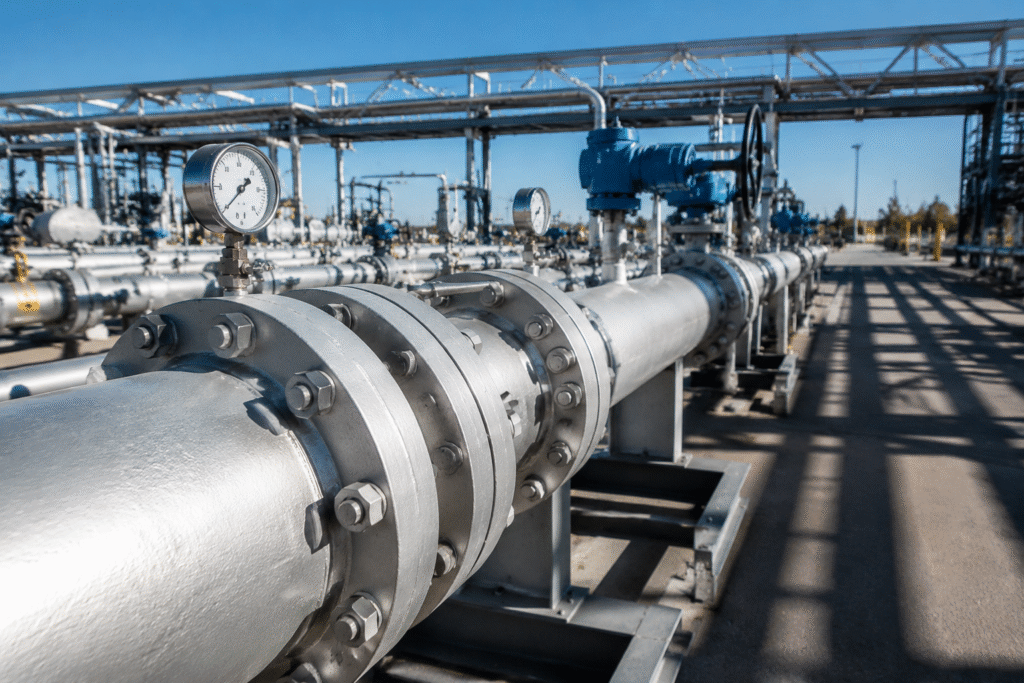
An orifice flange is a specialty flange assembly designed to hold an orifice plate and provide pressure tappings for differential pressure measurement. In practice, they simplify installation because they eliminate the need for separate tapping points on the pipe wall.
The core design logic is straightforward. A restriction element, usually an orifice plate, creates a pressure drop, and paired pressure taps measure the differential pressure across that restriction.
That pressure signal then supports flow calculation when combined with instrumentation and calibrated equations. This is why orifice flange assemblies remain common in process plants that prioritize robust, standardized measurement hardware.
ASME B16.36 defines the dimensional and tolerancing framework for many of these products, while related requirements often reference ASME B16.5, ASME B1.20.1, and applicable ASTM material standards. Moreover, project specifications may add API, NACE, DIN, or EN requirements depending on geography and service conditions.
For procurement professionals, the issue is not only the definition of ORIFICE FLANGES. The real concern is whether they meet pressure class, material compatibility, tapping configuration, facing type, inspection level, and documentation needs.
That is where manufacturing competence matters. Backed by advanced CNC machining and comprehensive quality testing, SASA FLANGE supplies stainless steel, carbon steel, alloy, duplex, nickel alloy, and titanium flanges for industrial service.
With production in grades such as 304, 316, 316L, 904L, 2205, 2507, A105, A182, Inconel, Monel, Hastelloy, and Titanium, the company supports projects across Oil & Gas, Petrochemical, Power Generation, Shipbuilding & Marine, Water Treatment, and Construction. Additionally, buyers can review broader manufacturing capability through SASA FLANGE company information.
According to Mordor Intelligence (2024), process automation investments continue to rise across energy and chemicals, reinforcing demand for dependable flow metering hardware. Consequently, the details behind orifice flange dimensions, tapping orientation, and assembly method now influence both measurement reliability and total lifecycle cost.
Orifice Flange Definition, Details and Technical Design Under ASME B16.36
The standard technical definition is precise. Orifice flanges are usually installed in pairs and machined with radial pressure tappings so operators can connect transmitters or gauges directly to the flange set.
Most designs also include jack screws. These allow safe flange separation during maintenance, which makes orifice plate inspection or replacement significantly easier.
As John Carter, Senior Piping Engineer, states: “A properly machined orifice flange pair reduces field variability because the tapping geometry is controlled at the flange rather than improvised in the line.” That observation aligns with common field practice in refineries and gas processing facilities.
From a construction standpoint, the most common forms resemble weld neck, slip on, or threaded flanges, but they include added machining features. These usually include two pressure tap holes and threaded tapping outlets, often 1/2 inch NPT, in accordance with ASME B1.20.1 thread requirements.
ASME notes that dimensional consistency is essential where measurement repeatability matters (ASME, 2023). Therefore, buyers should verify not only nominal size and class, but also tapping size, tapping centerline orientation, and facing details.
In most industrial projects, the following design variables define suitability:
- Nominal pipe size and schedule compatibility
- Pressure class such as Class 300, 600, 900, 1500, or 2500
- Flange type including weld neck, slip on, or threaded
- Facing type such as Raised Face or RTJ
- Material grade based on corrosion, pressure, and temperature
- Tapping thread and instrument connection details
- Jack screw quantity and positioning
- Inspection and certification requirements such as EN 10204 3.1
According to Market Research Future (2024), industrial instrumentation demand is increasing in line with process efficiency targets and emissions monitoring programs. As a result, more end users expect flange assemblies to integrate cleanly with modern transmitters and digital monitoring systems.
An orifice flange assembly is not only a pressure boundary item. It is also a measurement interface, and that dual role makes machining quality especially important.
For example, poor concentricity or inaccurate tapping locations can affect measurement repeatability. Likewise, incorrect facing finish or gasket selection can lead to leakage, maintenance downtime, or unstable readings.
As Dr. Emily Huang, Materials and Flow Systems Specialist, states: “In corrosive and high-pressure service, flange material selection is inseparable from metering performance because corrosion at the bore or tapping points can shift accuracy over time.” That is particularly relevant in sour service, chloride environments, and offshore systems.
Common material selections include the following:
- ASTM A105 for general carbon steel service
- ASTM A182 F304 and F316 for corrosion-resistant process systems
- ASTM A182 F316L for improved weldability and lower carbon exposure
- Duplex 2205 and Super Duplex 2507 for chloride and seawater resistance
- 904L for aggressive chemical environments
- Nickel alloys such as Inconel, Monel, and Hastelloy for severe corrosion and temperature conditions
According to NACE guidance, material compatibility remains a leading factor in sour and corrosive applications (NACE, 2023). Therefore, buyers in oil and gas projects should review NACE MR0175 or ISO 15156 requirements where applicable.
Manufacturers with broad machining and metallurgy capability offer a clear advantage here. SASA FLANGE manufactures flanges in premium grades from 1/2 inch to 60 inch, and supports customized pressure tapping, facing, and inspection requirements for international projects.
When reviewing a B16.36.pdf file or ANSI project drawing, engineers should also confirm whether the assembly includes the orifice plate or only the flange pair. In many RFQs, scope ambiguity leads to avoidable delays during purchasing and installation.
For that reason, technical datasheets should clearly state:
- Whether the order includes flange pair only or full orifice flange assembly
- Plate material, thickness, and bore details if included
- Gasket type and bolting scope
- Pressure tapping thread standard and plug requirements
- Required hydrostatic, PMI, hardness, or NDE testing
- Marking, traceability, and certification package
ASME B16.36, ASTM Materials and Global Compliance Requirements for Orifice Flanges
ASME B16.36 is the primary standard for orifice flanges, while ASME B16.5 often governs dimensions for related flange geometry. In addition, ASME B1.20.1 applies where NPT tapping threads are specified.
ASTM standards define the material framework. For example, ASTM A105 covers forged carbon steel flanges, and ASTM A182 covers forged alloy and stainless steel grades widely used in process piping.
European and international projects may also reference DIN, EN 1092, PED 2014/68/EU, and AD 2000. Therefore, export manufacturers must understand not only ASME and ANSI expectations, but also documentary and conformity requirements for multiple regions.
The following standards appear frequently in orifice flange procurement packages:
- ASME B16.36 for orifice flange dimensions and tolerances
- ASME B16.5 for pipe flanges and flanged fittings
- ASME B1.20.1 for NPT thread dimensions and gaging
- ASME B16.47 for larger diameter flange systems where applicable
- ASTM A105 and ASTM A182 for forging materials
- EN 1092 for European flange requirements in selected projects
- PED 2014/68/EU for pressure equipment compliance in the EU
- NACE MR0175 or ISO 15156 for sour service materials
In practical terms, compliance means more than stamping a standard number on the flange rim. It requires documented control of raw materials, forging, heat treatment, machining, inspection, traceability, and final release.
According to ISO, quality management systems improve process consistency and corrective action discipline (ISO, 2023). This is one reason ISO 9001:2015 certification remains important for critical piping supply chains.
For procurement teams, a compliant orifice flange package should usually include:
- Material test certificates to EN 10204 3.1
- Dimensional inspection reports
- Pressure class and marking verification
- PMI reports for alloy and stainless grades when required
- Hydrostatic or supplementary test records if specified
- PED or other regulatory documentation for export projects
According to DNV (2024), documentation quality is a recurring issue in international industrial procurement audits. As a result, manufacturers that provide traceable records reduce project risk and expedite approval cycles.
This is particularly important in regulated sectors such as offshore, petrochemical, and power generation. A flange that is dimensionally correct but poorly documented can still delay commissioning.
With ISO 9001:2015, PED 2014/68/EU, and AD 2000 certifications, SASA FLANGE supports customers that need both technical conformity and export-ready documentation. Furthermore, its product range covers stainless steel flanges, carbon steel flanges, alloy flanges, and pipe fittings for integrated package supply.
From a specification perspective, engineers should distinguish between Raised Face and RTJ designs. Raised Face suits many general industrial duties, while RTJ is often preferred for higher pressure and more demanding sealing performance.
The standards comparison below helps simplify selection:
- Raised Face: common in process plants, broad gasket availability, simpler maintenance
- RTJ: stronger metal-to-metal style sealing interface for severe pressure service
- Weld Neck Orifice Flange: preferred for high pressure, cyclic, or critical service
- Slip On Orifice Flange: used where economy and lower pressure dominate
- Threaded Orifice Flange: useful where welding is undesirable in smaller sizes
Engineers should always check project specifications before substituting flange type. Even when dimensions appear similar, service category and piping code requirements may prohibit informal substitution.
How to Select Orifice Flanges for Oil and Gas, Chemical, Power and Marine Applications
Application-specific selection is where many RFQs become more complex. The same nominal size may require a different material, facing, or tapping arrangement depending on the medium, pressure, temperature, and maintenance philosophy.
In oil and gas systems, corrosion resistance and pressure class are usually the first screening criteria. According to Statista (2024), this sector consumes about 35% of global flanges, so proven configurations dominate engineering specifications.
For upstream and midstream service, buyers often specify ASTM A105, ASTM A182 F316/F316L, Duplex 2205, or Super Duplex 2507 depending on pressure and fluid chemistry. In sour service, NACE compliance becomes essential, and documentation must be checked carefully.
For chemical processing, alloy selection often drives lifecycle value more than purchase price. Chlorides, acids, and oxidizing media can quickly punish under-specified materials, especially around tapping points and gasket seating areas.
For power generation, thermal cycling and reliability matter. Therefore, weld neck designs, controlled bore finish, and strong dimensional consistency are often preferred for long-term plant performance.
For marine and shipbuilding systems, salt exposure changes the selection logic. Duplex stainless steel and corrosion-resistant alloys often provide the best balance between strength and seawater durability.
The following checklist supports practical selection:
- Confirm fluid type, corrosion profile, and impurity content
- Define design pressure, temperature, and piping code basis
- Select flange type based on service severity and maintenance needs
- Choose Raised Face or RTJ based on sealing requirement
- Specify tapping size, orientation, and thread standard
- Verify whether jack screws are supplied and how they are positioned
- Clarify if the scope includes the orifice plate, gaskets, bolts, and plugs
- Request EN 10204 3.1, PMI, and NDE where applicable
Installation quality is equally important. Even the best-machined orifice flange can underperform if the plate is misaligned, the upstream straight run is insufficient, or the instrument impulse lines are poorly configured.
As Michael Torres, Flow Measurement Consultant, states: “Most field problems with orifice systems come from installation shortcuts, not from the basic flange concept.” That is why engineering teams should treat assembly discipline as part of measurement design.
Common installation concerns include:
- Correct flow direction and plate bevel orientation
- Adequate upstream and downstream straight lengths
- Proper transmitter line routing and condensate management
- Uniform bolt tightening and gasket compression
- Clean tapping ports without burrs or contamination
Custom manufacturing also matters in retrofit work. Older plants may require nonstandard tapping positions, special bore finishes, matching spools, or mixed standards between ASME and DIN interfaces.
That is where factory-direct support can save engineering time. SASA FLANGE offers custom sizes from 1/2 inch to 60 inch with competitive factory-direct pricing, and serves customers in more than 50 countries across Oil & Gas, Petrochemical, Power, and Marine industries.
Buyers sourcing full line packages can also review product scope through SASA FLANGE products. This helps EPC contractors consolidate flanges and pipe fittings such as elbows, tees, reducers, and caps under one qualified supplier.
Future Outlook, Procurement Strategy and Practical Recommendations for Orifice Flange Buyers
The market outlook for industrial flanges remains positive. According to Grand View Research (2024), the sector is expected to grow from $5.8 billion in 2023 to $7.2 billion by 2030, supported by energy, process manufacturing, and infrastructure spending.
At the same time, buyers face higher expectations for quality assurance, shorter lead times, and broader material availability. Therefore, supplier evaluation now extends beyond unit price to include documentation performance, CNC capability, test capacity, and export compliance.
Several trends are shaping procurement decisions for orifice flange assemblies:
- Higher demand for duplex and nickel alloy materials in corrosive service
- More traceability requirements from EPCs and end users
- Greater preference for suppliers with integrated flange and fitting capability
- Continued demand for ASME, PED, and EN documentation packages
- Stronger focus on lifecycle cost rather than lowest initial cost
According to McKinsey industrial procurement analysis (2024), strategic sourcing programs increasingly reward suppliers that reduce schedule risk and quality escapes. In piping packages, that usually favors manufacturers with stable quality systems and strong technical communication.
For engineers, the practical recommendation is simple. Define scope clearly, reference the governing standards precisely, and request all inspection and document requirements in the RFQ.
For procurement managers, supplier selection should consider more than the base flange forging. It should also evaluate machining precision, tapping quality, alloy availability, lead time reliability, and responsiveness during drawing review.
In many projects, a technically complete quotation saves more money than the cheapest initial offer. That is especially true where shutdown windows are short and rework costs are high.
Manufacturers that combine standards knowledge with flexible production offer the strongest long-term value. For companies needing ASME B16.36 orifice flange support, customized materials, or export documentation, discussing the project early with SASA FLANGE can simplify both technical review and procurement planning.
Frequently Asked Questions
What is an orifice flange?
●An orifice flange is a specialty flange designed to hold an orifice plate and provide pressure tapping points for differential pressure flow measurement, and this category remains relevant in a market projected to reach $7.2 billion by 2030 (Grand View Research, 2024).
●It is usually supplied in pairs with two tapped holes, often 1/2 inch NPT, and may include jack screws that help separate the flanges for plate inspection or replacement.
●For projects requiring ASME B16.36 compliance, buyers should confirm flange type, class, facing, tapping thread, and material certificates before ordering from established manufacturers like SASA FLANGE.
What is the purpose of the orifice?
●The purpose of the orifice is to create a controlled restriction that generates a measurable pressure drop, which instruments use to calculate flow rate in accordance with differential pressure principles recognized in process engineering practice.
●According to Market Research Future (2024), process instrumentation demand is rising as plants pursue efficiency and monitoring improvements, which supports continued use of orifice-based flow systems.
●When specifying an orifice assembly, engineers should match plate design, flange tapping geometry, and installation layout to the process fluid and piping standard to achieve stable readings.
What are the three types of flanges?
●The three common orifice flange styles are weld neck, slip on, and threaded, with ASME B16.36 commonly covering weld neck classes 300 to 2500 and slip on or threaded versions in more limited ranges.
●Weld neck designs suit higher pressure and cyclic duty, slip on designs support more economical lower-pressure service, and threaded designs help where welding is restricted.
●Procurement teams should select the type based on pressure class, maintenance needs, and piping code requirements rather than on appearance alone.
What is the difference between orifice plate and orifice flange?
●The orifice plate is the flow-restricting measurement element, while the orifice flange is the piping connection component that holds the plate and provides pressure tapping access.
●In most assemblies, the plate creates the differential pressure signal and the flange pair provides the mechanical support, sealing surfaces, tapping ports, and maintenance access through features such as jack screws.
●To avoid RFQ confusion, buyers should clearly state whether they need only the flange pair or a complete assembly including plate, gaskets, bolts, and documentation.
How are orifice flange dimensions specified?
●Orifice flange dimensions are generally specified by nominal pipe size, pressure class, facing type, bore, tapping size, and the governing standard, with ASME B16.36 and related ASME B16.5 references being the most common basis.
●According to ASME (2023), dimensional consistency is essential where standardization and interchangeability affect system performance and maintenance planning.
●Engineers should review project drawings, flange schedules, and thread details carefully, especially when comparing ASME systems with DIN or EN project requirements.
What should buyers check before installing an orifice flange assembly?
●Before installation, buyers should verify material grade, class marking, tapping cleanliness, facing condition, gasket compatibility, plate orientation, and certificate package including EN 10204 3.1 where required.
●According to DNV (2024), documentation and verification gaps remain a common cause of delay in international industrial supply chains, which makes pre-installation checks commercially important.
●For critical oil, gas, chemical, or marine service, working with qualified suppliers that offer traceable quality systems and technical support helps reduce startup risk and rework.
Related Posts
Flange Face Finish: Concentric vs Spiral Serrations Explained
Concentric and spiral serrations are both machined flange face finishes…
Duplex 2205 vs 316L Flanges: Which Material Should You Choose?
Quick answer: Duplex 2205 flanges are usually the stronger candidate…

Black Disposal Flange Market Guide: Materials, 3.5″ Compatibility, and B2B Sourcing Data for Kitchen Sink Flanges
Black disposal flange demand is rising as Kitchen fixture buyers…
Flange Types Guide: 2024 Data, Standards, and Best Selection Practices for Industrial Piping
The global market for flange types continues to expand as…