Description
Operational line blank | ASME B16.48
ASTM A182 F55 Super Duplex S32760 Spectacle Blind
ASME B16.48 super duplex line blank in ASTM A182 F55 / UNS S32760 for demanding isolation duties. Available with project-specific dimensions, documentation and inspection.
Direct answer
What is a ASTM A182 F55 Super Duplex spectacle blind?
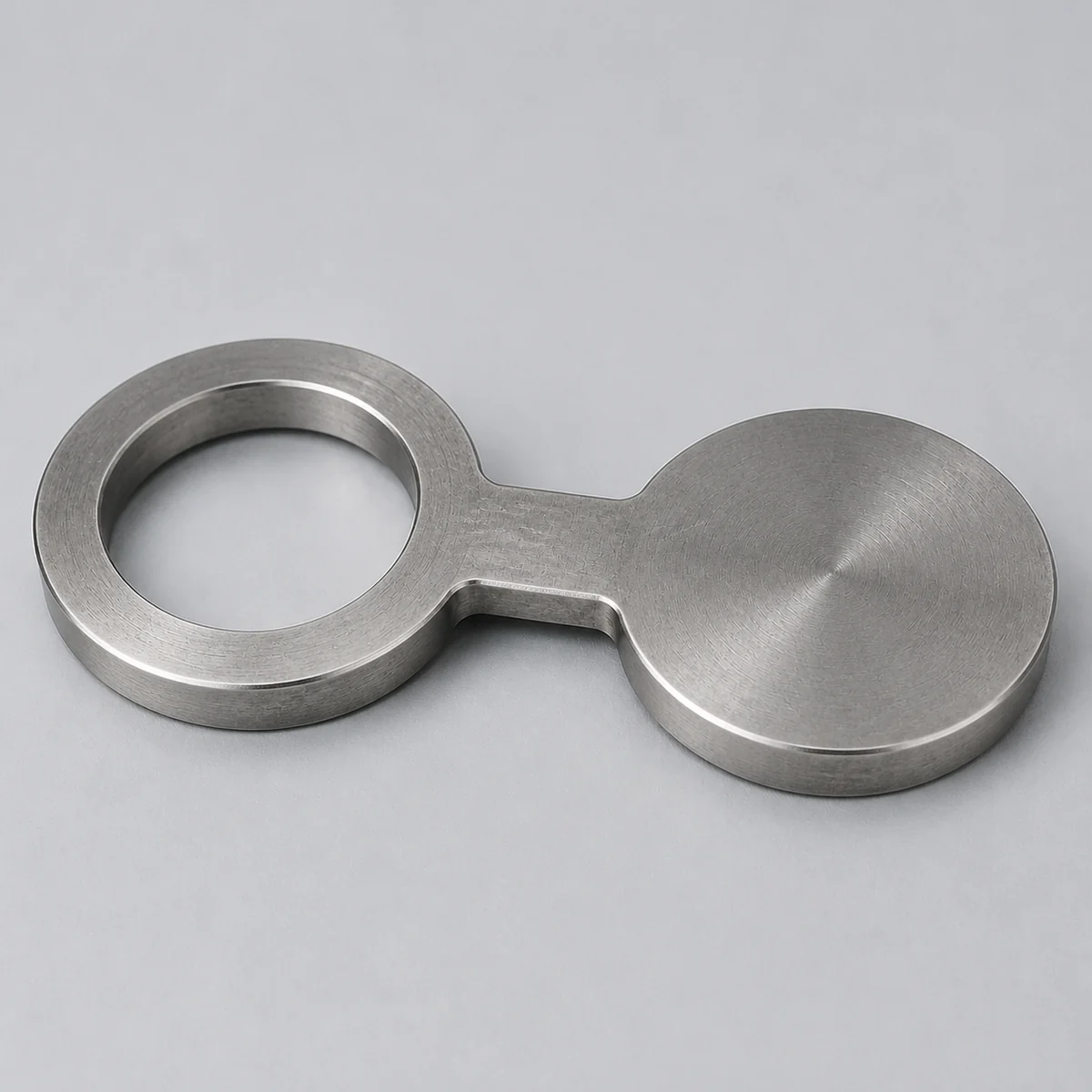
A spectacle blind is a positive-isolation line blank installed between matching pipe flanges. Its solid end blocks flow, while its open ring restores the flow path after the bolted joint is opened and the component is rotated. The visible position gives operators a direct indication of whether the line is open or isolated.
ASTM A182 F55 is the forged super duplex grade corresponding to UNS S32760. It is a high-strength corrosion-resistant material used for demanding chloride, seawater and sour-service projects when approved by the project specification.
The figure-8 profile keeps the blind and spacer together, reducing the risk of losing a separate spacer during maintenance. Thickness, outside diameter, bore, bridge geometry, sealing surfaces and marking must match the ordered ASME B16.48 class and flange joint. The piping designer remains responsible for isolation philosophy, gasket selection, bolting, operating procedure and code compliance.
Technical specifications
| Product | Spectacle Blind |
|---|---|
| Material specification | ASTM A182 F55 |
| UNS designation | UNS S32760 |
| Dimensional standard | ASME B16.48 |
| Size range | NPS 1/2 through NPS 24 within the pressure-class limits of ASME B16.48 |
| Rating / schedule | ASME Classes 150, 300, 600, 900, 1500 and 2500, subject to size and material limits |
| Configuration | One-piece figure-8 line blank with one solid blind end and one open spacer end |
| Documentation | EN 10204 3.1 MTC, heat-number traceability, dimensional report and PMI when ordered |
| Optional inspection | PMI, PT, UT, ferrite, corrosion testing, hardness and third-party inspection when ordered |
Final dimensions, ratings, tests and acceptance criteria follow the purchase order, approved drawing, applicable code and specified standard edition.
Why specify ASTM A182 F55 Super Duplex?
S32760 combines chromium, molybdenum and nitrogen with additions such as copper and tungsten. The chemistry supports resistance to localized corrosion in selected aggressive environments and provides a distinct material option from S32750.
Controlled heat treatment, qualified welding procedures and suitable consumables are essential. The completed component and weld joint must satisfy the specified ferrite, hardness, corrosion and mechanical-property requirements.
Typical applications
These are selection examples, not universal suitability claims. Verify corrosion, temperature, pressure, fabrication and code requirements for the actual service.
Ordering and specification guidance
Specify the material route, NPS, pressure class, mating flange facing, surface finish and required line-blank type. Do not order by nominal size alone: a Class 150 spectacle blind and a Class 600 spectacle blind differ materially in thickness and outside dimensions.
Include any sour-service, impact, hardness, corrosion-test, ferrite or third-party inspection requirements before manufacture.
Engineering selection boundaries
Material grade, nominal size and pressure class are necessary purchasing inputs, but they do not prove suitability by themselves. The responsible piping engineer should verify the design code, design pressure and temperature, corrosion allowance, connected pipe dimensions, flange facing, gasket system, bolting, welding procedure and examination plan as one coordinated specification. Service chemistry, concentration, contaminants, velocity, shutdown conditions and cleaning media can change corrosion performance. Request written confirmation against the project datasheet and approved drawing before manufacture, especially where sour service, seawater exposure, cyclic loading, vacuum, lethal service or regulatory inspection applies.
Manufacturing, inspection and traceability
Inspection focuses on material identity, thickness, bore, outside profile, bridge dimensions, flatness, sealing-face finish and permanent marking. PMI, dimensional reports and liquid-penetrant examination can be added when stated in the purchase order.
A robust release package can include the 3.1 MTC, PMI, ferrite results, ASTM G48 results, PT and dimensional records.
Official standards and engineering references
Use the current project-approved editions. The following official scope pages help procurement teams separate dimensional requirements from material requirements.
Related spectacle blind products
RFQ checklist
- Line-blank type
- NPS and pressure class
- Mating flange standard and facing
- Material grade and UNS number
- Required thickness or drawing
- Surface finish and gasket details
- Quantity and marking
- MTC, PMI and inspection requirements
Frequently asked questions
What is the difference between a spectacle blind and a paddle blind?
A spectacle blind combines the blind and spacer in one figure-8 component. A paddle blind and paddle spacer are separate components. The selected form must match the operating and maintenance procedure.
Is a spectacle blind the same as a blind flange?
No. A spectacle blind is installed between two mating flanges and can be rotated between open and closed positions. A blind flange terminates a flanged connection.
Which standard controls spectacle blind dimensions?
ASME B16.48 is commonly specified for operational line blanks used between ASME B16.5 flanges. The ordered edition, size, class and facing must be stated.
What is the UNS designation for ASTM A182 F55?
ASTM A182 F55 corresponds to UNS S32760.
How does S32760 differ from S32750?
Both are super duplex grades, but their chemistries and project approvals differ. They should not be substituted without engineering review.
Request a technical quotation
Send the material grade, standard, size, rating or schedule, quantity and inspection requirements. SASA FLANGE will review the complete specification before quotation.