
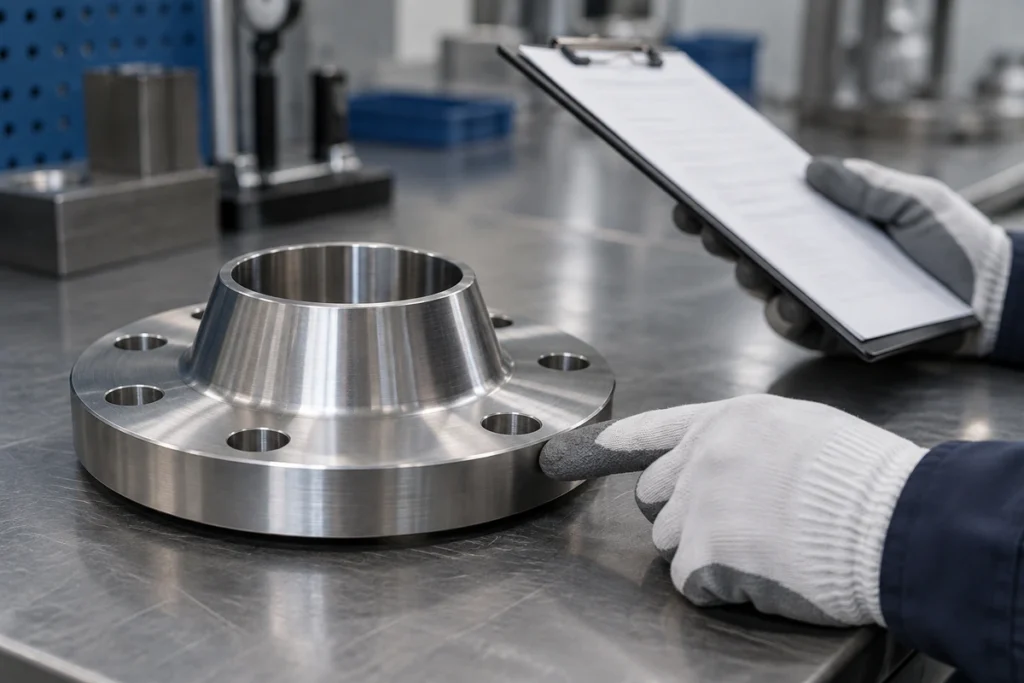
Dual-Certified 316/316L Flanges: What the MTC Must Prove
A dual-certified F316/F316L flange must have documented compliance with both ordered grades. Low carbon alone does not establish dual certification. Before accepting the flange, confirm the material specification, both grade designations, applicable test results, heat-treatment condition and traceability to the delivered item.
A slash on a quotation is not enough. Ask what the manufacturer actually certifies, and obtain engineering approval before using the material as a substitute for a different purchase specification.
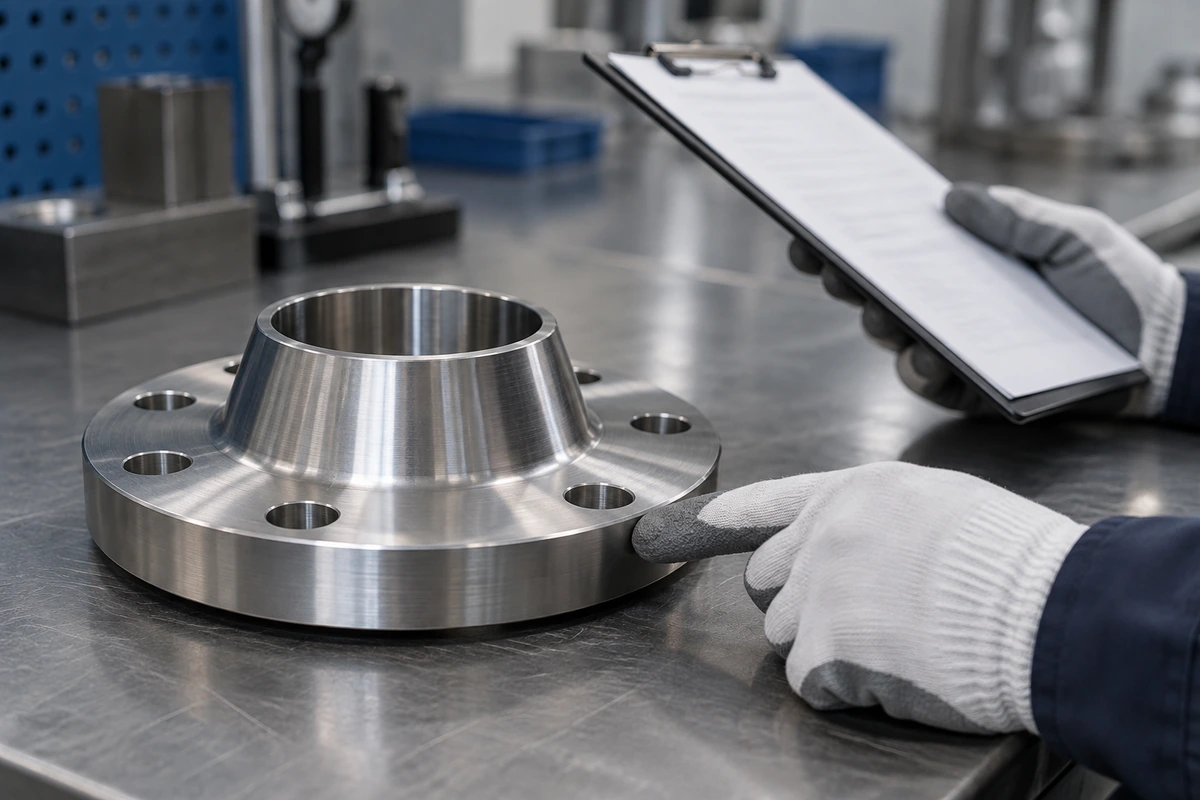
This guide addresses one procurement decision: whether a flange offered as “316/316L dual certified” satisfies an order. It is not a general comparison of stainless steel grades or a substitute for the complete material standard.
What Does F316/F316L Dual Certification Mean?
Dual certification means the same material is certified against two grade requirements. It does not mean that two alloys have been joined together, or that two certificates automatically create compliance. The British Stainless Steel Association explains the principle in its guidance on multiple certification.
For a forged flange ordered under ASTM A182/A182M, the relevant designations are F316 and F316L. A certificate listing only generic “316 stainless steel” does not clearly identify this forging specification. Likewise, a plate or pipe certificate cannot, by its grade name alone, demonstrate compliance of the finished forging.
If a document also lists EN grades or other standards, ask which requirements are covered. Additional grade names may describe chemistry and mechanical-property compatibility without establishing every dimensional or manufacturing requirement of a second standard.
Why Low Carbon Is Only Part of the Decision
The low-carbon 316L variant was developed to reduce susceptibility to intergranular corrosion associated with sensitization, particularly around welding. BSSA discusses this in its comparison of standard and low-carbon grades. This does not make 316L immune to all corrosion mechanisms.
A low carbon result may satisfy one chemistry requirement while leaving other acceptance questions unanswered. Review the complete elemental analysis and the required mechanical results against both grade rows in the contractual standard. Confirm that the reported tests represent the supplied material in its final required heat-treatment condition.
ASTM A182/A182M addresses heat treatment, chemical composition and mechanical properties of the covered piping components. Use the edition specified by your order, including applicable notes and supplementary requirements. Do not copy plate datasheet values into a forging acceptance checklist.
Keep three kinds of numbers separate
- Standard limits: the acceptance requirements for the ordered grade, product form, condition and edition.
- Typical values: descriptive material data, not proof that a shipment passes.
- Reported test results: values linked to the applicable heat or test lot, which must be assessed against the required limits.
Missing test evidence should remain an open question. Neither a typical strength figure nor an assumed carbon content should be entered as a measured result.
Three Common Offers and How to Review Them
| What the supplier provides | Procurement response |
|---|---|
| F316L certificate, with a separate quotation describing the flange as dual certified | Hold the dual-certification claim for clarification. Request the issuer’s confirmation of F316 compliance and the supporting evidence. |
| F316/F316L designation, with results and traceability supporting both grades | Continue the remaining purchase-order checks. Dual-grade evidence does not waive dimensions, inspection or project approval. |
| Both grade names, but incomplete results, unexplained limits or a mismatched heat number | Resolve the discrepancy through the issuing organization before release. Do not correct the certificate yourself. |
These are suggested review responses, not automatic acceptance or rejection rules. Apply your approved inspection plan. For the wider document review, see our ASTM A182 flange MTC checklist.
Dual Certification Does Not Increase the Flange Rating
The grade designation and the flange pressure class answer different questions. ASME B16.5 covers pressure-temperature ratings, materials, dimensions and other flange requirements. Two grade names do not create a higher pressure class or permit a higher operating temperature.
For a proposed substitution, the responsible engineer should check the applicable material group, temperature-dependent rating, design-code restrictions and project specification. Review the complete joint, including the mating component, gasket and bolting. Room-temperature tensile results alone are not a pressure-rating calculation.
How to Request Dual-Certified Flanges
When enquiring about ASTM A182 F316L weld neck flanges, distinguish an F316L-only requirement from an F316/F316L dual-certification requirement. State the flange type, size, pressure class, facing, bore, quantity and required documents.
Quote forged flanges to the specified edition of ASTM A182/A182M, with F316/F316L dual certification required. Identify the certification scope and provide traceable evidence supporting both grade designations. State any exceptions before order acceptance. Include the required inspection-document type and confirm marking and documentation requirements with the purchaser.
The clause is a starting point for agreement, not a declaration that any offered batch is already dual certified. Confirm availability and documentation for the actual order.
Buyer Questions
Is every F316L flange automatically F316/F316L?
No. Do not infer a second certified grade from the “L” suffix. The manufacturer’s certification and supporting records must establish the claimed compliance.
Is dual grade the same as EN 10204 3.1?
No. Dual grade concerns the material designations being certified. An inspection-document type concerns a different documentation requirement. State both requirements separately in the purchase order.
Can I add F316 to a certificate if the numbers look acceptable?
No. Request a controlled clarification or corrected document from the authorized issuer. Purchaser review is not authority to rewrite the manufacturer’s certificate or re-mark a flange.
Preparing a flange purchase specification? Send SASA FLANGE your drawing, quantity, required material designations and certification scope. Identify any proposed alternative separately from the approved requirement.