
C-2000 vs C22 Flanges: Material Selection and RFQ Checks
C-2000 vs C22 Flanges: Material Selection and RFQ Checks
Technical news · Nickel alloy selection · Reviewed 17 October 2026
C-2000 and C22 flanges are different nickel alloys. C-2000 is UNS N06200 and contains a deliberate copper addition; C22 is UNS N06022. Evaluate the actual process environment before choosing either grade, then verify the forging specification, dimensions, joint rating and material certificate. A substitution requires engineering approval.
A quotation that says only “Hastelloy flange” leaves the material identity unresolved. Both grades can be considered for aggressive chemical duties, but similar names and similar appearance do not make the components interchangeable. This guide explains how buyers can compare the two without confusing corrosion performance with pressure suitability.
C-2000 vs C22: start with the exact UNS number
| Review point | C-2000 | C22 |
|---|---|---|
| UNS identity | N06200 | N06022 |
| Alloy family | Nickel-chromium-molybdenum-copper | Nickel-chromium-molybdenum with tungsten |
| Important selection distinction | Copper addition is relevant to sulfuric-acid evaluation | Established option for mixed oxidizing and non-oxidizing chemical environments |
| Forging specification route | ASTM B564 / ASME SB-564 where ordered | ASTM B564 / ASME SB-564 where ordered |
| Interchangeability | Requires service-specific engineering approval and documentation; the shared forging standard does not make the grades equivalent | |
Haynes identifies the copper addition as a distinguishing feature of C-2000. Its C22 information describes broad corrosion resistance in oxidizing and non-oxidizing media. These are reasons to investigate a candidate alloy, not universal service guarantees. Use the linked technical data with the project’s corrosion criteria.
Compare the process envelope before comparing unit prices
Define normal, upset and cleaning conditions
Record the chemical composition and concentration range, maximum metal temperature, pressure, dissolved oxygen, contaminants, solids and flow conditions. Include shutdown, start-up and cleaning exposure. A flange may encounter a different liquid composition during washing or evaporation than during steady operation.
For an acid circuit, the acid name alone is insufficient. A concentration change, an oxidizing impurity or a local temperature increase can change the corrosion response. Provide measured or specified ranges to the materials engineer, and identify whether laboratory testing or operating experience represents the proposed service.
Consider the gasket crevice and the welded assembly
Bulk corrosion data do not fully describe a loaded gasket interface. Deposits and stagnant zones can create local conditions different from the main flow. Review the seal design, gasket chemical resistance, face finish and cleaning practice together with the flange grade.
For a weld neck connection, also review pipe material, weld filler selection, qualified procedures and examination requirements. The base-metal designation by itself does not certify the finished weld. Resolve any dissimilar-metal joint or material substitution before production.
Separate material certification from flange pressure rating
ASTM B564 is a forging material specification; it does not define the complete piping joint. ASME B16.5 addresses flange dimensions and pressure-temperature ratings within its scope. An engineer must check the specified alloy, product form, temperature limits, applicable material group and governing code edition.
Two flanges can share a bolt pattern while having different allowable service conditions. Likewise, “Class 300” is a rating designation and does not mean that every alloy flange can operate at 300 psi at every temperature. Avoid using a pressure table copied from another alloy or an unverified supplier page.
Match the bore independently of the pressure class
A weld neck flange enquiry needs the pipe OD, wall thickness or schedule, bore and weld preparation. Pressure class does not determine the pipe wall. Check the transition against the drawing and the adjoining pipe specification before accepting a quotation.
Five checks before approving a purchase order
- Lock the grade: write N06200 or N06022 explicitly. State whether certified trade-name origin is required or a specification-compliant generic alloy is acceptable.
- Lock the design basis: include material and dimensional standards, editions, size, class, facing, bore and drawing revision.
- Lock the acceptance scope: specify certificate type, traceability, dimensional inspection, NDE methods and acceptance criteria.
- Review alternatives: assess a substitution against the process environment, code basis and welding requirements before commercial acceptance.
- Check delivery documents: reconcile heat numbers, grade, actual test results and flange marking; investigate inconsistencies before installation.
PMI can support alloy identification but cannot prove every property, processing step or specification requirement. Its method and detection limits matter. Keep it as part of the agreed inspection plan rather than treating an instrument reading as a complete material certificate.
Apply the comparison to an RFQ
For an N06200 project, use our Alloy C-2000 weld neck flange page to prepare the specification. For an approved N06022 piping class, review the existing C22 flange product page. The nickel alloy material center provides related material context.
Send your service conditions and flange drawing. Identify the required alloy and any proposed alternative separately so the quotation can record the technical basis clearly.
Frequently asked questions
Is C-2000 simply another name for C22?
No. C-2000 is N06200; C22 is N06022. Their alloy design and material identification differ.
Which grade is better for sulfuric acid?
C-2000 deserves evaluation because of its copper addition, but the choice requires concentration, temperature, impurities and project corrosion criteria. Neither alloy is a universal answer.
Does the same ASTM standard allow automatic substitution?
No. A material specification can cover multiple distinct alloys. The ordered UNS grade and engineering approval control substitutions.
Can a product image confirm N06200?
No. Appearance cannot establish alloy chemistry. Use traceable certification and the specified inspection methods.
Sources and review basis
- Haynes International: C-2000 alloy, corrosion guidance and specifications
- Haynes International: C22 alloy data
- ASME: B16.5 scope
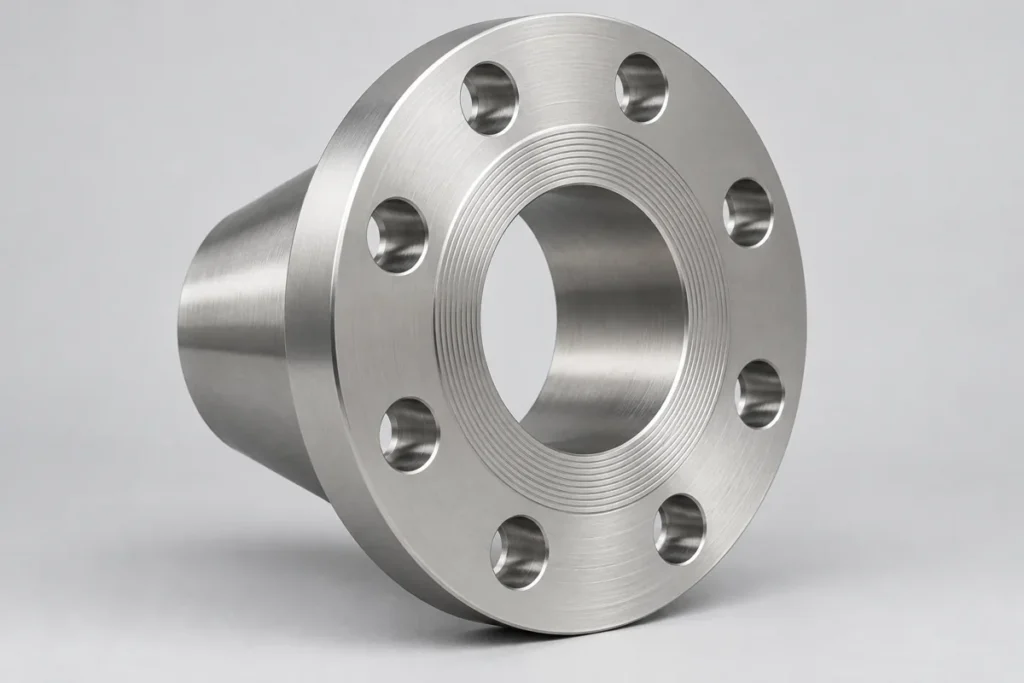
This is a technical knowledge article, not a report of a customer project. HASTELLOY®, C-2000® and C-22® are trademarks of Haynes International. The AI-generated flange illustration is not evidence of material grade, inspection or stock availability.
Related Posts
ASTM A182 F51 vs F60 Flanges: S31803 vs S32205 Explained
Compare ASTM A182 F51 and F60 duplex flanges, including S31803/S32205…
UNS S32750 vs S32760 Flanges: ASTM A182 F53 or F55?
Compare S32750 and S32760 super duplex flanges, including ASTM A182…

Can a PN16 Flange Mate With an ASME Class 150 Valve?
Can a PN16 flange bolt to an ASME Class 150…
Can EN 1092-1 Type B1/B2 Mate With ASME Raised Face Flanges?
Can EN 1092-1 Type B1 or B2 mate with an…