
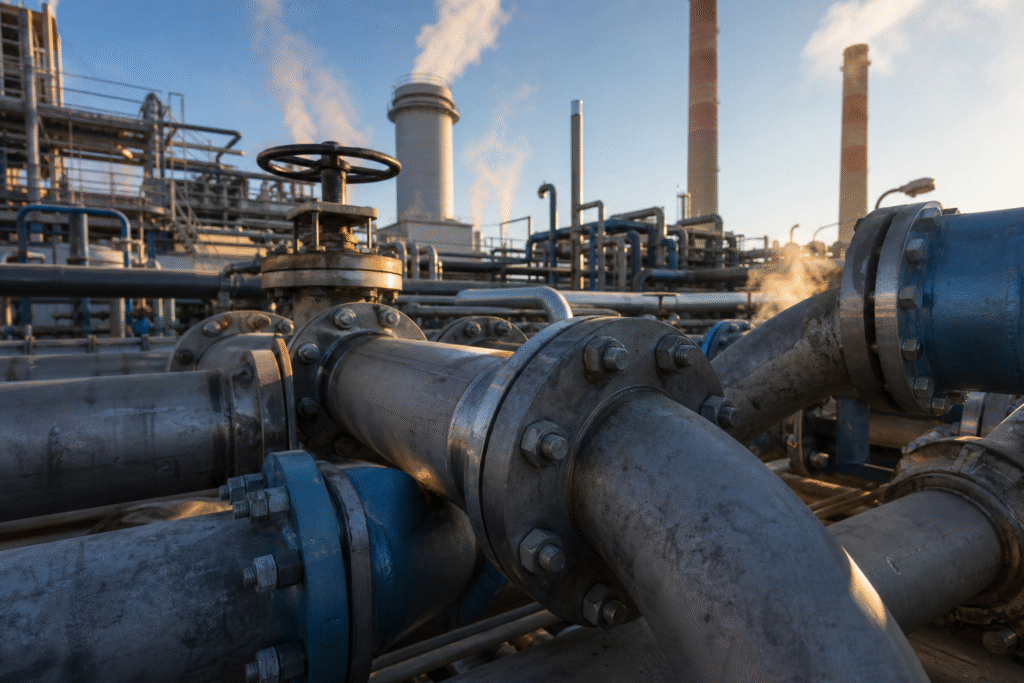
Leitfaden zur Zertifizierung und Beschaffung von Edelstahlflanschen
Der Markt für Rohrflansche aus Edelstahl wächst weiter, da Industrieprojekte eine längere Lebensdauer erfordern, strengere Leckkontrolle, und stärkere Korrosionsbeständigkeit. Laut Grand View Research (2024), Der globale Markt für Industrieflansche wurde mit bewertet $5.8 Milliarden in 2023 und wird voraussichtlich erreicht werden $7.2 Milliarden von 2030, which makes stainless steel pipe flange sourcing a strategic procurement decision rather than a routine purchase.
Für Ingenieure und Einkäufer, Die häufigste Herausforderung besteht darin, keine Flansche zu finden. It is choosing the right material grade, Druckklasse, gegenüber, and standard for a specific pipe system without increasing lifecycle cost.
Why the Stainless Steel Pipe Flange Market Keeps Growing in Industrial Projects
Industrial demand remains strong across upstream, Mittelstrom, verfeinern, Leistung, Entsalzung, and EPC construction. Laut Statista (2024), auf die Öl- und Gasindustrie entfallen ca 35% des weltweiten Flanschverbrauchs, which explains why pressure integrity and compliance dominate purchase specifications.
Manufacturing concentration also shapes lead times and pricing. Laut IBISWorld (2024), Der asiatisch-pazifische Raum macht mehr als aus 45% der weltweiten Flanschproduktion, wobei China der größte Hersteller ist, giving buyers access to high-volume capacity and broader grade availability.
These numbers matter because flange supply is no longer evaluated on unit price alone. Procurement teams now compare traceability, mill test documentation, Bearbeitungspräzision, PMI-Fähigkeit, Und EN 10204 3.1 documentation before issuing a purchase order.
The Hidden Advantages of stainless steel pipe flange systems become clear when lifecycle performance is measured against replacement frequency and unplanned shutdown risk. Stainless materials such as 304, 316, 316L, 904L, 2205, Und 2507 often reduce corrosion-related maintenance in aggressive media, especially where chloride exposure or cyclic temperature changes occur.
Laut Mordor-Geheimdienst (2024), global investment in water treatment and desalination piping systems is rising steadily as municipalities and industrial users upgrade corrosion-resistant infrastructure. Infolge, Edelstahlflansche, Beschläge, and valves are specified more often in coastal, chemisch, and high-purity installations.
SASA FLANGE supports this demand with manufacturing coverage across stainless steel flanges, Flansche aus Kohlenstoffstahl, Flansche aus Legierung, und Rohrverbindungsstücke. Mit ISO 9001:2015 und PED 2014/68/EU-Zertifizierungen, the company supplies projects requiring ASME B16.5, ANSI B16.47, ASME B16.9, DIN, JIS, GOST, und EN 1092 Einhaltung.
Für B2B-Käufer, availability across grades is equally important. Herstellung von Flanschen in 304, 316, 316L, 904L, 2205, 2507 and other premium grades allows better alignment between media chemistry, Auslegungstemperatur, and budget target.
Laut Market Research Future (2024), industrial stainless components are seeing above-average growth in sectors that prioritize asset longevity and lower total maintenance cost. daher, a flange is no longer treated as a simple connector. It is treated as a reliability component inside the larger pressure boundary.
That change affects vendor evaluation. Buyers increasingly favor manufacturers with advanced CNC machining, in-house inspection, and broad export experience, especially when custom bores, Bohrmuster, and non-standard dimensions are required.
Für Projektteams, die Lieferanten vergleichen, detailed technical support matters as much as production capacity. You can review manufacturing support and project communication options through SASA FLANGE and discuss custom requirements directly via their contact team.
Technischer Vergleich von Edelstahlrohrflanschtypen, Materialien, und versteckte Vorteile
The most common stainless steel pipe flange materials remain ASTM A182 F304, F304L, F316, und F316L. Jedoch, more demanding applications often move toward 904L, Duplex 2205, Super-Duplex 2507, or nickel alloys when chloride stress corrosion cracking or sour service becomes a concern.
Als Dr. James Holloway, Werkstoffingenieur und Korrosionsberater, Staaten: “The right flange grade is selected by process chemistry first, then by pressure class and fabrication method, not by material price alone.” That principle helps procurement teams avoid the common mistake of overbuying for mild service or under-specifying for corrosive duty.
Gemäß ASTM- und ASME-Materialpraxis, lower-carbon grades such as 304L and 316L are widely preferred where welding is required and post-weld corrosion must be minimized (ASTM, 2024; ASME, 2024). Im Gegensatz, higher-performance duplex grades can deliver superior strength-to-weight ratio, which may reduce section thickness in some engineered systems.
Gemäß NACE-Korrosionsrichtlinie, chloride-bearing and sour environments require careful control of hardness, Chemie, and fabrication route when materials are selected for pressure equipment (NACE, 2024). daher, material selection should always consider media composition, Betriebstemperatur, and potential crevice corrosion zones around bolting and gasket interfaces.
Als Michael Trent, Leitender Rohrleitungsingenieur, Staaten: “Most flange failures do not start at the flange body. They start with poor grade selection, poor facing compatibility, or weak installation control.” This observation is especially relevant for gasket seating and bolt load management in raised-face and RTJ assemblies.
Zu den gängigen Arten und Verwendungszwecken von Edelstahlrohrflanschen gehören die folgenden:
- Vorschweißflansch: Bevorzugt für hohen Druck, Temperaturwechsel, and critical service because its tapered hub reduces stress concentration.
- Aufsteckflansch: Most common in lower-pressure utility systems where easier alignment and lower machining cost matter.
- Blindflansch: Wird zum Schließen von Zeilenenden verwendet, pressure test systems, oder zukünftige Erweiterungspunkte zulassen.
- Muffenschweißflansch: Suitable for small-bore high-pressure lines where a smooth bore and compact connection are needed.
- Gewindeflansch: Applied where welding is restricted, although vibration-heavy service may require additional evaluation.
- Überlappungsflansch: Useful in systems requiring frequent dismantling and rotational alignment with stub ends.
Facing selection is equally critical. Raised face remains the Most Common option under ASME B16.5, while ring type joint flanges are favored in higher-pressure hydrocarbon service due to stronger sealing performance.
Typical technical selection points include:
- Druckklassen: 150, 300, 400, 600, 900, 1500, 2500.
- Größenbereich: häufig 1/2 Zoll zu 24 Zoll unter ASME B16.5, with larger diameters under B16.47.
- Materialstandards: ASTM A182 for forged alloy and stainless flanges, ASTM A240 for plate material, ASTM A403 for stainless fittings.
- Face types: RF, FF, RTJ, Nut und Feder, männlich und weiblich.
- Inspektion: PMI, Maßprüfung, hydrotest where applicable, Härteprüfung, Ferritprüfungen, Und EN 10204 3.1 Zertifizierung.
One of the Hidden Advantages of stainless material is cleanliness in process handling. Stainless grades are widely used in food, pharmazeutisch, Reinstwasser, and clean utility systems because they support surface finish control and contamination resistance.
According to ISO-related manufacturing quality benchmarks, tighter process control directly improves dimensional consistency and repeatability in sealing surfaces (ISO, 2024). That is important because gasket seating stress depends on flange flatness, beenden, and bolt-up uniformity.
SASA FLANGE bietet maßgeschneiderte Größen von an 1/2 Zoll zu 60 Zoll mit wettbewerbsfähigen Direktpreisen ab Werk, which is relevant for EPC contractors and stockists managing mixed standard and project-specific orders. Unterstützt durch fortschrittliche CNC-Bearbeitung und umfassende Qualitätsprüfungen, the company supports both standard B16.5 items and custom drilling or facing requirements.
Für Käufer, die Lieferanten bewerten, it is useful to confirm whether the manufacturer can supply matching elbows, T-Shirts, Reduzierstücke, and caps in the same project package. That reduces inspection complexity and often shortens procurement cycles through consolidated logistics.
You can explore broader product categories at SASA FLANGE Produkte or send RFQs with grade, Klasse, Standard, and quantity details through die Kontaktseite. Zusätzlich, integrated sourcing becomes more valuable when shutdown schedules leave little room for supplier coordination delays.
Stainless Steel Pipe Flange Standards, Einhaltung, and Certification Requirements
Industrial buyers should never evaluate flanges without checking the governing standard first. ASME B16.5 deckt die Abmessungen ab, Toleranzen, Druck-Temperatur-Werte, Markierung, and testing for flanges and flanged fittings up to NPS 24, während ASME B16.47 adressiert größere Durchmesser.
Material compliance usually starts with ASTM. ASTM A182 is the core standard for forged or rolled alloy and stainless steel pipe flanges, geschmiedete Beschläge, und Ventile für den Hochtemperaturbetrieb, während ASTM A240 gilt für Chrom- und Chrom-Nickel-Edelstahlblech, Blatt, und ausziehen.
Europäische Projekte erfordern oft EN 1092-1 and PED compliance. Zusätzlich, viele Käufer verlangen EN 10204 3.1 material certificates for positive traceability and audit readiness.
For international engineering projects, the following standards are frequently referenced:
- ASME B16.5: Pipe flange dimensions and ratings up to NPS 24.
- ASME B16.47: Stahlflansche mit großem Durchmesser.
- ASME B16.9: Fabrikgefertigte Formstücke zum Stumpfschweißen.
- ASTM A182: Geschmiedete Flanschmaterialien aus Edelstahl und Legierung.
- EN 1092-1: Europäische Flansche mit PN-Bezeichnungen.
- DIN und JIS: Regional flange systems for equipment and replacement markets.
- NACE MR0175: Materials guidance for sour service applications.
There is also a practical distinction between dimensional standards and material standards. ASME B16.5 defines geometry and ratings, während ASTM A182 defines what the forged stainless material must be.
When projects involve export to Europe, PED 2014/68/EU becomes a major commercial and technical requirement. daher, supplier qualification should include not only production capability but also document control, marking discipline, and quality-system traceability.
Gemäß dem PED-Rahmen der Europäischen Kommission, pressure equipment manufacturers and component suppliers must demonstrate conformity to applicable safety requirements for covered equipment categories (PED, 2024). That is why certified documentation packages can influence bid acceptance as much as the flange price itself.
Als Laura Chen, Industriemarktanalyst, Staaten: “In current bidding cycles, documentation quality increasingly separates approved vendors from low-cost vendors.” This trend is clear in petrochemical and power projects where third-party inspection and final dossier submission are mandatory.
SASA FLANGE strengthens compliance confidence through ISO 9001:2015, PED 2014/68/EU, und AD 2000 Anmeldeinformationen. Portion 50+ Länder in ganz Öl & Gas, Petrochemie, Leistung, und Marineindustrie, the company aligns production with purchaser specifications, Maßnormen, und Inspektionsanforderungen.
For buyers seeking an authoritative source on flange rules, the ASME code library remains essential, and official references are available at ASME.org. Jedoch, practical purchasing still requires checking drawing revision, Verkleidungsende, Verschraubungsmaterial, and gasket compatibility before approval.
In contrast with generic online catalog listings, compliant flange procurement needs a full package. That package includes standard reference, Materialqualität, Größe, Druckklasse, gegenüber, Rückverfolgbarkeit der Herdenzahl, and acceptance criteria for testing and certification.
So wählen Sie einen Edelstahlrohrflansch für Öl aus, Gas, Leistung, Marine, und Wassersysteme
To Choose the correct stainless steel pipe flange, engineers should begin with process media and design code. After that, they should verify pressure class, Korrosionszuschlag, Dichtungstyp, bolt load requirement, and installation constraints.
Oil and gas projects typically prioritize pressure containment, sour service resistance, und Rückverfolgbarkeit. Laut Statista (2024), this sector uses roughly 35% der globalen Flanschleistung, so standardization around ASME classes and ASTM grades is common for both greenfield and MRO demand.
Chemical processing often requires stronger resistance to acids, Chloride, and cyclic thermal conditions. daher, 316L, 904L, Duplex 2205, or nickel alloys may be selected depending on chloride level, pH-Wert, und Betriebstemperatur.
Power generation systems demand mechanical reliability under steam, Kondensat, and thermal fatigue conditions. In diesen Anwendungen, weld neck flanges are often preferred because they distribute stress more efficiently under pressure and vibration.
Marine and shipbuilding environments introduce saline exposure and external corrosion risk. Infolge, stainless grades with stronger pitting resistance or duplex structures are often chosen for ballast, Meerwasser, and deck utility systems.
Water treatment and desalination projects increasingly specify stainless and duplex flange assemblies for pumps, Kufen, membranes, and chemical dosing lines. Laut Market Research Future (2024), corrosion-resistant piping components are seeing accelerated demand in water infrastructure upgrades, especially in coastal regions.
Buyers should review the following selection criteria before ordering:
- Medienchemie, einschließlich Chloride, Schwefelverbindungen, und Reinigungsmittel.
- Design temperature and pressure class.
- Applicable dimensional and material standards.
- Required face type and gasket compatibility.
- Welding method and post-fabrication corrosion risk.
- Inspektionsumfang, including PMI and EN 10204 3.1.
- Vorlaufzeit, Verpackung, and export marking requirements.
Common application examples include:
- Upstream skid package: ASTM A182 F316L-Vorschweißflansch, Klasse 600, RF face.
- Desalination line: Duplex 2205 slip-on flange with corrosion-focused material verification.
- Power condensate service: ASTM A182 F304L blind flange for maintenance isolation.
- Chemical dosing unit: 904L threaded or socket weld flange for compact corrosion-resistant assemblies.
SASA FLANGE supports custom manufacturing for project buyers who need non-standard bores, spezielle Verkleidungsoberflächen, and mixed-material packages including elbows, T-Shirts, Reduzierstücke, und Mützen. That flexibility is valuable when an EPC package combines ASME, DIN, and EN requirements in one shipment.
Darüber hinaus, supplier responsiveness affects project risk. A capable flange vendor should confirm quotation details such as wall thickness interface, Bohrplan, Bohrbild, Markierung, and packing method before order release.
Für technische Projekte, the most Common error is requesting only size and class without specifying the pipe schedule bore. That omission can create field mismatch, nacharbeiten, and unnecessary delay during installation.
For tailored quotation support, buyers can reach SASA FLANGE with RFQ data including standard, Material, Druckklasse, Größenbereich, and destination market. Außerdem, early technical alignment usually shortens approval time and reduces costly revision rounds.
Zukunftsaussichten für die Beschaffung von Edelstahlrohrflanschen und strategische Kaufempfehlungen
Die Marktaussichten bleiben im Energiebereich positiv, Wasser, chemisch, and infrastructure projects continue to invest in durable piping systems. Laut Grand View Research (2024), Es wird erwartet, dass der Markt für Industrieflansche an Bedeutung gewinnt $7.2 Milliarden von 2030, reflecting steady long-term purchasing demand.
Gleichzeitig, buyers face more complexity in sourcing. Material volatility, certification scrutiny, and regional logistics shifts mean that approved vendor strategy matters more than spot-price buying.
Laut IBISWorld (2024), Asia-Pacific controls over 45% der weltweiten Flanschproduktion, so procurement teams should evaluate not only manufacturing price but also export reliability, Dokumentationsgenauigkeit, and production scheduling discipline. daher, supplier selection should combine technical qualification with supply-chain resilience.
Blick nach vorn, the Most Intriguing trend is the move toward lifecycle-based sourcing. Buyers increasingly compare corrosion resistance, Wartungsintervalle, and downtime risk rather than focusing on initial purchase price alone.
Zu den strategischen Empfehlungen für Beschaffungsteams gehören::
- Standardize approved grades for repeat applications to reduce engineering time.
- Request full technical quotations with standard, Klasse, langweilig, und Verkleidungsdetails.
- Qualify vendors that can supply both flanges and matching fittings.
- Verifizieren ISO 9001:2015, PED, and inspection document capability before tender award.
- Use duplex or higher-alloy grades selectively where corrosion cost exceeds material premium.
Zusätzlich, project buyers should keep a clear approved-vendor list for MRO and shutdown planning. That approach improves response speed when replacement flanges are needed urgently for critical Pipe systems.
SASA FLANGE remains relevant in this environment because it combines broad grade coverage, kundenspezifische Fertigung, and international compliance support. Für Käufer, die Flanschhersteller vergleichen, a detailed inquiry through SASA FLANGE Kontakt can help clarify specification fit, Zertifizierungsanforderungen, and commercial lead time before final sourcing decisions are made.
Häufig gestellte Fragen
Welche verschiedenen Arten von Edelstahlflanschen gibt es??
●Die wichtigsten Edelstahlflanschtypen sind Vorschweißflansche, Slip-on, blind, Muffenschweißen, mit Gewinde, und Überlappungsgelenk, Und ASME B16.5 remains the most common dimensional standard for sizes up to NPS 24.
●Each type suits a different service condition because weld neck flanges handle pressure and thermal cycling well, while slip-on flanges are often chosen for easier fit-up in lower-pressure systems.
●For most engineered projects, Käufer sollten den Flanschtyp an die Druckklasse anpassen, Korrosionseinwirkung, Dichtungsstil, und Rohrplan, and working with established manufacturers like SASA FLANGE helps ensure correct specification review.
Was ist besser? 304 oder 420 Edelstahl?
●Für die meisten Anwendungen mit Edelstahlrohrflanschen, 304 ist normalerweise besser als 420 because it offers stronger corrosion resistance and is widely used under ASTM A182 Flanschspezifikationen.
●Grad 420 has higher hardness and wear potential after heat treatment, but it is less common for industrial flanges because corrosion performance is generally more limited than 304 in wet or chemical service.
●Procurement teams should choose 304 for general industrial piping and move to 316 or duplex when chloride resistance becomes critical, especially when vendor support from companies such as SASA FLANGE is available for material selection.
In welcher Branche wird am meisten Edelstahl verwendet??
●Oil and gas is one of the largest flange-consuming sectors, und laut Statista (2024), es macht ungefähr aus 35% des weltweiten Flanschverbrauchs.
●Jedoch, stainless steel use is also very strong in chemical processing, Wasseraufbereitung, Marine, Lebensmittelverarbeitung, and pharmaceutical systems because corrosion resistance and hygiene matter in those industries.
●If a project needs long service life, Rückverfolgbarkeit, and compliance with ASME or EN requirements, buyers should source from qualified flange manufacturers that can provide full documentation and application guidance.
Welche drei Arten von Flanschen gibt es??
●The three most common flange types in industrial piping are weld neck flange, Aufsteckflansch, und Blindflansch, although many systems also use socket weld, mit Gewinde, und Überlappungsversionen.
●Weld neck flanges are preferred for high-pressure service, slip-on flanges are common in utility lines, and blind flanges are used to close or isolate line ends for maintenance and testing.
●Für eine sichere Auswahl, engineers should confirm pressure class, gegenüber, Materialqualität, and bore schedule before purchasing, especially when ordering for replacement parts or shutdown inventory.
Was beeinflusst den Preis für Edelstahlrohrflansche??
●Der Preis für Edelstahlrohrflansche hängt hauptsächlich von der Materialqualität ab, Größe, Druckklasse, Gesichtstyp, Zertifizierungsumfang, and whether the order includes custom machining or third-party inspection.
●Laut Grand View Research (2024), der Markt für Industrieflansche erreicht $5.8 Milliarden in 2023, and that scale reflects how raw material cost and compliance requirements continue to shape market pricing.
●Buyers should request quotations with complete technical data, including ASTM grade, ASME class, Größe, langweilig, und Dokumentationspflichten, because incomplete RFQs often lead to inaccurate pricing and procurement delays.
How do I choose a flange manufacturer or flange vendor for industrial projects?
●A reliable flange manufacturer should offer compliant production to ASME, ASTM, DIN, or EN standards together with ISO 9001:2015 quality control and full traceability documentation.
●Laut IBISWorld (2024), Der asiatisch-pazifische Raum produziert über 45% von globalen Flanschen, so buyers should evaluate supplier capability by inspection systems, Exporterfahrung, Bearbeitungsqualität, and communication speed rather than by price alone.
●Für Projekte, die individuelle Größen erfordern, Premium-Qualitäten, and coordinated flange-and-fitting supply, working with proven manufacturers like SASA FLANGE improves technical alignment and reduces sourcing risk.
Verwandte Beiträge
Flanschoberflächenfinish: Konzentrische vs. spiralförmige Verzahnungen erklärt
Konzentrische und spiralförmige Verzahnungen sind beide bearbeitete Flanschflächenoberflächen…
Duplex 2205 vs. 316L-Flansche: Welches Material sollten Sie wählen??
Schnelle Antwort: Duplex 2205 Flansche sind normalerweise der stärkere Kandidat…

Definition des Öffnungsflansches, Details und Übersicht über ASME B16.36-Flansche: Marktdaten, Auswahlhilfe und Compliance-Einblicke
Der globale Markt für Industrieflansche wurde mit bewertet $5.8 Milliarde…

Marktführer für schwarze Entsorgungsflansche: Materialien, 3.5″ Kompatibilität, und B2B-Beschaffungsdaten für Küchenspülenflansche
Die Nachfrage nach schwarzen Entsorgungsflanschen steigt bei Käufern von Küchenarmaturen…