
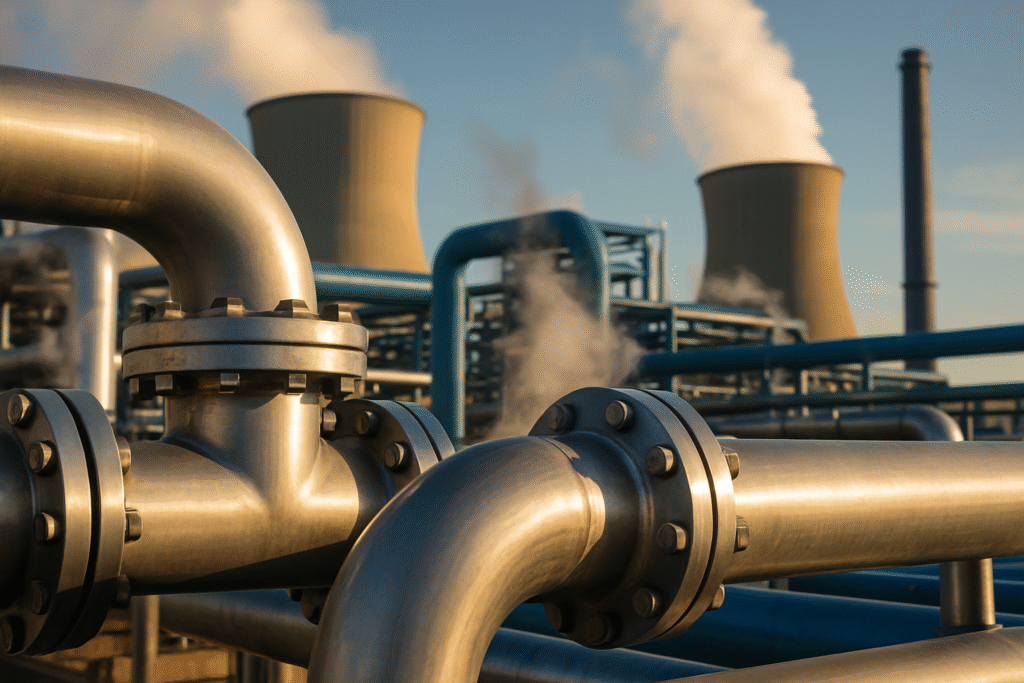
Rohrflansch aus Edelstahl: 7 Datengestützte Vorteile, Typen, Verwendungsmöglichkeiten, und So wählen Sie Premium-Optionen aus
Der Edelstahlrohrflansch bleibt aufgrund der Leckageintegrität eine kritische Komponente in industriellen Rohrleitungen, Korrosionsbeständigkeit, und die Lebenszykluskosten sind heute wichtiger als der bloße Kaufpreis. Laut Grand View Research (2024), Der globale Markt für Industrieflansche wurde mit bewertet $5.8 Milliarden in 2023 und wird voraussichtlich erreicht werden $7.2 Milliarden von 2030.
That growth reflects a Hidden shift in procurement priorities. Engineers and buyers increasingly focus on Premium materials, verified standards, and long-term durability when they Choose Flanges for demanding service.
Warum der Markt für Edelstahlrohrflansche weiter wächst
Industrial buyers are no longer selecting flanges as commodity items. Stattdessen, they evaluate total system performance, corrosion margins, inspection traceability, and compatibility with welded and threaded Pipe systems.
Laut IBISWorld (2024), Der asiatisch-pazifische Raum macht mehr als aus 45% der weltweiten Flanschproduktion, wobei China der größte Hersteller ist. Infolge, global sourcing strategies now depend on manufacturers that can combine cost efficiency with documented quality compliance.
Demand is also heavily concentrated in process industries. Laut Statista (2024), auf die Öl- und Gasindustrie entfallen ca 35% des weltweiten Flanschverbrauchs, which explains why ASME pressure classes, alloy verification, and mill test certification remain central to purchasing decisions.
Darüber hinaus, corrosion-related failures continue to drive replacement cycles and specification upgrades. NACE has long emphasized that material mismatch in corrosive service can sharply reduce asset life, vor allem bei Chloriden, saure Medien, or cyclic temperatures are present (NACE, 2023).
This is where the Intriguing value of Stainless and alloy-based systems becomes clear. Compared with unprotected carbon steel, stainless solutions offer strong Advantages in cleanliness, Korrosionsbeständigkeit, and maintenance reduction across water treatment, chemische Verarbeitung, and marine lines.
Laut Mordor-Geheimdienst (2024), global investment in water and wastewater infrastructure is increasing steadily, supporting higher demand for corrosion resistant flanges, Beschläge, und Ventile. daher, stainless steel pipe flange selection is now closely tied to lifecycle reliability rather than only capex control.
Procurement teams also want broader material and size flexibility. A supplier that can support 304, 316, 316L, 904L, 2205, 2507, A182-Klassen, and specialty alloys reduces qualification delays during multi-site projects.
SASA FLANGE supports these requirements with stainless steel flanges, Flansche aus Kohlenstoffstahl, Flansche aus Legierung, and pipe fittings for global EPC, OEM, and distributor customers. Mit ISO 9001:2015 und PED 2014/68/EU-Zertifizierungen, Das Unternehmen beliefert Öl & Gas, Petrochemie, Stromerzeugung, Schiffbau & Marine, Wasseraufbereitung, und Bauanwendungen.
Buyers also assess manufacturer responsiveness and technical depth before issuing RFQs. For project support, dimensional review, and certified supply planning, procurement teams can connect with SASA FLANGE früh in der Spezifikationsphase.
Zusätzlich, digital sourcing has changed how engineers compare suppliers. Search behavior increasingly includes long-tail queries such as stainless steel pipe flange sizes, stainless steel flange Types, Rohrflansch aus Edelstahl mit Gewinde, Und 4 Zoll-Rohrflansch aus Edelstahl.
That trend makes structured technical content more important than ever. A manufacturer must explain materials, Standards, Verwendungsmöglichkeiten, Druckklassen, and quality documents in clear terms that support both SEO and engineering evaluation.
Flanschtypen für Edelstahlrohre, Versteckte Vorteile, und technische Auswahlfaktoren
A stainless steel pipe flange is not one product but a family of connection designs. Its Versatility comes from matching flange geometry, Verblendungstyp, Druckklasse, and material grade to the actual process duty.
As John Bremer, Leitender Rohrleitungsingenieur, Staaten: “The best flange selection is the one that balances corrosion allowance, gasket seating performance, and inspection traceability across the full operating envelope.” That principle explains why experienced buyers compare more than nominal size and price.
Entsprechend ASME B16.5, common flange pressure-temperature ratings depend on material group, class designation, und Betriebstemperatur (ASME, 2023). daher, eine Klasse 150 flange in A182 F316L does not behave identically to a Class 150 flange in carbon steel at elevated temperature.
Material choice also changes long-term maintenance economics. Laut Market Research Future (2024), industrial asset owners are increasing spending on corrosion-resistant piping components as unplanned shutdown costs continue to rise across refining and chemical sectors.
The most common stainless steel flange Types include the following:
- Vorschweißflansche für Hochdruck, zyklisch, und Einsatz bei extremen Temperaturen.
- Slip-on flanges for moderate pressure systems where installation economy matters.
- Blindflansche zur Leitungsisolierung, Testen, und zukünftige Erweiterungspunkte.
- Socket weld flanges for small bore high-pressure piping.
- Threaded flanges for low-pressure or non-weld applications.
- Überlappungsflansche für Systeme, die häufig demontiert werden müssen.
The face design is equally important. Erhöhtes Gesicht, flaches Gesicht, and ring type joint options determine gasket seating behavior and sealing reliability under load.
Zum Beispiel, raised face flanges remain common in refinery and petrochemical service. Ring type joint flanges, Jedoch, are preferred for higher pressure applications where metal-to-metal sealing performance is critical.
Standard material grades each bring different performance profiles:
- 304 and 304L provide strong general corrosion resistance and good fabrication performance.
- 316 und 316L fügen Molybdän hinzu, which improves pitting resistance in chloride-bearing environments.
- 904L supports more aggressive chemical media and higher corrosion demands.
- 2205 duplex combines strength and chloride resistance with good weight efficiency.
- 2507 super duplex delivers higher PREN values for severe offshore and marine exposure.
- Titan, Inconel, Monel, and Hastelloy support highly specialized corrosive or temperature-critical service.
Als Dr. Elena Morris, Materialwissenschaftler, Notizen: “316L is often the practical baseline for chloride service, but duplex grades frequently provide a better strength-to-corrosion ratio when design conditions intensify.” This is especially relevant in seawater systems, Entsalzung, and offshore skid packages.
The Hidden Advantages of a Premium stainless steel pipe flange often appear after installation. Lower rust contamination, easier hygiene maintenance, better media compatibility, and reduced coating dependence can all improve plant uptime.
Darüber hinaus, weldability matters in fabrication shops. Low-carbon grades such as 304L and 316L help limit sensitization after welding, which supports corrosion performance in heat-affected zones under the right procedure controls.
Key specification factors should be reviewed before ordering:
- Nennrohrgröße von 1/2 Zoll zu 60 inch or project-specific custom dimensions.
- Druckklasse wie z 150, 300, 600, 900, 1500, oder 2500.
- Verkleidungstyp einschließlich RF, FF, oder RTJ.
- Materialstandard wie z ASTM A182 or EN equivalent grades.
- Wall schedule and matching pipe specification.
- Corrosion environment including chlorides, H2S, Säuren, or caustic media.
- Inspection and documentation requirements such as EN 10204 3.1.
SASA FLANGE stellt Flansche her 304, 316, 904L, 2205, 2507 und andere Premiumqualitäten, Unterstützt durch fortschrittliche CNC-Bearbeitung und umfassende Qualitätsprüfungen. That capability helps project teams control tolerances, Verkleidungsende, and documentation consistency across repeat orders.
In praktischer Hinsicht, engineers often compare stainless versus alloy or carbon steel on total installed risk. Although stainless may carry a higher initial material cost, the durability and reduced maintenance burden often improve lifecycle value.
According to ISO guidance for quality management and process control, documented production consistency reduces nonconformance risks in critical industrial supply chains (ISO, 2023). That is one reason certified manufacturers with stable QA systems remain preferred for export and regulated projects.
For buyers evaluating custom dimensions, Bohrmuster, and non-standard requirements, it helps to review supplier capabilities early. You can explore manufacturing scope and project support via SASA FLANGE Produktressourcen and align specification details before procurement closes.
Standards, Einhaltung, and Quality Documents for Stainless Steel Pipe Flange Procurement
Standards are the language of dependable flange procurement. Without clear compliance to ASME, ASTM, DIN, JIS, GOST, or EN requirements, even a visually correct flange can create fit-up, Druck, or inspection problems.
Für die meisten Industrieprojekte, ASME B16.5 covers pipe flanges and flanged fittings for NPS 1/2 durch 24. ASME B16.47 extends coverage to large diameter steel flanges, which are common in water, Marine, and terminal applications (ASME, 2023).
Material standards are just as important. ASTM A182 regelt geschmiedete oder gewalzte Rohrflansche aus Legierung und Edelstahl, geschmiedete Beschläge, und Ventile für den Hochtemperaturbetrieb, während ASTM A240 applies to stainless plate, Blatt, and strip products used in broader fabrication contexts (ASTM, 2023).
European and international buyers often specify EN 1092 und PED-Anforderungen. daher, exporters serving pressure equipment projects must understand dimensional compliance, Markierung, Rückverfolgbarkeit, and document retention expectations.
The most referenced standards in flange sourcing include:
- ASME B16.5 for standard dimensional and pressure class requirements.
- ASME B16.47 for large diameter flanges.
- ASME B16.9 for associated butt weld fittings.
- ASTM A182 für geschmiedete Edelstahl- und Legierungsflanschmaterialien.
- EN 1092 for European flange dimensions and pressure systems.
- NACE MR0175 for sour service material selection where applicable.
- PED 2014/68/EU for pressure equipment compliance in the EU market.
Comparison points that buyers should verify include:
- Dimensional standard and drilling compatibility.
- Pressure-temperature rating basis.
- Forged versus plate flange manufacturing route.
- Heat number traceability and PMI requirements.
- Oberflächenbeschaffenheit, serration, and facing tolerances.
- Third-party inspection needs such as DNV or customer-appointed agencies.
Bild-Alternativtext-Empfehlung: stainless steel pipe flange inspection and dimensional verification under ASME standards.
Gemäß DNV-Richtlinien für Marine- und Offshore-Komponenten, traceable documentation and verified material properties are essential to reduce operational and safety risk in critical systems (DNV, 2023). That matters even more when flanges operate in vibration, Salzsprühnebel, and fluctuating pressure environments.
Als Mark Ellison, Global Supply Chain Analyst, Staaten: “Procurement failures in piping projects usually begin with incomplete specifications, not with machining errors.” His point reflects a common issue in international sourcing where buyers request stainless flanges without defining grade, gegenüber, Klasse, Testen, or certificates.
SASA FLANGE addresses this challenge through documented quality systems and export-oriented compliance support. Mit ISO 9001:2015, PED 2014/68/EU, und AD 2000 Anmeldeinformationen, the company helps customers align technical, regulatory, and commercial requirements in one sourcing workflow.
Zusätzlich, many project owners now request EN 10204 3.1 Zertifizierung, PMI, hydrotest records where relevant, und Maßkontrollberichte. These documents are no longer optional in many EPC and MRO programs because they simplify receiving inspection and audit readiness.
Procurement teams should also confirm whether the project requires corrosion testing, Härteprüfung, Ferritkontrolle, or NACE-related restrictions. These details can change both cost and lead time, especially for duplex, Nickellegierung, or titanium-based flanges.
Manufacturer background also influences risk management. Reviewing engineering support, quality controls, and production history through Die SASA FLANGE Unternehmensprofil can help buyers shortlist qualified suppliers faster.
Zusätzlich, outbound technical reference sources remain valuable during specification work. Buyers can review official standard guidance directly from ASME to confirm dimensional and code-related requirements before finalizing procurement packages.
Anwendungsleitfaden: Verwendungsmöglichkeiten, Größenbestimmung, and How to Choose the Right Stainless Steel Pipe Flange
The right stainless steel pipe flange depends on process chemistry, Druckklasse, Temperatur, mechanical loading, und Wartungsstrategie. Engineers should evaluate the entire piping loop rather than selecting flanges in isolation.
Bei Öl und Gas, flange selection often focuses on pressure containment, sour service risk, and fire-safe system integrity. Because this sector represents about 35% des weltweiten Flanschverbrauchs (Staatsmann, 2024), specification rigor is usually high from the first RFQ.
For petrochemical plants, 316L, 904L, and alloy materials are often reviewed for media compatibility and chloride exposure. Darüber hinaus, weld neck designs remain common where thermal cycling and vibration create higher fatigue demand.
Bei der Stromerzeugung, temperature and pressure swings drive the selection process. Hochdruckdampf, Kondensat, and auxiliary chemical lines may require different material strategies within the same facility.
Marine and shipbuilding projects often prioritize chloride resistance and weight efficiency. daher, Duplex-Sorten wie z 2205 Und 2507 can offer an Intriguing balance of strength, Korrosionsbeständigkeit, and footprint reduction.
Water treatment and desalination projects typically favor stainless and duplex materials for long service life. Laut Mordor-Geheimdienst (2024), sustained investment in water infrastructure is increasing demand for corrosion-resistant piping systems worldwide.
Selection criteria should include the following checks:
- Confirm media type, Konzentration, and contamination profile.
- Match flange material to pipe, Beschlag, bolt, und Dichtungskompatibilität.
- Verify ASME or EN dimensional standard before issuing the PO.
- Check pressure class against the full operating temperature range.
- Wählen Sie Schweißhals, Slip-on, mit Gewinde, blind, or lap joint based on service duty.
- Specify facing type and gasket style together, not separately.
- Define testing and documentation requirements in advance.
- Review lead time for special grades such as titanium, Hastelloy, oder Monel.
Buyers also ask about flange width, flange chart data, and stainless steel pipe flange sizes. In der Praxis, dimensional decisions should always be checked against the governing standard table because bolt circle, Nabengeometrie, and thickness vary by class and standard family.
Zum Beispiel, A 4 Zoll Edelstahlrohrflansch in ASME B16.5 Klasse 150 differs significantly from a 4 Zoll-Klasse 600 option. daher, engineers should never purchase by nominal size alone.
Price is another important factor, but price alone can mislead. Der Preis für Edelstahlrohrflansche hängt von der Sorte ab, Schmiederoute, Größe, Druckklasse, Bearbeitungskomplexität, Testumfang, und Lieferplan.
Gemäß den von IBISWorld zusammengefassten Beschaffungs-Benchmarks der Branche (2024), raw material volatility remains one of the largest cost drivers in industrial component sourcing. Infolge, buyers should compare landed value, not only ex-works quotations.
Custom manufacturing is increasingly important for global projects. SASA FLANGE bietet maßgeschneiderte Größen von an 1/2 Zoll zu 60 Zoll mit wettbewerbsfähigen Direktpreisen ab Werk, helping EPC contractors and distributors consolidate sourcing across standard and non-standard requirements.
That matters when projects need mixed packages of flanges, Ellenbogen, T-Shirts, Reduzierstücke, und Mützen. A supplier able to deliver matching materials and dimensional consistency simplifies inspection, warehousing, and installation sequencing.
Bild-Alternativtext-Empfehlung: premium stainless steel pipe flange types for oil and gas, Marine, und Wasseraufbereitungsanwendungen.
Für Einkaufsmanager, a practical evaluation sequence works best. Erste, lock material and standard. Nächste, verify pressure class and facing. Dann, confirm documents, Testen, quantity breaks, and logistics support before final approval.
When project timelines are tight, early communication reduces change orders and field mismatches. Buyers seeking technical clarification, MTC support, or custom quotation planning can contact SASA FLANGE to streamline specification review.
Future Outlook for Stainless Steel Pipe Flange Supply and Strategic Buying Recommendations
The next phase of the flange market will be shaped by reliability, Rückverfolgbarkeit, and material optimization. Laut Grand View Research (2024), Es wird erwartet, dass der Markt weiter wächst $5.8 Milliarden in 2023 Zu $7.2 Milliarden von 2030, signaling continued demand across energy, Infrastruktur, and industrial processing.
Gleichzeitig, buyers will face more pressure to reduce total cost of ownership. daher, Premium sourcing decisions will increasingly favor flanges with proven durability, stronger QA systems, and better documentation support.
Laut IBISWorld (2024), Der asiatisch-pazifische Raum trägt bereits mehr als bei 45% der weltweiten Flanschproduktion. This means procurement teams can access scale and pricing advantages, but they must also screen suppliers carefully for standards compliance, lead-time reliability, and export documentation quality.
Digital procurement will also become more technical. Engineers now expect quick access to flange chart data, material comparisons, EN 10204 Zertifikate, and clear guidance on how to Choose between stainless, Duplex, Nickellegierung, Titan, and F11 flanges for specific service conditions.
Zu den strategischen Empfehlungen für Käufer gehören::
- Standardize approved material grades for repeat applications.
- Use lifecycle cost models when comparing stainless and coated carbon steel.
- Präqualifizieren Sie Lieferanten mit ISO 9001:2015 and PED capabilities.
- Request dimensional, chemisch, and mechanical traceability before order release.
- Consolidate flanges and fittings under fewer qualified suppliers where possible.
- Engage manufacturers early for custom drilling, Dicke, and machining requests.
Zusätzlich, specification clarity remains the simplest way to control risk. A complete RFQ should define standard, Größe, Klasse, gegenüber, Materialqualität, Menge, Markierung, Zertifikate, Inspektionsumfang, und Lieferziel.
The Hidden advantage of working with a technically capable manufacturer is speed with confidence. Portion 50+ Länder in ganz Öl & Gas, Petrochemie, Leistung, und Marineindustrie, SASA FLANGE combines broad material coverage with export-ready documentation and responsive engineering support.
As projects become more global and compliance-driven, supplier quality will matter as much as material quality. For buyers planning upcoming flange and fittings packages, an early discussion with SASA FLANGE can help align standards, Materialien, and lead times before procurement pressure builds.
Häufig gestellte Fragen
Wofür werden Edelstahlflansche verwendet??
●Zur Verbindung von Rohren werden Edelstahlflansche verwendet, Ventile, Pumps, und Druckgeräte in Systemen, die Korrosionsbeständigkeit erfordern, mechanische Festigkeit, und zuverlässige Abdichtung.
●Laut Statista (2024), auf den Öl- und Gassektor entfallen ca 35% des weltweiten Flanschverbrauchs, which shows how essential flanges are in high-demand industrial piping networks.
●Common Uses include water treatment lines, petrochemische Anlagen, Schiffsrohrleitungen, Lebensmitteltaugliche Systeme, pharmazeutische Anlagen, and power generation facilities where cleanliness and durability are critical.
●They also simplify maintenance because bolted joints allow inspection, Isolierung, and equipment replacement without cutting long sections of pipe.
●For chloride-bearing service, buyers often Choose 316L or duplex grades rather than 304 because molybdenum and improved metallurgy support better pitting resistance.
●ASME B16.5 Und ASTM A182 are the most common references for dimensional and material compliance in forged stainless flanges, während IN 1092 is widely used in European-oriented projects.
●In der praktischen Beschaffung, the right stainless steel pipe flange should match pipe size, Druckklasse, Verblendungstyp, Dichtungssystem, and the actual process chemistry.
●As John Bremer, Leitender Rohrleitungsingenieur, Staaten: “A flange only performs as well as the system it is matched to,” which is why material compatibility and standards alignment matter so much.
●For projects requiring verified documentation, EN 10204 3.1 certificates and PMI can add confidence during receiving inspection and quality audits.
●When buyers need standard or custom stainless steel flanges and fittings with ISO 9001:2015 and PED-backed support, mit arbeiten SASA FLANGE helps reduce sourcing risk and specification errors.
Was ist der ASME-Code für Edelstahlflansche??
●The most widely used ASME code standard for stainless steel flanges is ASME B16.5, which covers pipe flanges and flanged fittings for NPS 1/2 durch 24.
●Für größere Durchmesser, ASME B16.47 gilt, and both standards define dimensions, Bohren, gegenüberstehende Optionen, Druckklassen, and temperature-related rating frameworks.
●Laut ASME (2023), flange ratings are material-dependent, so a stainless steel flange and a carbon steel flange in the same class may have different allowable pressure-temperature performance.
●That is why procurement teams should avoid asking only for a Class 150 oder Klasse 300 flange without specifying material grade such as ASTM A182 F304, F304L, F316, oder F316L.
●ASTM A182 is the key material standard for forged stainless and alloy steel flanges, während ASME B16.5 or B16.47 controls the dimensional side of the purchase requirement.
●In europäischen Projekten, EN 1092 may replace ASME dimensions, so cross-standard substitution should never happen unless the bolt pattern, Dicke, and gasket interface have been checked carefully.
●Laut DNV (2023), documentation and traceability are especially important in marine and offshore piping, where standard mismatches can create serious installation and safety issues.
●Buyers should also define facing type such as RF, FF, or RTJ because the code standard alone does not complete the sealing design decision.
●Als Mark Ellison, Global Supply Chain Analyst, Staaten: “Incomplete flange specifications are one of the most preventable causes of project delay in piping procurement.”
●For projects that require ASME-compliant stainless steel flanges with clear material traceability, Dimensionskontrolle, and export-ready certification, procurement teams can consult SASA FLANGE für anwendungsspezifische Hinweise.
Welche drei Arten von Flanschen gibt es??
●The three most commonly referenced flange types in general industrial discussion are weld neck flanges, Aufsteckflansche, und Blindflansche.
●Weld neck flanges are preferred for high-pressure and high-temperature service because their tapered hub improves stress distribution and fatigue resistance.
●Slip-on flanges are often selected for moderate service because they are easier to align and usually cost less to install, although they generally provide lower fatigue strength than weld neck designs.
●Blind flanges are used to close line ends, Geräte isolieren, and create future tie-in points during plant expansion or maintenance planning.
●Entsprechend ASME B16.5 (2023), these flange types are available across multiple pressure classes and dimensions, which means the same basic type can perform very differently depending on size, Material, und Bewertung.
●In real procurement, Ingenieure sollten auch über Muffenschweißen nachdenken, mit Gewinde, Überlappungsgelenk, and ring type joint configurations because many systems need more specialized connection designs than the basic three.
●Laut Grand View Research (2024), the global industrial flange market is projected to reach $7.2 Milliarden von 2030, reflecting continued demand for fit-for-purpose connection types across energy and infrastructure sectors.
●The best type depends on operating pressure, Vibration, Korrosionseinwirkung, maintenance strategy, and whether the line will be welded, mit Gewinde, or frequently dismantled.
●Zum Beispiel, a stainless steel threaded pipe flange may suit low-pressure utility service, while a weld neck flange is usually better for critical process lines.
●For projects needing help comparing flange types, Materialqualitäten, and standard dimensions, etablierte Hersteller mögen SASA FLANGE can support faster and more accurate selection.
Was ist besser? 304 oder 420 Edelstahl?
●Für die meisten Anwendungen mit Edelstahlrohrflanschen, 304 ist normalerweise besser als 420 because it offers stronger corrosion resistance and better weldability for piping service.
●Typ 420 is a martensitic stainless steel that can achieve higher hardness, but it is generally not the preferred material for standard industrial flanges exposed to corrosive fluids or welded fabrication requirements.
●Im Gegensatz, 304 is an austenitic grade widely used in pipe flanges, Beschläge, Panzer, and process lines because it balances formability, Verfügbarkeit, and lifecycle durability.
●Gemäß ASTM und allgemeiner Branchenpraxis, forged stainless flanges are often supplied in ASTM A182 F304 or F304L for general service, während 420 is more commonly associated with components requiring wear resistance rather than broad corrosion performance.
●For chloride environments, Jedoch, 316L is often better than both 304 Und 420 because molybdenum improves pitting resistance in more aggressive media.
●Als Dr. Elena Morris, Materialwissenschaftler, Staaten: “304 is a practical workhorse, but the right answer always depends on chloride content, Temperatur, and fabrication route.”
●Laut Market Research Future (2024), corrosion-resistant material demand is rising as operators work to lower shutdown and maintenance costs across process industries.
●That trend reinforces why material selection should focus on service conditions rather than simple grade familiarity.
●Buyers comparing 304, 316, Duplex, Titan, or specialty alloy flanges should review corrosion risk, Druckklasse, and welding procedures together before making a final decision.
●For technical support on selecting the right stainless or alloy flange grade for your application, procurement teams can contact SASA FLANGE for engineering-backed recommendations.
How do I choose stainless steel pipe flange sizes and flange chart details?
●You should choose stainless steel pipe flange sizes by matching nominal pipe size, Wandplan, Druckklasse, and dimensional standard rather than relying on diameter alone.
●A flange chart is essential because thickness, Lochkreis, Anzahl der Schraubenlöcher, Nabenabmessungen, and facing measurements change significantly between ASME B16.5 classes and EN 1092 Druckbezeichnungen.
●Zum Beispiel, A 4 Zoll-Edelstahlrohrflansch in der Klasse 150 has different dimensions and pressure capability than a 4 Zollflansch in der Klasse 300 oder Klasse 600.
●Entsprechend ASME B16.5 (2023), pressure-temperature ratings also depend on the material group, so dimensional selection and pressure verification must be reviewed together.
●Buyers should also define whether the flange is weld neck, Slip-on, blind, mit Gewinde, Überlappungsgelenk, or socket weld because geometry and installation method affect final dimensions.
●Flange width is not a standalone purchasing term in most industrial standards, so engineers should refer to flange outside diameter, Dicke, Nabenabmessungen, and facing details listed in the governing table.
●Laut IBISWorld (2024), Der asiatisch-pazifische Raum macht mehr als aus 45% der weltweiten Flanschproduktion, which means many buyers compare suppliers internationally and must be especially careful about standard compatibility.
●A common sourcing mistake is requesting a stainless steel flange by pipe size only without specifying ASME, DIN, JIS, GOST, oder EN-Maße.
●That can lead to bolt mismatch, gasket seating problems, or field rework during installation.
●For accurate flange chart interpretation and custom sizing support from 1/2 Zoll zu 60 Zoll, buyers can work with SASA FLANGE to confirm dimensions before release.
What affects stainless steel pipe flange price and where can I find a reliable manufacturer?
●Der Preis für Edelstahlrohrflansche wird hauptsächlich von der Materialqualität beeinflusst, Größe, Druckklasse, Schmiederoute, Bearbeitungskomplexität, Testanforderungen, und Lieferplan.
●Standard F304 or F316 flanges usually cost less than 904L, 2205, 2507, Titan, Monel, Inconel, or Hastelloy options because alloy content and manufacturing controls are more demanding.
●Large diameters, RTJ-Beschichtungen, Spezialbohrung, NACE-Konformität, Inspektion durch Dritte, and urgent shipment can also increase total project cost.
●Laut Grand View Research (2024), the industrial flange market is forecast to reach $7.2 Milliarden von 2030, and that continuing demand keeps price sensitivity high across global procurement channels.
●Jedoch, the lowest unit quote is not always the best commercial decision because documentation quality, Dimensionskonsistenz, and on-time delivery directly affect installation efficiency and project risk.
●Reliable stainless steel flange manufacturers should provide clear compliance with ASME B16.5, ASME B16.47, ASTM A182, EN 1092, and project-specific certification requirements such as EN 10204 3.1.
●They should also offer traceability, PMI-Unterstützung, quality management credentials, and enough manufacturing flexibility to handle both standard and custom orders.
●Laut ISO (2023), robust quality systems improve process consistency and reduce nonconformance risks in industrial supply chains.
●That is why buyers often shortlist suppliers with ISO 9001:2015 and PED 2014/68/EU certification before RFQ evaluation begins.
●For companies seeking a reliable Stainless Steel Flange manufacturer with broad material coverage, custom production capability, und exportfähige Qualitätsdokumentation, SASA FLANGE is a strong option to evaluate.
Verwandte Beiträge
Flanschoberflächenfinish: Konzentrische vs. spiralförmige Verzahnungen erklärt
Konzentrische und spiralförmige Verzahnungen sind beide bearbeitete Flanschflächenoberflächen…
Duplex 2205 vs. 316L-Flansche: Welches Material sollten Sie wählen??
Schnelle Antwort: Duplex 2205 Flansche sind normalerweise der stärkere Kandidat…

Definition des Öffnungsflansches, Details und Übersicht über ASME B16.36-Flansche: Marktdaten, Auswahlhilfe und Compliance-Einblicke
Der globale Markt für Industrieflansche wurde mit bewertet $5.8 Milliarde…

Marktführer für schwarze Entsorgungsflansche: Materialien, 3.5″ Kompatibilität, und B2B-Beschaffungsdaten für Küchenspülenflansche
Die Nachfrage nach schwarzen Entsorgungsflanschen steigt bei Käufern von Küchenarmaturen…