
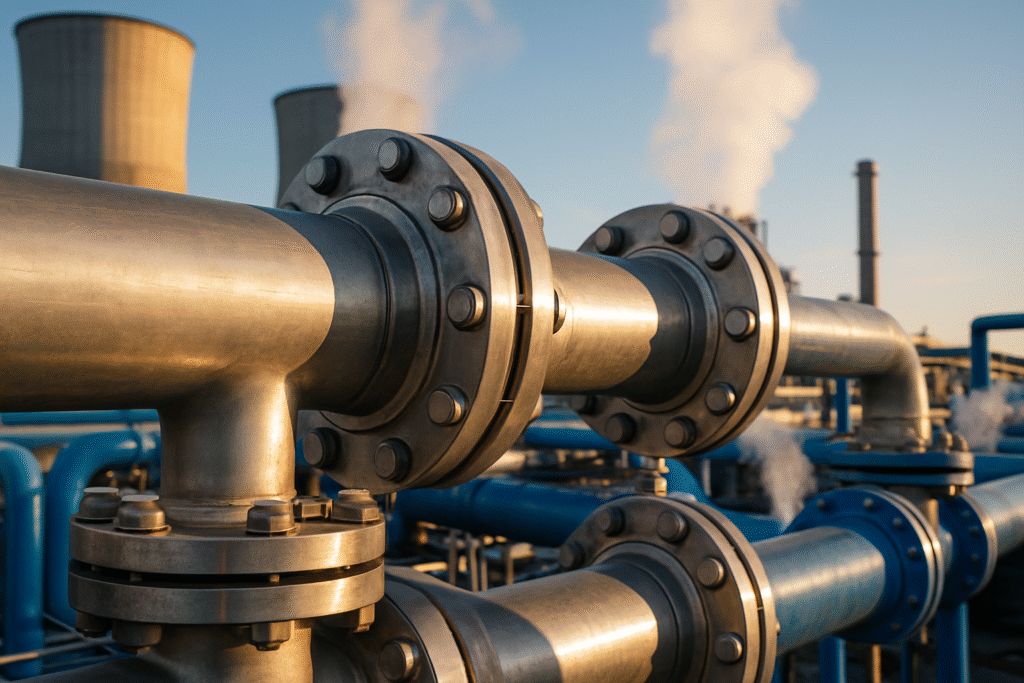
Brida de tubería de acero inoxidable: Datos intrigantes, Ventajas ocultas, Tipos, Usos y cómo elegir diferentes bridas
El brida de tubería de acero inoxidable El mercado se encuentra en el centro de la confiabilidad de las tuberías industriales., y los números confirman su valor estratégico. Según la investigación de Grand View (2024), El mercado mundial de bridas industriales se valoró en $5.8 mil millones en 2023 y se prevé que alcance $7.2 mil millones por 2030.
Para ingenieros y gerentes de adquisiciones, que el crecimiento refleja una realidad: stainless steel flanges remain essential where corrosion resistance, integridad de la presión, and traceable compliance matter most. Además, buyers now expect more than material labels, so technical selection, documentación, and manufacturing quality have become decisive.
Impulsores del mercado industrial detrás de la demanda de bridas para tuberías de acero inoxidable
Demand for stainless steel flanges continues to rise because industrial plants need durable, low-maintenance connections across aggressive service environments. Según IBISWorld (2024), Asia-Pacífico representa más de 45% de la producción mundial de bridas, siendo China el mayor fabricante.
That regional concentration affects lead time, precios, and sourcing strategy for global EPC contractors and distributors. Por lo tanto, buyers increasingly evaluate factory capability, experiencia exportadora, and quality documentation alongside unit cost.
Según Statista (2024), La industria del petróleo y el gas representa aproximadamente 35% del consumo global de bridas. This is significant because upstream, centro de la corriente, and downstream systems depend on flanged joints for inspection access, maintenance flexibility, and secure bolted sealing.
Generación de energía, construcción naval, tratamiento de agua, and petrochemical processing also support strong demand. Además, grados de acero inoxidable como 304, 316, 316l, 904l, 2205, y 2507 address very different chloride, temperatura, and pressure profiles.
The intriguing shift in procurement is not only about volume. It is also about selecting the right flange face, clase de presión, ruta de forja, and inspection package to reduce lifecycle cost.
Como Mark Jensen, Ingeniero Senior de Tuberías, estados: “A flange failure rarely begins at installation; it usually starts with a mismatch between alloy, clase de presión, frente a, and service chemistry.” That insight explains why engineers now compare hidden advantages across materials instead of treating all stainless options as interchangeable.
Según la inteligencia de Mordor (2024), industrial infrastructure upgrades in energy and water sectors are sustaining steady growth in piping components globally. Además, stricter maintenance planning is increasing demand for predictable, standards-compliant flange assemblies.
Para equipos de adquisiciones, stainless steel pipe flange sourcing should therefore include more than a price check. It should cover forging quality, tolerancias de mecanizado, PMI, hydrotest needs, EN 10204 3.1 proceso de dar un título, and packaging for export logistics.
SASA FLANGE operates in this quality-focused environment with ISO 9001:2015 y certificaciones PED 2014/68/UE. Servicio 50+ países de todo el petróleo & Gas, Petroquímico, Fuerza, e industrias marinas, la empresa suministra bridas de acero inoxidable, bridas de acero al carbono, bridas de aleación, and pipe fittings with factory-direct support.
En la práctica, industrial buyers compare suppliers based on consistency, not only catalog breadth. Respaldado por mecanizado CNC avanzado y pruebas de calidad integrales, SASA FLANGE supports project requirements from standard ASME B16.5 dimensions to custom export orders in premium alloys.
Tipos de bridas para tuberías de acero inoxidable, Materiales, and Hidden Advantages in Technical Selection
The strongest buying decisions start with understanding the different flange types and the hidden advantages of each design. While the keyword focus is stainless steel pipe flange, engineers actually choose among multiple mechanical interfaces depending on pressure cycling, acceso de mantenimiento, and weld procedure qualification.
De acuerdo a ASME B16.5, dimensiones de la brida, perforación, frente a, and pressure-temperature ratings must be standardized to ensure interchangeability (ASME, 2023). Como resultado, design engineers can align piping classes around repeatable geometry instead of project-specific improvisation.
Como Dr.. Elaine Morris, Científico de materiales, estados: “316L is often selected for corrosion resistance, but duplex grades can deliver a more compelling balance of strength and chloride resistance when stress and environment justify the upgrade.” That is a practical reminder that stainless steel flange selection should always match the actual process condition.
Common stainless materials in industrial flange manufacturing include ASTM A182 F304, F304L, F316, F316L, F904L, F51, y F53. Además, special applications may require Inconel, Monel, Hastelloy, or Titanium for sour service, agua de mar, o medios altamente corrosivos.
- 304/304l: Cost-effective general corrosion resistance for water, alimento, y tareas químicas ligeras.
- 316/316l: Improved pitting resistance due to molybdenum, widely used in marine and chemical service.
- 904l: Enhanced resistance in sulfuric and chloride-rich environments.
- 2205 Dúplex: Higher strength than austenitic grades, often selected for offshore and desalination systems.
- 2507 Súper Dúplex: Excellent chloride stress corrosion cracking resistance for severe seawater service.
From a mechanical standpoint, the main flange types solve different installation and operating challenges. Por lo tanto, buyers should match the flange design to alignment tolerance, presión de funcionamiento, and future maintenance expectations.
- Brida de cuello soldado: Lo mejor para alta presión, temperatura alta, and cyclic duty because its tapered hub reduces stress concentration.
- Brida deslizante: Easier to align and generally more economical for lower-pressure service.
- Brida ciega: Used to isolate lines, terminate connections, o permitir una futura expansión.
- Brida de soldadura: Suitable for smaller bore piping where a smooth bore and strong connection are required.
- Brida roscada: Útil donde la soldadura no es práctica, although pressure and vibration limitations must be considered.
- Brida articular: Preferred when frequent dismantling or stub-end rotation is advantageous.
De acuerdo a ASTM A182/A182M, forged or rolled alloy and stainless steel pipe flanges must meet defined chemical and mechanical property requirements (ASTM, 2023). This matters because chemistry control and forging integrity directly affect corrosion performance and load-bearing reliability.
La clase de presión es igualmente importante. In ASME systems, Las clasificaciones comunes incluyen Clase 150, 300, 600, 900, 1500, y 2500, and the final selection depends on material group and service temperature.
Según Market Research Future (2024), corrosion-related maintenance can account for a substantial share of plant operating costs in process industries, often ranging between 3% y 5% of asset value annually. Por lo tanto, choosing a better-suited flange alloy can save far more than the initial material premium.
The hidden advantages of a correctly specified stainless steel pipe flange include more than corrosion resistance. Buyers also gain better weldability, menor riesgo de contaminación, longer inspection intervals, and stronger resale confidence in regulated industries.
Surface finish and facing also affect sealing performance. cara levantada, Cara plana, Junta tipo anillo, Lengua y ranura, and male-female facings each support different gasket systems and pressure ranges.
Por ejemplo, a 4 Brida de tubería de acero inoxidable en pulgadas en clase 150 for water treatment differs dramatically from a 4 clase de pulgadas 600 weld neck flange for offshore hydrocarbons. Although the nominal size is identical, the metallurgy, diseño de cubo, selección de juntas, and bolt load requirements are not.
SASA FLANGE fabrica bridas en 304, 316, 316l, 904l, 2205, 2507 y otros grados premium, plus matching elbows, camisetas, reductores, y gorras. Ofreciendo tamaños personalizados desde 1/2 pulgada a 60 pulgadas con precios competitivos directos de fábrica, the company supports both standard and made-to-drawing orders.
Además, advanced CNC machining improves concentricity, bolt hole accuracy, and facing finish consistency. For EPC and distributor clients, that helps reduce fit-up delays during site installation and lowers rework risk.
Procurement managers should also compare documentation scope before ordering. EN 10204 3.1 MTC, PMI, informes dimensionales, hardness tests, controles de ferrita, y NACE MR0175 review can be critical in oil, gas, and sour service projects.
ASME, ASTM, DIN and EN Standards That Govern Stainless Steel Pipe Flange Compliance
Industrial buyers should never evaluate a stainless steel pipe flange without checking the governing standards first. Compliance determines interchangeability, trazabilidad, and legal acceptance in pressure equipment applications.
For dimensional and rating requirements, ASME B16.5 covers flanges and flanged fittings from NPS 1/2 a través de 24. ASME B16.47 extends coverage for large diameter steel flanges from NPS 26 a través de 60 (ASME, 2023).
Los estándares materiales son igualmente importantes. ASTM A182 define bridas de tuberías de acero inoxidable y de aleación forjadas o laminadas, mientras ASTM A240 governs stainless plate, hoja, y tiras para recipientes a presión y aplicaciones generales (ASTM, 2023).
European and international projects often call for DIN, EN 1092, or PED-related compliance. Además, marine and offshore applications may require DNV, NORUEGA, or project-specific third-party inspection.
Según el marco PED 2014/68/UE de la Comisión Europea, pressure equipment supplied into the EU must meet essential safety requirements and applicable conformity assessment procedures. Por lo tanto, documentation discipline is not optional when supplying regulated projects.
Key standards and references commonly used in procurement include:
- ASME B16.5: Dimensiones, tolerancias, clasificaciones de presión-temperatura, calificación.
- ASME B16.47: Large diameter flange dimensions and drilling.
- ASME B16.9: Accesorios forjados para soldar a tope fabricados en fábrica.
- ASTM A182: Forged stainless and alloy steel flanges and fittings.
- ASTM A240: Stainless plate and sheet material specification.
- EN 1092: Dimensiones de bridas europeas y clases de presión..
- NACE MR0175/ISO 15156: Requisitos de materiales para entornos que contienen H2S.
These standards do more than define dimensions. They establish the basis for pressure boundary integrity, compatibilidad de soldadura, and quality assurance throughout fabrication and installation.
As David Kerr, Analista de Mercados Industriales, estados: “En proyectos globales, the supplier that controls certification, trazabilidad, and cross-standard equivalency often wins over the supplier with the lowest nominal price.” That observation is especially true when shutdown cost or regulatory delay exceeds hardware cost.
A practical comparison helps procurement teams choose correctly:
- ASME/ANSI systems: Common in North America, Oriente Medio, and many global oil and gas projects.
- DIN/EN systems: Common in Europe and equipment exported to EU-regulated markets.
- JIS systems: Often specified in Japanese industrial projects and related supply chains.
- GOST systems: Used in certain CIS and regional industrial applications.
Buyers should also verify pressure-temperature ratings by material group rather than assuming class numbers are universal. Por ejemplo, austenitic stainless grades and carbon steels do not always share identical allowable values across temperature ranges.
Con ISO 9001:2015 y certificaciones PED 2014/68/UE, SASA FLANGE supports projects that require documented quality systems and export-ready records. The company also offers AD 2000 apoyo, trazabilidad de materiales, and inspection coordination for demanding international orders.
Además, matching fittings matter when building complete systems. Codos, camisetas, reductores, and caps produced to ASME B16.9 help maintain dimensional consistency across the piping assembly.
Purchasers looking for stainless steel flanges and fittings should therefore assess the full package. A compliant flange with undocumented fittings can still create project risk.
Cómo elegir diferentes bridas para aceite, Gas, Químico, Power and Marine Uses
Elegir la brida adecuada para tuberías de acero inoxidable requiere un enfoque basado en el servicio. Engineers should begin with media composition, presión de funcionamiento, temperatura de diseño, tolerancia a la corrosión, and the applicable piping code.
En petróleo y gas, Bridas con cuello soldado en 316L., dúplex 2205, o súper dúplex 2507 are common where chlorides, ciclos de presión, or offshore exposure exist. Según Statista (2024), El petróleo y el gas representan aproximadamente 35% del consumo global de bridas, so reliability expectations in this sector strongly influence overall market standards.
Chemical processing often requires more careful alloy selection than mechanical design alone. Por lo tanto, buyers may move from 304L to 316L, 904l, Hastelloy, or other corrosion-resistant materials depending on acid concentration and temperature.
Power generation applications prioritize pressure integrity and long-term thermal stability. Como consecuencia, high-pressure lines often specify weld neck or socket weld designs with rigorous NDE and documentation controls.
Marine and shipbuilding projects need resistance to salt spray, agua de mar, and galvanic concerns. En estos casos, 316l, 2205, y 2507 frequently offer better lifecycle value than basic austenitic grades.
Water treatment and desalination systems also drive demand for stainless and duplex materials. According to ISO-related industry studies cited by market analysts, lifecycle corrosion performance is increasingly prioritized over lowest first cost in municipal and industrial water projects.
Al seleccionar una brida, engineers should review these factors:
- Material grade and corrosion resistance in actual process media.
- Nominal size and schedule compatibility with connected pipe.
- Pressure class and pressure-temperature rating.
- Tipo de revestimiento y compatibilidad de juntas.
- Welding procedure and installation constraints.
- Inspección, pruebas, y requisitos de certificación.
- Standard system, como ASME, DIN, JIS, o ES.
- plazo de entrega, embalaje, and destination-country compliance.
A 2 inch stainless steel flange for sale in a distributor catalog may look equivalent to another part number, yet practical suitability can differ significantly. The better choice depends on metallurgy, clase de presión, frente a, and certificate package rather than size alone.
Pricing also varies by alloy and processing route. Stainless steel pipe flange price is influenced by nickel and molybdenum content, forging cost, complejidad del mecanizado, cantidad, clase de presión, alcance de la prueba, y embalaje de exportación.
Por ejemplo, a stainless steel threaded pipe flange may reduce field welding cost in low-pressure utility service. Sin embargo, an API-oriented hydrocarbon line will often favor a weld neck flange because it offers better fatigue resistance and structural continuity.
Custom manufacturing can be essential when standard stock does not fit project conditions. SASA FLANGE supports custom drilling, espesor no estándar, revestimientos especiales, and machining for project-specific assemblies used in oil and gas, petroquímico, generación de energía, y sectores marítimos.
That flexibility is important for EPC contractors handling mixed-standard projects. Además, integrated supply of flanges and fittings can simplify vendor qualification and reduce coordination risk during shutdowns or new plant construction.
Procurement professionals should request drawings, MTC samples, previous export references, and inspection plans before placing large orders. This approach improves comparison accuracy and reduces the chance of hidden total-cost issues after award.
Perspectivas futuras, Buying Recommendations and Strategic Sourcing for Stainless Steel Pipe Flange Projects
The outlook for stainless steel pipe flange demand remains positive because industrial capital expenditure continues in energy, quimicos, agua, e infraestructura. Según la investigación de Grand View (2024), Se espera que el mercado crezca de $5.8 mil millones en 2023 a $7.2 mil millones por 2030.
This expansion will likely favor manufacturers that combine alloy range, control de documentación, and export responsiveness. En contraste, suppliers competing only on basic price may struggle in projects requiring PED, ANUNCIO 2000, or higher-level traceability.
Según IBISWorld (2024), China sigue siendo la mayor base manufacturera dentro de la región de Asia y el Pacífico, which produces over 45% de bridas globales. Como resultado, strategic buyers are increasingly developing direct factory relationships to improve cost transparency and lead-time control.
Digital procurement is also changing how buyers evaluate suppliers. Technical datasheets, MTC previews, inspection photos, and fast quotation response now influence vendor selection almost as much as catalog breadth.
The intriguing advantage for modern sourcing teams is that better information enables better standardization. Por lo tanto, buyers can reduce SKU complexity by aligning flange types, materiales, and fitting combinations across multiple projects.
Recommended sourcing actions include:
- Standardize core materials such as 304L, 316l, 2205, y 2507 por categoría de servicio.
- Precalificar proveedores para ASME, ASTM, EN, and PED documentation needs.
- Request clear pricing separation for material, mecanizado, pruebas, y embalaje.
- Confirm dimensional tolerances and facing finish before order release.
- Bundle flanges and fittings where possible to simplify quality control.
For procurement managers comparing flange manufacturers, the best partner is usually the one that can explain why a given flange should be chosen, not only what it costs. That is especially true for different applications where corrosion, fatiga, and compliance interact.
For projects requiring standard or custom stainless steel pipe flange supply, SASA FLANGE offers technical support, amplia cobertura material, and export-oriented manufacturing coordination. That combination helps buyers move from quote collection to specification confidence with fewer delays.
Preguntas frecuentes
¿Para qué se utiliza una brida de acero inoxidable??
●Se utiliza una brida de acero inoxidable para conectar tuberías., valvulas, zapatillas, and pressure equipment in systems that require a detachable, sealed joint.
●Según Statista (2024), La industria del petróleo y el gas representa aproximadamente 35% del consumo global de bridas, which shows how important flanged connections are in high-value industrial service.
●En la práctica, stainless steel flanges are chosen for corrosion resistance, higiene, resistencia mecánica, and easier maintenance compared with permanent welded-only systems.
●Los usos comunes incluyen líneas petroquímicas., patines de tratamiento de agua, marine pipework, sistemas de procesamiento de alimentos, and power plant utility piping.
●For projects requiring reliable material traceability and standards compliance, trabajando con fabricantes establecidos como SASA FLANGE helps ensure the right alloy, clase de presión, y paquete de certificación.
¿Fabrican accesorios para tuberías de acero inoxidable??
●Sí, Los fabricantes producen accesorios para tuberías de acero inoxidable, como codos., camisetas, reductores, and caps to match stainless piping and flange systems.
●ASME B16.9 is the key standard for factory-made wrought butt welding fittings, while ASTM material standards define chemistry and mechanical properties for stainless grades.
●These fittings are widely supplied in 304, 316, 316l, 904l, 2205, y 2507 depending on corrosion severity, presión, and end-use industry.
●Using matched stainless steel flanges and fittings improves welding compatibility, consistencia dimensional, and long-term corrosion performance.
●For integrated sourcing, buyers often prefer one supplier for both flanges and fittings so inspection records and material traceability remain aligned.
¿Cuál es el estándar para bridas de acero inoxidable??
●The most common standards for stainless steel flanges are ASME B16.5, ASME B16.47, ASTM A182, DIN, y ES 1092, depending on the project region and code basis.
●ASME B16.5 cubre dimensiones, perforación, vueltas, y clasificaciones de presión y temperatura para NPS 1/2 a 24, mientras ASTM A182 covers forged stainless material requirements.
●Los proyectos europeos pueden requerir EN 1092 y cumplimiento de PED 2014/68/UE, especially when equipment enters regulated EU pressure equipment markets.
●Buyers should confirm not only the flange standard but also inspection documents such as EN 10204 3.1 MTCs and any NACE MR0175 requirement for sour service.
●Para aplicaciones críticas, asking suppliers to clarify standard equivalency before purchase can prevent costly installation and approval issues.
¿Cuál es el tipo de brida de tubería más resistente??
●The weld neck flange is generally considered the strongest common piping flange for high-pressure, alta temperatura, y servicio cíclico.
●Its tapered hub and butt-weld connection distribute stress more effectively than slip-on or threaded designs, which improves fatigue resistance in demanding systems.
●Según la práctica de diseño de ASME., weld neck flanges are widely preferred in refinery, costa afuera, and power applications where pressure integrity is critical.
●Sin embargo, the strongest practical choice still depends on the full design basis, including alloy grade, clase de presión, tipo de revestimiento, sistema de juntas, and bolt load.
●Engineers should evaluate service conditions carefully before selecting a flange, because an oversized or poorly matched design can still underperform in operation.
¿Cómo eligen los compradores entre 304, 316l, 2205, y 2507 bridas de acero inoxidable?
●Buyers usually choose 304 for general corrosion service, 316L for better chloride resistance, 2205 for higher strength and good chloride performance, y 2507 for severe seawater or offshore duty.
●Como Dr.. Elaine Morris, Científico de materiales, explica, duplex grades can provide a better strength-to-corrosion balance than standard austenitic grades when service conditions justify the upgrade.
●Material cost rises as alloy complexity increases, but lifecycle savings can offset the premium when corrosion failure or shutdown risk is high.
●Según Market Research Future (2024), El mantenimiento relacionado con la corrosión puede consumir 3% a 5% of asset value annually in process industries, so alloy optimization matters financially.
●Procurement teams should review chloride content, temperatura, presión, método de soldadura, and required documentation before finalizing grade selection.
¿Qué factores afectan el precio y el tiempo de entrega de la brida de tubería de acero inoxidable??
●El precio y el tiempo de entrega de la brida de tubería de acero inoxidable dependen del grado de aleación, tamaño, clase de presión, disponibilidad de forja, complejidad del mecanizado, alcance de la prueba, y cantidad del pedido.
●Por ejemplo, a standard 2 clase de pulgadas 150 304 flange is typically faster and less expensive than a custom 2507 weld neck flange with PMI, inspección de terceros, and PED documentation.
●Según IBISWorld (2024), Asia-Pacífico produce más 45% de bridas globales, which means sourcing strategy and factory access can strongly influence delivery schedules and landed cost.
●Additional factors include raw material volatility, export packaging requirements, revestimientos especiales, and whether matching fittings are ordered together.
●For time-sensitive projects, requesting a detailed quotation with separate line items for material, mecanizado, pruebas, and shipment provides the clearest basis for comparison.
Posts Relacionados
Acabado de la cara de la brida: Dentados concéntricos versus espirales explicados
Los dentados concéntricos y en espiral son acabados de cara de brida mecanizados.…
Dúplex 2205 frente a bridas 316L: ¿Qué material debería elegir??
respuesta rapida: Dúplex 2205 Las bridas suelen ser el candidato más fuerte.…

Definición de brida de orificio, Detalles y descripción general de bridas ASME B16.36: Datos de mercado, Guía de selección e información sobre cumplimiento
El mercado mundial de bridas industriales se valoró en $5.8 mil millones…

Guía del mercado de bridas de eliminación negras: Materiales, 3.5″ Compatibilidad, y datos de abastecimiento B2B para bridas de fregaderos de cocina
La demanda de bridas de eliminación negras está aumentando a medida que los compradores de accesorios de cocina…