
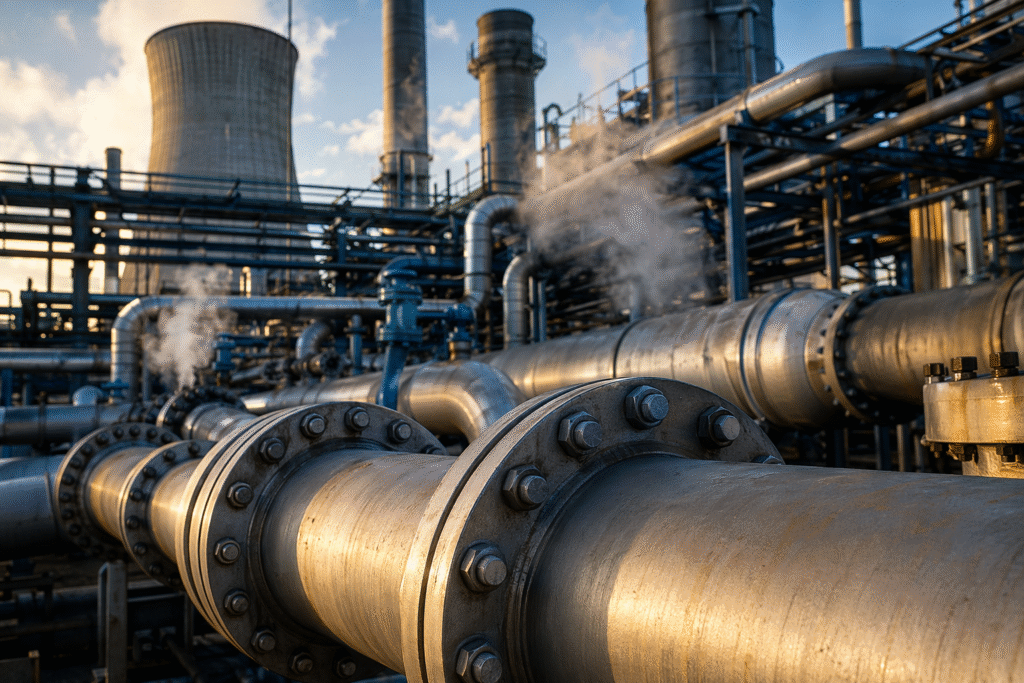
Flensa Stainless Steel untuk Minyak, Gas, Layanan Kimia dan Kelautan
Permintaan flensa pipa baja tahan karat terus meningkat karena operator industri memprioritaskan ketahanan terhadap korosi, nilai siklus hidup, dan kepatuhan. Menurut Penelitian Grand View (2024), pasar flensa industri global dihargai $5.8 miliar masuk 2023 dan diperkirakan akan tercapai $7.2 miliar oleh 2030.
That growth reflects a simple procurement reality. Buyers need flanges that perform under pressure, perputaran suhu, and aggressive media while meeting ASME, ASTM, DIN, dan persyaratan EN.
Untuk para insinyur, pembeli, and EPC teams, this guide explains the intriguing and often hidden advantages of stainless steel pipe flange products. It also compares types, kegunaan, bahan, and selection criteria so you can choose flanges with greater confidence.
Why Stainless Steel Pipe Flange Demand Keeps Expanding in Global Industry
Menurut IBISWorld (2024), Asia-Pasifik menyumbang lebih dari itu 45% produksi flensa global, dengan Tiongkok sebagai produsen terbesar. Karena itu, sourcing strategies now focus not only on price, but also on traceability, kepatuhan standar, dan konsistensi pemesinan.
Menurut Statista (2024), industri minyak dan gas menyumbang sekitar 35% konsumsi flensa global. Lebih-lebih lagi, petrokimia, pembangkit listrik, laut, and water treatment projects continue to specify stainless grades where corrosion risk and maintenance costs are high.
Dalam praktiknya, stainless steel pipe flange products deliver value far beyond initial material cost. They reduce unplanned shutdowns, support longer inspection intervals, and improve sealing reliability in piping systems.
Sebagai akibat, procurement teams increasingly compare total installed cost rather than only unit price. That approach often favors 304, 316, 316L, rangkap, and high-alloy flange solutions over lower-grade alternatives.
Menurut Intelijen Mordor (2024), global process industry investment remains strong in refinery upgrades, LNG infrastructure, and industrial water systems. Each of these sectors relies on standardized flange connections for maintenance access, modular assembly, and safe pressure containment.
Lebih-lebih lagi, pressure class requirements continue to shape buying decisions. Dalam banyak proyek, buyers specify Class 150, 300, 600, 900, 1500, atau 2500 flanges under ASME B16.5, while larger diameters may require ASME B16.47 Seri A atau B.
The hidden advantages of stainless steel pipe flange systems often appear after years of operation. These include better resistance to pitting, improved cleanability, risiko kontaminasi yang lebih rendah, and stronger long-term performance in chloride-bearing environments.
Sebagai Dr. Helen Morris, Insinyur Material dan konsultan korosi, negara bagian: “In lifecycle cost analysis, stainless flanges often outperform coated carbon steel when downtime, tenaga kerja pemeliharaan, and media compatibility are fully considered.” That insight is especially relevant for continuous-process plants where leaks create safety and production losses.
SASA FLANGE melayani permintaan ini dengan flensa baja tahan karat, flensa baja karbon, flensa paduan, dan alat kelengkapan pipa di 304, 316, 316L, 904L, 2205, 2507, A105, A182, tidak konel, Monel, Hastelloy, dan Titanium. Dengan ISO 9001:2015 dan sertifikasi PED 2014/68/EU, the company supports buyers seeking factory-direct supply and internationally recognized quality documentation.
For teams comparing global suppliers, manufacturing capability matters as much as metallurgy. Didukung oleh permesinan CNC canggih dan pengujian kualitas yang komprehensif, SASA FLANGE mendukung ukuran khusus dari 1/2 inci ke 60 inci untuk Minyak & Gas, Petrokimia, Kekuatan, Laut, and Construction projects.
Selain itu, experienced suppliers can align flange faces, peringkat tekanan, and inspection documents with project requirements early in the RFQ stage. That reduces delays caused by mismatched standards, incomplete MTCs, or unclear dimensional tolerances.
Buyers should also note the growing importance of EN 10204 3.1 documentation and PED traceability for exports into Europe. Sebaliknya, upstream oil and gas projects may place more weight on sour service compatibility, material heat traceability, Dan NACE MR0175 considerations.
Jenis Flange Pipa Stainless Steel, Bahan, dan Keuntungan Tersembunyi dalam Pelayanan Nyata
A stainless steel pipe flange is not a single commodity item. It is a pressure-retaining component whose geometry, menghadap, metalurgi, and dimensional standard directly affect system integrity.
Menurut Riset Pasar Masa Depan (2024), industrial demand for corrosion-resistant alloys is growing steadily due to stricter reliability and safety requirements. Karena itu, stainless flanges and fittings remain a strategic category in both greenfield and brownfield investments.
Seperti James Porter, Insinyur Perpipaan Senior, negara bagian: “The best flange selection is rarely the cheapest piece price. It is the component that matches pressure class, tunjangan korosi, desain paking, and maintenance reality.”
From a technical standpoint, buyers typically evaluate stainless steel pipe flange options by alloy family, kelas tekanan, tipe menghadap, bore compatibility, dan mengakhiri koneksi. Lebih-lebih lagi, they compare whether welding, threading, or lap-joint assembly best suits the piping layout.
The most common stainless grades include 304 Dan 316 families. Namun, severe service may require 316L, 904L, 2205 rangkap, 2507 super dupleks, or nickel alloys when chlorides, asam, or elevated temperatures are present.
- 304 flensa baja tahan karat: good general corrosion resistance and attractive cost-performance balance.
- 316 and 316L stainless steel flange: improved resistance to chlorides and chemical media because of molybdenum content.
- 904L mengarah: suited to highly corrosive environments such as sulfuric acid service.
- 2205 flensa dupleks: higher strength and better chloride stress corrosion cracking resistance than austenitic grades.
- 2507 flensa super dupleks: preferred for offshore, air laut, and aggressive chemical service.
Material selection should also consider welding performance. Low-carbon grades such as 304L and 316L reduce sensitization risk after welding, which matters in fabricated spool systems and field installations.
In terms of geometry, several flange types dominate industrial piping. Each one addresses a different balance of pressure integrity, kenyamanan instalasi, and total system cost.
- Flensa leher las: best for severe pressure and temperature duty because the tapered hub reduces stress concentration.
- Selipkan flensa: easier to align and often lower in fabrication cost, but generally less robust than weld neck in cyclic service.
- Flensa buta: used to close line ends, nozel, atau titik ekspansi di masa depan.
- Flensa las soket: common in small-bore, sistem bertekanan tinggi.
- Flensa berulir: berguna jika pengelasan tidak praktis, especially in low-pressure utility service.
- Flensa sambungan putaran: suitable for systems needing frequent dismantling and alignment flexibility.
Menurut ASME B16.5, peringkat tekanan-suhu bervariasi menurut kelompok bahan dan kelas. Karena itu, sebuah Kelas 300 stainless steel pipe flange does not simply mean one universal pressure value across all temperatures.
Facing configuration is equally important. Wajah terangkat, wajah datar, and ring type joint designs must match the mating flange and gasket system to avoid leakage or flange damage.
Misalnya, RF flanges are widely used in process piping. Flensa RTJ, Namun, are preferred in higher-pressure and critical service because the metal ring gasket can provide superior sealing under demanding conditions.
Procurement managers often ask about hidden advantages beyond corrosion resistance. One advantage is lower contamination risk in clean service, including food processing, pharmaceutical utility systems, and high-purity water lines.
Another advantage is durability under washdown and marine exposure. Stainless steel pipe flange products also maintain appearance better than coated carbon steel, which supports visible installations and corrosive outdoor service.
According to ASTM and ASME material specifications, forged stainless flanges are often supplied under ASTM A182 with dimensions governed by ASME B16.5 atau ASME B16.47. Selain itu, butt weld fittings commonly follow ASME B16.9, which helps buyers align elbows, kaos, reduksi, and caps with flange materials and schedules.
For specification clarity, buyers should confirm these parameters before placing an order:
- Material grade and dual certification, such as 316/316L.
- Standard and pressure class, seperti ASME B16.5 Kelas 300.
- Tipe menghadap, seperti RF, FF, atau RTJ.
- Jadwal pipa dan kecocokan bore, such as SCH 40 or SCH 80.
- Surface finish and serration where gasket performance matters.
- Persyaratan inspeksi termasuk PMI, uji hidro, or NDE where applicable.
- Documentation such as EN 10204 3.1 MTC dan ketertelusuran panas.
SASA FLANGE supports these specification needs with flanges and pipe fittings manufactured to ANSI B16.5, ANSI B16.47, ASME B16.9, DIN, JIS, gost, dan EN 1092. Buyers evaluating stainless steel flanges and fittings can review product scope at halaman produk and align flange orders with complete piping packages.
According to ISO guidance and major EPC procurement practice, material traceability and dimensional consistency reduce field rework significantly. Akibatnya, experienced manufacturers that control forging, permesinan, menandai, and final inspection provide measurable schedule advantages.
Sebagai Laura Chen, Analis Pasar Industri, negara bagian: “Procurement leaders increasingly favor suppliers that can deliver flanges, siku, kaos, reduksi, and caps under one quality system because it simplifies inspection and vendor management.” That is especially useful on multi-site and export-driven projects.
ASME, ASTM, DIN, dan Standar EN Yang Mengatur Kualitas Flange Pipa Stainless Steel
Standards are the backbone of reliable flange procurement. Tanpa mereka, buyers cannot verify dimensions, peringkat tekanan, kimia, ruang lingkup pengujian, or interchangeability.
Untuk proyek Amerika Utara dan banyak proyek global, ASME B16.5 mencakup flensa pipa dan fitting flensa dari NPS 1/2 melalui 24. ASME B16.47 mencakup diameter yang lebih besar, biasanya dari NPS 26 melalui 60, using Series A and Series B dimensions.
Material requirements commonly point to ASTM A182 untuk paduan tempa atau canai dan flensa baja tahan karat. Sementara itu, stainless plate products used elsewhere in fabrication may reference ASTM A240 depending on form and application.
Proyek-proyek Eropa sering kali menyebutkan EN 1092 flanges and PED compliance. Karena itu, exporters must understand not just dimensional differences, but also marking, inspeksi, and declaration requirements for the target market.
The following comparison helps procurement teams check compatibility quickly:
- ASME B16.5: ukuran, pengeboran, menghadap, and pressure-temperature classes for common pipe flanges.
- ASME B16.47: large-diameter flanges with Series A and Series B options.
- ASTM A182: chemical and mechanical requirements for forged stainless and alloy flange materials.
- ASME B16.9: alat kelengkapan las pantat tempa buatan pabrik, termasuk siku, kaos, reduksi, dan topi.
- EN 1092: European flange dimensions and pressure designations such as PN16, PN25, dan PN40.
- standar DIN: still referenced in many legacy systems and regional specifications.
- NACE MR0175 / ISO 15156: critical for sour service material compatibility.
According to ASME and ASTM published standards, dimensional compliance alone is not enough. Buyers must also confirm chemistry, sifat tarik, hardness where relevant, and manufacturing route.
Lebih-lebih lagi, standards do not eliminate the need for application engineering. A technically compliant flange can still be a poor choice if the grade, menghadapi, paking, lari, and operating environment are mismatched.
Untuk lepas pantai, kimia, and sour service systems, compliance can extend beyond baseline dimensions. NORWEGIA, DNV, PED, and client-specific inspection test plans may also apply depending on the project and region.
That is why qualified manufacturers maintain documented quality systems. Dengan ISO 9001:2015, PED 2014/68/UE, dan IKLAN 2000 sertifikasi, SASA FLANGE helps customers align production, dokumentasi, and export requirements under one controlled process.
Traceability is another major procurement issue. Heat number marking, identifikasi material positif, Dan EN 10204 3.1 certificates support auditability from raw material to final shipment.
Selain itu, machining quality affects field fit-up. Penjajaran lubang baut, flange thickness tolerance, menghadapi selesai, and bore concentricity all influence installation efficiency and leak performance.
Procurement professionals should request these documents when sourcing stainless steel pipe flange products:
- Sertifikat uji materi ke EN 10204 3.1.
- Laporan inspeksi dimensi.
- PMI report for alloy verification when required.
- Pressure class and standard confirmation.
- Surface treatment or pickling/passivation records where specified.
- PED declarations for EU-bound equipment where applicable.
For teams needing more supplier background, SASA FLANGE informasi perusahaan provides manufacturing context, supported grades, and service coverage. This is particularly useful when prequalifying flange manufacturers and long-term flange vendor partners.
Buyers should also use authoritative references directly when finalizing specifications. Pejabat itu situs ASME remains an essential source for current code and standard information.
Cara Memilih Produk Flange Pipa Stainless Steel untuk Oli, Gas, Kimia, Kekuatan, dan Dinas Kelautan
The right flange selection starts with service conditions, bukan kenyamanan katalog. Tekanan, suhu, sedang, risiko korosi, metode pembersihan, and inspection requirements should drive the decision.
Untuk sistem minyak dan gas, corrosion allowance and sealing integrity are usually the first priorities. Menurut Statista (2024), sektor ini mewakili tentang 35% konsumsi flensa global, so specification discipline is critical.
In upstream and midstream service, buyers often choose weld neck or RTJ configurations for pressure containment and vibration resistance. Duplex and super duplex grades may also be preferred for seawater, di lepas pantai, and chloride-rich media.
Di pabrik petrokimia, media compatibility becomes more complex. Asam, klorida, solvent exposure, and elevated temperatures can quickly eliminate low-cost materials from consideration.
Untuk aplikasi ini, engineers often compare 316L, 904L, paduan 20 alternatives, or nickel alloys depending on the process fluid. Selain itu, gasket material and bolt metallurgy must be reviewed as part of the whole flange assembly.
Power generation systems place heavy emphasis on temperature, bersepeda, and joint reliability. Karena itu, weld neck flanges and higher-pressure classes are common in steam, kondensat, and auxiliary piping.
Lingkungan kelautan dan pembuatan kapal menciptakan tantangan yang berbeda. Semprotan garam, kelembaban, and intermittent immersion push many buyers toward 316L, 2205, atau 2507 grades for critical lines and exposed assemblies.
Water treatment systems often prioritize corrosion resistance and maintenance reduction. Stainless steel pipe flange products work well in desalination, RO tergelincir, garis dosis kimia, and sludge treatment packages.
Saat mengevaluasi ukuran flensa pipa baja tahan karat, buyers should confirm more than nominal diameter. A 4 flensa pipa baja tahan karat inci, Misalnya, still requires matching schedule, menghadap, pola pengeboran, dan kelas tekanan.
Use this checklist when you choose flanges for a project:
- Define process medium, kadar klorida, kisaran suhu, and pressure envelope.
- Match flange standard to project specification, seperti ASME B16.5 atau EN 1092.
- Pilih jenis flensa berdasarkan tegangan, frekuensi pemeliharaan, and welding access.
- Confirm material grade against corrosion and temperature requirements.
- Verify gasket compatibility and bolting material.
- Request traceability, pengujian, and certificate package before production.
- Check lead time, kemasan ekspor, and logistics support.
Price should be evaluated carefully. Stainless steel pipe flange price varies with alloy, penempaan rute, kelas, diameter, kompleksitas pemesinan, dan ruang lingkup pemeriksaan.
Namun, lower upfront cost can become expensive if fit-up issues, corrosion failure, or certificate gaps delay commissioning. Sebagai akibat, many EPC buyers shortlist suppliers that can offer both technical support and manufacturing control.
SASA FLANGE provides custom manufacturing for flanges and related fittings including elbows, kaos, reduksi, dan topi. Porsi 50+ negara-negara di seluruh Minyak & Gas, Petrokimia, Kekuatan, dan industri Kelautan, the company helps clients consolidate sourcing while maintaining specification accuracy.
That supplier model is valuable when a project requires mixed materials such as 316L flanges, A182 forgings, duplex fittings, and special alloy components. It also reduces the coordination burden between multiple flange manufacturers and fitting vendors.
For projects involving stainless steel flange types, threaded options, or nonstandard dimensions, early technical review is recommended. Buyers can discuss project-specific requirements through SASA FLANGE before final RFQ release.
Prospek Masa Depan Pengadaan Flange Pipa Stainless Steel dan Keputusan Pembelian Strategis
Market indicators suggest continued growth for corrosion-resistant piping components. Menurut Penelitian Grand View (2024), the flange market is forecast to reach $7.2 miliar oleh 2030, which signals sustained investment in infrastructure and process reliability.
Pada saat yang sama, buyers will face more demanding expectations around documentation, keberlanjutan, dan ketahanan pasokan. Karena itu, supplier qualification will increasingly include digital traceability, kepatuhan ekspor, and multi-standard manufacturing capacity.
Another clear trend is package sourcing. Procurement teams prefer fewer qualified vendors that can deliver flanges, perlengkapan buttweld, and special materials together under one audited system.
That approach reduces inspection complexity and improves schedule predictability. It also supports stronger commercial leverage on large-volume projects.
Melihat ke depan, duplex and high-performance stainless grades should gain share in chloride-heavy and high-risk services. Sebaliknya, standar 304 Dan 316 families will remain dominant in general industrial, air, konstruksi, and moderate chemical service.
Buyers should also expect greater emphasis on lifecycle engineering. Instead of asking only what flanges are for sale, leading teams now ask how the selected flange will perform after five or ten years in service.
Secara strategis, procurement managers should do three things. Pertama, standardize approved flange specifications by service class. Kedua, prequalify suppliers that hold ISO 9001:2015 and PED-related capabilities. Ketiga, align RFQs with exact pressure class, menghadap, bahan, dan persyaratan dokumentasi.
For companies building resilient supply chains, the best results usually come from technical clarity and stable supplier partnerships. When stainless steel pipe flange reliability, kepatuhan, and competitive factory pricing all matter, a conversation with SASA FLANGE can help move projects from specification to shipment with less risk.
Pertanyaan yang Sering Diajukan
Untuk apa flensa baja tahan karat??
●Flensa baja tahan karat digunakan untuk menyambung pipa, katup, pompa, and vessels in pressure systems where corrosion resistance and sealing reliability are critical.
●Menurut Statista (2024), industri minyak dan gas menyumbang sekitar 35% konsumsi flensa global, which shows how important flanged joints are in high-value process infrastructure.
●Mereka banyak digunakan di pabrik petrokimia, sistem kelautan, pembangkit listrik, jalur pengolahan makanan, and water treatment facilities because they allow maintenance access and standardized assembly.
Apakah mereka membuat alat kelengkapan pipa stainless steel?
●Ya, produsen memproduksi alat kelengkapan pipa stainless steel seperti siku, kaos, reduksi, and caps to work with flange systems and welded pipe networks.
●ASME B16.9 is a common standard for factory-made wrought buttwelding fittings, and buyers often match these components with ASTM A182 stainless steel flanges for material consistency.
●For projects requiring coordinated supply of flanges and fittings in 304, 316, 2205, atau 2507 nilai, bekerja dengan produsen mapan seperti SASA FLANGE helps simplify sourcing and documentation.
Flensa apa yang terbuat dari baja tahan karat?
●Flensa baja tahan karat yang umum termasuk leher las, mengenakan, buta, las soket, berulir, and lap joint designs made in grades such as 304, 304L, 316, 316L, 904L, 2205, Dan 2507.
●Menurut praktik ASTM dan ASME, forged stainless flanges are frequently supplied under ASTM A182 and dimensioned to ASME B16.5 atau ASME B16.47 tergantung pada ukuran.
●Buyers should choose the flange type and grade based on pressure class, sedang, suhu, and required facing such as RF, FF, atau RTJ.
Sebutkan tiga jenis flensa?
●Tiga jenis flensa yang paling sering dirujuk dalam diskusi industri umum adalah leher las, mengenakan, dan flensa buta.
●Weld neck flanges are preferred for severe pressure and temperature service, flensa slip on mendukung penyelarasan yang lebih mudah dan biaya fabrikasi yang lebih rendah, and blind flanges seal line ends or nozzle openings.
●For critical duty, engineers should verify ASME B16.5 kelas, muka flensa, and pipe schedule before selecting any of these standard types.
Bagaimana pembeli memilih di antara keduanya 304 Dan 316 bahan flensa pipa stainless steel?
●304 stainless steel pipe flange products are suitable for many general industrial services, ketika 316 and 316L provide better resistance in chloride-bearing and chemical environments because of molybdenum content.
●According to corrosion engineering practice and common ASTM material selection guidance, 316L is often preferred where welding and reduced sensitization risk matter.
●When the service includes seawater, aggressive cleaning chemicals, or higher pitting risk, buyers should evaluate 316L, rangkap, or higher-alloy alternatives instead of defaulting to 304.
What documents should a flange manufacturer or flange vendor provide with stainless steel flanges?
●A qualified flange manufacturer should provide at least a material test certificate, dimensional inspection confirmation, ketertelusuran panas, and standard designation such as ASME B16.5 atau EN 1092.
●Untuk proyek ekspor dan diatur, EN 10204 3.1 dokumentasi, PED-related declarations, laporan PMI, and marking records may also be required depending on destination and service class.
●Buyers seeking reliable compliance should request the full documentation package before production release and confirm it matches project specifications line by line.
Posting Terkait
Selesai Wajah Flange: Penjelasan Gerigi Konsentris vs Spiral
Gerigi konsentris dan spiral keduanya merupakan penyelesaian permukaan flensa yang dikerjakan dengan mesin…
Rangkap 2205 vs Flensa 316L: Bahan Mana Yang Harus Anda Pilih?
Jawaban cepat: Rangkap 2205 flensa biasanya merupakan kandidat yang lebih kuat…

Definisi Flensa Lubang, Detail dan Ikhtisar Flensa ASME B16.36: Data Pasar, Panduan Seleksi dan Wawasan Kepatuhan
Pasar flensa industri global dihargai $5.8 miliar…

Panduan Pasar Flensa Pembuangan Hitam: Bahan, 3.5″ Kesesuaian, dan Data Sumber B2B untuk Flensa Wastafel Dapur
Permintaan flensa pembuangan hitam meningkat sebagai pembeli perlengkapan dapur…