
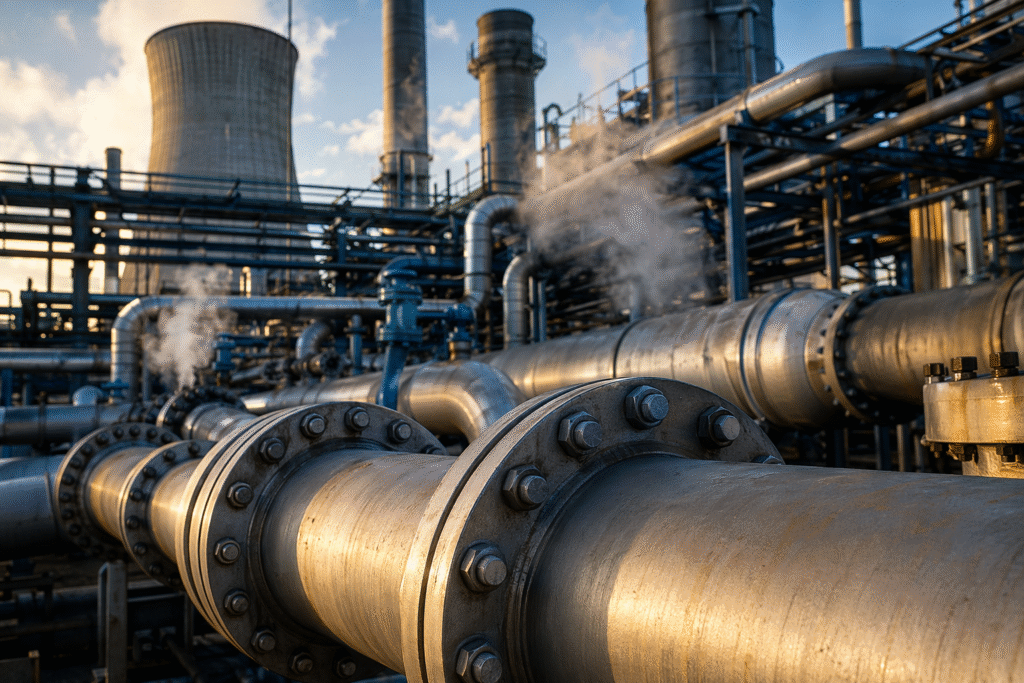
Flanges de aço inoxidável para óleo, Gás, Serviço Químico e Marítimo
A demanda por flanges para tubos de aço inoxidável continua a aumentar à medida que os operadores industriais priorizam a resistência à corrosão, valor do ciclo de vida, e conformidade. De acordo com a pesquisa Grand View (2024), o mercado global de flanges industriais foi avaliado em $5.8 bilhão em 2023 e está projetado para atingir $7.2 bilhão por 2030.
That growth reflects a simple procurement reality. Buyers need flanges that perform under pressure, ciclagem de temperatura, and aggressive media while meeting ASME, ASTM, DIN, e requisitos EN.
Para engenheiros, compradores, and EPC teams, this guide explains the intriguing and often hidden advantages of stainless steel pipe flange products. It also compares types, usa, materiais, and selection criteria so you can choose flanges with greater confidence.
Why Stainless Steel Pipe Flange Demand Keeps Expanding in Global Industry
De acordo com IBISWorld (2024), Ásia-Pacífico é responsável por mais de 45% da produção global de flanges, sendo a China o maior fabricante. Portanto, sourcing strategies now focus not only on price, but also on traceability, conformidade padrão, e consistência de usinagem.
De acordo com Statista (2024), a indústria de petróleo e gás é responsável por aproximadamente 35% do consumo global de flanges. Além disso, petroquímico, geração de energia, marinho, and water treatment projects continue to specify stainless grades where corrosion risk and maintenance costs are high.
Na prática, stainless steel pipe flange products deliver value far beyond initial material cost. They reduce unplanned shutdowns, support longer inspection intervals, and improve sealing reliability in piping systems.
Como resultado, procurement teams increasingly compare total installed cost rather than only unit price. That approach often favors 304, 316, 316eu, duplex, and high-alloy flange solutions over lower-grade alternatives.
De acordo com a Inteligência Mordor (2024), global process industry investment remains strong in refinery upgrades, LNG infrastructure, and industrial water systems. Each of these sectors relies on standardized flange connections for maintenance access, modular assembly, and safe pressure containment.
Além disso, pressure class requirements continue to shape buying decisions. Em muitos projetos, buyers specify Class 150, 300, 600, 900, 1500, ou 2500 flanges under ASME B16.5, while larger diameters may require ASME B16.47 Series A or B.
The hidden advantages of stainless steel pipe flange systems often appear after years of operation. These include better resistance to pitting, improved cleanability, menor risco de contaminação, and stronger long-term performance in chloride-bearing environments.
Como Dr.. Helen Morris, Engenheiro de Materiais e consultor de corrosão, estados: “In lifecycle cost analysis, stainless flanges often outperform coated carbon steel when downtime, mão de obra de manutenção, and media compatibility are fully considered.” That insight is especially relevant for continuous-process plants where leaks create safety and production losses.
SASA FLANGE serves this demand with stainless steel flanges, flanges de aço carbono, flanges de liga, e acessórios para tubos em 304, 316, 316eu, 904eu, 2205, 2507, A105, A182, Inconel, Monel, Hastelloy, e titânio. Com ISO 9001:2015 e certificações PED 2014/68/EU, the company supports buyers seeking factory-direct supply and internationally recognized quality documentation.
For teams comparing global suppliers, manufacturing capability matters as much as metallurgy. Apoiado por usinagem CNC avançada e testes de qualidade abrangentes, SASA FLANGE suporta tamanhos personalizados de 1/2 polegada para 60 polegada para óleo & Gás, Petroquímica, Poder, Marinho, e projetos de construção.
Adicionalmente, experienced suppliers can align flange faces, classificações de pressão, and inspection documents with project requirements early in the RFQ stage. That reduces delays caused by mismatched standards, incomplete MTCs, or unclear dimensional tolerances.
Buyers should also note the growing importance of EN 10204 3.1 documentation and PED traceability for exports into Europe. Em contraste, upstream oil and gas projects may place more weight on sour service compatibility, material heat traceability, e NACE MR0175 considerations.
Tipos de flange de tubo de aço inoxidável, Materiais, e vantagens ocultas no serviço real
A stainless steel pipe flange is not a single commodity item. It is a pressure-retaining component whose geometry, enfrentando, metalurgia, and dimensional standard directly affect system integrity.
De acordo com a Pesquisa de Mercado Futuro (2024), industrial demand for corrosion-resistant alloys is growing steadily due to stricter reliability and safety requirements. Portanto, stainless flanges and fittings remain a strategic category in both greenfield and brownfield investments.
Como James Porter, Engenheiro de Tubulação Sênior, estados: “The best flange selection is rarely the cheapest piece price. It is the component that matches pressure class, tolerância à corrosão, projeto de junta, and maintenance reality.”
From a technical standpoint, buyers typically evaluate stainless steel pipe flange options by alloy family, classe de pressão, tipo de revestimento, bore compatibility, e conexão final. Além disso, they compare whether welding, rosqueamento, or lap-joint assembly best suits the piping layout.
The most common stainless grades include 304 e 316 families. No entanto, severe service may require 316L, 904eu, 2205 duplex, 2507 superduplex, or nickel alloys when chlorides, ácidos, or elevated temperatures are present.
- 304 flange de aço inoxidável: good general corrosion resistance and attractive cost-performance balance.
- 316 and 316L stainless steel flange: improved resistance to chlorides and chemical media because of molybdenum content.
- 904Flange L: suited to highly corrosive environments such as sulfuric acid service.
- 2205 flange duplex: higher strength and better chloride stress corrosion cracking resistance than austenitic grades.
- 2507 flange super duplex: preferred for offshore, água do mar, e serviço químico agressivo.
Material selection should also consider welding performance. Low-carbon grades such as 304L and 316L reduce sensitization risk after welding, which matters in fabricated spool systems and field installations.
In terms of geometry, several flange types dominate industrial piping. Each one addresses a different balance of pressure integrity, conveniência de instalação, and total system cost.
- Flange de pescoço soldado: best for severe pressure and temperature duty because the tapered hub reduces stress concentration.
- Deslizar no flange: easier to align and often lower in fabrication cost, but generally less robust than weld neck in cyclic service.
- Flange cega: used to close line ends, bicos, ou futuros pontos de expansão.
- Flange de solda de soquete: comum em furo pequeno, sistemas de alta pressão.
- Flange roscada: útil onde a soldagem é impraticável, especially in low-pressure utility service.
- Flange de junta sobreposta: suitable for systems needing frequent dismantling and alignment flexibility.
De acordo com ASME B16.5, as classificações de pressão-temperatura variam de acordo com o grupo e a classe do material. Portanto, uma aula 300 stainless steel pipe flange does not simply mean one universal pressure value across all temperatures.
Facing configuration is equally important. Rosto levantado, cara plana, and ring type joint designs must match the mating flange and gasket system to avoid leakage or flange damage.
Por exemplo, RF flanges are widely used in process piping. Flanges RTJ, no entanto, are preferred in higher-pressure and critical service because the metal ring gasket can provide superior sealing under demanding conditions.
Procurement managers often ask about hidden advantages beyond corrosion resistance. One advantage is lower contamination risk in clean service, including food processing, pharmaceutical utility systems, and high-purity water lines.
Another advantage is durability under washdown and marine exposure. Stainless steel pipe flange products also maintain appearance better than coated carbon steel, which supports visible installations and corrosive outdoor service.
According to ASTM and ASME material specifications, forged stainless flanges are often supplied under ASTM A182 com dimensões regidas por ASME B16.5 ou ASME B16.47. Além disso, butt weld fittings commonly follow ASME B16.9, which helps buyers align elbows, camisetas, redutores, and caps with flange materials and schedules.
For specification clarity, buyers should confirm these parameters before placing an order:
- Grau de material e certificação dupla, such as 316/316L.
- Standard and pressure class, como ASME B16.5 Aula 300.
- Tipo de revestimento, such as RF, FF, ou RTJ.
- Cronograma de tubulação e correspondência de furo, such as SCH 40 or SCH 80.
- Surface finish and serration where gasket performance matters.
- Requisitos de inspeção, incluindo PMI, hidroteste, or NDE where applicable.
- Documentation such as EN 10204 3.1 MTC e rastreabilidade térmica.
SASA FLANGE supports these specification needs with flanges and pipe fittings manufactured to ANSI B16.5, ANSI B16.47, ASME B16.9, DIN, JIS, GOST, e PT 1092. Buyers evaluating stainless steel flanges and fittings can review product scope at a página do produto and align flange orders with complete piping packages.
According to ISO guidance and major EPC procurement practice, material traceability and dimensional consistency reduce field rework significantly. Consequentemente, experienced manufacturers that control forging, usinagem, marcação, and final inspection provide measurable schedule advantages.
Como Laura Chen, Analista de Mercado Industrial, estados: “Procurement leaders increasingly favor suppliers that can deliver flanges, cotovelos, camisetas, redutores, and caps under one quality system because it simplifies inspection and vendor management.” That is especially useful on multi-site and export-driven projects.
ASME, ASTM, DIN, e normas EN que regem a qualidade dos flanges de tubos de aço inoxidável
Standards are the backbone of reliable flange procurement. Without them, buyers cannot verify dimensions, classificações de pressão, química, escopo de teste, or interchangeability.
Para projetos na América do Norte e em muitos projetos globais, ASME B16.5 cobre flanges de tubos e acessórios flangeados da NPS 1/2 através 24. ASME B16.47 cobre diâmetros maiores, typically from NPS 26 através 60, using Series A and Series B dimensions.
Material requirements commonly point to ASTM A182 para ligas forjadas ou laminadas e flanges de aço inoxidável. Enquanto isso, stainless plate products used elsewhere in fabrication may reference ASTM A240 depending on form and application.
Os projectos europeus especificam frequentemente EN 1092 flanges and PED compliance. Portanto, exporters must understand not just dimensional differences, but also marking, inspeção, and declaration requirements for the target market.
The following comparison helps procurement teams check compatibility quickly:
- ASME B16.5: dimensões, perfuração, enfrentando, and pressure-temperature classes for common pipe flanges.
- ASME B16.47: large-diameter flanges with Series A and Series B options.
- ASTM A182: chemical and mechanical requirements for forged stainless and alloy flange materials.
- ASME B16.9: acessórios de solda de topo forjados feitos de fábrica, incluindo cotovelos, camisetas, redutores, e bonés.
- EN 1092: European flange dimensions and pressure designations such as PN16, PN25, e PN40.
- Padrões DIN: still referenced in many legacy systems and regional specifications.
- NACE MR0175 / ISO 15156: critical for sour service material compatibility.
According to ASME and ASTM published standards, dimensional compliance alone is not enough. Buyers must also confirm chemistry, propriedades de tração, hardness where relevant, and manufacturing route.
Além disso, standards do not eliminate the need for application engineering. A technically compliant flange can still be a poor choice if the grade, face, junta, aparafusamento, and operating environment are mismatched.
For offshore, químico, and sour service systems, compliance can extend beyond baseline dimensions. NORUEGA, DNV, DEP, and client-specific inspection test plans may also apply depending on the project and region.
That is why qualified manufacturers maintain documented quality systems. Com ISO 9001:2015, PED 2014/68/EU, e ANÚNCIO 2000 certificações, SASA FLANGE helps customers align production, documentação, and export requirements under one controlled process.
Traceability is another major procurement issue. Heat number marking, identificação positiva de material, e EN 10204 3.1 certificates support auditability from raw material to final shipment.
Além disso, machining quality affects field fit-up. Alinhamento do furo do parafuso, flange thickness tolerance, acabamento frontal, and bore concentricity all influence installation efficiency and leak performance.
Procurement professionals should request these documents when sourcing stainless steel pipe flange products:
- Certificado de teste de material para EN 10204 3.1.
- Relatório de inspeção dimensional.
- PMI report for alloy verification when required.
- Classe de pressão e confirmação padrão.
- Surface treatment or pickling/passivation records where specified.
- PED declarations for EU-bound equipment where applicable.
For teams needing more supplier background, SASA FLANGE informações da empresa provides manufacturing context, supported grades, and service coverage. This is particularly useful when prequalifying flange manufacturers and long-term flange vendor partners.
Buyers should also use authoritative references directly when finalizing specifications. O oficial Site da ASME remains an essential source for current code and standard information.
Como escolher produtos de flange de tubo de aço inoxidável para petróleo, Gás, Químico, Poder, e Serviço Marítimo
The right flange selection starts with service conditions, não conveniência de catálogo. Pressão, temperatura, médio, risco de corrosão, método de limpeza, and inspection requirements should drive the decision.
Para sistemas de petróleo e gás, corrosion allowance and sealing integrity are usually the first priorities. De acordo com Statista (2024), este setor representa cerca de 35% do consumo global de flanges, so specification discipline is critical.
In upstream and midstream service, buyers often choose weld neck or RTJ configurations for pressure containment and vibration resistance. Duplex and super duplex grades may also be preferred for seawater, offshore, and chloride-rich media.
Em plantas petroquímicas, media compatibility becomes more complex. Ácidos, cloretos, solvent exposure, and elevated temperatures can quickly eliminate low-cost materials from consideration.
Para essas aplicações, engineers often compare 316L, 904eu, liga 20 alternatives, or nickel alloys depending on the process fluid. Além disso, gasket material and bolt metallurgy must be reviewed as part of the whole flange assembly.
Power generation systems place heavy emphasis on temperature, ciclismo, and joint reliability. Portanto, weld neck flanges and higher-pressure classes are common in steam, condensado, and auxiliary piping.
Os ambientes marítimos e de construção naval criam um desafio diferente. Spray de sal, umidade, and intermittent immersion push many buyers toward 316L, 2205, ou 2507 grades for critical lines and exposed assemblies.
Water treatment systems often prioritize corrosion resistance and maintenance reduction. Stainless steel pipe flange products work well in desalination, Patins RO, linhas de dosagem química, and sludge treatment packages.
When evaluating stainless steel pipe flange sizes, buyers should confirm more than nominal diameter. UM 4 flange de tubo de aço inoxidável de polegada, por exemplo, still requires matching schedule, enfrentando, padrão de perfuração, e classe de pressão.
Use this checklist when you choose flanges for a project:
- Define process medium, nível de cloreto, faixa de temperatura, and pressure envelope.
- Match flange standard to project specification, como ASME B16.5 ou PT 1092.
- Selecione o tipo de flange com base na tensão, frequência de manutenção, and welding access.
- Confirm material grade against corrosion and temperature requirements.
- Verify gasket compatibility and bolting material.
- Request traceability, testando, and certificate package before production.
- Check lead time, embalagem de exportação, and logistics support.
O preço deve ser avaliado com cuidado. Stainless steel pipe flange price varies with alloy, rota de forjamento, aula, diâmetro, complexidade de usinagem, e escopo de inspeção.
No entanto, lower upfront cost can become expensive if fit-up issues, corrosion failure, or certificate gaps delay commissioning. Como resultado, many EPC buyers shortlist suppliers that can offer both technical support and manufacturing control.
SASA FLANGE provides custom manufacturing for flanges and related fittings including elbows, camisetas, redutores, e bonés. Servindo 50+ países em todo o petróleo & Gás, Petroquímica, Poder, e indústrias marítimas, the company helps clients consolidate sourcing while maintaining specification accuracy.
That supplier model is valuable when a project requires mixed materials such as 316L flanges, A182 forgings, duplex fittings, and special alloy components. It also reduces the coordination burden between multiple flange manufacturers and fitting vendors.
Para projetos envolvendo tipos de flange de aço inoxidável, threaded options, or nonstandard dimensions, early technical review is recommended. Buyers can discuss project-specific requirements through SASA FLANGE before final RFQ release.
Perspectivas futuras para aquisição de flanges de tubos de aço inoxidável e decisões estratégicas de compra
Market indicators suggest continued growth for corrosion-resistant piping components. De acordo com a pesquisa Grand View (2024), o mercado de flanges deverá atingir $7.2 bilhão por 2030, which signals sustained investment in infrastructure and process reliability.
Ao mesmo tempo, buyers will face more demanding expectations around documentation, sustentabilidade, e resiliência da oferta. Portanto, supplier qualification will increasingly include digital traceability, conformidade de exportação, and multi-standard manufacturing capacity.
Another clear trend is package sourcing. Procurement teams prefer fewer qualified vendors that can deliver flanges, acessórios para soldar, and special materials together under one audited system.
That approach reduces inspection complexity and improves schedule predictability. It also supports stronger commercial leverage on large-volume projects.
Olhando para frente, duplex and high-performance stainless grades should gain share in chloride-heavy and high-risk services. Em contraste, padrão 304 e 316 families will remain dominant in general industrial, água, construção, and moderate chemical service.
Buyers should also expect greater emphasis on lifecycle engineering. Instead of asking only what flanges are for sale, leading teams now ask how the selected flange will perform after five or ten years in service.
Estrategicamente, procurement managers should do three things. Primeiro, standardize approved flange specifications by service class. Segundo, prequalify suppliers that hold ISO 9001:2015 and PED-related capabilities. Terceiro, align RFQs with exact pressure class, enfrentando, material, e requisitos de documentação.
For companies building resilient supply chains, the best results usually come from technical clarity and stable supplier partnerships. When stainless steel pipe flange reliability, conformidade, and competitive factory pricing all matter, a conversation with SASA FLANGE can help move projects from specification to shipment with less risk.
Perguntas frequentes
Para que são usados os flanges de aço inoxidável?
●Flanges de aço inoxidável são usadas para conectar tubos, válvulas, bombas, and vessels in pressure systems where corrosion resistance and sealing reliability are critical.
●De acordo com Statista (2024), a indústria de petróleo e gás é responsável por aproximadamente 35% do consumo global de flanges, which shows how important flanged joints are in high-value process infrastructure.
●Eles são amplamente especificados em plantas petroquímicas, sistemas marinhos, centrais eléctricas, linhas de processamento de alimentos, and water treatment facilities because they allow maintenance access and standardized assembly.
Eles fazem acessórios para tubos de aço inoxidável?
●Sim, os fabricantes produzem acessórios para tubos de aço inoxidável, como cotovelos, camisetas, redutores, and caps to work with flange systems and welded pipe networks.
●ASME B16.9 is a common standard for factory-made wrought buttwelding fittings, and buyers often match these components with ASTM A182 stainless steel flanges for material consistency.
●For projects requiring coordinated supply of flanges and fittings in 304, 316, 2205, ou 2507 notas, trabalhando com fabricantes estabelecidos como SASA FLANGE helps simplify sourcing and documentation.
Quais flanges são feitas de aço inoxidável?
●Flanges comuns de aço inoxidável incluem pescoço de solda, escorregar, cego, solda de soquete, rosqueado, and lap joint designs made in grades such as 304, 304eu, 316, 316eu, 904eu, 2205, e 2507.
●De acordo com a prática ASTM e ASME, forged stainless flanges are frequently supplied under ASTM A182 and dimensioned to ASME B16.5 ou ASME B16.47 dependendo do tamanho.
●Buyers should choose the flange type and grade based on pressure class, médio, temperatura, and required facing such as RF, FF, ou RTJ.
Quais são os três tipos de flanges?
●The three most commonly referenced flange types in general industrial discussions are weld neck, escorregar, e flanges cegas.
●Weld neck flanges are preferred for severe pressure and temperature service, deslizamento em flanges suporta alinhamento mais fácil e menor custo de fabricação, and blind flanges seal line ends or nozzle openings.
●For critical duty, engineers should verify ASME B16.5 aula, face do flange, and pipe schedule before selecting any of these standard types.
Como os compradores escolhem entre 304 e 316 materiais de flange de tubo de aço inoxidável?
●304 stainless steel pipe flange products are suitable for many general industrial services, enquanto 316 and 316L provide better resistance in chloride-bearing and chemical environments because of molybdenum content.
●According to corrosion engineering practice and common ASTM material selection guidance, 316L is often preferred where welding and reduced sensitization risk matter.
●When the service includes seawater, aggressive cleaning chemicals, or higher pitting risk, buyers should evaluate 316L, duplex, or higher-alloy alternatives instead of defaulting to 304.
What documents should a flange manufacturer or flange vendor provide with stainless steel flanges?
●A qualified flange manufacturer should provide at least a material test certificate, dimensional inspection confirmation, rastreabilidade térmica, and standard designation such as ASME B16.5 ou PT 1092.
●Para projetos de exportação e regulamentados, EN 10204 3.1 documentação, PED-related declarations, Relatórios PMI, and marking records may also be required depending on destination and service class.
●Buyers seeking reliable compliance should request the full documentation package before production release and confirm it matches project specifications line by line.
Posts Relacionados
Acabamento da face do flange: Serrilhas concêntricas vs espirais explicadas
As serrilhas concêntricas e espirais são acabamentos de face de flange usinados…
Dúplex 2205 vs Flanges 316L: Qual material você deve escolher?
Resposta rápida: Dúplex 2205 flanges são geralmente o candidato mais forte…

Definição de flange de orifício, Detalhes e visão geral dos flanges ASME B16.36: Dados de mercado, Guia de seleção e insights de conformidade
O mercado global de flanges industriais foi avaliado em $5.8 bilhão…

Guia de mercado de flange de descarte preto: Materiais, 3.5″ Compatibilidade, e dados de fornecimento B2B para flanges de pia de cozinha
A demanda por flanges descartáveis pretos está aumentando à medida que os compradores de utensílios de cozinha…