
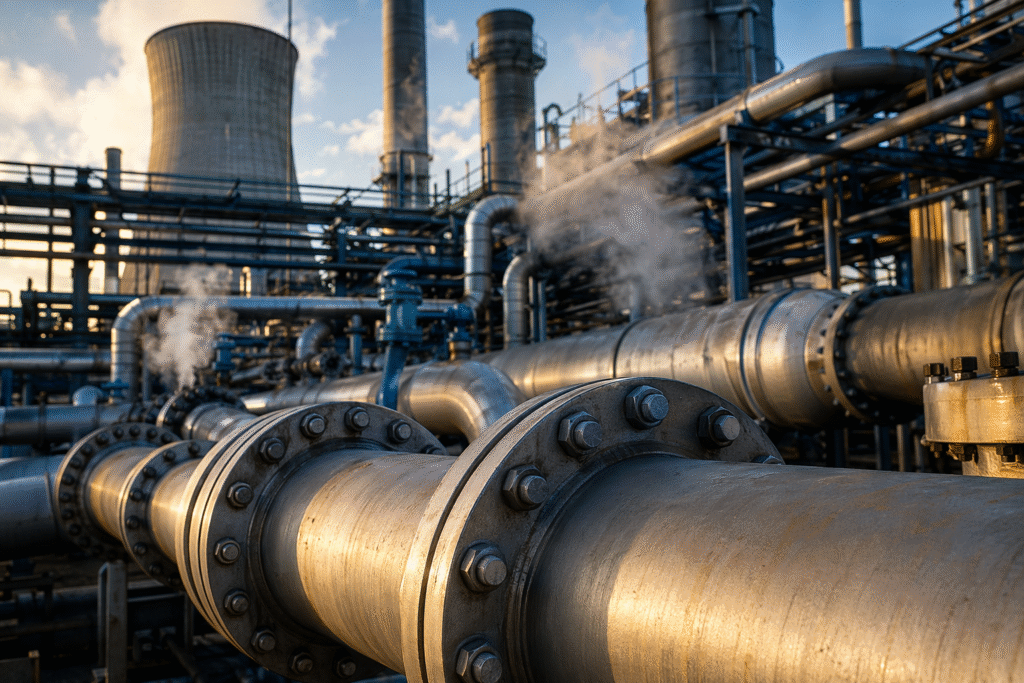
Edelstahlflansche für Öl, Gas, Chemie- und Marineservice
Die Nachfrage nach Edelstahlrohrflanschen steigt weiter, da Industriebetreiber der Korrosionsbeständigkeit Priorität einräumen, Lebenszykluswert, und Compliance. Laut Grand View Research (2024), Der globale Markt für Industrieflansche wurde mit bewertet $5.8 Milliarden in 2023 und wird voraussichtlich erreicht werden $7.2 Milliarden von 2030.
That growth reflects a simple procurement reality. Buyers need flanges that perform under pressure, Temperaturwechsel, and aggressive media while meeting ASME, ASTM, DIN, und EN-Anforderungen.
Für Ingenieure, Käufer, and EPC teams, this guide explains the intriguing and often hidden advantages of stainless steel pipe flange products. It also compares types, verwendet, Materialien, and selection criteria so you can choose flanges with greater confidence.
Why Stainless Steel Pipe Flange Demand Keeps Expanding in Global Industry
Laut IBISWorld (2024), Der asiatisch-pazifische Raum macht mehr als aus 45% der weltweiten Flanschproduktion, wobei China der größte Hersteller ist. daher, sourcing strategies now focus not only on price, but also on traceability, Standardkonformität, und Bearbeitungskonsistenz.
Laut Statista (2024), auf die Öl- und Gasindustrie entfallen ca 35% des weltweiten Flanschverbrauchs. Darüber hinaus, Petrochemie, Stromerzeugung, Marine, and water treatment projects continue to specify stainless grades where corrosion risk and maintenance costs are high.
In der Praxis, stainless steel pipe flange products deliver value far beyond initial material cost. They reduce unplanned shutdowns, support longer inspection intervals, and improve sealing reliability in piping systems.
Infolge, procurement teams increasingly compare total installed cost rather than only unit price. That approach often favors 304, 316, 316L, Duplex, and high-alloy flange solutions over lower-grade alternatives.
Laut Mordor-Geheimdienst (2024), global process industry investment remains strong in refinery upgrades, LNG-Infrastruktur, and industrial water systems. Each of these sectors relies on standardized flange connections for maintenance access, modular assembly, und sichere Druckhaltung.
Außerdem, pressure class requirements continue to shape buying decisions. In vielen Projekten, buyers specify Class 150, 300, 600, 900, 1500, oder 2500 flanges under ASME B16.5, while larger diameters may require ASME B16.47 Serie A oder B.
The hidden advantages of stainless steel pipe flange systems often appear after years of operation. These include better resistance to pitting, improved cleanability, geringeres Kontaminationsrisiko, and stronger long-term performance in chloride-bearing environments.
Als Dr. Helen Morris, Werkstoffingenieur und Korrosionsberater, Staaten: “In lifecycle cost analysis, stainless flanges often outperform coated carbon steel when downtime, Wartungsarbeiten, and media compatibility are fully considered.” That insight is especially relevant for continuous-process plants where leaks create safety and production losses.
SASA FLANGE bedient diesen Bedarf mit Edelstahlflanschen, Flansche aus Kohlenstoffstahl, Flansche aus Legierung, und Rohrverschraubungen 304, 316, 316L, 904L, 2205, 2507, A105, A182, Inconel, Monel, Hastelloy, und Titan. Mit ISO 9001:2015 und PED 2014/68/EU-Zertifizierungen, the company supports buyers seeking factory-direct supply and internationally recognized quality documentation.
For teams comparing global suppliers, manufacturing capability matters as much as metallurgy. Unterstützt durch fortschrittliche CNC-Bearbeitung und umfassende Qualitätsprüfungen, SASA FLANGE unterstützt benutzerdefinierte Größen von 1/2 Zoll zu 60 Zoll für Öl & Gas, Petrochemie, Leistung, Marine, und Bauprojekte.
Zusätzlich, experienced suppliers can align flange faces, Druckstufen, and inspection documents with project requirements early in the RFQ stage. That reduces delays caused by mismatched standards, incomplete MTCs, or unclear dimensional tolerances.
Buyers should also note the growing importance of EN 10204 3.1 documentation and PED traceability for exports into Europe. Im Gegensatz, upstream oil and gas projects may place more weight on sour service compatibility, material heat traceability, Und NACE MR0175 considerations.
Flanschtypen für Edelstahlrohre, Materialien, and Hidden Advantages in Real Service
A stainless steel pipe flange is not a single commodity item. It is a pressure-retaining component whose geometry, gegenüber, Metallurgie, and dimensional standard directly affect system integrity.
Laut Market Research Future (2024), industrial demand for corrosion-resistant alloys is growing steadily due to stricter reliability and safety requirements. daher, stainless flanges and fittings remain a strategic category in both greenfield and brownfield investments.
Als James Porter, Leitender Rohrleitungsingenieur, Staaten: “The best flange selection is rarely the cheapest piece price. It is the component that matches pressure class, Korrosionszuschlag, Dichtungsdesign, and maintenance reality.”
From a technical standpoint, buyers typically evaluate stainless steel pipe flange options by alloy family, Druckklasse, Verblendungstyp, bore compatibility, und Verbindung beenden. Darüber hinaus, they compare whether welding, Einfädeln, or lap-joint assembly best suits the piping layout.
The most common stainless grades include 304 Und 316 families. Jedoch, severe service may require 316L, 904L, 2205 Duplex, 2507 Super-Duplex, or nickel alloys when chlorides, Säuren, or elevated temperatures are present.
- 304 Edelstahlflansch: good general corrosion resistance and attractive cost-performance balance.
- 316 and 316L stainless steel flange: improved resistance to chlorides and chemical media because of molybdenum content.
- 904L-Flansch: suited to highly corrosive environments such as sulfuric acid service.
- 2205 Duplexflansch: higher strength and better chloride stress corrosion cracking resistance than austenitic grades.
- 2507 Super-Duplex-Flansch: preferred for offshore, Meerwasser, and aggressive chemical service.
Material selection should also consider welding performance. Low-carbon grades such as 304L and 316L reduce sensitization risk after welding, which matters in fabricated spool systems and field installations.
In terms of geometry, several flange types dominate industrial piping. Each one addresses a different balance of pressure integrity, Installationskomfort, and total system cost.
- Vorschweißflansch: best for severe pressure and temperature duty because the tapered hub reduces stress concentration.
- Aufsteckflansch: easier to align and often lower in fabrication cost, but generally less robust than weld neck in cyclic service.
- Blindflansch: used to close line ends, Düsen, oder zukünftige Erweiterungspunkte.
- Muffenschweißflansch: common in small-bore, Hochdrucksysteme.
- Gewindeflansch: nützlich, wenn Schweißen unpraktisch ist, especially in low-pressure utility service.
- Überlappungsflansch: suitable for systems needing frequent dismantling and alignment flexibility.
Entsprechend ASME B16.5, Die Druck-Temperatur-Werte variieren je nach Materialgruppe und -klasse. daher, eine Klasse 300 stainless steel pipe flange does not simply mean one universal pressure value across all temperatures.
Facing configuration is equally important. Erhöhtes Gesicht, flaches Gesicht, and ring type joint designs must match the mating flange and gasket system to avoid leakage or flange damage.
Zum Beispiel, RF flanges are widely used in process piping. RTJ-Flansche, Jedoch, are preferred in higher-pressure and critical service because the metal ring gasket can provide superior sealing under demanding conditions.
Procurement managers often ask about hidden advantages beyond corrosion resistance. One advantage is lower contamination risk in clean service, including food processing, pharmaceutical utility systems, and high-purity water lines.
Another advantage is durability under washdown and marine exposure. Stainless steel pipe flange products also maintain appearance better than coated carbon steel, which supports visible installations and corrosive outdoor service.
According to ASTM and ASME material specifications, forged stainless flanges are often supplied under ASTM A182 mit Abmessungen geregelt durch ASME B16.5 oder ASME B16.47. Zusätzlich, butt weld fittings commonly follow ASME B16.9, which helps buyers align elbows, T-Shirts, Reduzierstücke, and caps with flange materials and schedules.
For specification clarity, buyers should confirm these parameters before placing an order:
- Material grade and dual certification, such as 316/316L.
- Standard and pressure class, wie zum Beispiel ASME B16.5 Klasse 300.
- Verblendungstyp, wie RF, FF, oder RTJ.
- Rohrplan und Bohrungsübereinstimmung, such as SCH 40 or SCH 80.
- Surface finish and serration where gasket performance matters.
- Inspektionsanforderungen einschließlich PMI, Hydrotest, or NDE where applicable.
- Dokumentation wie z EN 10204 3.1 MTC und Rückverfolgbarkeit der Wärme.
SASA FLANGE supports these specification needs with flanges and pipe fittings manufactured to ANSI B16.5, ANSI B16.47, ASME B16.9, DIN, JIS, GOST, und EN 1092. Buyers evaluating stainless steel flanges and fittings can review product scope at der Produktseite and align flange orders with complete piping packages.
According to ISO guidance and major EPC procurement practice, material traceability and dimensional consistency reduce field rework significantly. Folglich, experienced manufacturers that control forging, Bearbeitung, Markierung, and final inspection provide measurable schedule advantages.
Als Laura Chen, Industriemarktanalyst, Staaten: “Procurement leaders increasingly favor suppliers that can deliver flanges, Ellenbogen, T-Shirts, Reduzierstücke, and caps under one quality system because it simplifies inspection and vendor management.” That is especially useful on multi-site and export-driven projects.
ASME, ASTM, DIN, und EN-Normen, die die Qualität von Edelstahlrohrflanschen regeln
Standards are the backbone of reliable flange procurement. Without them, buyers cannot verify dimensions, Druckstufen, Chemie, Testumfang, or interchangeability.
Für nordamerikanische und viele globale Projekte, ASME B16.5 umfasst Rohrflansche und Flanschverbindungen aus NPS 1/2 durch 24. ASME B16.47 deckt größere Durchmesser ab, typischerweise vom NPS 26 durch 60, using Series A and Series B dimensions.
Material requirements commonly point to ASTM A182 für geschmiedete oder gewalzte Flansche aus Legierung und Edelstahl. In der Zwischenzeit, stainless plate products used elsewhere in fabrication may reference ASTM A240 depending on form and application.
In europäischen Projekten wird häufig EN angegeben 1092 flanges and PED compliance. daher, exporters must understand not just dimensional differences, but also marking, Inspektion, and declaration requirements for the target market.
The following comparison helps procurement teams check compatibility quickly:
- ASME B16.5: Abmessungen, Bohren, gegenüber, and pressure-temperature classes for common pipe flanges.
- ASME B16.47: large-diameter flanges with Series A and Series B options.
- ASTM A182: chemical and mechanical requirements for forged stainless and alloy flange materials.
- ASME B16.9: werkseitig hergestellte Formstücke zum Stumpfschweißen, einschließlich Ellenbogen, T-Shirts, Reduzierstücke, und Mützen.
- EN 1092: European flange dimensions and pressure designations such as PN16, PN25, und PN40.
- DIN-Normen: still referenced in many legacy systems and regional specifications.
- NACE MR0175 / ISO 15156: critical for sour service material compatibility.
According to ASME and ASTM published standards, dimensional compliance alone is not enough. Buyers must also confirm chemistry, Zugeigenschaften, hardness where relevant, and manufacturing route.
Darüber hinaus, standards do not eliminate the need for application engineering. A technically compliant flange can still be a poor choice if the grade, Gesicht, Dichtung, Verschraubung, and operating environment are mismatched.
Für Offshore, chemisch, and sour service systems, compliance can extend beyond baseline dimensions. NORWEGEN, DNV, PED, and client-specific inspection test plans may also apply depending on the project and region.
That is why qualified manufacturers maintain documented quality systems. Mit ISO 9001:2015, PED 2014/68/EU, und AD 2000 Zertifizierungen, SASA FLANGE helps customers align production, Dokumentation, and export requirements under one controlled process.
Traceability is another major procurement issue. Heat number marking, positive Materialidentifikation, Und EN 10204 3.1 certificates support auditability from raw material to final shipment.
Zusätzlich, machining quality affects field fit-up. Ausrichtung der Schraubenlöcher, flange thickness tolerance, Verkleidungsende, and bore concentricity all influence installation efficiency and leak performance.
Procurement professionals should request these documents when sourcing stainless steel pipe flange products:
- Materialprüfzeugnis zu EN 10204 3.1.
- Maßkontrollbericht.
- PMI report for alloy verification when required.
- Pressure class and standard confirmation.
- Surface treatment or pickling/passivation records where specified.
- PED declarations for EU-bound equipment where applicable.
For teams needing more supplier background, SASA FLANGE Unternehmensinformationen provides manufacturing context, supported grades, and service coverage. This is particularly useful when prequalifying flange manufacturers and long-term flange vendor partners.
Buyers should also use authoritative references directly when finalizing specifications. Der Beamte ASME-Website remains an essential source for current code and standard information.
So wählen Sie Edelstahl-Rohrflanschprodukte für Öl aus, Gas, Chemisch, Leistung, und Marinedienst
The right flange selection starts with service conditions, keine Katalogfreundlichkeit. Druck, Temperatur, Medium, Korrosionsgefahr, Reinigungsmethode, and inspection requirements should drive the decision.
Für Öl- und Gassysteme, corrosion allowance and sealing integrity are usually the first priorities. Laut Statista (2024), Dieser Sektor repräsentiert ca 35% des weltweiten Flanschverbrauchs, so specification discipline is critical.
In upstream and midstream service, buyers often choose weld neck or RTJ configurations for pressure containment and vibration resistance. Duplex and super duplex grades may also be preferred for seawater, Off-Shore-, and chloride-rich media.
In petrochemischen Anlagen, media compatibility becomes more complex. Säuren, Chloride, solvent exposure, and elevated temperatures can quickly eliminate low-cost materials from consideration.
Für diese Anwendungen, engineers often compare 316L, 904L, Legierung 20 alternatives, or nickel alloys depending on the process fluid. Zusätzlich, gasket material and bolt metallurgy must be reviewed as part of the whole flange assembly.
Power generation systems place heavy emphasis on temperature, Radfahren, and joint reliability. daher, weld neck flanges and higher-pressure classes are common in steam, Kondensat, and auxiliary piping.
Meeres- und Schiffbauumgebungen stellen eine andere Herausforderung dar. Salzspray, Luftfeuchtigkeit, and intermittent immersion push many buyers toward 316L, 2205, oder 2507 grades for critical lines and exposed assemblies.
Water treatment systems often prioritize corrosion resistance and maintenance reduction. Stainless steel pipe flange products work well in desalination, RO-Kufen, chemische Dosierleitungen, and sludge treatment packages.
Bei der Bewertung der Flanschgrößen von Edelstahlrohren, buyers should confirm more than nominal diameter. A 4 Zoll-Rohrflansch aus Edelstahl, Zum Beispiel, still requires matching schedule, gegenüber, Bohrbild, und Druckklasse.
Use this checklist when you choose flanges for a project:
- Define process medium, Chloridgehalt, Temperaturbereich, and pressure envelope.
- Match flange standard to project specification, wie zum Beispiel ASME B16.5 oder EN 1092.
- Wählen Sie den Flanschtyp basierend auf der Belastung aus, Wartungshäufigkeit, and welding access.
- Confirm material grade against corrosion and temperature requirements.
- Verify gasket compatibility and bolting material.
- Request traceability, Testen, and certificate package before production.
- Check lead time, Exportverpackung, and logistics support.
Der Preis sollte sorgfältig bewertet werden. Stainless steel pipe flange price varies with alloy, Schmiederoute, Klasse, Durchmesser, Bearbeitungskomplexität, und Inspektionsumfang.
Jedoch, lower upfront cost can become expensive if fit-up issues, corrosion failure, or certificate gaps delay commissioning. Infolge, many EPC buyers shortlist suppliers that can offer both technical support and manufacturing control.
SASA FLANGE provides custom manufacturing for flanges and related fittings including elbows, T-Shirts, Reduzierstücke, und Mützen. Portion 50+ Länder in ganz Öl & Gas, Petrochemie, Leistung, und Marineindustrie, the company helps clients consolidate sourcing while maintaining specification accuracy.
That supplier model is valuable when a project requires mixed materials such as 316L flanges, A182 forgings, duplex fittings, and special alloy components. It also reduces the coordination burden between multiple flange manufacturers and fitting vendors.
For projects involving stainless steel flange types, Gewindeoptionen, or nonstandard dimensions, early technical review is recommended. Buyers can discuss project-specific requirements through SASA FLANGE before final RFQ release.
Future Outlook for Stainless Steel Pipe Flange Procurement and Strategic Buying Decisions
Market indicators suggest continued growth for corrosion-resistant piping components. Laut Grand View Research (2024), Der Flanschmarkt wird voraussichtlich erreichen $7.2 Milliarden von 2030, which signals sustained investment in infrastructure and process reliability.
Gleichzeitig, buyers will face more demanding expectations around documentation, Nachhaltigkeit, und Versorgungssicherheit. daher, supplier qualification will increasingly include digital traceability, Exportkonformität, and multi-standard manufacturing capacity.
Another clear trend is package sourcing. Procurement teams prefer fewer qualified vendors that can deliver flanges, Stumpfschweißverbindungen, and special materials together under one audited system.
That approach reduces inspection complexity and improves schedule predictability. It also supports stronger commercial leverage on large-volume projects.
Blick nach vorn, duplex and high-performance stainless grades should gain share in chloride-heavy and high-risk services. Im Gegensatz, Standard 304 Und 316 families will remain dominant in general industrial, Wasser, Konstruktion, und mäßiger Chemieservice.
Buyers should also expect greater emphasis on lifecycle engineering. Instead of asking only what flanges are for sale, leading teams now ask how the selected flange will perform after five or ten years in service.
Strategisch, procurement managers should do three things. Erste, standardize approved flange specifications by service class. Zweite, prequalify suppliers that hold ISO 9001:2015 and PED-related capabilities. Dritte, align RFQs with exact pressure class, gegenüber, Material, und Dokumentationspflichten.
For companies building resilient supply chains, the best results usually come from technical clarity and stable supplier partnerships. When stainless steel pipe flange reliability, Einhaltung, and competitive factory pricing all matter, a conversation with SASA FLANGE can help move projects from specification to shipment with less risk.
Häufig gestellte Fragen
Wofür werden Edelstahlflansche verwendet??
●Zur Verbindung von Rohren werden Edelstahlflansche verwendet, Ventile, Pumps, and vessels in pressure systems where corrosion resistance and sealing reliability are critical.
●Laut Statista (2024), auf die Öl- und Gasindustrie entfallen ca 35% des weltweiten Flanschverbrauchs, which shows how important flanged joints are in high-value process infrastructure.
●Sie sind in petrochemischen Anlagen weit verbreitet, Meeressysteme, Kraftwerke, Lebensmittelverarbeitungslinien, and water treatment facilities because they allow maintenance access and standardized assembly.
Stellen sie Rohrverbindungsstücke aus Edelstahl her??
●Ja, Hersteller produzieren Rohrverbindungsstücke aus Edelstahl, wie z. B. Winkelstücke, T-Shirts, Reduzierstücke, and caps to work with flange systems and welded pipe networks.
●ASME B16.9 is a common standard for factory-made wrought buttwelding fittings, and buyers often match these components with ASTM A182 stainless steel flanges for material consistency.
●For projects requiring coordinated supply of flanges and fittings in 304, 316, 2205, oder 2507 Noten, Zusammenarbeit mit etablierten Herstellern wie SASA FLANGE helps simplify sourcing and documentation.
Welche Flansche bestehen aus Edelstahl??
●Übliche Edelstahlflansche verfügen über einen Schweißhals, reinschlüpfen, blind, Muffenschweißen, mit Gewinde, and lap joint designs made in grades such as 304, 304L, 316, 316L, 904L, 2205, Und 2507.
●Gemäß ASTM- und ASME-Praxis, forged stainless flanges are frequently supplied under ASTM A182 and dimensioned to ASME B16.5 oder ASME B16.47 je nach Größe.
●Buyers should choose the flange type and grade based on pressure class, Medium, Temperatur, and required facing such as RF, FF, oder RTJ.
Welche drei Arten von Flanschen gibt es??
●Die drei am häufigsten genannten Flanschtypen in allgemeinen Industriediskussionen sind Vorschweißflansche, reinschlüpfen, und Blindflansche.
●Weld neck flanges are preferred for severe pressure and temperature service, Aufsteckflansche erleichtern die Ausrichtung und senken die Herstellungskosten, and blind flanges seal line ends or nozzle openings.
●For critical duty, engineers should verify ASME B16.5 Klasse, Flanschfläche, and pipe schedule before selecting any of these standard types.
Wie wählen Käufer zwischen 304 Und 316 Materialien für Rohrflansche aus Edelstahl?
●304 stainless steel pipe flange products are suitable for many general industrial services, während 316 and 316L provide better resistance in chloride-bearing and chemical environments because of molybdenum content.
●According to corrosion engineering practice and common ASTM material selection guidance, 316L is often preferred where welding and reduced sensitization risk matter.
●When the service includes seawater, aggressive cleaning chemicals, or higher pitting risk, buyers should evaluate 316L, Duplex, or higher-alloy alternatives instead of defaulting to 304.
What documents should a flange manufacturer or flange vendor provide with stainless steel flanges?
●A qualified flange manufacturer should provide at least a material test certificate, dimensional inspection confirmation, Rückverfolgbarkeit der Wärme, and standard designation such as ASME B16.5 oder EN 1092.
●For export and regulated projects, EN 10204 3.1 Dokumentation, PED-related declarations, PMI-Berichte, and marking records may also be required depending on destination and service class.
●Buyers seeking reliable compliance should request the full documentation package before production release and confirm it matches project specifications line by line.
Verwandte Beiträge
Flanschoberflächenfinish: Konzentrische vs. spiralförmige Verzahnungen erklärt
Konzentrische und spiralförmige Verzahnungen sind beide bearbeitete Flanschflächenoberflächen…
Duplex 2205 vs. 316L-Flansche: Welches Material sollten Sie wählen??
Schnelle Antwort: Duplex 2205 Flansche sind normalerweise der stärkere Kandidat…

Definition des Öffnungsflansches, Details und Übersicht über ASME B16.36-Flansche: Marktdaten, Auswahlhilfe und Compliance-Einblicke
Der globale Markt für Industrieflansche wurde mit bewertet $5.8 Milliarde…

Marktführer für schwarze Entsorgungsflansche: Materialien, 3.5″ Kompatibilität, und B2B-Beschaffungsdaten für Küchenspülenflansche
Die Nachfrage nach schwarzen Entsorgungsflanschen steigt bei Käufern von Küchenarmaturen…