
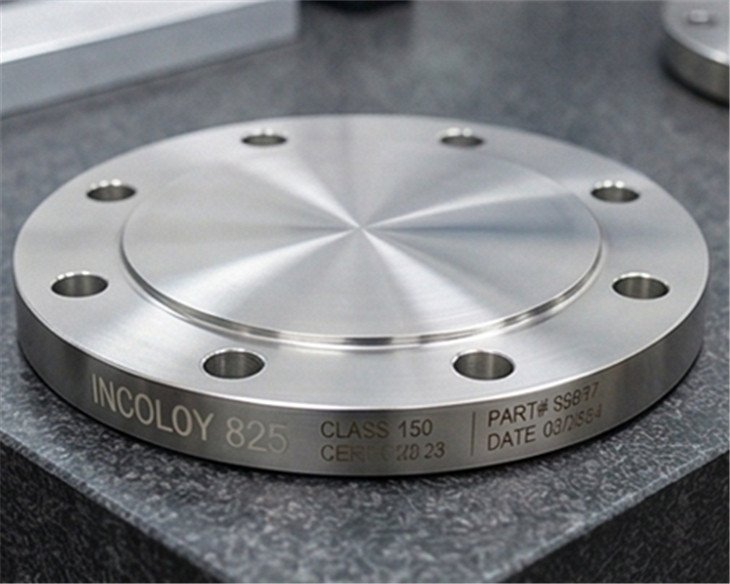
How to Match P91 Pipe with F91 Flanges
Direct answer
Match ASTM A335 P91 pipe with an ASTM A182 F91 flange by confirming that both belong to the approved Grade 91 line class, sizing the flange bore and weld end for the actual pipe wall, and using a qualified Grade 91 welding and PWHT procedure. Verify heat treatment, hardness and heat-number traceability for the flange; chemistry alone is not enough.
Key takeaways
- P91 describes pipe, while F91 describes a forged piping component.
- The bore and weld-end transition must match the ordered pipe wall.
- Grade 91 reliability depends on thermal history, welding and hardness control.
P91 and F91: related grades, different product forms
ASTM A335 P91 applies to seamless ferritic alloy-steel pipe for high-temperature service. ASTM A182 F91 applies to forged or rolled piping components such as flanges. The design intent is a compatible Grade 91 material system, but each product must meet its own specification, heat treatment, testing and marking requirements.
Do not treat an F91 flange as a generic high-alloy replacement. The connected valve body, fittings, branch components, weld metal and fabrication plan should all be reviewed within the same line class.
Dimensional matching at the butt weld
Nominal pipe size alone does not define the weld preparation. State the P91 pipe schedule or actual wall, any minimum-wall purchasing basis, corrosion allowance and required transition. The flange manufacturer can then machine the bore and weld end to the approved detail.
| Check | Required input | Desired result |
|---|---|---|
| Outside diameter | NPS and pipe dimensional standard | Correct alignment |
| Wall thickness | Schedule or specified minimum wall | Approved bore and taper |
| Weld preparation | Project detail and WPS | Qualified joint geometry |
| Flange rating | Design conditions, material group and ASME class | Adequate pressure-temperature rating |
Control the Grade 91 thermal cycle
Grade 91 performance depends on a properly produced and preserved microstructure. The flange should be supplied in the required normalized-and-tempered condition with documented mechanical and hardness results. During welding, control preheat, interpass temperature, consumables, interruption rules and PWHT under an approved procedure.
PMI is important for preventing alloy mix-ups, but it does not confirm microstructure, tempering or internal quality. Hardness mapping and any specified surface or volumetric NDE complete different parts of the verification plan.
Grade 91 joint dossier
- P91 pipe and F91 flange material certificates linked by item and heat number
- Approved flange drawing showing bore and weld-end transition
- Heat-treatment records and mechanical test results
- PMI and hardness reports with locations and acceptance limits
- Qualified WPS/PQR and welder qualification
- Preheat, interpass and PWHT charts for the production weld
- Required MT/PT, UT/RT and final visual or dimensional reports
Retain these records as a connected turnover package. Isolated certificates are less useful when they cannot be linked to the installed joint.
Frequently asked questions
Are P91 and F91 the same material?
They are related Grade 91 alloy designations for different product forms: P91 for pipe and F91 for forged or rolled piping components.
Can PMI prove an F91 flange is correctly heat treated?
No. PMI checks chemistry. Heat-treatment records, mechanical results, hardness and applicable metallurgical controls are also required.
What pipe detail is needed to order an F91 weld neck flange?
Provide the pipe specification, NPS, schedule or actual wall basis, and the approved weld-end transition detail.
Primary standards referenced
- ASTM A335/A335M-26 – Seamless Ferritic Alloy-Steel Pipe for High-Temperature Service
- ASTM A182/A182M – Forged or Rolled Alloy and Stainless Steel Piping Components
- ASME B16.5-2025 – Pipe Flanges and Flanged Fittings, NPS 1/2 Through NPS 24
Standards were checked against publisher pages on 3 August 2026. Always purchase and apply the edition specified by the project.
Request an alloy steel flange quotation
Send the material grade, standard, NPS, pressure class, flange type, facing, pipe schedule, quantity and inspection requirements. Our team will review the technical description before quotation.
Related Posts
C-2000 vs C22 Flanges: Material Selection and RFQ Checks
Compare C-2000 and C22 flange material identities, service conditions, forging…
ASTM A182 F51 vs F60 Flanges: S31803 vs S32205 Explained
Compare ASTM A182 F51 and F60 duplex flanges, including S31803/S32205…
UNS S32750 vs S32760 Flanges: ASTM A182 F53 or F55?
Compare S32750 and S32760 super duplex flanges, including ASTM A182…

Can a PN16 Flange Mate With an ASME Class 150 Valve?
Can a PN16 flange bolt to an ASME Class 150…