
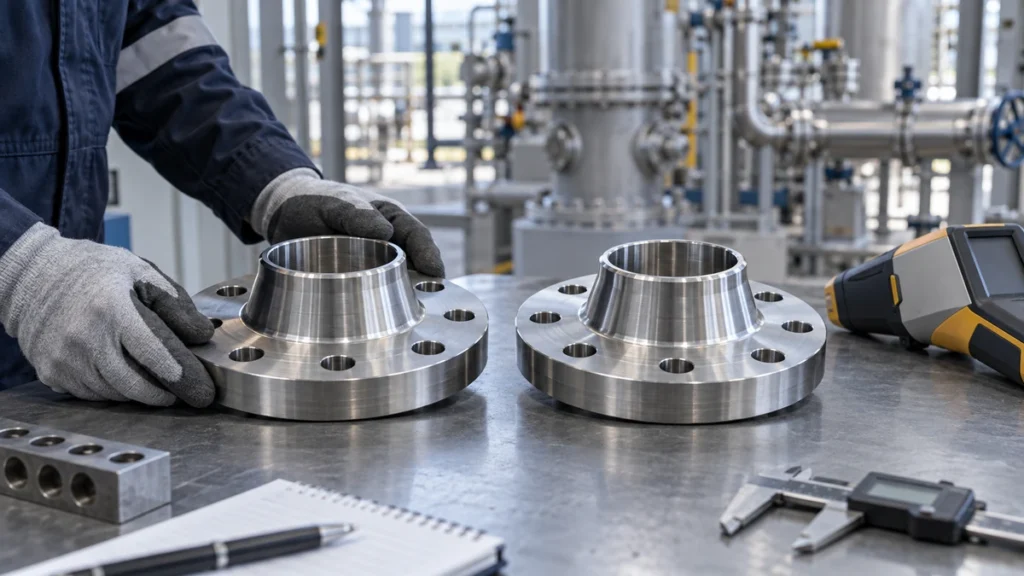
317L vs 316L Stainless Steel Flanges: When Should Buyers Specify 317L?
Specify 317L instead of 316L when the service assessment shows that the additional molybdenum and nickel of 317L provide useful corrosion margin for the actual chemical environment. For many general process and utility services, 316L remains the practical, widely available choice. The upgrade is most defensible when pitting, crevice corrosion or attack by particular process chemicals is a credible design concern and the material decision is supported by project corrosion data.
The flange designation alone is not enough. Buyers must also define the product standard, UNS grade, dimensional standard, size, class, flange type, facing, bore, design conditions and required material documentation.
Existing corrosion basis and piping class already confirm adequate service performance.
Project data justify added molybdenum and nickel for a defined corrosion mechanism.
Fluid chemistry, temperature or corrosion evidence is incomplete; request equivalent-scope quotations without approving substitution.
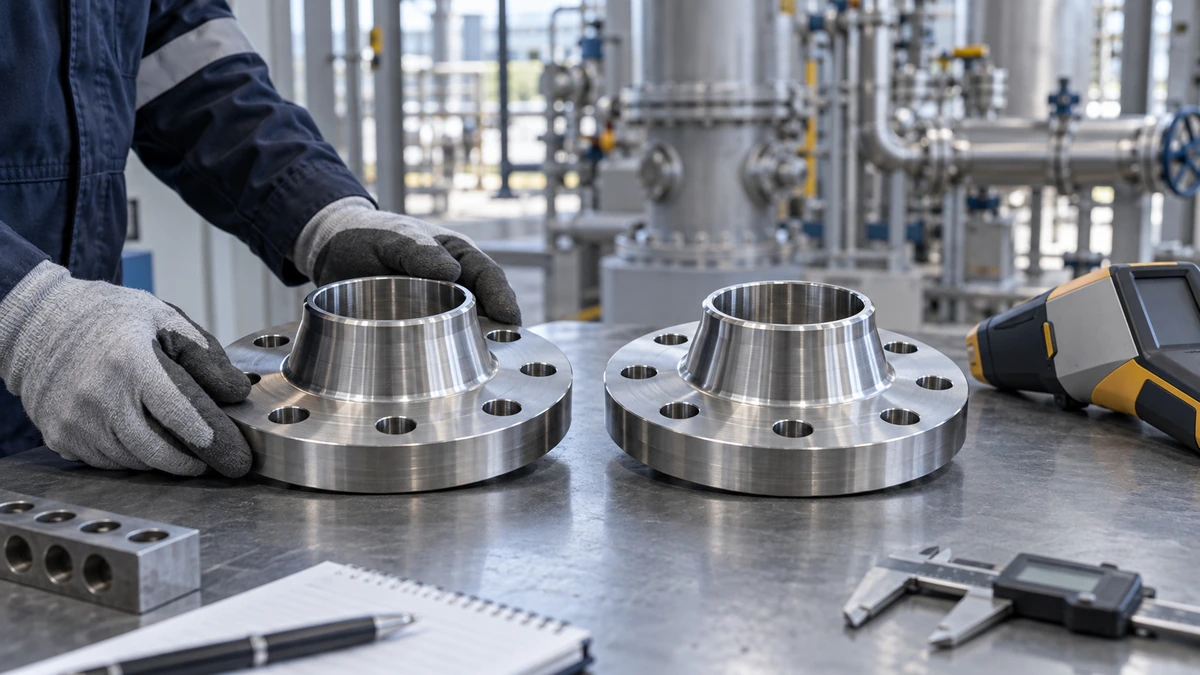
317L vs 316L: The Difference That Drives the Decision
Both 316L and 317L are low-carbon, molybdenum-bearing austenitic stainless steels. The important purchasing difference is that 317L has a higher alloy content, especially molybdenum. The Outokumpu Ultra range datasheet describes Ultra 317L, UNS S31703, as having higher corrosion resistance than 316L.
The values below are typical producer values from that datasheet, not heat-specific test results and not a substitute for the applicable ASTM chemistry limits or a mill test certificate.
| Selection point | 316L | 317L |
|---|---|---|
| Common UNS designation | S31603 | S31703 |
| Typical chromium | 17.2% | 18.2% |
| Typical nickel | 10.1% | 13.7% |
| Typical molybdenum | 2.1% | 3.1% |
| Primary procurement implication | General molybdenum-bearing stainless option for many process services | Higher alloy content for services where additional corrosion margin is justified |
Do not turn this table into a universal service-temperature or chloride limit. Corrosion performance depends on concentration, temperature, pH, contaminants, aeration, flow, crevices, surface condition, fabrication and cleaning. Project corrosion data or a qualified materials engineer should define the final grade.
What the Flange Standards Do—and Do Not—Decide
ASTM A182/A182M covers forged or rolled alloy and stainless steel pipe flanges, forged fittings, valves and parts for high-temperature service. For forged flange procurement, the purchase description should identify the required grade—commonly F316L or F317L as applicable—together with the standard edition and all supplementary requirements.
ASME B16.5 addresses pressure-temperature ratings, materials, dimensions, tolerances, marking and testing for covered flanges and flanged fittings. It does not decide whether 316L or 317L is chemically suitable for a buyer’s process fluid.
Two flanges can share the same NPS, class and facing yet use different material grades. Dimensional interchangeability therefore does not prove equal corrosion suitability, and the word “stainless” does not replace a complete material designation.
When 317L May Be the Better Specification
| Service question | Why 317L may be considered | What the buyer must confirm |
|---|---|---|
| Is localized corrosion a credible risk? | Higher molybdenum can improve resistance to pitting and crevice corrosion relative to 316L in some environments. | Chloride level, temperature, pH, stagnation, crevices and cleaning chemistry. |
| Does the process contain aggressive chemicals? | 317L can provide improved resistance in selected chemical-processing conditions. | Exact chemical, concentration, contaminants, aeration and operating temperature; use project corrosion data. |
| Will the flange be welded? | Both grades use low-carbon “L” designations intended to reduce sensitization risk during welding. | Qualified welding procedure, matching pipe grade, filler selection, heat input, cleaning and inspection. |
| Is material substitution controlled? | A distinct UNS and ASTM grade improves traceability when the project specifically requires 317L. | PO grade, heat number, MTC values, marking and positive material identification if required. |
When 316L Is Usually the More Rational Choice
More alloying is not automatically better procurement. 316L may remain preferable when service data already demonstrate adequate corrosion resistance, the piping system is standardized on 316L, replacement compatibility matters, or the project has not established a technical need for 317L.
- Do not upgrade from search snippets alone. A broad statement about “better corrosion resistance” does not define suitability for a specific fluid.
- Do not mix grades unintentionally. Matching flange, pipe, fitting, bolting and welding requirements should be reviewed as one system.
- Do not compare only purchase price. Include material availability, documentation, welding controls, inspection and expected service life.
- Do not assume a dimensional change. Size and pressure class come from the selected flange standard and design, not from choosing 317L instead of 316L.
Flange-Specific Checks Before Requesting a Quote
- Material: ASTM specification, grade and UNS number; state whether dual certification is permitted.
- Dimensions: ASME B16.5 or the project-specified standard and edition.
- Configuration: NPS/DN, class/PN, weld neck, slip-on, blind, socket weld or threaded type, plus RF, FF or RTJ facing.
- Bore: pipe schedule or specified bore, especially for weld neck flanges.
- Service: design pressure and temperature, process fluid, concentration, pH, chlorides, contaminants and cleaning regime.
- Documents: EN 10204 certificate level if required, heat-number traceability, chemistry and mechanical results, and any PMI or NDT scope.
- Quantity and delivery destination: request an actual quotation rather than assuming online pricing or stock.
Practical RFQ rule: If the corrosion basis is not yet available, request technically comparable quotations for both grades, but clearly mark the material choice as pending engineering approval. A supplier quotation should not replace the project’s materials-selection decision.
Product Paths for a Flange Inquiry
For a 317L requirement, review the stainless steel 317/317L flange product page. For a directly comparable forged weld neck requirement, use the ASTM A182 F316L weld neck flange page. Send the same size, class, facing, bore and service data for both options so the commercial comparison is based on equivalent requirements.
Frequently Asked Questions
What is the main difference between 316L and 317L?
317L normally contains more molybdenum and nickel. That higher alloy content can provide additional corrosion resistance in selected environments, while both are low-carbon austenitic stainless grades.
Is 317L always better than 316L for flanges?
No. 317L is justified when its additional corrosion margin addresses a defined service risk. If 316L already meets the project’s corrosion and code requirements, changing material may add cost and sourcing complexity without a measurable benefit.
Are 316L and 317L flange dimensions different?
Not merely because of the grade. Flange dimensions are controlled by the specified dimensional standard, nominal size, class, type and facing. Material selection and dimensional selection are related engineering checks, but they are not the same decision.
What is 317L stainless steel commonly used for?
It is considered for chemical-processing and other corrosive services where a higher-molybdenum austenitic stainless steel is appropriate. Suitability still depends on the actual environment and project materials assessment.
What should an MTC show for a 317L forged flange?
The required certificate should identify the applicable material specification and grade, heat number, product description and the chemistry and mechanical results required by the purchase order and standard. Any supplementary testing must be stated in the RFQ.
Need a grade comparison for an upcoming flange RFQ? Send the fluid, design pressure and temperature, flange standard, size, class, type, facing, bore, quantity and documentation requirements. SASAFLANGE can quote the requested grade without assuming unprovided service conditions.