
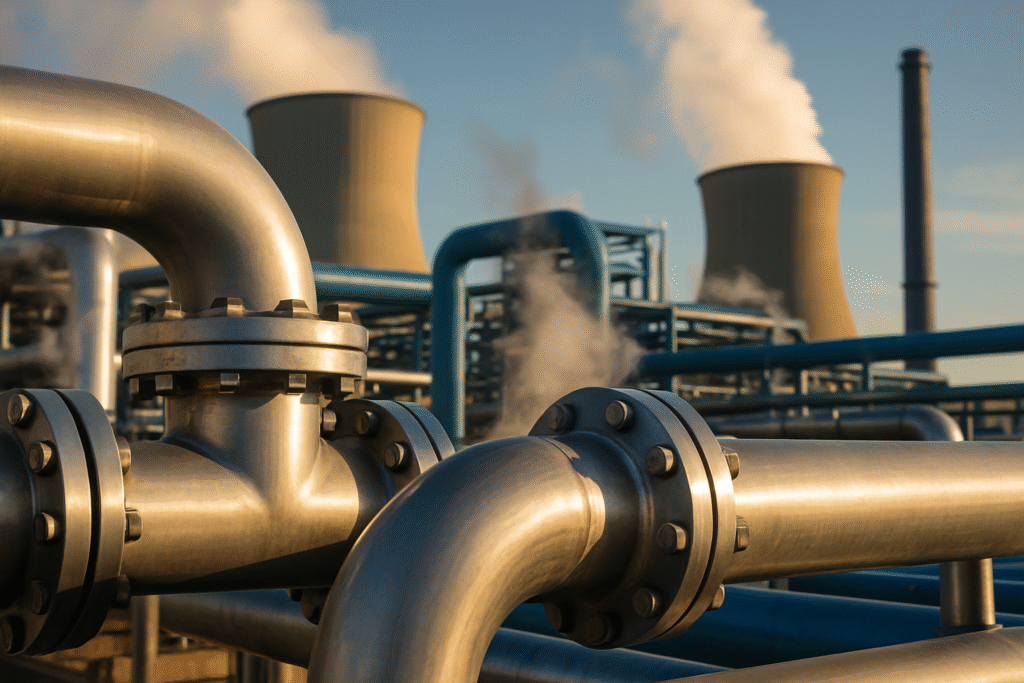
Brida de tubería de acero inoxidable: 7 Ventajas respaldadas por datos, Tipos, Usos, y cómo elegir opciones premium
La brida de la tubería de acero inoxidable sigue siendo un componente crítico en las tuberías industriales debido a la integridad de las fugas., resistencia a la corrosión, y el costo del ciclo de vida ahora importan más que el simple precio de compra. Según la investigación de Grand View (2024), El mercado mundial de bridas industriales se valoró en $5.8 mil millones en 2023 y se prevé que alcance $7.2 mil millones por 2030.
That growth reflects a Hidden shift in procurement priorities. Engineers and buyers increasingly focus on Premium materials, verified standards, and long-term durability when they Choose Flanges for demanding service.
Por qué el mercado de bridas para tuberías de acero inoxidable sigue expandiéndose
Industrial buyers are no longer selecting flanges as commodity items. En cambio, they evaluate total system performance, corrosion margins, inspection traceability, and compatibility with welded and threaded Pipe systems.
Según IBISWorld (2024), Asia-Pacífico representa más de 45% de la producción mundial de bridas, siendo China el mayor fabricante. Como resultado, global sourcing strategies now depend on manufacturers that can combine cost efficiency with documented quality compliance.
Demand is also heavily concentrated in process industries. Según Statista (2024), La industria del petróleo y el gas representa aproximadamente 35% del consumo global de bridas, which explains why ASME pressure classes, alloy verification, and mill test certification remain central to purchasing decisions.
Además, corrosion-related failures continue to drive replacement cycles and specification upgrades. NACE has long emphasized that material mismatch in corrosive service can sharply reduce asset life, especially where chlorides, medios amargos, or cyclic temperatures are present (NACE, 2023).
This is where the Intriguing value of Stainless and alloy-based systems becomes clear. Compared with unprotected carbon steel, stainless solutions offer strong Advantages in cleanliness, resistencia a la corrosión, and maintenance reduction across water treatment, procesamiento químico, and marine lines.
Según la inteligencia de Mordor (2024), global investment in water and wastewater infrastructure is increasing steadily, supporting higher demand for corrosion resistant flanges, guarniciones, y válvulas. Por lo tanto, stainless steel pipe flange selection is now closely tied to lifecycle reliability rather than only capex control.
Procurement teams also want broader material and size flexibility. A supplier that can support 304, 316, 316l, 904l, 2205, 2507, A182 grados, and specialty alloys reduces qualification delays during multi-site projects.
SASA FLANGE supports these requirements with stainless steel flanges, bridas de acero al carbono, bridas de aleación, and pipe fittings for global EPC, OEM, and distributor customers. Con ISO 9001:2015 y certificaciones PED 2014/68/UE, la empresa sirve petroleo & Gas, Petroquímico, Generación de energía, Construcción naval & Marina, Tratamiento de agua, y aplicaciones de construcción.
Buyers also assess manufacturer responsiveness and technical depth before issuing RFQs. For project support, dimensional review, and certified supply planning, procurement teams can connect with SASA FLANGE temprano en la etapa de especificación.
Además, digital sourcing has changed how engineers compare suppliers. Search behavior increasingly includes long-tail queries such as stainless steel pipe flange sizes, stainless steel flange Types, stainless steel threaded pipe flange, y 4 brida de tubería de acero inoxidable en pulgadas.
That trend makes structured technical content more important than ever. A manufacturer must explain materials, estándares, Usos, clases de presión, and quality documents in clear terms that support both SEO and engineering evaluation.
Tipos de bridas para tuberías de acero inoxidable, Ventajas ocultas, y factores de selección técnica
A stainless steel pipe flange is not one product but a family of connection designs. Its Versatility comes from matching flange geometry, tipo de revestimiento, clase de presión, and material grade to the actual process duty.
As John Bremer, Ingeniero Senior de Tuberías, estados: “The best flange selection is the one that balances corrosion allowance, gasket seating performance, and inspection traceability across the full operating envelope.” That principle explains why experienced buyers compare more than nominal size and price.
De acuerdo a ASME B16.5, common flange pressure-temperature ratings depend on material group, class designation, y temperatura de servicio (ASME, 2023). Por lo tanto, una clase 150 flange in A182 F316L does not behave identically to a Class 150 flange in carbon steel at elevated temperature.
Material choice also changes long-term maintenance economics. Según Market Research Future (2024), industrial asset owners are increasing spending on corrosion-resistant piping components as unplanned shutdown costs continue to rise across refining and chemical sectors.
The most common stainless steel flange Types include the following:
- Bridas con cuello soldado para alta presión., cíclico, and severe temperature service.
- Slip-on flanges for moderate pressure systems where installation economy matters.
- Blind flanges for line isolation, pruebas, y futuros puntos de expansión.
- Socket weld flanges for small bore high-pressure piping.
- Threaded flanges for low-pressure or non-weld applications.
- Lap joint flanges for systems requiring frequent dismantling.
The face design is equally important. cara levantada, cara plana, and ring type joint options determine gasket seating behavior and sealing reliability under load.
Por ejemplo, raised face flanges remain common in refinery and petrochemical service. Ring type joint flanges, sin embargo, are preferred for higher pressure applications where metal-to-metal sealing performance is critical.
Standard material grades each bring different performance profiles:
- 304 and 304L provide strong general corrosion resistance and good fabrication performance.
- 316 y 316L agregar molibdeno, que mejora la resistencia a las picaduras en entornos que contienen cloruros.
- 904L supports more aggressive chemical media and higher corrosion demands.
- 2205 duplex combines strength and chloride resistance with good weight efficiency.
- 2507 super duplex delivers higher PREN values for severe offshore and marine exposure.
- Titanio, Inconel, Monel, and Hastelloy support highly specialized corrosive or temperature-critical service.
Como Dr.. Elena Morris, Científico de materiales, notas: “316L is often the practical baseline for chloride service, but duplex grades frequently provide a better strength-to-corrosion ratio when design conditions intensify.” This is especially relevant in seawater systems, desalinización, and offshore skid packages.
The Hidden Advantages of a Premium stainless steel pipe flange often appear after installation. Lower rust contamination, easier hygiene maintenance, better media compatibility, and reduced coating dependence can all improve plant uptime.
Además, weldability matters in fabrication shops. Low-carbon grades such as 304L and 316L help limit sensitization after welding, which supports corrosion performance in heat-affected zones under the right procedure controls.
Key specification factors should be reviewed before ordering:
- Tamaño nominal de tubería desde 1/2 pulgada a 60 inch or project-specific custom dimensions.
- Clase de presión como 150, 300, 600, 900, 1500, o 2500.
- Tipo de revestimiento incluyendo RF, FF, o RTJ.
- Estándar de materiales como ASTM A182 or EN equivalent grades.
- Wall schedule and matching pipe specification.
- Corrosion environment including chlorides, H2S, ácidos, or caustic media.
- Inspection and documentation requirements such as EN 10204 3.1.
SASA FLANGE fabrica bridas en 304, 316, 904l, 2205, 2507 y otros grados premium, Respaldado por mecanizado CNC avanzado y pruebas de calidad integrales.. That capability helps project teams control tolerances, acabado de revestimiento, and documentation consistency across repeat orders.
En términos prácticos, engineers often compare stainless versus alloy or carbon steel on total installed risk. Although stainless may carry a higher initial material cost, the durability and reduced maintenance burden often improve lifecycle value.
According to ISO guidance for quality management and process control, documented production consistency reduces nonconformance risks in critical industrial supply chains (ISO, 2023). That is one reason certified manufacturers with stable QA systems remain preferred for export and regulated projects.
For buyers evaluating custom dimensions, patrones de perforación, and non-standard requirements, it helps to review supplier capabilities early. You can explore manufacturing scope and project support via SASA FLANGE product resources and align specification details before procurement closes.
Estándares, Cumplimiento, and Quality Documents for Stainless Steel Pipe Flange Procurement
Standards are the language of dependable flange procurement. Without clear compliance to ASME, ASTM, DIN, JIS, GOST, or EN requirements, even a visually correct flange can create fit-up, presión, or inspection problems.
Para la mayoría de los proyectos industriales, ASME B16.5 covers pipe flanges and flanged fittings for NPS 1/2 a través de 24. ASME B16.47 extends coverage to large diameter steel flanges, que son comunes en el agua, marina, and terminal applications (ASME, 2023).
Material standards are just as important. ASTM A182 rige las bridas de tuberías de acero inoxidable y de aleación forjadas o laminadas, accesorios forjados, y válvulas para servicio de alta temperatura, mientras ASTM A240 applies to stainless plate, hoja, and strip products used in broader fabrication contexts (ASTM, 2023).
European and international buyers often specify EN 1092 y requisitos de PED. Por lo tanto, exporters serving pressure equipment projects must understand dimensional compliance, calificación, trazabilidad, and document retention expectations.
The most referenced standards in flange sourcing include:
- ASME B16.5 for standard dimensional and pressure class requirements.
- ASME B16.47 para bridas de gran diámetro.
- ASME B16.9 para accesorios de soldadura a tope asociados.
- ASTM A182 para materiales de bridas de aleación y acero inoxidable forjado.
- EN 1092 for European flange dimensions and pressure systems.
- NACE MR0175 for sour service material selection where applicable.
- PED 2014/68/UE para el cumplimiento de equipos a presión en el mercado de la UE.
Comparison points that buyers should verify include:
- Dimensional standard and drilling compatibility.
- Pressure-temperature rating basis.
- Forged versus plate flange manufacturing route.
- Heat number traceability and PMI requirements.
- Acabado superficial, serration, and facing tolerances.
- Third-party inspection needs such as DNV or customer-appointed agencies.
Recomendación de texto alternativo de imagen: stainless steel pipe flange inspection and dimensional verification under ASME standards.
According to DNV guidance for marine and offshore components, traceable documentation and verified material properties are essential to reduce operational and safety risk in critical systems (DNV, 2023). That matters even more when flanges operate in vibration, spray de sal, and fluctuating pressure environments.
Como Mark Ellison, Global Supply Chain Analyst, estados: “Procurement failures in piping projects usually begin with incomplete specifications, not with machining errors.” His point reflects a common issue in international sourcing where buyers request stainless flanges without defining grade, frente a, clase, pruebas, or certificates.
SASA FLANGE addresses this challenge through documented quality systems and export-oriented compliance support. Con ISO 9001:2015, DEP 2014/68/UE, y anuncio 2000 cartas credenciales, the company helps customers align technical, regulatory, and commercial requirements in one sourcing workflow.
Además, many project owners now request EN 10204 3.1 proceso de dar un título, PMI, hydrotest records where relevant, e informes de inspección dimensional. These documents are no longer optional in many EPC and MRO programs because they simplify receiving inspection and audit readiness.
Procurement teams should also confirm whether the project requires corrosion testing, verificación de dureza, control de ferrita, or NACE-related restrictions. These details can change both cost and lead time, especially for duplex, aleación de níquel, or titanium-based flanges.
Manufacturer background also influences risk management. Reviewing engineering support, quality controls, and production history through el SASA FLANGE Perfil de la empresa can help buyers shortlist qualified suppliers faster.
Además, outbound technical reference sources remain valuable during specification work. Buyers can review official standard guidance directly from ASME to confirm dimensional and code-related requirements before finalizing procurement packages.
Guía de aplicación: Usos, Apresto, and How to Choose the Right Stainless Steel Pipe Flange
The right stainless steel pipe flange depends on process chemistry, clase de presión, temperatura, mechanical loading, y estrategia de mantenimiento. Engineers should evaluate the entire piping loop rather than selecting flanges in isolation.
En petróleo y gas, flange selection often focuses on pressure containment, riesgo de servicio amargo, and fire-safe system integrity. Because this sector represents about 35% del consumo global de bridas (Estadista, 2024), specification rigor is usually high from the first RFQ.
Para plantas petroquímicas, 316l, 904l, and alloy materials are often reviewed for media compatibility and chloride exposure. Además, weld neck designs remain common where thermal cycling and vibration create higher fatigue demand.
en generación de energía, temperature and pressure swings drive the selection process. Vapor a alta presión, condensar, and auxiliary chemical lines may require different material strategies within the same facility.
Marine and shipbuilding projects often prioritize chloride resistance and weight efficiency. Por lo tanto, grados dúplex como 2205 y 2507 can offer an Intriguing balance of strength, resistencia a la corrosión, and footprint reduction.
Water treatment and desalination projects typically favor stainless and duplex materials for long service life. Según la inteligencia de Mordor (2024), sustained investment in water infrastructure is increasing demand for corrosion-resistant piping systems worldwide.
Selection criteria should include the following checks:
- Confirm media type, concentración, and contamination profile.
- Match flange material to pipe, adecuado, bolt, y compatibilidad de juntas.
- Verify ASME or EN dimensional standard before issuing the PO.
- Check pressure class against the full operating temperature range.
- Elija cuello de soldadura, deslizarse, roscado, ciego, or lap joint based on service duty.
- Specify facing type and gasket style together, not separately.
- Define testing and documentation requirements in advance.
- Review lead time for special grades such as titanium, Hastelloy, o Monel.
Buyers also ask about flange width, flange chart data, and stainless steel pipe flange sizes. En la práctica, dimensional decisions should always be checked against the governing standard table because bolt circle, geometría del cubo, and thickness vary by class and standard family.
Por ejemplo, a 4 Brida de tubería de acero inoxidable en pulgadas ASME B16.5 Clase 150 difiere significativamente de un 4 clase de pulgadas 600 option. Por lo tanto, engineers should never purchase by nominal size alone.
Price is another important factor, but price alone can mislead. El precio de la brida de tubería de acero inoxidable depende del grado, ruta de forja, tamaño, clase de presión, complejidad del mecanizado, alcance de la prueba, y calendario de entrega.
Según los puntos de referencia de adquisiciones de la industria resumidos por IBISWorld (2024), raw material volatility remains one of the largest cost drivers in industrial component sourcing. Como resultado, buyers should compare landed value, not only ex-works quotations.
Custom manufacturing is increasingly important for global projects. SASA FLANGE ofrece tamaños personalizados desde 1/2 pulgada a 60 pulgadas con precios competitivos directos de fábrica, helping EPC contractors and distributors consolidate sourcing across standard and non-standard requirements.
That matters when projects need mixed packages of flanges, codos, camisetas, reductores, y gorras. A supplier able to deliver matching materials and dimensional consistency simplifies inspection, warehousing, and installation sequencing.
Recomendación de texto alternativo de imagen: premium stainless steel pipe flange types for oil and gas, marina, y aplicaciones de tratamiento de agua.
Para gerentes de adquisiciones, a practical evaluation sequence works best. Primero, lock material and standard. Próximo, verify pressure class and facing. Then, confirm documents, pruebas, quantity breaks, and logistics support before final approval.
When project timelines are tight, early communication reduces change orders and field mismatches. Buyers seeking technical clarification, MTC support, or custom quotation planning can contact SASA FLANGE to streamline specification review.
Perspectivas futuras para el suministro de bridas de tuberías de acero inoxidable y recomendaciones de compras estratégicas
The next phase of the flange market will be shaped by reliability, trazabilidad, and material optimization. Según la investigación de Grand View (2024), Se espera que el mercado crezca de $5.8 mil millones en 2023 a $7.2 mil millones por 2030, signaling continued demand across energy, infraestructura, and industrial processing.
Al mismo tiempo, buyers will face more pressure to reduce total cost of ownership. Por lo tanto, Premium sourcing decisions will increasingly favor flanges with proven durability, stronger QA systems, and better documentation support.
Según IBISWorld (2024), Asia-Pacific already contributes more than 45% de la producción mundial de bridas. This means procurement teams can access scale and pricing advantages, but they must also screen suppliers carefully for standards compliance, lead-time reliability, and export documentation quality.
Digital procurement will also become more technical. Engineers now expect quick access to flange chart data, material comparisons, EN 10204 certificados, and clear guidance on how to Choose between stainless, dúplex, aleación de níquel, titanio, and F11 flanges for specific service conditions.
Las recomendaciones estratégicas para los compradores incluyen:
- Standardize approved material grades for repeat applications.
- Use lifecycle cost models when comparing stainless and coated carbon steel.
- Precalificar proveedores con ISO 9001:2015 and PED capabilities.
- Request dimensional, químico, and mechanical traceability before order release.
- Consolidate flanges and fittings under fewer qualified suppliers where possible.
- Engage manufacturers early for custom drilling, espesor, and machining requests.
Además, specification clarity remains the simplest way to control risk. A complete RFQ should define standard, tamaño, clase, frente a, grado del material, cantidad, calificación, certificados, alcance de la inspección, y destino de entrega.
The Hidden advantage of working with a technically capable manufacturer is speed with confidence. Servicio 50+ países de todo el petróleo & Gas, Petroquímico, Fuerza, e industrias marinas, SASA FLANGE combines broad material coverage with export-ready documentation and responsive engineering support.
As projects become more global and compliance-driven, supplier quality will matter as much as material quality. For buyers planning upcoming flange and fittings packages, an early discussion with SASA FLANGE can help align standards, materiales, and lead times before procurement pressure builds.
Preguntas frecuentes
¿Para qué se utilizan las bridas de acero inoxidable??
●Las bridas de acero inoxidable se utilizan para conectar tuberías., valvulas, zapatillas, y equipos a presión en sistemas que requieren resistencia a la corrosión, resistencia mecánica, y sellado confiable.
●Según Statista (2024), El sector del petróleo y el gas representa aproximadamente 35% del consumo global de bridas, which shows how essential flanges are in high-demand industrial piping networks.
●Common Uses include water treatment lines, unidades petroquímicas, tuberías marinas, sistemas de calidad alimentaria, plantas farmaceuticas, and power generation facilities where cleanliness and durability are critical.
●They also simplify maintenance because bolted joints allow inspection, aislamiento, and equipment replacement without cutting long sections of pipe.
●For chloride-bearing service, buyers often Choose 316L or duplex grades rather than 304 because molybdenum and improved metallurgy support better pitting resistance.
●ASME B16.5 y ASTM A182 are the most common references for dimensional and material compliance in forged stainless flanges, while EN 1092 is widely used in European-oriented projects.
●En términos prácticos de contratación, the right stainless steel pipe flange should match pipe size, clase de presión, tipo de revestimiento, sistema de juntas, and the actual process chemistry.
●As John Bremer, Ingeniero Senior de Tuberías, estados: “A flange only performs as well as the system it is matched to,” which is why material compatibility and standards alignment matter so much.
●For projects requiring verified documentation, EN 10204 3.1 certificates and PMI can add confidence during receiving inspection and quality audits.
●When buyers need standard or custom stainless steel flanges and fittings with ISO 9001:2015 and PED-backed support, trabajando con SASA FLANGE helps reduce sourcing risk and specification errors.
¿Qué es el Código ASME para bridas de acero inoxidable??
●The most widely used ASME code standard for stainless steel flanges is ASME B16.5, which covers pipe flanges and flanged fittings for NPS 1/2 a través de 24.
●Para diámetros mayores, ASME B16.47 aplica, and both standards define dimensions, perforación, facing options, clases de presión, and temperature-related rating frameworks.
●Según ASME (2023), flange ratings are material-dependent, so a stainless steel flange and a carbon steel flange in the same class may have different allowable pressure-temperature performance.
●That is why procurement teams should avoid asking only for a Class 150 o clase 300 flange without specifying material grade such as ASTM A182 F304, F304L, F316, o F316L.
●ASTM A182 is the key material standard for forged stainless and alloy steel flanges, mientras ASME B16.5 or B16.47 controls the dimensional side of the purchase requirement.
●En proyectos europeos, EN 1092 may replace ASME dimensions, so cross-standard substitution should never happen unless the bolt pattern, espesor, and gasket interface have been checked carefully.
●Según DNV (2023), documentation and traceability are especially important in marine and offshore piping, where standard mismatches can create serious installation and safety issues.
●Buyers should also define facing type such as RF, FF, or RTJ because the code standard alone does not complete the sealing design decision.
●Como Mark Ellison, Global Supply Chain Analyst, estados: “Incomplete flange specifications are one of the most preventable causes of project delay in piping procurement.”
●For projects that require ASME-compliant stainless steel flanges with clear material traceability, control dimensional, and export-ready certification, procurement teams can consult SASA FLANGE para obtener orientación específica de la aplicación.
¿Cuáles son los tres tipos de bridas??
●The three most commonly referenced flange types in general industrial discussion are weld neck flanges, bridas deslizantes, y bridas ciegas.
●Weld neck flanges are preferred for high-pressure and high-temperature service because their tapered hub improves stress distribution and fatigue resistance.
●Slip-on flanges are often selected for moderate service because they are easier to align and usually cost less to install, although they generally provide lower fatigue strength than weld neck designs.
●Blind flanges are used to close line ends, aislar el equipo, and create future tie-in points during plant expansion or maintenance planning.
●De acuerdo a ASME B16.5 (2023), these flange types are available across multiple pressure classes and dimensions, which means the same basic type can perform very differently depending on size, material, y calificación.
●In real procurement, Los ingenieros también deberían considerar la soldadura por encaje., roscado, junta de regazo, and ring type joint configurations because many systems need more specialized connection designs than the basic three.
●Según la investigación de Grand View (2024), Se prevé que el mercado mundial de bridas industriales alcance $7.2 mil millones por 2030, reflecting continued demand for fit-for-purpose connection types across energy and infrastructure sectors.
●The best type depends on operating pressure, vibración, exposición a la corrosión, maintenance strategy, and whether the line will be welded, roscado, or frequently dismantled.
●Por ejemplo, a stainless steel threaded pipe flange may suit low-pressure utility service, while a weld neck flange is usually better for critical process lines.
●For projects needing help comparing flange types, grados de materiales, and standard dimensions, fabricantes establecidos como SASA FLANGE can support faster and more accurate selection.
cual es mejor 304 o 420 acero inoxidable?
●Para la mayoría de aplicaciones de bridas de tuberías de acero inoxidable, 304 suele ser mejor que 420 because it offers stronger corrosion resistance and better weldability for piping service.
●Tipo 420 is a martensitic stainless steel that can achieve higher hardness, but it is generally not the preferred material for standard industrial flanges exposed to corrosive fluids or welded fabrication requirements.
●En contraste, 304 is an austenitic grade widely used in pipe flanges, guarniciones, tanques, and process lines because it balances formability, disponibilidad, and lifecycle durability.
●Según ASTM y la práctica común de la industria, forged stainless flanges are often supplied in ASTM A182 F304 or F304L for general service, mientras 420 is more commonly associated with components requiring wear resistance rather than broad corrosion performance.
●For chloride environments, sin embargo, 316L is often better than both 304 y 420 because molybdenum improves pitting resistance in more aggressive media.
●Como Dr.. Elena Morris, Científico de materiales, estados: “304 is a practical workhorse, but the right answer always depends on chloride content, temperatura, and fabrication route.”
●Según Market Research Future (2024), corrosion-resistant material demand is rising as operators work to lower shutdown and maintenance costs across process industries.
●That trend reinforces why material selection should focus on service conditions rather than simple grade familiarity.
●Buyers comparing 304, 316, dúplex, titanio, or specialty alloy flanges should review corrosion risk, clase de presión, and welding procedures together before making a final decision.
●For technical support on selecting the right stainless or alloy flange grade for your application, procurement teams can contact SASA FLANGE for engineering-backed recommendations.
How do I choose stainless steel pipe flange sizes and flange chart details?
●You should choose stainless steel pipe flange sizes by matching nominal pipe size, horario de pared, clase de presión, and dimensional standard rather than relying on diameter alone.
●A flange chart is essential because thickness, círculo de pernos, cantidad de orificios para pernos, dimensiones del cubo, and facing measurements change significantly between ASME B16.5 classes and EN 1092 designaciones de presión.
●Por ejemplo, a 4 Brida de tubería de acero inoxidable en pulgadas en clase 150 has different dimensions and pressure capability than a 4 brida en pulgadas en clase 300 o clase 600.
●De acuerdo a ASME B16.5 (2023), pressure-temperature ratings also depend on the material group, so dimensional selection and pressure verification must be reviewed together.
●Buyers should also define whether the flange is weld neck, deslizarse, ciego, roscado, junta de regazo, or socket weld because geometry and installation method affect final dimensions.
●Flange width is not a standalone purchasing term in most industrial standards, so engineers should refer to flange outside diameter, espesor, dimensiones del cubo, and facing details listed in the governing table.
●Según IBISWorld (2024), Asia-Pacífico representa más de 45% de la producción mundial de bridas, which means many buyers compare suppliers internationally and must be especially careful about standard compatibility.
●A common sourcing mistake is requesting a stainless steel flange by pipe size only without specifying ASME, DIN, JIS, GOST, o dimensiones EN.
●That can lead to bolt mismatch, gasket seating problems, or field rework during installation.
●For accurate flange chart interpretation and custom sizing support from 1/2 pulgada a 60 pulgada, Los compradores pueden trabajar con SASA FLANGE to confirm dimensions before release.
What affects stainless steel pipe flange price and where can I find a reliable manufacturer?
●El precio de la brida de tubería de acero inoxidable se ve afectado principalmente por la calidad del material., tamaño, clase de presión, ruta de forja, complejidad del mecanizado, requisitos de prueba, y calendario de entrega.
●Standard F304 or F316 flanges usually cost less than 904L, 2205, 2507, titanio, Monel, Inconel, or Hastelloy options because alloy content and manufacturing controls are more demanding.
●Grandes diámetros, Revestimientos RTJ, perforación especial, Cumplimiento de la NACE, inspección de terceros, and urgent shipment can also increase total project cost.
●Según la investigación de Grand View (2024), the industrial flange market is forecast to reach $7.2 mil millones por 2030, and that continuing demand keeps price sensitivity high across global procurement channels.
●Sin embargo, the lowest unit quote is not always the best commercial decision because documentation quality, consistencia dimensional, and on-time delivery directly affect installation efficiency and project risk.
●Reliable stainless steel flange manufacturers should provide clear compliance with ASME B16.5, ASME B16.47, ASTM A182, EN 1092, and project-specific certification requirements such as EN 10204 3.1.
●They should also offer traceability, Soporte del PMI, quality management credentials, and enough manufacturing flexibility to handle both standard and custom orders.
●Según ISO (2023), robust quality systems improve process consistency and reduce nonconformance risks in industrial supply chains.
●That is why buyers often shortlist suppliers with ISO 9001:2015 and PED 2014/68/EU certification before RFQ evaluation begins.
●For companies seeking a reliable Stainless Steel Flange manufacturer with broad material coverage, custom production capability, y documentación de calidad lista para exportar, SASA FLANGE is a strong option to evaluate.
Posts Relacionados
Acabado de la cara de la brida: Dentados concéntricos versus espirales explicados
Los dentados concéntricos y en espiral son acabados de cara de brida mecanizados.…
Dúplex 2205 frente a bridas 316L: ¿Qué material debería elegir??
respuesta rapida: Dúplex 2205 Las bridas suelen ser el candidato más fuerte.…

Definición de brida de orificio, Detalles y descripción general de bridas ASME B16.36: Datos de mercado, Guía de selección e información sobre cumplimiento
El mercado mundial de bridas industriales se valoró en $5.8 mil millones…

Guía del mercado de bridas de eliminación negras: Materiales, 3.5″ Compatibilidad, y datos de abastecimiento B2B para bridas de fregaderos de cocina
La demanda de bridas de eliminación negras está aumentando a medida que los compradores de accesorios de cocina…