
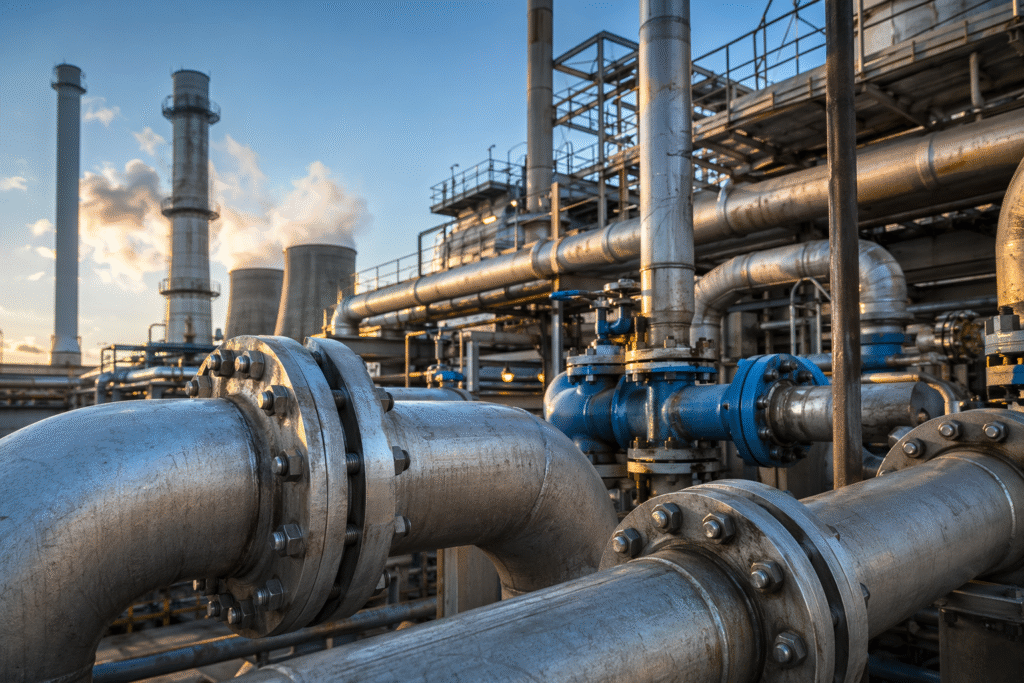
Markt für Edelstahlrohrflansche: 7 Versteckte Vorteile, Typen, Verwendungsmöglichkeiten, und wie man ASME B16.5 auswählt & B16.47 Flansche
Laut Grand View Research (2024), Der globale Markt für Industrieflansche wurde mit bewertet $5.8 Milliarden in 2023 und wird voraussichtlich erreicht werden $7.2 Milliarden von 2030. That growth highlights why the Rohrflansch aus Edelstahl remains a critical component for engineers, EPC-Auftragnehmer, und Beschaffungsteams, die Korrosionsbeständigkeit anstreben, Druckintegrität, und lange Lebensdauer.
Für industrielle Käufer, Der faszinierendste Faktor ist nicht nur der Preis, but also the hidden advantages of selecting the right flange material, Druckklasse, und Standard. daher, this guide explains flange types, verwendet, ASME requirements, and practical selection criteria for demanding pipe systems.
Industrial Demand for Stainless Steel Pipe Flange in Global Process Markets
Laut IBISWorld (2024), Der asiatisch-pazifische Raum macht mehr als aus 45% der weltweiten Flanschproduktion, wobei China der größte Hersteller ist. Infolge, sourcing strategies increasingly focus on qualified Chinese exporters that can deliver ASME, DIN, JIS, GOST, and EN compliant products with full material traceability.
Laut Statista (2024), auf die Öl- und Gasindustrie entfallen ca 35% des weltweiten Flanschverbrauchs. Darüber hinaus, petrochemische Verarbeitung, Stromerzeugung, Schiffbau, and water treatment continue to drive demand for stainless steel pipe flange products in 304, 316, Duplex, und Nickellegierungssorten.
These numbers matter because flange failure can shut down an entire line. Im Gegensatz, a correctly specified flange improves joint integrity, verkürzt die Wartungsintervalle, and supports safer operation under thermal cycling, Vibration, und korrosive Medien.
Laut Mordor-Geheimdienst (2024), industrial infrastructure investments in energy and water sectors continue to support steady growth in piping components across emerging markets. Außerdem, buyers now prioritize suppliers that can combine machining precision, EN 10204 3.1 Dokumentation, und kurze Lieferzeiten.
The hidden advantages of stainless steel are especially relevant in facilities handling chlorides, Säuren, Dampf, and high-purity fluids. Zum Beispiel, 316L stainless steel flange products usually outperform 304 in chloride exposure because molybdenum improves pitting resistance, while low carbon content helps reduce sensitization during welding.
As John Martinez, Leitender Rohrleitungsingenieur, Staaten: “A flange is a small component in cost share, but it is a major component in reliability strategy.” That insight reflects procurement reality, because flange quality often influences inspection frequency, leak risk, and lifecycle cost more than buyers expect.
SASA FLANGE agiert in diesem Umfeld mit ISO 9001:2015 und PED 2014/68/EU-Zertifizierungen. Zusätzlich, Das Unternehmen liefert Edelstahl, Kohlenstoffstahl, Legierung, Duplex, and special material flanges and fittings for clients across Oil & Gas, Petrochemie, Leistung, Marine, und Wasseraufbereitung.
Unterstützt durch fortschrittliche CNC-Bearbeitung und umfassende Qualitätsprüfungen, SASA FLANGE stellt Produkte her 304, 316, 316L, 904L, 2205, 2507, A105, A182, Inconel, Monel, Hastelloy, und Titansorten. daher, buyers can align corrosion performance, Druckstufe, and budget with actual service conditions instead of relying on generic substitution.
Laut Market Research Future (2024), industrial stainless component demand is rising as operators seek longer asset life and lower maintenance costs. Folglich, flange sourcing has become a technical purchasing decision rather than a simple commodity buy.
Versteckte Vorteile, Flanges Types, and Technical Factors Engineers Should Evaluate
The most intriguing aspect of a stainless steel pipe flange is its ability to combine strength, Korrosionsbeständigkeit, and maintainability in one connection point. Jedoch, those benefits only appear when engineers match flange type, gegenüber, Bewertung, and metallurgy to the pipe system.
Entsprechend ASME B16.5, Flanschabmessungen, Toleranzen, Druck-Temperatur-Werte, Markierung, and materials are standardized for NPS 1/2 durch 24. Parallel dazu, ASME B16.47 covers larger diameter flanges from NPS 26 durch 60, die bei der Übertragung üblich sind, Marine, and large process pipelines (ASME, 2023).
Als Dr. Helen Zhou, Materialwissenschaftler, Staaten: “The best flange selection is a corrosion and temperature decision first, and a price decision second.” daher, Auswählen 304, 316L, 904L, 2205, oder 2507 should follow fluid chemistry, Chloridgehalt, Temperaturbereich, und Herstellungsverfahren.
In der Praxis, engineers often evaluate the following flange types for industrial pipe systems:
- Vorschweißflansch für Hochdruck, Temperaturwechsel, and critical services.
- Slip-on flange for moderate pressure applications with easier alignment and lower fabrication cost.
- Blindflansch zur Leitungsisolierung, Hydrotest, und zukünftige Erweiterungspunkte.
- Muffenschweißflansch für kleine Bohrung, Hochdruckleitungen.
- Gewindeflansch für Niederdrucksysteme, bei denen Schweißen unerwünscht ist.
- Überlappungsflansch für Systeme, die häufig demontiert werden müssen.
Each flange type has hidden advantages. Zum Beispiel, weld neck designs distribute stress more evenly at the hub-to-pipe transition, while blind flanges provide strong end closure for pressure testing and maintenance isolation.
Ebenso wichtig ist die Materialauswahl. ASTM A182 Regelt üblicherweise geschmiedete Flansche aus rostfreiem und legiertem Stahl, während ASTM A240 covers plate materials used in related components and fabrication (ASTM, 2024).
For most chemical and utility systems, common stainless choices include:
- 304/304L for general corrosion resistance and cost-effective performance.
- 316/316L for chloride-bearing media and better pitting resistance.
- 321 Und 347 grades for elevated temperature stabilization.
- 904L for aggressive acidic environments.
- 2205 Duplex und 2507 Superduplex für hohe Festigkeit und Chlorid-Spannungskorrosionsbeständigkeit.
According to NACE guidance used widely in sour service selection, chloride and H2S exposure can rapidly narrow acceptable alloy options (NACE, 2023). Infolge, duplex and high-alloy stainless flange products are increasingly chosen for offshore, produziertes Wasser, and desalination lines.
Pressure class also changes the buying decision. ASME classes such as 150, 300, 600, 900, 1500, Und 2500 define flange strength and sealing capability under temperature-related derating.
Für Einkaufsmanager, the practical comparison often includes these factors:
- Pressure-temperature rating by ASME class.
- Verblendungstyp wie RF, RTJ, oder FF.
- Dimensional standard such as ASME B16.5, ASME B16.47, DIN, oder EN 1092.
- Materialstandard wie z ASTM A182 F304, F316L, F51, oder F53.
- Inspection documents including EN 10204 3.1 MTC.
- NDT requirements such as PMI, PT, UT, and hardness testing.
According to ISO requirements referenced by many EPC specifications, traceability and documented inspection are essential for pressure equipment quality systems (ISO, 2023). daher, a low initial unit price may become expensive if reinspection, rejection, or unplanned downtime occurs.
A well-chosen stainless steel pipe flange also simplifies maintenance planning. Darüber hinaus, stainless flanges generally support repeated disassembly better than lower-grade alternatives in clean service, Lebensmittelverarbeitung, und Wasseraufbereitungsanlagen, where contamination control and surface condition matter.
SASA FLANGE bietet maßgeschneiderte Größen ab 1/2" bis 60" mit wettbewerbsfähigen Direktpreisen ab Werk. Zusätzlich, the company supports RF, FF, RTJ, mit Gewinde, Muffenschweißen, blind, and weld neck configurations manufactured to ANSI B16.5, ANSI B16.47, DIN, JIS, GOST, und EN 1092 Anforderungen.
Portion 50+ Länder in ganz Öl & Gas, Petrochemie, Leistung, und Marineindustrie, SASA FLANGE aligns supply with real project documentation needs. Zum Beispiel, buyers often request PMI, Maßprüfung, hydrostatic support data, and packing suitable for export logistics.
Als Mark Ellison, Industriemarktanalyst, Staaten: “Procurement leaders now value certified documentation nearly as much as they value delivered price.” That trend is especially clear in PED projects, offshore packages, and owner-approved vendor lists.
Laut Grand View Research (2024), capital investment in industrial processing equipment remains a major support factor for connection components and maintenance demand. Folglich, stainless flange buyers should focus on specification accuracy, Lebenszykluskosten, and supplier consistency instead of comparing only quote totals.
ASME, ASTM, DIN, and EN Requirements for Stainless Steel Flanges Compliance
Standards compliance is where many flange projects succeed or fail. daher, engineers should distinguish clearly between dimensional standards, material standards, Inspektionsanforderungen, and regional regulatory requirements.
ASME B16.5 covers pipe flanges and flanged fittings for NPS 1/2 durch 24. Im Gegensatz, ASME B16.47 applies to large diameter steel flanges from NPS 26 durch 60, with Series A and Series B dimensional differences that affect bolt patterns and compatibility (ASME, 2023).
ASTM A182 specifies forged or rolled alloy and stainless steel flange materials for high-temperature service. Zusätzlich, ASTM material designations such as F304, F304L, F316, F316L, F51, and F53 help engineers define chemistry and mechanical properties more precisely.
Europäische Projekte erfordern oft EN 1092 dimensional compliance and PED 2014/68/EU documentation. Ähnlich, DIN legacy references remain common in maintenance and retrofit environments, especially where older installed systems must match existing components.
The following summary helps clarify the main standards landscape:
- ASME B16.5: Abmessungen, Toleranzen, Druckklassen, und Kennzeichnung für NPS 1/2 Zu 24.
- ASME B16.47: Flanschabmessungen mit großem Durchmesser für NPS 26 Zu 60.
- ASME B16.9: Werkseitig hergestellte Formstücke zum Stumpfschweißen, wie z. B. Winkelstücke, T-Shirts, Reduzierstücke, und Mützen.
- ASTM A182: Forged stainless and alloy steel materials for flanges and fittings.
- EN 1092: Europäische Flanschabmessungen und Druckbezeichnungen.
- NACE MR0175/ISO 15156: Materialleitfaden für saure Betriebsumgebungen.
Gemäß dem PED-Rahmen der Europäischen Kommission, pressure equipment compliance requires technical documentation, Konformitätsbewertung, and appropriate material traceability for applicable equipment categories (PED, 2014). Infolge, project buyers should verify not just the flange standard, but also the complete documentation package.
For corrosion-critical services, standards alone do not guarantee field performance. Jedoch, they create the baseline for interchangeability, qualification, and quality consistency across global supply chains.
In der praktischen Beschaffung, buyers should confirm these documentation points before purchase:
- Materialprüfzeugnis zu EN 10204 3.1.
- Heat number traceability on each flange.
- Maßkontrollbericht.
- PMI report for stainless, Duplex, und Nickellegierungssorten.
- Surface finish and facing inspection.
- Packing and marking requirements by project specification.
According to DNV expectations in many marine and offshore supply chains, traceability and inspection records significantly reduce non-conformance risk during audits and installation reviews (DNV, 2023). daher, consistent QA systems matter as much as machining capacity.
SASA FLANGE unterstützt diese Anforderungen mit ISO 9001:2015, PED 2014/68/EU, und AD 2000 Zertifizierungen. Darüber hinaus, the company manufactures stainless steel flanges and pipe fittings under documented quality procedures suited to EPC, Verteiler, and end-user sourcing models.
Für Käufer, die Anbieter vergleichen, one useful hidden advantage is standard flexibility. A supplier capable of ASME, DIN, JIS, GOST, and EN execution can simplify global projects, spare parts planning, and mixed-site maintenance programs.
Engineers should also review sealing face compatibility. Zum Beispiel, RF flanges dominate general industrial service, while RTJ flanges are preferred in higher pressure and critical hydrocarbon duties because the metal ring gasket offers robust sealing under severe service conditions.
For official dimensional and code references, Käufer können sich beraten lassen ASME. That step is valuable when project teams need to verify class ratings, Abmessungen, or code cross-references during design review.
So wählen Sie einen Edelstahlrohrflansch für Öl aus, Gas, Chemisch, Leistung, und maritime Nutzungen
Choosing the right stainless steel pipe flange begins with the service environment, nicht die Katalogseite. daher, engineers should define media composition, Betriebsdruck, Auslegungstemperatur, Korrosionszuschlag, and maintenance frequency before selecting a flange type or grade.
Oil and gas systems often require strong performance under pressure cycling, Vibration, and corrosive exposure. In these lines, weld neck and RTJ flange options are common, while duplex or super duplex materials may be preferred for seawater, injection, and offshore splash-zone duties.
Laut Statista (2024), Öl und Gas machen etwa aus 35% des weltweiten Flanschverbrauchs. Folglich, project specifications in this sector tend to be highly detailed, often requiring NACE compliance, PMI, Härteprüfung, and strict MTC control.
Chemical processing lines usually demand corrosion resistance first. Zum Beispiel, 316L, 904L, Hastelloy, or Monel flange products may be specified depending on chlorides, Säuren, Temperatur, and concentration.
Power generation projects focus heavily on thermal cycles and pressure integrity. daher, engineers may select higher class flanges, stabilized stainless grades, or alloy materials for steam, Kondensat, and high-temperature auxiliary lines.
Marine and shipbuilding applications present a different challenge because saltwater exposure accelerates pitting and crevice corrosion. Infolge, 316L, 2205, Und 2507 often become more attractive than 304 in deck piping, Ballast, Wäscher, und Meerwassersysteme.
The following checklist helps procurement teams choose more effectively:
- Confirm pipe size, Wandstärke, and matching schedule.
- Verify design pressure, Temperatur, and ASME class.
- Select flange type based on service criticality and maintenance needs.
- Match gasket and facing style to sealing requirements.
- Review corrosion data for chlorides, Säuren, H2S, or seawater.
- Specify required test certificates and inspection scope.
- Check regional standards such as ASME, EN, DIN, oder JIS.
Another hidden advantage is total installed cost control. A slightly higher-grade flange can reduce replacement frequency, shutdown exposure, and leak risk, which often delivers better economics across the asset lifecycle.
Zum Beispiel, A 4 inch stainless steel pipe flange used in a water treatment skid may only need ASME Class 150 and 316L material. Im Gegensatz, a similar nominal size in offshore injection service could require duplex material, RTJ facing, stricter NDT, and tighter traceability controls.
Laut Market Research Future (2024), water infrastructure upgrades continue to increase demand for corrosion-resistant piping components worldwide. daher, municipal and industrial water projects are becoming important growth segments for stainless and duplex flange procurement.
SASA FLANGE supports custom manufacturing for non-standard drilling, gegenüber, and material combinations. Zusätzlich, the company can supply matching elbows, T-Shirts, Reduzierstücke, and caps to simplify package procurement for complete piping systems.
For distributors and EPC contractors, consolidated sourcing can shorten project timelines. Darüber hinaus, factory-direct coordination helps reduce dimensional mismatch risk between the flange, Dichtung, Schrauben, and mating pipe or fitting.
When buyers need guidance on flange types, Materialien, or project documentation, early technical review is essential. Für Projekte, die individuelle Größen erfordern, Premium-Legierungen, or fast delivery, kontaktieren SASA FLANGE early can improve specification accuracy and purchasing efficiency.
Future Outlook for Stainless Flange Procurement and Strategic Buying Recommendations
The outlook for stainless flange demand remains positive as energy, Wasser, Marine, and process industries continue upgrading aging infrastructure. Laut Grand View Research (2024), Es wird erwartet, dass der Markt für Industrieflansche an Bedeutung gewinnt $7.2 Milliarden von 2030, which indicates stable long-term procurement activity.
Gleichzeitig, buyers are becoming more selective. daher, supplier evaluation increasingly includes not only price, but also certification status, Bearbeitungsfähigkeit, Exporterfahrung, traceability systems, und Reaktionsgeschwindigkeit.
One intriguing shift is the move toward lifecycle-based purchasing. Instead of choosing the lowest initial quote, procurement teams now compare maintenance cost, failure risk, and expected service life across 304, 316L, Duplex, and high-alloy flange options.
Digital sourcing also changes buyer behavior. Zum Beispiel, engineers often search terms like stainless steel pipe flange sizes, Flanschtypen aus Edelstahl, Rohrflansch aus Edelstahl mit Gewinde, and stainless steel pipe flange price before issuing RFQs.
That search behavior means supplier content must answer technical and commercial questions clearly. Darüber hinaus, pages that combine standards guidance, material comparisons, and application advice are more likely to support both SEO performance and conversion quality.
Strategisch, buyers should follow five practical recommendations:
- Standardize approved materials for recurring services.
- Präqualifizieren Sie Lieferanten mit ISO 9001:2015 and PED capabilities.
- Anfrage EN 10204 3.1 certificates and PMI for critical grades.
- Vergleichen Sie den Lebenszykluswert, nicht nur der Stückpreis.
- Use suppliers that can deliver both flanges and fittings for package consistency.
Laut IBISWorld (2024), China bleibt für die weltweite Flanschproduktionskapazität von zentraler Bedeutung. Infolge, working with experienced exporters that understand international standards and documentation can create significant cost and schedule advantages.
For companies balancing quality, delivery, und globale Compliance, a data-driven sourcing approach is the safest path. When your next project requires ASME B16.5, B16.47, DIN, or EN compliant stainless steel flange solutions, discussing specifications with SASA FLANGE can help align technical needs with reliable factory supply.
Häufig gestellte Fragen
Welche verschiedenen Arten von Edelstahlflanschen gibt es??
●Die wichtigsten Edelstahlflanschtypen sind Vorschweißflansche, Slip-on, blind, Muffenschweißen, mit Gewinde, und Überlappungsgelenk, Und ASME B16.5 defines the dimensional framework for most standard sizes up to NPS 24.
●Laut Statista (2024), oil and gas consumes about 35% von globalen Flanschen, so weld neck and blind designs are especially common in high-integrity process lines.
●Für kritische Rohrsysteme, engineers should choose flange types based on pressure class, Verkleidungsstil, Wartungszugang, und Korrosionsumgebung, and established manufacturers like SASA FLANGE can support matching material and standard selection.
Was ist besser? 304 oder 420 Edelstahl?
●Für die meisten Anwendungen mit Edelstahlrohrflanschen, 304 ist im Allgemeinen besser als 420 Weil 304 offers superior corrosion resistance, Schweißbarkeit, and formability for industrial piping service.
●ASTM A182 flange grades such as F304 and F304L are widely used in pressure systems, während 420 is a martensitic stainless steel more often selected for hardness and wear resistance than for corrosive process piping.
●Buyers should usually select 304 for general flange service and move to 316L or duplex for harsher environments, while consulting experienced suppliers like SASA FLANGE when chloride exposure or elevated temperatures are involved.
Welche drei Arten von Flanschen gibt es??
●The three most commonly referenced flange types in general industry are weld neck, Slip-on, and blind flanges because they cover most pressure connection, Installation, und Isolationsbedürfnisse.
●Entsprechend ASME B16.5, these flange categories are standardized for dimensions, Bohren, und Druck-Temperatur-Bewertungen, which helps ensure interchangeability across many pipe systems.
●For most projects, weld neck suits severe service, slip-on suits moderate duty, and blind suits end closure or hydrotesting, so buyers should match the type to service risk and maintenance plans.
Was ist der ASME-Code für Edelstahlflansche??
●Die wichtigsten ASME-Standards für Edelstahlflansche sind ASME B16.5 für NPS 1/2 durch 24 Und ASME B16.47 für NPS 26 durch 60, während ASTM A182 commonly defines the forged stainless material grade.
●These standards cover dimensions, Druckklassen, Toleranzen, facings, und Markierung, but project compliance may also require PED, EN 1092, oder NACE MR0175 je nach Anwendung.
●Procurement teams should specify both the ASME dimensional standard and the ASTM material grade in every RFQ to avoid mismatched flange supply and documentation issues.
Wie wähle ich die richtige Flanschgröße und Druckklasse für Edelstahlrohre aus??
●Die Flanschgröße muss mit dem NPS-Wert und dem Zeitplan des Rohrs übereinstimmen, while pressure class such as 150, 300, oder 600 must reflect design pressure and temperature according to ASME rating tables.
●Laut Grand View Research (2024), the flange market is growing with more complex industrial applications, which makes accurate class and material selection increasingly important for lifecycle cost control.
●Engineers should verify size, gegenüber, Bohren, Materialqualität, and gasket compatibility together before ordering, especially for 2 Zoll und 4 inch stainless steel pipe flange requirements in mixed-standard systems.
Why are 316L and duplex stainless flanges often chosen over 304 im Marine- und Chemieservice?
●316L and duplex stainless flanges are often preferred because they provide better resistance to pitting, Spaltkorrosion, and chloride stress corrosion cracking than standard 304 in aggressive environments.
●Laut IBISWorld (2024), Asien-Pazifik ist weltweit führend in der Flanschproduktion, and marine and water infrastructure projects are increasing demand for higher-performance alloys such as 2205 Und 2507.
●Für Meerwasser, Chloride, or sour service, buyers should review full process chemistry and request PMI and EN 10204 3.1 certification before final material approval.
Verwandte Beiträge
Flanschoberflächenfinish: Konzentrische vs. spiralförmige Verzahnungen erklärt
Konzentrische und spiralförmige Verzahnungen sind beide bearbeitete Flanschflächenoberflächen…
Duplex 2205 vs. 316L-Flansche: Welches Material sollten Sie wählen??
Schnelle Antwort: Duplex 2205 Flansche sind normalerweise der stärkere Kandidat…

Definition des Öffnungsflansches, Details und Übersicht über ASME B16.36-Flansche: Marktdaten, Auswahlhilfe und Compliance-Einblicke
Der globale Markt für Industrieflansche wurde mit bewertet $5.8 Milliarde…

Marktführer für schwarze Entsorgungsflansche: Materialien, 3.5″ Kompatibilität, und B2B-Beschaffungsdaten für Küchenspülenflansche
Die Nachfrage nach schwarzen Entsorgungsflanschen steigt bei Käufern von Küchenarmaturen…