
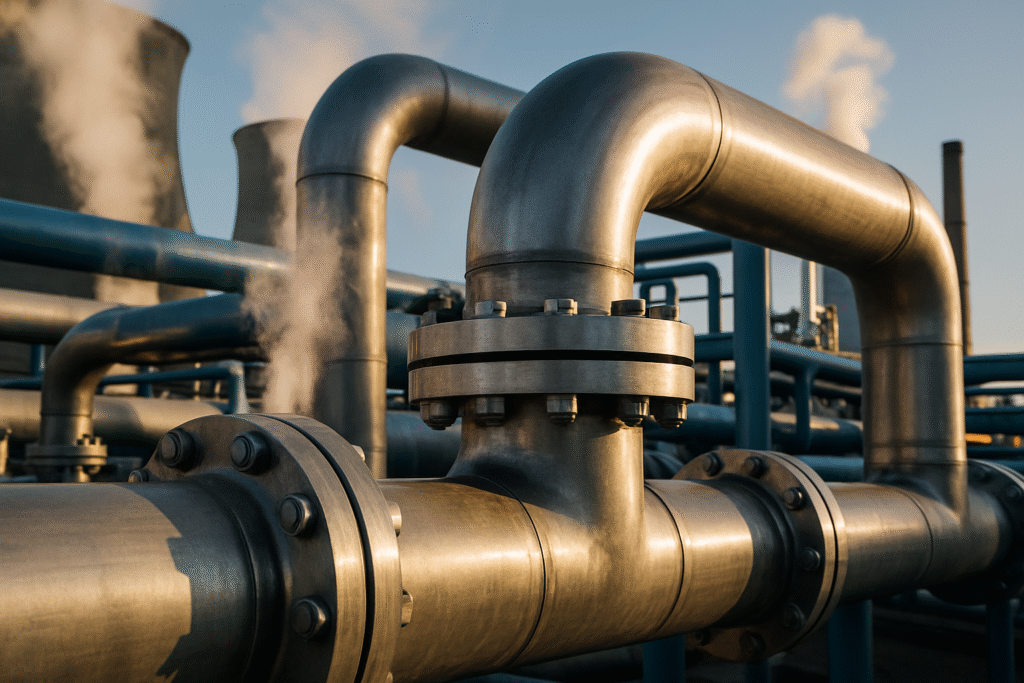
El mercado de bridas para tubos de acero inoxidable alcanzará los 7.200 millones de dólares 2030: Ventajas ocultas, Tipos, Usos, y como elegir
Según la investigación de Grand View (2024), El mercado mundial de bridas industriales se valoró en $5.8 mil millones en 2023 y se prevé que alcance $7.2 mil millones por 2030. That growth explains why the stainless steel pipe flange has become a strategic procurement item for EPC contractors, ingenieros de planta, and industrial distributors seeking corrosion resistance, integridad de la presión, y larga vida útil.
For buyers in Oil & Gas, petroquímico, fuerza, marina, y tratamiento de agua, the hidden advantages of stainless steel pipe flange selection often appear in lifecycle cost rather than initial purchase price. Por lo tanto, understanding flange materials, clases de presión, estándares, and application-specific uses is essential before you choose a pipe flange for critical service.
Industrial Demand for Stainless Steel Pipe Flange Is Rising Across Global Projects
Según IBISWorld (2024), Asia-Pacífico representa más de 45% de la producción mundial de bridas, siendo China el mayor fabricante. Como resultado, procurement teams increasingly source from qualified Chinese manufacturers that combine scale, trazabilidad, y cumplimiento de exportaciones.
Según Statista (2024), La industria del petróleo y el gas representa aproximadamente 35% del consumo global de bridas. Además, refinery upgrades, terminales de GNL, plataformas marinas, and pipeline rehabilitation projects continue to drive demand for forged and machined stainless flanges in ASTM and ASME grades.
Market expansion also reflects stricter operating conditions. Corrosión, exposición al cloruro, servicio amargo, ciclo térmico, and pressure pulsation all push end users toward stainless, dúplex, aleación de níquel, and other engineered flange materials.
Según la inteligencia de Mordor (2024), industrial process equipment investment in emerging markets continues to rise alongside chemical, desalinización, and energy infrastructure spending. Como consecuencia, procurement managers now evaluate flanges not only by unit cost, but also by compliance, metalurgia, y confiabilidad en la entrega.
En este ambiente, stainless steel pipe flange sourcing has become a technical buying process. Buyers want dimensional accuracy, EN 10204 3.1 documentación, Capacidad PMI, soporte de prueba hidrostático o neumático, and full conformity to ASME B16.5, ASME B16.47, DIN, JIS, GOST, y ES 1092 requisitos.
ASME specifies the dimensional and pressure-temperature framework that underpins most industrial flange systems, especially in North America and export projects. You can review core requirements directly at ASME.org, which remains an essential reference for engineering validation.
SASA FLANGE operates in this exact procurement space. Con ISO 9001:2015 y certificaciones PED 2014/68/UE, la empresa suministra bridas de acero inoxidable, bridas de acero al carbono, bridas de aleación, and pipe fittings for demanding industrial services in more than 50 países.
Además, SASA FLANGE manufactures in 304, 316, 316l, 904l, 2205, 2507, A105, A182, Inconel, Monel, Hastelloy, y titanio. Respaldado por mecanizado CNC avanzado y pruebas de calidad integrales, it supports custom sizes from 1/2" a 60" for global project and MRO requirements.
Para compradores B2B, this matters because late-stage flange failure can be expensive. Según Market Research Future (2024), maintenance and replacement costs in industrial piping systems can consume a significant share of total plant operating expenditure, particularly in corrosive processing environments.
Como David Hughes, Ingeniero Senior de Tuberías, estados: “A flange is never just a connector; it is a pressure boundary, a maintenance interface, and a reliability decision.” That perspective explains why experienced buyers compare material grade, acabado de revestimiento, carga de pernos, and gasket compatibility before issuing a purchase order.
When procurement teams evaluate experienced manufacturers, they also look for application knowledge. In contrast to generic traders, technically competent producers can recommend whether a weld neck, ponerse, ciego, roscado, soldadura de encaje, junta de regazo, or reducing flange is the correct choice for pressure class, schedule number, and service media.
Stainless Steel Pipe Flange Hidden Advantages, Tipos, y factores de selección técnica
The most intriguing aspect of a stainless steel pipe flange is not simply corrosion resistance. Its hidden advantages include lower contamination risk, better appearance retention, reliable cleanability, strong mechanical performance, and reduced maintenance frequency in wet or aggressive environments.
According to ASTM and ASME material practices, forged stainless flanges commonly use ASTM A182 grados como F304, F304L, F316, F316L, F321, F347, and duplex variants where specified. These grades support a wide range of temperature and corrosion conditions, although exact selection depends on media composition, clase de presión, and welding procedure requirements.
According to NACE guidance for corrosive service, chloride stress corrosion cracking and sulfide-related damage remain central risks in plant metallurgy decisions (NACE, 2023). Por lo tanto, 316/316l, 904l, 2205, o 2507 may outperform 304 en agua de mar, agrio, or chloride-bearing applications.
Como Dr.. Elena Markovic, Científico de materiales, estados: “The right stainless flange grade is chosen by environment, no es costumbre; molibdeno, nickel balance, and duplex structure can dramatically improve field life.” That is why experienced engineers compare not only price, but pitting resistance, soldabilidad, and crevice corrosion behavior.
For most industrial buyers, the main flange types include the following.
- Weld neck flange for high-pressure and high-temperature service with superior stress distribution.
- Slip on flange for moderate service where easier alignment and lower initial cost are priorities.
- Blind flange for system isolation, paradas de mantenimiento, y pruebas de presión.
- Socket weld flange for small-bore, sistemas de alta presión.
- Threaded flange for non-welded connections in low to medium pressure service.
- Lap joint flange for systems requiring frequent dismantling and alignment flexibility.
- Reducing flange for transitions between larger and smaller piping sizes.
Each type serves different uses. Por ejemplo, a weld neck stainless steel pipe flange suits thermal cycling and severe service, while a threaded pipe flange may fit utility lines where field welding is restricted.
The decision matrix usually starts with five variables.
- Grado de material como 304, 316l, 904l, 2205, o 2507.
- Pressure-temperature class such as Class 150, 300, 600, 900, 1500, o 2500.
- Compatibilidad con programas de tuberías como SCH 10, SCH 40, SCH 80, o XS.
- Tipo de revestimiento como RF, FF, RTJ, lengua y ranura, o hombre y mujer.
- Applicable code such as ASME B16.5, ASME B16.47, DIN, o ES 1092.
De acuerdo a ASME B16.5, dimensiones de la brida, tolerancias, perforación, vueltas, and pressure classes must be controlled to ensure interchangeability and sealing integrity (ASME, 2020). Por lo tanto, dimensional conformity is not optional; it directly affects gasket compression, tensión del perno, and leak performance.
ASTM A182 governs many forged or rolled alloy and stainless steel pipe flange materials for high-temperature service (ASTM, 2023). Mientras tanto, ASTM A240 often applies to plate products that may feed some flange or fitting manufacturing routes, especially for flat or fabricated components.
Procurement managers often ask whether 304 o 316 is better. En la práctica, 304 offers excellent general corrosion resistance and cost efficiency, while 316/316L adds molybdenum for stronger resistance in chloride-containing environments and many chemical services.
Sin embargo, the hidden advantages of duplex grades deserve equal attention. Dúplex 2205 combines higher strength with improved resistance to chloride pitting and stress corrosion cracking, y súper dúplex 2507 provides even greater corrosion performance for offshore, desalinización, and marine process systems.
Según la guía DNV para sistemas marinos, material selection strongly influences lifecycle integrity where chloride loading, vibración, and cyclic operating conditions are high (DNV, 2023). Por lo tanto, a lower-cost flange can become the more expensive option if corrosion allowance, mano de obra de reemplazo, and downtime are considered.
En SASA FLANGE, buyers can source stainless steel pipe flange products in multiple grades and configurations through its product portfolio. The company supports forged flanges and related fittings, incluyendo codos, camisetas, reductores, y gorras, which helps EPC and distributor customers consolidate supply chains.
Lead time and consistency also shape buying decisions. Según los puntos de referencia de adquisiciones de la industria resumidos por IBISWorld (2024), delayed mechanical components can disrupt construction schedules and increase indirect project cost by multiples of the original component value.
Por esa razón, engineers should request these documents during technical review.
- Certificados de prueba de materiales para EN 10204 3.1.
- Trazabilidad del número de calor e identificación positiva de materiales..
- Registros de inspección dimensional.
- NDE or supplementary test reports if required.
- DEP, ANUNCIO 2000, or project-specific compliance statements.
These requirements are especially important when buying stainless steel flanges and fittings for regulated systems. Además, where sour service or corrosive media are present, buyers should align purchase specifications with NACE MR0175 or project metallurgy rules.
ASME, ASTM, DIN, y normas EN que definen el cumplimiento de bridas de tuberías de acero inoxidable
Standards compliance separates commodity supply from project-grade supply. En tuberías industriales, the flange must match not only the pipe size, but also the code basis, clase de presión, estándar de materiales, frente a la geometría, y requisitos de inspección.
The most frequently referenced standards include ASME B16.5 para NPS 1/2 a través de 24 y ASME B16.47 para diámetros mayores. En proyectos europeos, EN 1092 often governs pressure classes, dimensiones, and drilling patterns, while DIN legacy references may still appear in older facilities.
Las normas ASTM definen la química de los materiales y las propiedades mecánicas.. For stainless steel pipe flange manufacturing, ASTM A182 is especially relevant for forged grades, y ASTM A240 may apply for plate-based materials used in associated components.
Según los principios de gestión de calidad ISO., manufacturing control and traceability reduce variation and support repeatable conformance in industrial components (ISO, 2015). Como consecuencia, ISO 9001:2015 certification remains a meaningful screening criterion for procurement teams.
The following comparison helps engineers align common standards.
- ASME B16.5: flange dimensions and pressure-temperature ratings for common industrial sizes.
- ASME B16.47: large diameter flange dimensions for major pipeline and plant systems.
- ASME B16.9: dimensions for butt weld fittings such as elbows and reducers.
- ASTM A182: forged or rolled alloy and stainless steel flange material requirements.
- EN 1092: European flange dimensions and PN classifications.
- NACE MR0175: material guidance for sour service environments.
Pressure class and pressure rating are often misunderstood. una clase 150 stainless steel pipe flange does not mean 150 psi in all conditions, because allowable pressure decreases as temperature rises, and exact values depend on material group and code tables.
Facing finish also deserves attention. Raised face flanges remain standard in many process lines, while ring type joint flanges are preferred for higher pressure and more critical sealing applications.
Recomendación de texto alternativo de imagen: stainless steel pipe flange dimensions and ASME standard forged flange inspection. This visual should show dimensional verification, flange facings, and CNC-machined sealing surfaces in a clean industrial setting.
SASA FLANGE fortalece la confianza en el cumplimiento a través de ISO 9001:2015, DEP 2014/68/UE, y anuncio 2000 cartas credenciales. For export-oriented buyers, those certifications support qualification for projects that demand documented quality management and pressure equipment conformity.
Además, the company manufactures to ANSI B16.5, ANSI B16.47, ASME B16.9, DIN, JIS, GOST, y ES 1092. That range is useful for contractors managing mixed-specification projects, brownfield replacements, or multinational plant expansions.
Como Mark Feldman, Analista de Mercados Industriales, estados: “In flange procurement, nonconforming dimensions create hidden cost faster than material price ever saves.” Por lo tanto, buyers should verify drilling patterns, bore dimensions, acabado dentado, and facing type against approved drawings and standards before shipment.
For projects requiring special inspection, buyers can also request hardness testing, PMI, ferrite checks where applicable, e inspección de testigos de terceros. These steps are common in offshore, químico, generación de energía, and marine contracts where failure risk is high.
Recomendación de texto alternativo de imagen: stainless steel pipe flange manufacturing with CNC machining, Pruebas del PMI, and export packing for industrial piping systems. This image should communicate quality assurance and factory-direct production capability.
Cómo elegir la brida de tubería de acero inoxidable adecuada para petróleo, Gas, Químico, Fuerza, y Servicio Marítimo
To choose the correct stainless steel pipe flange, engineers should start with service conditions rather than catalog preference. Composición de los medios, temperatura de funcionamiento, pressure transients, filosofía de mantenimiento, and corrosion allowance all affect the final specification.
Para sistemas de petróleo y gas, 316/316l, dúplex 2205, y súper dúplex 2507 often appear where chlorides, agua de mar, or aggressive fluids are present. Según Statista (2024), el sector representa aproximadamente 35% del consumo global de bridas, so oil and gas specifications strongly shape market demand.
En plantas petroquímicas y químicas., buyers should evaluate corrosion by acid, caustic, solvent, y exposición al cloruro. Como resultado, 904l, aleaciones de níquel, or higher-performance stainless grades may be justified despite higher upfront cost.
Power generation introduces another challenge: fatiga térmica. High-temperature systems may require material grades and flange types that better handle expansion, carga cíclica, and steam service, especially in superheated or high-pressure circuits.
Marine and shipbuilding applications demand strong resistance to salt spray, seawater contamination, and galvanic interaction. Por lo tanto, 316l, 2205, o 2507 often provide stronger lifecycle economics than standard 304 in deck, lastre, desalinización, and cooling-water service.
Water treatment and desalination projects add constant chloride exposure and cleaning cycles. En estos sistemas, the hidden advantages of molybdenum-bearing and duplex stainless flanges become especially important for long-term sealing reliability.
Engineers can use this practical selection checklist.
- Confirm service media, nivel de cloruro, pH, and operating temperature range.
- Match flange type to process duty, acceso de mantenimiento, and welding preference.
- Verify pressure class against design pressure and code temperature derating.
- Align bore and schedule with mating pipe to avoid flow disruption.
- Specify facing type based on gasket style and leakage tolerance.
- Request test certificates, trazabilidad, and required compliance documents.
- Review packaging and export protection for stainless surface quality.
Dimension questions are equally important. A 4 brida de tubería de acero inoxidable en pulgadas, Por ejemplo, may differ by ASME class, horario aburrido, estilo de revestimiento, and drilling pattern, so a nominal size alone is never enough for quotation or production.
Price should be evaluated carefully. Stainless steel pipe flange price varies by alloy content, ruta de forja, complejidad del mecanizado, alcance de la prueba, y cantidad, and freight can materially influence landed cost for urgent project deliveries.
Custom manufacturing can reduce these risks. A través de consulta técnica directa, SASA FLANGE admite tamaños personalizados desde 1/2" a 60", multiple material grades, and project-driven machining requirements for EPC, distribuidor, and OEM buyers.
That capability is valuable when standard catalog options do not match project drawings. Por ejemplo, reducing flanges, nonstandard bores, acabados de revestimiento especiales, or mixed packages of flanges and fittings can simplify procurement and shorten coordination cycles.
SASA FLANGE also serves buyers needing elbows, camisetas, reductores, and caps in matched metallurgy. This integrated supply approach helps maintain consistency across complete piping packages for construction and maintenance projects.
Cuando los compradores comparan proveedores, they should review these commercial points as closely as technical points.
- Minimum order quantity and lot flexibility.
- Production capacity and realistic lead times.
- Export experience and packaging standards.
- Third-party inspection support.
- After-sales response for documentation and claims.
For projects requiring certified stainless steel flanges and fittings, trabajando con SASA FLANGE can reduce technical ambiguity. Its mix of material range, cobertura de estándares, and inspection capability supports both distributor resale and end-user project procurement.
Future Outlook for Stainless Steel Pipe Flange Buyers and Strategic Procurement Recommendations
Según la investigación de Grand View (2024), Se espera que el mercado de bridas industriales crezca de $5.8 mil millones en 2023 a $7.2 mil millones por 2030. That trajectory signals sustained demand from energy transition projects, infraestructura de agua, GNL, procesamiento químico, and industrial maintenance programs.
Según IBISWorld (2024), Asia-Pacific already contributes more than 45% de la producción mundial de bridas. Por lo tanto, buyers who build structured sourcing relationships in the region can improve cost competitiveness while still maintaining quality, cumplimiento, and delivery control.
Sin embargo, strategic sourcing should not focus on price alone. En contraste, the strongest procurement outcomes come from balancing metallurgy, standards conformity, document quality, inventory planning, and supplier communication.
Three recommendations stand out for B2B buyers. Primero, standardize approved material and flange specifications by service category to reduce engineering rework and quote variability.
Segundo, prequalify suppliers with ISO 9001:2015, DEP, and traceability capability before the urgent project phase begins. Tercero, consolidate flanges and fittings where possible to reduce logistics complexity, document gaps, and mismatch risk across the piping package.
Digital procurement is also changing how industrial buyers evaluate suppliers. Buyers increasingly expect quick quotation turnaround, claridad dimensional, material substitutions only with approval, and full document support before shipment release.
Como resultado, suppliers that combine technical depth with responsive communication will gain share. For companies planning current or upcoming projects in stainless, dúplex, aleación de níquel, or mixed-material piping systems, early engagement with experienced manufacturers such as SASA FLANGE can improve specification accuracy and total project efficiency.
Preguntas frecuentes
¿Para qué se utilizan las bridas de acero inoxidable??
●Las bridas de acero inoxidable se utilizan para conectar tuberías., valvulas, zapatillas, y equipos a presión en sistemas que requieren resistencia a la corrosión, facilidad de limpieza, and secure disassembly for maintenance.
●Según Statista (2024), the oil and gas industry alone accounts for approximately 35% del consumo global de bridas, which shows how essential flange connections are in critical process infrastructure.
●Common uses include chemical transfer lines, tubería costa afuera, sistemas de vapor, food and beverage process lines, marine services, and water treatment plants where carbon steel may corrode too quickly.
●Engineers typically choose a stainless steel pipe flange when media, temperatura, requisitos de higiene, or lifecycle economics justify a premium material over painted or galvanized alternatives.
●For projects requiring traceable materials and standards compliance, trabajando con fabricantes establecidos como SASA FLANGE helps ensure dimensional accuracy, EN 10204 3.1 documentación, and reliable quality control.
¿Cuál es la diferencia entre 304 y 316 materiales de brida de tubería de acero inoxidable?
●The main difference is that 316 y 316L contienen molibdeno, which improves resistance to chlorides, many chemicals, and aggressive process conditions compared with 304 y 304L.
●ASTM A182 commonly covers both F304/F304L and F316/F316L forged flange grades, and engineers often specify 316L for marine, costero, and chemical duties where pitting resistance is more important.
●Según la guía NACE (2023), chloride-bearing environments require careful material selection because localized corrosion can accelerate quickly in unsuitable grades.
●En términos prácticos, 304 is often the economical choice for general industrial service, while 316L is preferred for seawater splash zones, process chemicals, and more corrosive cleaning cycles.
●For buyers comparing lifecycle value rather than unit price, requesting technical guidance from SASA FLANGE can help match grade selection to actual operating conditions.
¿Cuáles son los principales tipos de bridas de acero inoxidable??
●Los tipos de bridas de acero inoxidable más comunes son las de cuello soldado., ponerse, ciego, soldadura de encaje, roscado, junta de regazo, y bridas reductoras, and each type serves a different pressure, mantenimiento, or fabrication need.
●ASME B16.5 defines the dimensional framework for many of these flange types across common pressure classes such as Class 150, 300, 600, 900, 1500, y 2500.
●Se prefieren las bridas con cuello soldado para servicios de alta presión y alta temperatura., while slip on flanges are often selected for easier fabrication and lower initial cost in moderate conditions.
●Blind flanges isolate lines for testing or maintenance, threaded flanges avoid welding in some services, and reducing flanges simplify transitions between different pipe sizes.
●When specifying a flange type, engineers should also confirm facing style, calendario de perforación, compatibilidad de juntas, and code basis before purchase.
How are stainless steel flange dimensions determined?
●Stainless steel flange dimensions are determined by the governing standard, nominal pipe size, clase de presión, tipo de revestimiento, and pipe schedule rather than by nominal size alone.
●Por ejemplo, a 4 inch stainless steel pipe flange built to ASME B16.5 Clase 150 has different thickness, bolt-hole pattern, and bore dimensions than a 4 clase de pulgadas 600 brida.
●EN 1092 and DIN systems use different dimensional conventions and pressure designations, so buyers must confirm whether the project requires ASME, EN, DIN, JIS, or another standard.
●Dimension errors can create gasket seating problems, desalineación de pernos, and expensive field delays, which is why inspection reports and approved drawings are important for project supply.
●For replacement or custom applications, fabricantes como SASA FLANGE can help verify exact dimensions before production begins.
¿Qué temperatura tendrá? 304 stainless steel withstand in flange applications?
●304 stainless steel can withstand elevated temperatures in many services, but exact allowable conditions depend on code rules, clase de presión, medios de comunicación, and whether continuous or cyclic exposure is involved.
●ASME pressure-temperature ratings, not generic internet values, should be used to evaluate whether a 304 stainless steel pipe flange is suitable for a given operating condition.
●In higher-temperature systems, engineers may consider stabilized or high-temperature grades such as 321, 347, or other specified materials when sensitization, escalada, or creep-related concerns exist.
●Como Dr.. Elena Markovic, Científico de materiales, notas: “Temperature selection must include both oxidation resistance and what the process fluid does to the metal over time.”
●The safest recommendation is to review design temperature against ASME and ASTM material tables before ordering, especially for steam, horno, o servicio de ciclo térmico.
How do buyers choose between stainless steel flanges and fittings from different suppliers?
●Buyers should compare suppliers on technical compliance, manufacturing capability, documentation quality, confiabilidad de entrega, and total landed cost rather than on piece price alone.
●Según la investigación de Grand View (2024), Se espera que el mercado de bridas industriales alcance $7.2 mil millones por 2030, so supplier competition is strong but quality variation remains significant.
●Para bridas y accesorios de acero inoxidable, engineers should request ISO 9001:2015 cartas credenciales, EN 10204 3.1 certificados, traceability records, inspección dimensional, and confirmation of standards such as ASME B16.5, ASME B16.47, y ASME B16.9.
●Suppliers that can provide both flanges and related elbows, camisetas, reductores, and caps in matching metallurgy often reduce procurement complexity and mismatch risk across a project package.
●For critical industrial orders, fabricantes establecidos como SASA FLANGE offer an advantage through broad material coverage, experiencia exportadora, and project-oriented technical support.
Posts Relacionados
Acabado de la cara de la brida: Dentados concéntricos versus espirales explicados
Los dentados concéntricos y en espiral son acabados de cara de brida mecanizados.…
Dúplex 2205 frente a bridas 316L: ¿Qué material debería elegir??
respuesta rapida: Dúplex 2205 Las bridas suelen ser el candidato más fuerte.…

Definición de brida de orificio, Detalles y descripción general de bridas ASME B16.36: Datos de mercado, Guía de selección e información sobre cumplimiento
El mercado mundial de bridas industriales se valoró en $5.8 mil millones…

Guía del mercado de bridas de eliminación negras: Materiales, 3.5″ Compatibilidad, y datos de abastecimiento B2B para bridas de fregaderos de cocina
La demanda de bridas de eliminación negras está aumentando a medida que los compradores de accesorios de cocina…