
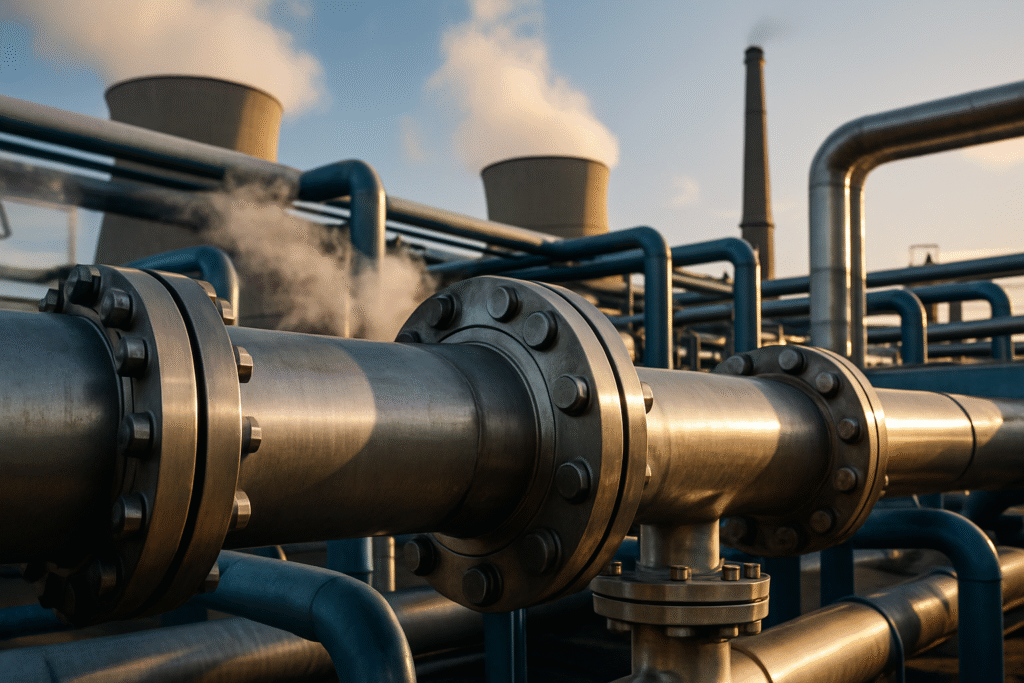
스테인레스 스틸 파이프 플랜지: 유형에 대한 완전한 가이드, 용도, 숨겨진 장점과 선택 방법 2026
그만큼 스테인레스 스틸 파이프 플랜지 market remains strategically important as industrial projects demand longer service life, 더욱 엄격한 누출 통제, 그리고 더 강한 내식성. 그랜드뷰 리서치에 따르면 (2024), 전 세계 산업용 플랜지 시장의 가치는 다음과 같습니다. $5.8 10억 2023 도달할 것으로 예상됩니다. $7.2 10억 단위로 2030.
엔지니어 및 조달 팀용, 성장은 실제 현실을 반영한다. Stainless steel flanges support critical piping systems in oil and gas, 석유화학, 발전, 선박, and water treatment projects where reliability directly affects safety and uptime.
This article provides an intriguing and complete guide to stainless steel pipe flange selection. It covers stainless steel flange types, common uses, hidden advantages, 표준, and how to choose the right specification for demanding industrial service.
Market Drivers Shaping Stainless Steel Pipe Flange Demand
Demand for stainless steel flanges is rising because end users want lower lifecycle cost, better corrosion resistance, and more predictable maintenance planning. IBISWorld에 따르면 (2024), 아시아 태평양 계정은 이상입니다. 45% 글로벌 플랜지 생산량의, with China remaining the largest manufacturer.
That manufacturing concentration matters for international buyers. It affects lead times, 가격, 합금 가용성, and access to custom machining for special sizes and nonstandard drilling patterns.
Oil and gas remains the largest single consumption segment. 스태티스타에 따르면 (2024), 석유 및 가스 산업은 대략적으로 35% 글로벌 플랜지 소비량, which explains why flange buyers focus heavily on pressure class, 재료 추적성, 부식 성능.
동시에, project specifications are becoming more stringent. EPC contractors increasingly require EN 10204 3.1 선적 서류 비치, PMI, hydrostatic verification, and dimensional control against ASME B16.5 또는 EN 1092-1 공차.
모르도르 정보국에 따르면 (2024), global investment in process industries continues to support demand for alloy and stainless piping components in both greenfield and brownfield projects. 그러므로, buyers are comparing not only price, but also QA systems, test capability, and export experience.
As material costs fluctuate, stainless grades with higher molybdenum or nickel content often face greater price volatility. 하지만, the longer service interval of 316L, 듀플렉스 2205, or 904L can offset upfront cost in chloride-bearing or aggressive chemical environments.
시장 조사 미래에 따르면 (2024), industrial infrastructure upgrades are increasing demand for corrosion-resistant piping products across water treatment, 담수화, 해양 부문. 게다가, that trend supports growth in forged flanges, buttweld fittings, 및 특수 합금.
Buyers also want a supplier that can align manufacturing and compliance. SASA FLANGE supports this need with ISO 9001:2015, PED 2014/68/EU, 그리고 광고 2000 신임장, 스테인레스 스틸 플랜지를 공급하면서, 탄소강 플랜지, 합금 플랜지, and pipe fittings to global industrial clients.
With manufacturing capability in 304, 316, 316엘, 904엘, 2205, 2507, A105, A182, 인코넬, 모넬, 하스텔로이, 그리고 티타늄, SASA FLANGE can address both standard and severe-service applications. 추가적으로, factory-direct production and CNC machining help procurement teams balance quality, 선적 서류 비치, and budget control.
For project buyers, the most intriguing shift is this. The purchase decision is no longer only about flange price per piece, but about total installed performance across service life, inspection frequency, and shutdown risk.
스테인레스 스틸 파이프 플랜지 유형, 재료, 및 기술 선택 요소
Choosing the correct stainless steel pipe flange starts with joint design, 서비스 조건, 및 재료 호환성. 실제로, engineers evaluate pressure class, 온도, 부식 매체, 직면 유형, bore match, and fabrication method before finalizing a purchase specification.
존 레이놀즈처럼, corrosion and materials specialist, 주: “A flange failure rarely begins at installation alone; it usually starts with a mismatch between metallurgy, 압력 등급, and actual service chemistry.” That is why material and design selection must be reviewed together.
The most common stainless steel flange types for industrial piping include weld neck, 슬립온, 눈이 먼, 소켓 용접, 스레드, 및 랩 조인트 디자인. Each type serves a different balance of strength, 설치 속도, 검사 접근, 그리고 비용.
- 용접 넥 플랜지: 고압에 선호, 순환 로딩, and temperature fluctuation because the tapered hub improves stress distribution.
- 슬립온 플랜지: Economical and easier to align in low to moderate pressure systems, 비록 피로저항은 웰드넥 디자인보다 낮지만.
- 블라인드 플랜지: 종료하는 데 사용됨, 격리하다, or future-proof pipe runs, especially during maintenance or phased plant expansion.
- 소켓 용접 플랜지: Suitable for smaller bore high-pressure service where socket connection simplifies fit-up.
- 스레드 플랜지: Useful where welding is undesirable, but pressure and vibration limits must be carefully evaluated.
- 랩 조인트 플랜지: Chosen when frequent dismantling is required and when rotating alignment helps field installation.
재료 선택도 마찬가지로 중요합니다. ASTM A182 F304 and F304L remain widely used for general process service, while F316 and F316L offer better pitting resistance in chloride environments due to molybdenum content (ASTM, 2024).
For stronger corrosion performance, buyers often move beyond standard austenitic grades. 듀플렉스 2205 그리고 슈퍼 듀플렉스 2507 더 높은 강도와 향상된 염화물 응력 부식 균열 저항성 제공, which is especially useful in offshore and desalination systems.
NACE 지침에 따르면, 염화물 농도, 온도, and oxygen level can sharply influence corrosion rate in stainless alloys (NACE, 2024). 그러므로, alloy selection should never rely on grade familiarity alone.
박사로서. Robert Baboian, corrosion expert, 주: “Stainless steel performs exceptionally well when the passive film remains stable, but local chemistry can change that performance very quickly.” That observation is particularly relevant in crevice-prone flange joints.
When specifying a stainless steel pipe flange, engineers should review these technical variables:
- Nominal pipe size from 1/2 인치에서 60 인치.
- 클래스와 같은 압력 클래스 150, 300, 600, 900, 1500, 또는 2500.
- RF를 포함한 페이싱 유형, FF, RTJ, 혀와 그루브, or male and female.
- Material grade such as 304, 316엘, 904엘, 2205, 또는 2507.
- Applicable standards including ASME B16.5, ASME B16.47, DIN, JIS, 고스트, 그리고 EN 1092.
- Required tests such as PMI, 경도, 페라이트, 수압 테스트 지원, 및 치수검사.
ASME에 따르면, dimensional consistency and pressure-temperature rating compliance are essential to safe bolted joint design (ASME, 2024). 게다가, flange performance depends on the entire assembly, including gasket, 탈당, 표면 마무리, and torque method.
Procurement managers also need to compare flange types by total project value rather than unit cost alone. A lower-cost slip-on flange may increase lifecycle risk in high-vibration service, while a weld neck flange can reduce long-term maintenance exposure.
그랜드뷰 리서치에 따르면 (2024), stainless and alloy components are gaining share in higher-value process applications due to durability and compliance requirements. 결과적으로, more buyers now request full traceability and third-party inspection at the PO stage.
SASA FLANGE manufactures flanges and fittings in premium grades including 304, 316, 316엘, 904엘, 2205, 그리고 2507, as well as nickel alloys for more severe service. 고급 CNC 가공 및 포괄적인 품질 테스트를 통해 뒷받침됨, 회사는 다음의 사용자 정의 크기를 지원합니다. 1/2 인치에서 60 인치.
That flexibility matters for buyers managing mixed standards or replacement projects. In contrast to catalog-only suppliers, custom drilling, 깃 달기, 마킹, and special dimensional tolerance control can reduce site rework and installation delay.
ASME, ASTM, DIN, 스테인레스 스틸 플랜지에 대한 EN 준수
Standards compliance is central to every stainless steel pipe flange purchase because it governs dimensions, 재료화학, 기계적 성질, 및 압력 온도 등급. Without correct standard alignment, even a high-quality flange may fail to fit, 밀봉하다, or pass inspection.
The most referenced dimensional standards are ASME B16.5 NPS용 1/2 ~을 통해 24 그리고 ASME B16.47 더 큰 직경의 경우. European projects often reference EN 1092-1, while certain regional specifications may also require DIN, JIS, or GOST dimensions.
Material standards define the metallurgy behind the flange. ASTM A182 단조 또는 압연 합금 및 스테인리스강 파이프 플랜지를 덮습니다., 단조 피팅, 밸브, 및 고온 서비스용 부품 (ASTM, 2024).
For stainless plate-based applications, ASTM A240 may appear in project documentation for raw material requirements. 하지만, engineers must verify whether the final flange is forged, plate cut, or machined from bar because code requirements differ.
These are the most common compliance references in industrial procurement:
- ASME B16.5: NPS용 파이프 플랜지 및 플랜지 피팅 1/2 에게 24.
- ASME B16.47: NPS용 대구경 강철 플랜지 26 에게 60.
- ASME B16.9: 공장에서 제작한 단조 맞댐용접 피팅.
- ASTM A182: Forged stainless and alloy flange materials.
- EN 1092-1: 유럽 플랜지 치수 및 압력 지정.
- NACE MR0175/ISO 15156: Material suitability for sour service environments.
ISO 및 PED 요구 사항에 따라, documentation quality is also increasingly important for pressure equipment placed on the European market (소아과, 2024). 그러므로, buyers frequently request EN 10204 3.1 인증서, 열수 추적성, and declaration of conformity packages.
For sour service and corrosive hydrocarbons, NACE MR0175 can be decisive. It helps define acceptable materials, hardness limitations, and environmental restrictions for oil and gas service where sulfide stress cracking is a concern.
Engineers should also compare flange standard systems carefully because dimensions are not always interchangeable. 예를 들어, ASME 클래스 150 and EN PN16 may appear close in concept, but bolt circle, 두께, and facing details can differ enough to create installation issues.
- ASME Class ratings: 150, 300, 600, 900, 1500, 2500.
- EN pressure ratings: PN6, PN10, PN16, PN25, PN40, PN63, PN100.
- Common face types: RF, FF, RTJ.
- Inspection add-ons: PMI, 유타, PT, 경도, 페라이트, IGC testing.
마리아 첸으로서, 수석 배관 엔지니어, 주: “Most flange problems in global projects are not due to metal quality alone; they come from standard mismatch, incomplete MTC review, or incorrect facing specification.” That is why procurement and engineering must coordinate early.
와 함께 ISO 9001:2015 및 PED 2014/68/EU 인증, SASA FLANGE supports buyers who need documented compliance for export and regulated projects. The company also serves 50+ 석유를 건너는 나라들 & 가스, 석유화학, 힘, 해양산업, where standard conformity and marking accuracy are essential.
실용적인 측면에서, a compliant stainless steel pipe flange should arrive with clear marking, traceable heat numbers, 치수 정확도, and supporting certificates. 뿐만 아니라, serious suppliers should be able to confirm whether the product is suitable for offshore, 화학적인, 압력 용기, or high-temperature service before shipment.
신청안내: 오일용 스테인레스 스틸 플랜지를 선택하는 방법, 가스, 화학적인, 힘, 해양 프로젝트
Application-based selection is the fastest way to narrow down the correct stainless steel pipe flange specification. Although many buyers begin with price, experienced engineers start with process media, 작동 압력, 온도 범위, 및 검사 요구 사항.
석유 및 가스 시스템, flange choice often depends on pressure class, sour service exposure, 유지보수 철학. 이 부문은 약을 소비하기 때문에 35% 글로벌 플랜지의, 스태티스타에 따르면 (2024), buyers typically prioritize forged materials, 추적성, and NACE suitability.
석유화학 플랜트용, corrosion mechanism should drive alloy choice. 염화물, 황 화합물, 유기산, and cleaning chemicals can quickly eliminate lower-grade materials from consideration.
Power generation projects often involve steam, 응축수, or high-temperature duty. 그러므로, flange design must account for thermal cycling, 개스킷 좌석, and bolting integrity during long operating campaigns.
Marine and shipbuilding applications face a different challenge. Salt-laden atmospheres and splash-zone exposure increase pitting and crevice corrosion risk, which often makes 316L, 듀플렉스 2205, 또는 슈퍼 듀플렉스 2507 more attractive than 304.
Water treatment and desalination systems also favor higher corrosion resistance. 시장 조사 미래에 따르면 (2024), infrastructure expansion in water and utility sectors is increasing demand for stainless and duplex piping products worldwide.
Use these selection criteria when you choose a flange:
- Match the flange material to the process medium and chloride level.
- 설계압력 및 온도 대비 압력등급 확인.
- Check whether ASME, EN, DIN, or JIS dimensions are required.
- Review flange facing type with the selected gasket system.
- Specify test certificates, PMI, and third-party inspection if needed.
- Consider weld neck flanges for vibration, 열 피로, 또는 중요한 서비스.
- Evaluate duplex or super austenitic grades for aggressive corrosion conditions.
예를 들어, 에이 4 클래스의 인치 스테인레스 스틸 파이프 플랜지 150 for clean water service may reasonably use 304 or 304L. 대조적으로, 에이 4 inch flange in offshore chloride exposure may need 316L, 2205, 또는 2507 depending on temperature and crevice severity.
비슷하게, a stainless steel threaded pipe flange may work in utility lines where welding is restricted. 하지만, it is usually not the first choice for high-vibration or severe cyclic service.
Buyers comparing stainless steel flange dimensions should verify bore schedule compatibility with the connected pipe. That simple check prevents field machining, 정렬 불량, and unnecessary installation delay.
Lead time and customization also affect project success. SASA FLANGE offers custom manufacturing for stainless steel flanges and fittings, 팔꿈치를 포함하여, 티셔츠, 감속기, 그리고 모자, which helps buyers consolidate sourcing and simplify inspection planning.
맞춤형 크기 제공 1/2 인치에서 60 경쟁력 있는 공장 직접 가격의 인치, SASA FLANGE supports both replacement orders and large EPC packages. 게다가, the company can align materials, 표준, and documentation for multinational projects with mixed specification requirements.
If you are evaluating stainless steel pipe flange price, compare more than the quote sheet. Include service life, compliance level, 테스트 범위, 포장, transit risk, and rework cost in the decision.
미래 전망, Procurement Strategy, and Hidden Advantages of Stainless Steel Flanges
The next phase of the flange market will likely be shaped by energy transition, 물 인프라, and stricter reliability standards. 그랜드뷰 리서치에 따르면 (2024), 시장은 다음과 같이 성장할 것으로 예상됩니다. $5.8 10억 2023 에게 $7.2 10억 단위로 2030, which indicates sustained industrial demand.
That outlook supports a more strategic buying approach. Procurement teams that standardize approved materials, document templates, and inspection checkpoints can reduce lifecycle risk and improve delivery consistency.
One hidden advantage of stainless steel flanges is reduced maintenance frequency in the right service. Although initial cost can exceed carbon steel, corrosion resistance often lowers replacement cycles, 셧다운 노출, and coating-related upkeep.
Another advantage is specification flexibility. Stainless steel flanges are available across a wide range of grades, 압력 등급, and face types, which helps engineers tailor assemblies to exact operating conditions rather than compromise around stock limitations.
IBISWorld에 따르면 (2024), Asia-Pacific remains the dominant production hub, and that will continue to influence supply chain strategy for global buyers. 그러므로, supplier selection should include export packaging, response time, QA transparency, and technical communication ability.
Forward-looking buyers should follow several best practices:
- Prequalify suppliers based on certifications, metallurgy range, 및 검사능력.
- Request clear MTC, 마킹, and traceability requirements at RFQ stage.
- Standardize preferred flange types for each service category.
- Compare lifecycle value, not just piece price.
- Plan buffer stock for critical maintenance items and shutdown materials.
For organizations seeking a reliable manufacturing partner, SASA FLANGE combines stainless, 탄소, and alloy flange production with fittings supply, 수출 경험, and certification-backed quality control. That integrated capability is particularly useful when projects require custom dimensions, multiple materials, and consistent documentation across the package.
In a market where downtime is expensive and compliance is non-negotiable, the best stainless steel pipe flange decision is a technical and commercial decision together. Buyers who align material science, 표준, and supplier capability will secure better long-term project outcomes.
자주 묻는 질문
어느 것이 더 낫습니까? 304 또는 420 스테인레스 스틸?
●304 stainless steel is generally better for flange service because it offers stronger corrosion resistance and broader industrial acceptance under ASTM A182 요구 사항.
●420 stainless steel has higher hardness due to its martensitic structure, but it is less suitable for many process piping environments where moisture, 약, or chlorides are present.
●For most stainless steel pipe flange applications in water treatment, 석유화학, 해양 시스템, engineers should choose 304 or upgrade to 316L rather than use 420.
다양한 유형의 스테인레스 스틸 플랜지는 무엇입니까?
●주요 스테인레스 스틸 플랜지 유형은 용접 넥입니다., 슬립온, 눈이 먼, 소켓 용접, 스레드, 랩 조인트, and specialty RTJ configurations used in higher-integrity service.
●ASME B16.5 covers the most common dimensional requirements for many of these designs from NPS 1/2 ~을 통해 24 in pressure classes from 150 에게 2500.
●Buyers should select flange type based on pressure, 온도, 진동, 유지 보수 액세스, and the connected pipe schedule rather than on price alone.
How can I tell if my stainless steel is 304 또는 316?
●The most reliable way to distinguish 304 ~에서 316 stainless steel is Positive Material Identification testing, 왜냐하면 316 contains molybdenum while 304 typically does not.
●Visual inspection is not dependable, and even mill markings should be verified when the flange will be installed in chloride-bearing or regulated service.
●중요한 주문의 경우, request PMI and EN 10204 3.1 certification from the manufacturer before shipment and before site installation.
What is the difference between SORF and SWRF flanges?
●SORF means Slip-On Raised Face, while SWRF means Socket Weld Raised Face, and the main difference is how the pipe connects to the flange.
●SORF flanges slide over the pipe and are fillet welded, while SWRF flanges use a socket that positions the pipe before fillet welding and are common in smaller high-pressure lines.
●Engineers should use SWRF when bore size is small and pressure is relatively high, but they should confirm flow conditions and crevice concerns before final selection.
What material is best for a stainless steel pipe flange in marine or chloride service?
●316L is often the minimum practical choice for marine or chloride exposure, but duplex 2205 또는 슈퍼 듀플렉스 2507 may perform better in aggressive conditions.
●NACE 지침에 따르면, chloride concentration and temperature strongly influence pitting and crevice corrosion risk in stainless alloys.
●바닷물용, 난바다 쪽으로 부는, or splash-zone duty, buyers should review full service chemistry and consider duplex grades with supplier-backed PMI and traceability.
How do I choose the right stainless steel pipe flange size and pressure rating?
●The correct flange size depends on nominal pipe size, 벽 일정, bore match, and the dimensional standard such as ASME B16.5 또는 EN 1092-1.
●The pressure rating must match design pressure and temperature because flange class does not represent pressure alone and changes with material group and operating temperature.
●To avoid mismatch, buyers should submit the full piping specification, gasket requirement, and service data to an experienced manufacturer such as SASA FLANGE.
관련 게시물

오리피스 플랜지 정의, 세부 정보 및 ASME B16.36 플랜지 개요: 시장 데이터, 선택 가이드 및 규정 준수 통찰력
전 세계 산업용 플랜지 시장의 가치는 다음과 같습니다. $5.8 10억…
